







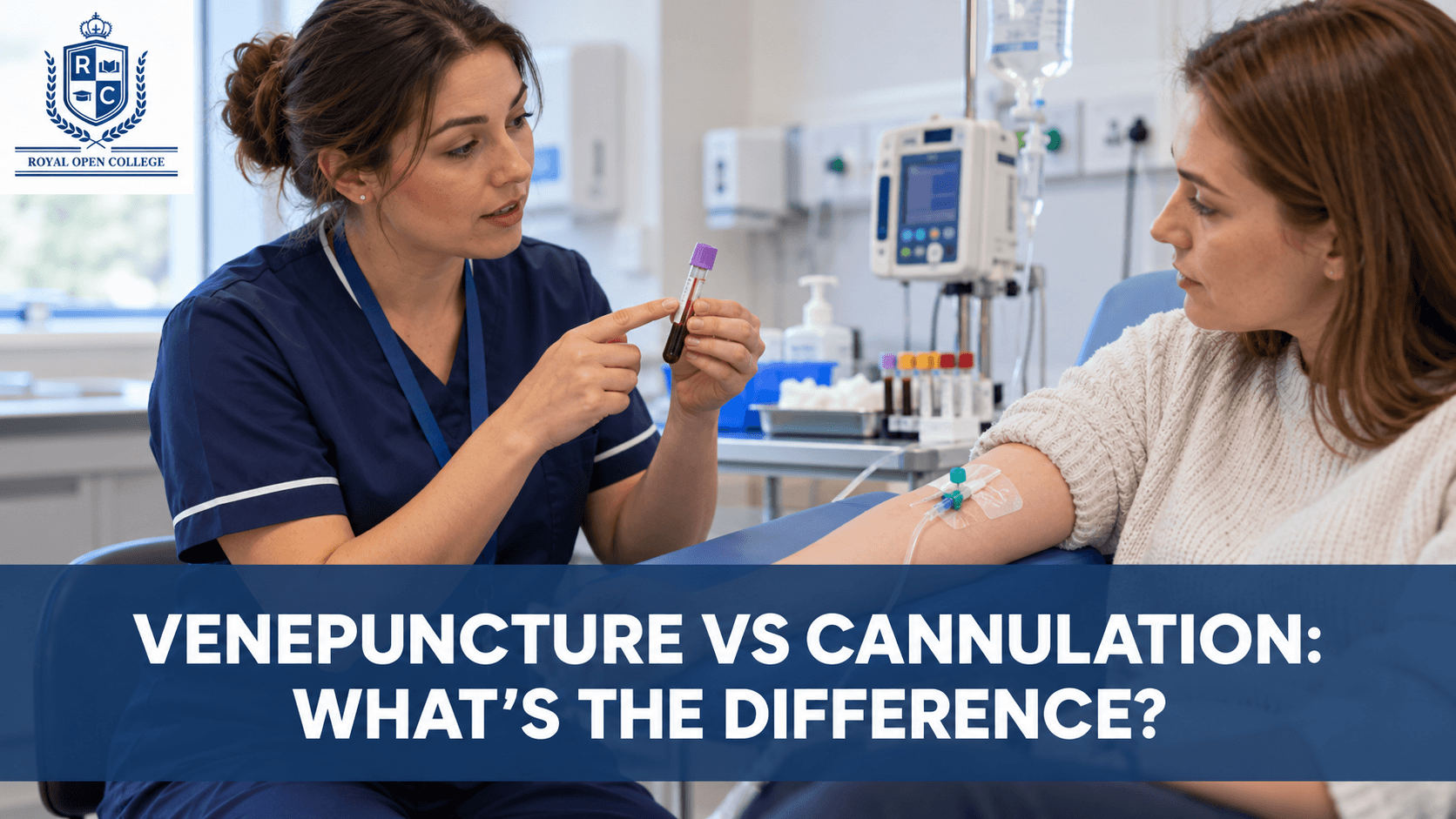



Venepuncture takes blood for tests and ends when the needle comes out. Cannulation places a small tube in a vein and leaves the tube there for treatment. Roles built around blood tests need the first skill. Roles built around intravenous treatment need the second.
This difference shapes the care after the needle. A cannula needs site checks, flushing and a secure dressing until staff remove the cannula. A blood test needs pressure and a plaster. Permission also differs: sign-off for venepuncture does not cover cannulation, and each employer sets the rules.
This guide compares the procedures, explains who is allowed to perform each in the UK and sets out the evidence on taking blood from a cannula and on how long a cannula stays in. Use the role guide near the end to choose which skill to learn first.
If your role includes blood tests or IV access, start with the theory. The Phlebotomy and Venipuncture Training at Royal Open College explains both procedures, so you understand each one before supervised practice begins. Online study builds knowledge, and your employer assesses your technique and signs you off. Check your job description first.
The Short Answer
The two procedures differ in purpose and aftercare, and your employer decides who performs each.
- Venepuncture ends with pressure and a dressing.
- A cannula needs site checks until removal.
- Guidelines recommend taking blood from a cannula only at insertion.
- Staff replace a cannula when the site shows problems, not on a fixed day.
- No single UK-wide rule names who performs either procedure.
- A course certificate shows learning, and sign-off shows permission.
Next step: read your job description, then ask your assessor.
What Is the Main Difference Between Venepuncture and Cannulation?
Venepuncture collects a blood sample, while cannulation places a tube for treatment. Venepuncture leaves nothing in the vein. Cannulation leaves a small plastic cannula in place, held by a dressing, so staff can give fluids, medicines or blood products. The device left behind sets everything else.
Venepuncture and Cannulation at a glance
Feature | Venepuncture | Cannulation |
Purpose | Collect a blood sample | Give fluids, medicines or blood products |
What stays in the vein | Nothing | A small plastic cannula held in place with a dressing |
Typical site | Veins at the bend of the elbow | Often the hand or forearm, away from joints |
Time involved | Usually a few minutes | Remains in place until treatment ends or the site develops problems |
Aftercare | Apply pressure, then a dressing | Check the site, flush as required and keep the dressing secure |
Who performs it | Staff assessed and signed off by their employer for venepuncture | Staff assessed and signed off by their employer for cannulation |
UK NHS policy treats phlebotomy as another name for venepuncture, so this guide uses both words for blood sampling. The NHS leaflet wording is the plain text: taking blood is venepuncture, and giving medicine into a vein is cannulation.
Both skills share vein assessment, aseptic technique, consent, safe sharps handling and a calm response when an attempt fails. The word cannula also names nasal oxygen tubing, so this guide always means the intravenous kind. Shared skills do not mean shared sign-off.
Do Guidelines Allow Blood to Be Taken From an Existing Cannula?
Guidelines recommend taking blood through a cannula only when staff place the cannula. Blood drawn through a cannula shows higher haemolysis rates, meaning more damaged blood cells, which spoil results. A sampling protocol might lower the rate, and a 2019 review of 16 studies calls for more research.
The saving for the patient is real, because one needle stick serves two purposes. Some results fell outside laboratory error limits in the review, though none needed clinical action. Blood culture findings were mixed, and the review stops short of a firm rule for any patient group.
Sampling at placement looks safe. In a 2024 Australian trial of 105 emergency patients, blood drawn through a newly placed cannula did not shorten dwell time or raise phlebitis rates. The trial did not test repeat sampling from a cannula already in use, so the guideline still stands.
Staff often combine the two in one visit: the blood tubes fill as the cannula goes in, so one needle stick does both jobs. Later tests usually need a fresh venepuncture, and any exception belongs to local policy and workplace training. Your employer sets the sampling rules.
Who Is Allowed to Perform Venepuncture and Cannulation in the UK?
No single UK-wide rule lists who is allowed to perform either procedure. Permission builds up in four layers: law, professional standards, employer policy and training. Doctors, nurses, nursing associates, phlebotomists, paramedics and healthcare assistants perform these skills in some settings, once training and local sign-off allow.
Rules also differ across the four nations. Each health system runs its own employers and trusts, and each trust writes its own policy, so an example from one trust does not apply everywhere. The examples below come from England and Scotland. Read each as a pattern, not a rule.
What the law covers
The Health and Safety (Sharp Instruments in Healthcare) Regulations 2013 came into force on 11 May 2013. They require healthcare employers to use safer sharps where reasonably practicable, limit recapping and give staff information and training. They do not name who takes blood. Northern Ireland has an equivalent regulation.
What professional standards require
Registered nurses, midwives and nursing associates must delegate only tasks within the other person’s competence and give the person supervision and guidance. Healthcare assistants are not NMC registrants, so their accountability runs through the employer and the delegating registrant. RCN guidance covers the whole nursing team.
What employers and training decide
Employers decide which roles perform each procedure. NHS Lothian trains support workers in venepuncture and registered nurses in both skills. University Hospitals Bristol and Weston lists band 3 health care support workers among staff allowed to cannulate (December 2023 document). Training teaches the knowledge. The employer grants permission.
H2: What Needs Checking After Each Procedure?
Venepuncture needs pressure, a dressing and careful sample handling. A cannula needs repeated site checks until staff remove the cannula. The difference follows the device: nothing stays in the vein after a blood test, while a cannula stays in for treatment.
After venepuncture
- What staff do: Staff press on the site until bleeding stops, then apply a dressing. Patients receive advice on bruising, pain and tingling in the arm or hand. Staff also label and handle the sample correctly, because damaged or mislabelled samples lead to repeat tests.
- What goes wrong: The main complications are:
- Haematoma, a collection of leaked blood under the skin and the most common complication
- Nerve injury, with sharp pain or tingling down the arm
- Fainting during or after the procedure
- Arterial puncture and infection
After cannulation
- What staff check: Staff secure the cannula with a clear dressing, flush the line with saline and check the site regularly, at least once each shift in many trusts. Phlebitis, a sore, inflamed vein, is the most common complication. Staff remove the cannula when problems appear.
- What patients report: Patients tell staff straight away about:
- Redness, pain or swelling around the site
- Fluid leaking from the site
- A loose, wet or dirty dressing
- A cannula that has moved or is hard to flush
How Long Does a Cannula Stay In?
Staff remove a cannula when treatment ends, or the site shows problems, not on a fixed day. Some websites still advise routine replacement every 48 to 72 hours, but UK guidance favours replacement on clinical need, with site checks at least once each shift.
Across five trials, bloodstream infection struck 1 of 2,365 cannulas replaced by clinical need and 2 of 2,441 replaced routinely after 72 to 96 hours. Routine replacement did not lower infection rates, and each extra cannula means another needle for the patient. RCN standards from 2016 back replacement by need.
Three things shape the decision:
- Manufacturer instructions for each device
- Local policy on how often staff check and record the site
- A visual phlebitis score, which guides when to resite a cannula
Which Should You Learn First?
Start with the procedure your role needs, because neither skill comes first for everyone. Roles built around blood tests start with venepuncture. Roles built around intravenous treatment need cannulation. Some trusts ask for venepuncture sign-off before cannulation training, so the order often sits in the employer’s hands.
A quick role guide:
- Healthcare assistant in outpatients or a GP surgery: venepuncture first
- Healthcare assistant on an acute ward: venepuncture, then cannulation if the role needs both
- Student nurse: both skills, under supervision, as the university allows
- Career changer: theory first, then a role that offers sign-off
- Phlebotomist: venepuncture
Confidence at taking bloods does not equal readiness to cannulate. Cannulation adds device choice, securing the line, checking the site and responding to complications. Learners often say the hardest part is advancing the cannula while withdrawing the needle. Treat each skill as a separate learning step.
Where Do Learners Get Confused?
Most confusion comes from mixing up skill, permission and sign-off. Four situations show where the mix-ups happen. Each one is an illustration, not clinical advice, and each ends with the rule behind the answer. Read them as patterns, because real policies vary.
- A patient has a cannula in the left hand and needs bloods. The cannula limits the choice of arm and site, and local policy sets the options.
- A healthcare assistant signed off for venepuncture is asked to cannulate. The sign-off covers blood tests only, so cannulation needs its own training and record.
- A learner finishes an online course and wants to start on the ward. The certificate shows learning, and supervised practice comes next.
- A first attempt fails. Many trusts set a limit of two attempts, then another practitioner takes over.
Flowchart: Before you start a procedure at work
START: You are asked to perform venepuncture or cannulation
↓
Check 1: Is the procedure within your job role?
No → Stop and speak to your manager
Destination: Clarify whether the procedure is within your responsibilities.
Yes → Go to Check 2
Check 2: Has your employer signed you off as competent for this skill and patient group?
No → Speak to your assessor or manager about supervised practice and competency assessment.
Destination: Complete the required training and sign-off before working independently.
Yes → Go to Check 3
Check 3: Are you confident about the current policy, procedure and your own limits today?
No → Ask a senior or appropriately qualified colleague before starting.
Destination: Clarify the procedure before proceeding.
Yes → Follow your employer’s policy, complete the procedure
Practice Points: Venepuncture Vs Cannulation
- Purpose: venepuncture takes a blood sample, while cannulation leaves a small tube in the vein for treatment.
- Aftercare: a blood test needs pressure and a dressing. A cannula needs a secure dressing, flushing and site checks until removal.
- Blood from a cannula: guidelines recommend sampling only at insertion, and evidence on later sampling is limited.
- Dwell time: staff replace a cannula when treatment ends or the site shows problems, not on a fixed day.
- Permission: no single UK-wide rule names who performs either procedure, so law, professional standards, employer policy and training each play a part.
- Sign-off: targets differ by employer. Homerton asked for five supervised practices in 2023, and Hampshire Hospitals asks for ten.
- Learning order: start with the skill your role needs, and ask whether your employer requires venepuncture sign-off before cannulation.
- Certificates: a course shows learning, and your assessor’s sign-off shows permission.
Frequently Asked Questions
Q: Is venepuncture the same as phlebotomy?
A: Yes, in NHS policy the two words mean the same thing. Some use phlebotomy for the whole process of collecting a sample, including identification, labelling and handling, but trust policy treats them as equal. Both differ from cannulation, which leaves a tube in place.
Q: Is cannulation harder than venepuncture?
A: Often, yes. A 2026 study of 298 children aged 6 to 12 recorded higher pain scores, higher fear and more attempts with cannulation than with venepuncture. Difficulty still depends on the patient, the vein and your experience, and the study covers children in one hospital.
Q: Does either procedure hurt?
A: Both cause a brief scratch, and some people feel soreness or bruising afterwards. For children, numbing cream takes up to 45 minutes to work, so staff use a spray when a test is urgent. Tell the clinician if you feel anxious or faint.
Q: What is the difference between a cannula and an IV drip?
A: A cannula is the small plastic tube in the vein. The drip is the fluid or medicine running through the tube from a bag. A cannula stays in without a drip attached, for example between doses of medicine, and staff flush the tube to keep the line clear.
Q: Does venepuncture or cannulation competence expire?
A: No universal expiry date exists, but skills fade when you stop practising. Employers decide when to reassess you, and a long break might lead to supervised practice or refresher training before you work alone again. Review dates sit in your employer’s competency record.
Q: Do you need venepuncture training before cannulation?
A: Some employers require venepuncture sign-off first. Sign-off stays separate for each skill, and your employer sets the order. Start your theory with Phlebotomy and Venipuncture Training at Royal Open College, then add Cannulation when your role needs intravenous access. Online study builds knowledge, and your employer signs off supervised practice.
Q: Is a cannula the same as a PICC line or midline?
A: No. A cannula is a short tube in a surface vein, often in the hand or forearm. PICC lines and midlines are longer tubes for longer treatment, and trained staff place them.
Q: Does cannulation hurt more than a blood test?
A: Both cause a brief sharp scratch. Cannulation takes longer because staff slide a small plastic tube into the vein after the needle, so some people feel more discomfort. Tell the clinician if the pain is sharp or the site stays sore afterwards.
Q: Can you shower with a cannula in place?
A: Keep the dressing dry. Ask staff for a waterproof cover, and tell them if the dressing gets wet, loose or dirty. A wet dressing raises the risk of infection at the site.
Q: Why do staff use a tourniquet for blood tests?
A: A tourniquet squeezes the upper arm for a short time so veins fill and show up. Staff keep the band on for as short a time as possible and release it once blood flows or before the needle comes out.
Q: Which arm do staff use for a blood test?
A: Either arm works. Staff choose the arm with the clearest vein and avoid an arm with a cannula already in place. Tell staff about previous surgery or treatment on either arm, because some conditions mean staff avoid that arm.
Q: Which arm do staff use for a blood test?
A: Either arm works. Staff choose the arm with the clearest vein and avoid an arm with a cannula already in place. Tell staff about previous surgery or treatment on either arm, because some conditions mean staff avoid that arm.
Q: Why do staff sometimes struggle to find a vein?
A: Dehydration, cold hands and repeated needles make veins harder to see. Drinking water before a test and keeping warm helps. After a failed attempt, staff try a different site or ask a colleague to take over.
Q: Do you need to fast before a blood test?
A: Some tests need fasting, and many do not. Follow the instructions on your appointment letter, because the rule depends on the test. Water is usually allowed unless staff tell you otherwise.
Q: What is the difference between a blood test and a finger-prick test?
A: A finger-prick test takes a small drop of blood from the fingertip, often to check glucose. Venepuncture takes a larger sample from a vein for many laboratory tests. Neither leaves a device in place.