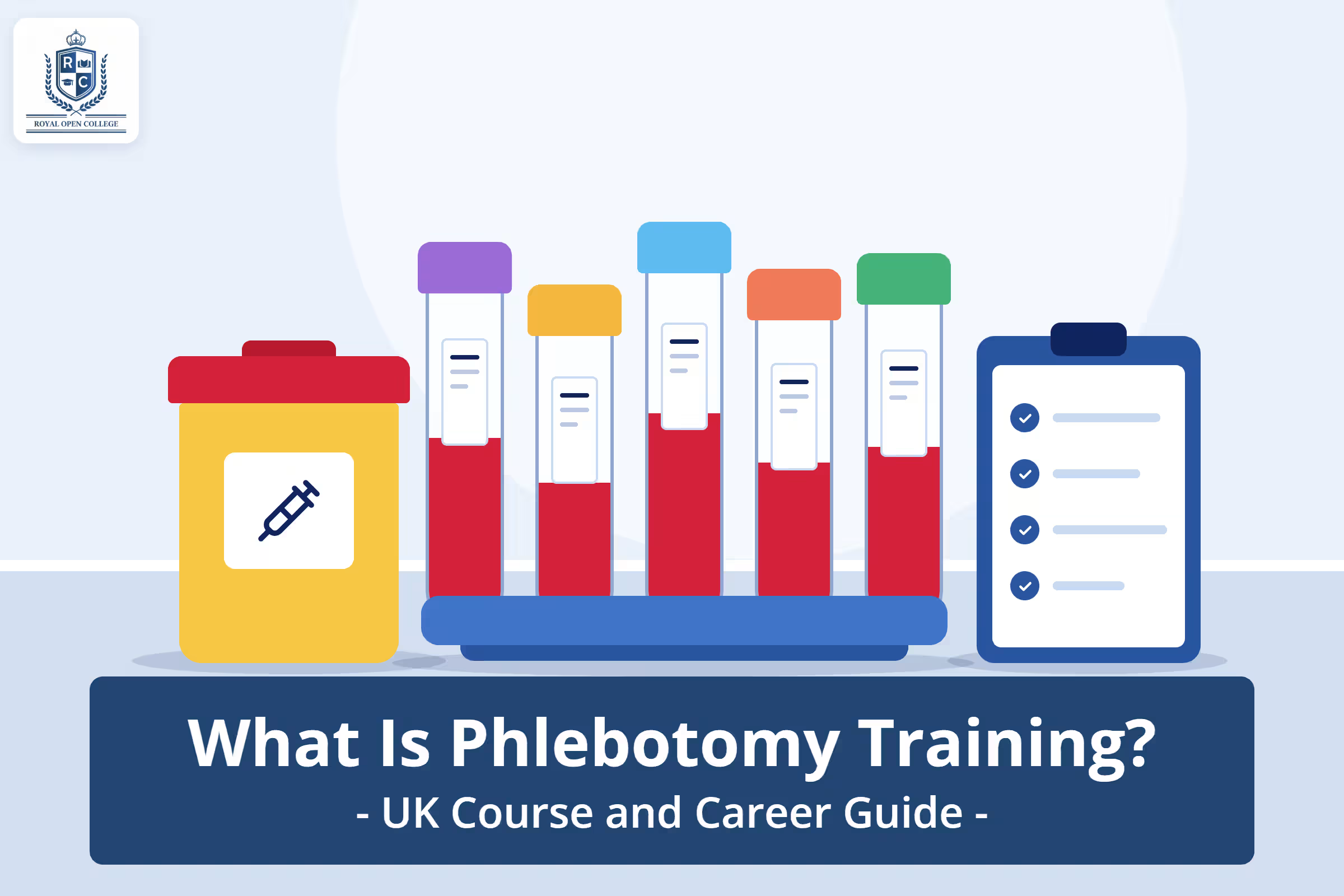


Phlebotomy training teaches you how to take blood samples from a vein safely, accurately and with the patient’s comfort in mind. It combines theory, practice on training arms and supervised blood draws on real patients, followed by a competency sign-off. Learners who want to build the theory first can start with the Phlebotomy and Venipuncture Training course through Royal Open College as part of their CPD learning.
Phlebotomy is an invasive clinical procedure, so knowledge alone is not enough. In the UK, NHS trusts and private employers expect staff to complete theory, simulated practice and a period of supervised practice before they take blood unsupervised. This guide explains what training covers, who needs it, how to get started and how to choose the right course.
Quick Recap
- Phlebotomy training covers theory, practice on training arms and supervised live blood draws.
- There are no set entry requirements to become a trainee phlebotomist in the UK.
- You must be signed off as competent before taking blood unsupervised.
What Does Phlebotomy Training Cover?
Phlebotomy training covers the knowledge and skills needed to obtain venous blood samples safely. In the UK, good courses map their content to the Skills for Health National Occupational Standard CHS132, Obtain Venous Blood Samples. Most training covers:
- Venous anatomy and how to choose a suitable vein
- Infection prevention and control, including hand hygiene and PPE
- Equipment such as tourniquets, vacuum tube systems and butterfly needles
- Patient identification and valid consent
- The correct order of draw when filling several sample tubes
- Sharps safety and what to do after a needlestick injury
- Contraindications, complications and adverse reactions such as fainting
- Labelling, documentation and safe transport of samples
Communication matters too. Many patients are anxious about needles, so training covers how to explain the procedure, reassure people and advise them on caring for the puncture site.
What Are the Stages of Phlebotomy Training?
Most phlebotomy training follows four stages. NHS trust policies typically require a recognised programme that includes theory, simulated practice and a period of supervised practice under a competent practitioner.
The Four Stages of Phlebotomy Training
- Theory: anatomy, infection control, equipment, consent and sample handling.
- Simulated practice: venepuncture on training arms or mannequins.
- Supervised practice: taking blood from real patients while a mentor observes.
- Competency sign-off: an assessor confirms you can practise independently.
The number of supervised draws varies by employer. One NHS trust course asks learners to complete 20 successful blood draws in a single supervised session. Other employers set their own targets in a competency workbook.
Theory • simulation • supervised practice • sign-off
Who Needs Phlebotomy Training?
Anyone who takes blood as part of their role needs phlebotomy training. This includes trainee phlebotomists, healthcare assistants, support workers, nursing associates and student nurses. Registered nurses, paramedics and doctors may learn venepuncture during their professional training, but they still follow their employer’s policy.
Phlebotomists specialise in this one skill. They work on hospital wards, in outpatient clinics, GP surgeries and community clinics, often taking blood from many patients each day.
Staff who never take blood can still benefit from the theory. Care workers often support people before and after blood tests, so understanding the procedure helps them reassure patients and spot problems early.
Do You Need Qualifications to Start Phlebotomy Training?
No. The National Careers Service says there are no set entry requirements to become a trainee phlebotomist. Having at least two GCSEs and a first aid certificate may help when you apply directly for a role.
Employers also look for personal qualities:
- A calm, kind and patient manner
- Clear communication with nervous patients
- Attention to detail when labelling samples
- The ability to follow procedures and work in a team
Many employers and training providers ask for a DBS check and occupational health clearance before supervised practice begins. In Scotland, some people enter the role through a Modern Apprenticeship in health care support.
What Types of Phlebotomy Training Courses Are There?
There are four main routes into phlebotomy training, and each one suits a different starting point.
On-the-job NHS training Many NHS trusts recruit trainee phlebotomists and healthcare assistants and train them in the workplace. This route includes theory, supervised practice and assessment, and you are paid while you learn.
Short practical courses Some NHS trusts and private providers run one or two day courses. These usually combine a theory session, practice on training arms and a supervised session with real patients. Fees vary, and some trust courses cost several hundred pounds.
Online theory courses Online CPD courses cover the knowledge side of phlebotomy at your own pace. They suit beginners exploring the career, healthcare staff preparing for workplace training and anyone needing a theory refresher. They do not include supervised practice, so on their own they do not make you competent to take blood.
Regulated qualifications Awarding organisations offer regulated phlebotomy qualifications, such as the NOCN Level 3 Award in Introduction to Phlebotomy. Level 3 certificates and diplomas are also available for people already working in the role.
If you are searching for phlebotomy courses in London or another UK city, check where the practical element takes place and how the provider arranges supervised blood draws.
How Do You Choose a Phlebotomy Training Course?
Choose a course that matches where you are in your career. A complete beginner needs a different route from a healthcare assistant whose employer already provides supervised practice.
Check these points before you enrol:
- Practical element: does the course include supervised live blood draws, or theory only?
- Standards: does the content map to the Skills for Health CHS132 standard?
- Certificate type: is it a certificate of attendance, a certificate of competence or a CPD certificate?
- Qualification status: is it CPD-accredited learning or a regulated qualification?
- Employer acceptance: will your current or future employer accept it?
- Hidden costs: are DBS checks, practical sessions and certificates included in the price?
A certificate of attendance shows you completed a course. A certificate of competence shows an assessor watched you take blood safely. Employers treat these very differently.
What Happens After Phlebotomy Training?
After training and sign-off, you can take blood independently within your employer’s policy. Most NHS phlebotomist roles are Band 2 on the Agenda for Change pay scale. Band 2 is a single rate of £25,272 a year in England for 2026/27. Some trusts offer Band 3 to experienced phlebotomists or after extra competencies.
Competence needs to stay current. Many trusts require refresher training after a career break or change of role, and some certificates of competence expire after a year. Phlebotomists can also join the National Association of Phlebotomists for updates on good practice.
Common Mistakes to Avoid
Most problems with phlebotomy training come from misunderstanding what a course can and cannot do. These mistakes are easy to make when course pages use similar words for very different certificates.
Five Common Mistakes
Assuming an online course makes you competent Theory is the first step only. You still need supervised practice and a competency sign-off before taking blood unsupervised.
Confusing attendance with competence A certificate of attendance proves you took part. Only an assessed sign-off shows you can take blood safely.
Treating CPD as a regulated qualification CPD-accredited courses support professional development. They are not regulated qualifications.
Skipping the employer check Employers set their own training requirements. Ask what they accept before paying for a course.
Letting skills go out of date Phlebotomy is a practical skill. After a long break, expect a refresher and reassessment before returning to practice.
Studying Through Royal Open College (CPD Learning)
Phlebotomy training starts with sound theory, and that is where online learning fits. Royal Open College offers a CPD-accredited Phlebotomy and Venipuncture Training course for beginners, career changers and healthcare support staff who want to understand blood collection before or alongside workplace training.
The course covers venous anatomy, vein selection, phlebotomy equipment, infection prevention and control, sharps safety and sample labelling. You study 100% online at your own pace, with a final multiple-choice exam and a CPD certificate on completion.
CPD learning supports professional development and builds a stronger understanding of safe blood collection. This course is theory-based and does not include supervised blood draws. It is not a regulated qualification, does not replace workplace training or competency assessment, and does not on its own qualify you to take blood from patients.