








Nursing Assistant vs Nursing Associate Key UK Differences Explained

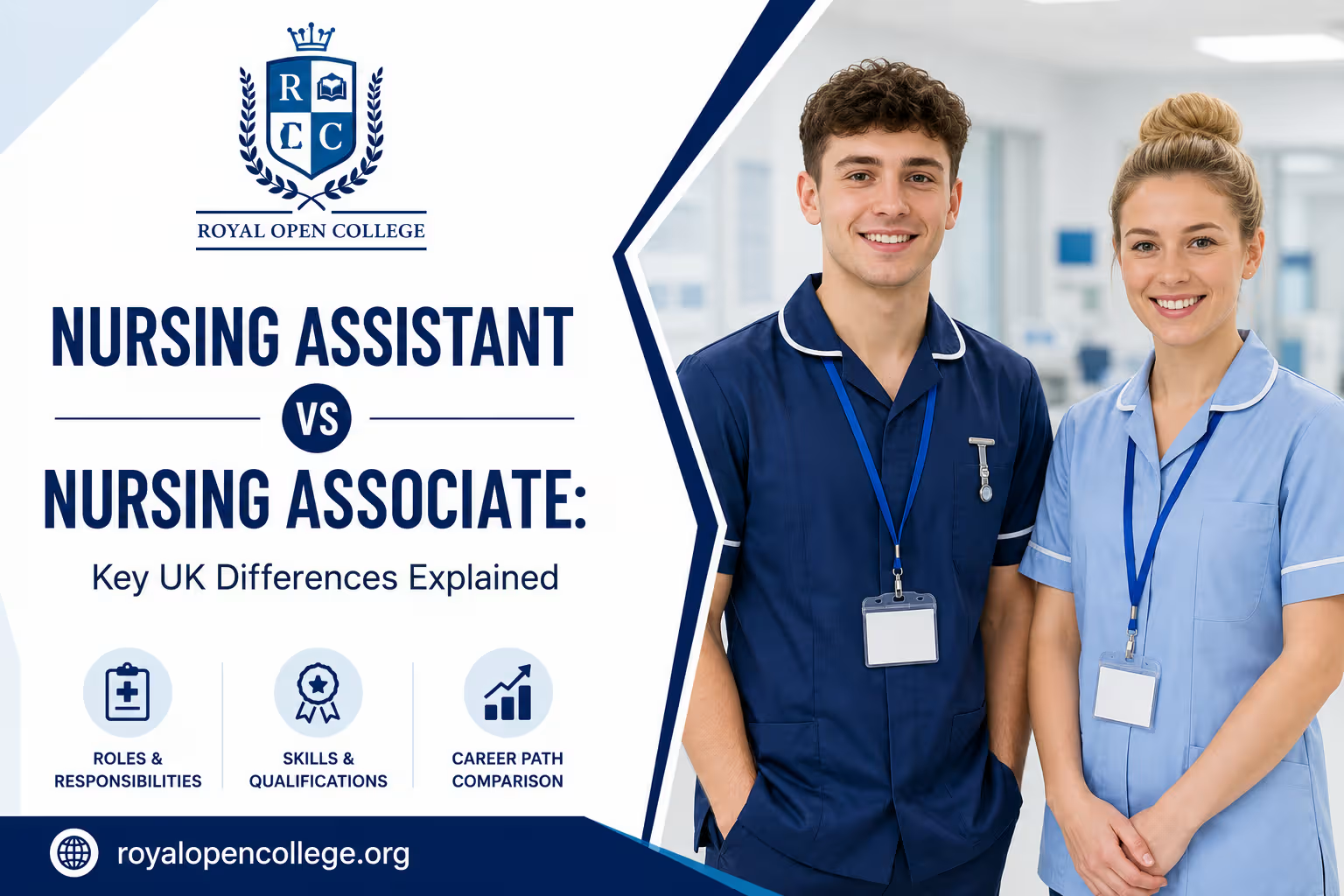
Nursing Assistant vs Nursing Associate: Key UK Differences Explained

Nursing assistant and nursing associate sound alike, but they are legally different roles in the UK. One is unregistered. The other holds NMC registration, carries personal accountability, and administers medicines. This guide explains both roles clearly, corrects the most common UK misconceptions, and shows you the exact career pathway from healthcare assistant to registered nursing associate.

A nursing assistant is an unregistered support worker. A nursing associate is a regulated professional registered with the Nursing and Midwifery Council (NMC). These two titles look similar, but they describe fundamentally different roles in UK healthcare.

Search for either term online and you will find pages treating them as though they mean the same thing. They do not. The registration gap, the accountability gap, and the pay gap between these two roles are significant. Understanding them shapes every career decision you make in healthcare.

This guide breaks down both roles clearly, corrects the most common UK misconceptions, and gives you the information to make the right choice.

Nursing Assistant vs Nursing Associate: Key UK Differences Explained

A nursing assistant is an unregistered support worker. A nursing associate is a regulated professional registered with the Nursing and Midwifery Council (NMC). These two titles look similar, but they describe fundamentally different roles in UK healthcare.

Search for either term online and you will find pages treating them as though they mean the same thing. They do not. The registration gap, the accountability gap, and the pay gap between these two roles are significant. Understanding them shapes every career decision you make in healthcare.

This guide breaks down both roles clearly, corrects the most common UK misconceptions, and gives you the information to make the right choice.

TL;DR: Quick Comparison at a Glance

Feature Nursing Assistant / HCA Nursing Associate
Regulation Unregistered. No NMC registration required. Accountable to employer only. NMC registered. Registration is mandatory. Accountable to the NMC. Subject to the NMC Code and fitness to practise procedures.
Training No mandatory formal qualification. Employers use the Care Certificate (16 standards, updated March 2025) as part of induction. Two-year foundation degree at Level 5 via an NMC-approved programme. Typically delivered as paid apprenticeship.
NHS Pay Band Band 2 from £24,465. Band 3 from £24,937. (Agenda for Change 2025/26) Band 3 from £24,937 during training (TNA). Band 4 from £27,485 on qualification. (Agenda for Change 2025/26)
Scope of Practice Delegated, task-oriented personal care under supervision. No medicines administration. Broader clinical scope including medicines administration, ECGs, venepuncture, and wound care. No prescribing rights.
Career Next Step Nursing Associate Apprenticeship via NMC-approved provider. Often funded through the apprenticeship levy. Registered Nurse Degree Apprenticeship. Shortened route available where prior nursing associate learning is recognised.
What Is the Difference Between a Nursing Assistant and a Nursing Associate in the UK?

What Is the Difference Between a Nursing Assistant and a Nursing Associate in the UK?

A nursing assistant is an unregistered support worker. A nursing associate is a registered professional on the NMC register, subject to the NMC Code and fitness to practise procedures. That single distinction changes everything about accountability, clinical scope, and career ceiling.

Nursing assistants, also called Healthcare Assistants (HCAs) or Healthcare Support Workers (HCSWs), deliver hands-on personal care under registered nurse supervision. “Nursing assistant” is not a protected job title in the UK. Employers use it interchangeably with HCA and HCSW depending on their setting.

A nursing associate completes a two-year Level 5 foundation degree and joins the NMC register before practising under that title. The NMC describes the nursing associate as “a separate profession to nursing with different knowledge and skills, set out in a distinct standard of proficiency.”

These two roles are not different grades of the same job. One carries personal professional accountability to a regulatory body. The other does not. That structural difference, not a list of daily tasks, sits at the core of this comparison.

What Is a Nursing Assistant in the UK?

A nursing assistant is an unregistered healthcare support worker. The role involves delivering hands-on personal care under the supervision of a registered nurse. There is no national register to join and no single mandatory qualification required by law.

In the NHS, nursing assistant roles typically sit at Band 2 or Band 3 under the Agenda for Change pay framework. In care homes and private settings, pay and job titles vary by employer.

Employers use several titles to describe this type of role:

  • Healthcare Assistant (HCA)
  • Healthcare Support Worker (HCSW)
  • Nursing Auxiliary
  • Clinical Support Worker (CSW)

NHS England confirms there are no set entry requirements for Healthcare Support Worker roles. Employers look for values, communication skills, reliability, and a willingness to learn.

Many employers use the Care Certificate as part of induction. Skills for Care updated the Care Certificate in March 2025. It now includes 16 standards, with the new 16th standard covering awareness of learning disability and autism. The Care Certificate is an induction framework, not a regulated qualification. Completing the Care Certificate does not place you on any professional register.

The Care Workforce Pathway, launched in January 2024 and expanded to eight role categories in April 2025, provides a career development framework for adult social care support workers.

Is “Nursing Assistant” an Official UK Job Title?

No. “Nursing assistant” carries no protected status in UK law. Employers choose their own job titles freely, which is why you will see nursing assistant, healthcare assistant, healthcare support worker, and nursing auxiliary used for roles with similar responsibilities in the same type of setting.

One important correction: “Certified Nursing Assistant” or “CNA” is an American title. It does not exist in UK healthcare regulation. Any UK training content using this term is importing American terminology with no legal standing in England, Wales, Scotland, or Northern Ireland. Treat any UK course advertising a “CNA” qualification with caution.

What Is a Nursing Associate in the UK?

A nursing associate is a regulated healthcare professional registered with the Nursing and Midwifery Council. Working under the nursing associate title in England and Wales without NMC registration is a regulatory breach. Registration is a legal requirement, not a choice.

The role was developed following the Shape of Caring review, led by Lord Willis in 2015. The review identified a skills gap between unregistered healthcare assistants and registered nurses. The nursing associate role was created to bridge that gap, supporting the registered nursing workforce and helping nurses focus on complex clinical care.

The NMC opened its register to nursing associates in January 2019. From 26 July 2019, anyone entering the profession must complete an NMC-approved programme. The formal NMC title is “Registered Nursing Associate.” Training leads to a Level 5 foundation degree, typically delivered as a paid two-year apprenticeship.

The nursing associate role is generic across all four fields of nursing: adult, children, mental health, and learning disability. It operates across hospitals, GP surgeries, community services, and care homes.

Once registered, nursing associates complete revalidation every three years. This requires demonstrating ongoing competence, completing continuing professional development (CPD), and reflecting on the NMC Code. The Nursing and Midwifery Order 2001 is the primary legislation giving the NMC its power to regulate nurses, midwives, and nursing associates.

Is the Nursing Associate Role Available Across the Whole UK?

No. The nursing associate as a regulated profession applies in England and Wales only. The NMC extended regulation to Wales in 2024. Scotland and Northern Ireland do not have the nursing associate as a regulated NMC profession.

Framework for Healthcare Support Workers

England
NMC regulated. Nursing Associate Apprenticeship via NMC-approved providers.
Wales
NMC regulation extended in 2024. Nursing associate now regulated by the NMC.
Scotland
NHS Education for Scotland (NES) Development and Education Framework for NMAHP Healthcare Support Workers. Separate Code of Conduct for Healthcare Support Workers in Scotland.
Northern Ireland
Department of Health Standards for Nursing Assistants. Separate framework independent of NMC nursing associate regulation.
Important: Any content presenting the nursing associate as a UK-wide regulated role is factually inaccurate.

What Are the Key Differences Between a Nursing Assistant and a Nursing Associate?

The biggest differences between these roles go well beyond day-to-day tasks. Regulatory status, personal accountability, clinical scope, and pay separate them at a structural level. Here is a full breakdown.

Regulation and Accountability

Nursing associates are personally accountable to the NMC. They operate under the NMC Code, a set of professional standards covering safe practice, dignity, honesty, and effective communication. If a nursing associate’s practice falls below the required standard, the NMC investigates and takes action, including removal from the register.

Nursing assistants are accountable to their employer only. No professional register exists for this role at a national level. No fitness to practise process applies. If a nursing assistant’s practice causes harm, the employer’s internal HR, safeguarding, and management processes respond. A regulatory body does not.

NMC Registration Explained

🛡️ What NMC Registration Means in Plain Terms

NMC registration is what legally separates a regulated nursing professional from an unregistered support worker in the UK healthcare system.

  • You appear on a publicly accessible list of approved professionals
  • You are bound by professional conduct rules under the NMC Code
  • Your registration is removed if your practice is found to be unsafe or dishonest
  • You undergo revalidation every three years to confirm your practice is up to date
This accountability distinction is absent from every competitor page on this topic. It is the most important structural difference between these two roles.

Scope of Practice and Medicines Administration

The NMC sets out nursing associate standards across six practice platforms, compared to seven for registered nurses.

Nursing Platforms Comparison

🩺 Nursing Associate: 6 Platforms

  • Be an accountable professional
  • Promote health and prevent ill health
  • Provide and monitor care
  • Work in teams
  • Improve safety and quality of care
  • Contribute to integrated care
Registered Nurse: 7 Platforms (key addition) 7. Assess needs and plan care (registered nurses lead on this exclusively)

 The most important practical differentiator is medicines administration. Nursing associates administer medicines within their agreed competence. Nursing assistants do not administer medicines in any setting. This was the key reason the nursing associate role secured NMC registration.

Nursing associates do not prescribe. Prescribing rights belong to the registered nurse role. Registered nurses lead on assessment, planning, and evaluation of care. Nursing associates contribute to delivery and monitoring.

Nursing Associate Tasks

In practice, depending on setting, nursing associates carry out tasks such as:

  • Medicines administration
  • ECGs and clinical observations
  • Venepuncture (blood sampling)
  • Wound dressings
  • Chronic disease reviews
  • Spirometry tests
  • Safeguarding recognition and escalation
These tasks are always agreed within the nursing team and aligned with NMC standards. They vary by employer and setting.

Training and Qualification

🎓 Nursing Associate Training Route

  • Two-year foundation degree at Level 5
  • Delivered as a paid apprenticeship in most cases
  • Programme must be NMC-approved
  • Entry requirements: GCSEs at grade 9 to 4 (A to C)
  • NHS Constitution values assessed at interview
  • Trainees typically sit at Band 3 during the apprenticeship

💼 Nursing Assistant Entry

  • No mandatory formal qualification required by law
  • Care Certificate commonly used as induction framework
  • No NMC-approved programme required
  • Usually employed at Band 2 or Band 3

Pay Under Agenda for Change (2025/26, England)

Figures are taken from the confirmed NHS Agenda for Change pay scales for 2025/26.

Source: NHS Employers, Agenda for Change 2025/26. A 3.3% uplift applies from 1 April 2026. London weighting (High-Cost Area Supplement) adds to basic pay for eligible areas. Always verify current figures with NHS Employers, as pay is reviewed each April.

NHS Salary Bands

Nursing Assistant / HCA

Band 2

Starting Salary

£24,465

Top of Band

£24,465

Senior Nursing Assistant / HCSW

Band 3

Starting Salary

£24,937

Top of Band

£26,598

Trainee Nursing Associate

Band 3

Starting Salary

£24,937

Top of Band

£26,598

Registered Nursing Associate

Band 4

Starting Salary

£27,485

Top of Band

£30,102

Registered Nurse (entry)

Band 5

Starting Salary

£31,049

Top of Band

£37,796

Source: NHS Employers, Agenda for Change 2025/26. A 3.3% uplift applies from 1 April 2026. London weighting (High-Cost Area Supplement) adds to basic pay for eligible areas. Always verify current figures with NHS Employers, as pay is reviewed each April.

Common Misconceptions About These Two Roles

Common Misconceptions About These Two Roles

Confusion around these titles is widespread. Online content uses them loosely, and much of it imports American healthcare terminology with no UK legal standing. Here are the four most widespread misconceptions.

Nursing Role Misconceptions
MYTH VS CORRECTION
Misconception: A nursing assistant and a nursing associate are the same role.
Correction: They are not. A nursing assistant is an unregistered support worker with no NMC registration. A nursing associate is a regulated professional on the NMC register with personal accountability to a professional body. These are structurally different roles, not different names for the same job.
MYTH VS CORRECTION
Misconception: Completing an online nursing assistant diploma qualifies you as a nursing associate.
Correction: It does not. The "Registered Nursing Associate" title is protected. To use it, you must complete an NMC-approved programme and join the NMC register. A CPD certificate, an online diploma, or a short course does not meet this requirement, regardless of its content or the organisation offering it.
MYTH VS CORRECTION
Misconception: "Certified Nursing Assistant" (CNA) is a recognised UK role.
Correction: It is not. The CNA title belongs to the US healthcare system. It has no equivalent in UK regulation. Searching for CNA courses in the UK will return results using American terminology that carries no legal standing in England, Wales, Scotland, or Northern Ireland.
MYTH VS CORRECTION
Misconception: The Care Certificate is a professional qualification.
Correction: It is not. The Care Certificate is an employer-led induction framework, updated to 16 standards by Skills for Care in March 2025. It covers baseline competence for healthcare support workers. Completing the Care Certificate does not place you on any professional register and does not make you a nursing associate.

How Does the Nursing Associate Role Benefit Employers and Care Teams?

The NMC is clear: nursing associates are designed to support registered nurses, not substitute them. This principle has direct implications for every employer making workforce decisions.

The Royal College of Nursing (RCN) places nursing associates at the “Assistive level” of the nursing support workforce. This sits above the “Supportive level” occupied by HCAs and HCSWs. At the Assistive level, nursing associates carry a deeper level of knowledge, skills, and training. Where appropriate, they guide supportive-level staff such as HCAs, while remaining under the supervision of the registered nurse.

The RCN is direct on this point: substitution, expecting staff to routinely work beyond their defined role due to workforce pressure, is not acceptable practice.

Employers who deploy nursing associates correctly free registered nurses to focus on complex assessment, clinical decision-making, and care coordination. NHS Employers describes the role as helping to “build the capacity of the nursing workforce” while enabling nurses to focus on more complex clinical duties.

A GP practice in West Yorkshire demonstrates this in action. A Trainee Nursing Associate at Rycroft Primary Care Centre took on ECGs, blood clinics, smoking cessations, chronic disease reviews, and spirometry tests. This gave the practice’s registered nurses time to manage more complex patients. The apprenticeship was funded through transferred levy funds from a local NHS Trust.

For workforce planning, the NHS Long-Term Workforce Plan (2024) reported 112,000 NHS vacancies as of March 2023, with a significant number in Bands 2 to 4. The nursing associate role directly addresses this gap.

How Do You Progress from Nursing Assistant to Nursing Associate?

Progression from nursing assistant to nursing associate is a recognised, well-supported NHS pathway. It does not happen automatically, but the route is clearly structured for those who meet the entry criteria and secure employer support.

Career Progression Flowchart

Career Progression Flowchart

1

Entry point

Nursing Assistant or HCA

Band 2 or Band 3 — unregistered role.

2

Apprenticeship

Trainee Nursing Associate Apprenticeship

Level 2 English & Maths required. NHS values assessed. Levy-funded in many cases.

3

Foundation degree

2-Year NMC-Approved Foundation Degree

Paid work-based learning at Band 3, Level 5. Placements: adult, mental health, children & learning disability.

4

Assessment

End-Point Assessment

Final assessment by NMC-approved provider.

5

Registration

Registered Nursing Associate

Band 4. Accountable professional, subject to NMC Code and revalidation.

£27,485 starting — AfC 2025/26
6

Progression

Registered Nurse (Band 5)

Registered Nurse Degree Apprenticeship — shortened route recognising prior learning. Typically 3–4 years, employer-funded.

£31,049 starting — NMC registered

Source: NHS Employers, NMC, Agenda for Change 2025/26

Entry Requirements for the Nursing Associate Apprenticeship

To apply for the nursing associate apprenticeship, you need:

Requirements Section
  • GCSEs at grade 9 to 4 (A to C) in Maths and English, or Functional Skills Level 2 equivalents
  • Ability to study at Level 5 foundation degree standard
  • Demonstration of NHS Constitution values at interview
  • Employment with an NHS Trust, care provider, or healthcare organisation during the apprenticeship
If you do not hold the required English and Maths qualifications, most education providers offer a free literacy and numeracy assessment at application. Functional Skills training and assessment are free for learners who do not hold the required GCSEs.

Funding the Apprenticeship

NHS employers with an annual pay bill of £3 million or more pay an apprenticeship levy of 0.5% of their total pay bill. These funds go toward training costs for apprenticeships, including nursing associate programmes. Larger NHS Trusts transfer levy funds to smaller organisations such as GP practices. In many cases, this makes the full two-year apprenticeship funded at no cost to the trainee.

Prior experience as a nursing assistant or HCA is valued. It does not replace the formal programme, but it provides a strong foundation for the application process and the academic and clinical demands of training.

What Happens After Qualifying as a Nursing Associate?

On joining the NMC register at Band 4, your certificated and experiential learning from the nursing associate programme counts toward a shortened pre-registration nursing degree in many cases. Contact your employer and preferred university to confirm what credit transfer applies to your specific programme. Shortened routes are available where prior learning is recognised, but they are not guaranteed.

Summary and Key Takeaways

  • A nursing assistant is an unregistered support worker. A nursing associate is a regulated professional on the NMC register. These are structurally different roles, not different names for the same job.
  • Nursing associates administer medicines within their agreed competence. Nursing assistants do not administer medicines in any setting. This is the clearest practical difference between the two roles.
  • NMC registration for nursing associates is a legal requirement in England and Wales. Working under the title without registration is a regulatory breach.
  • The Care Certificate is an induction framework for support workers, updated to 16 standards in March 2025. Completing the Care Certificate does not make you a nursing associate.
  • The nursing associate apprenticeship takes two years, leads to a Level 5 foundation degree, and is often funded through the NHS apprenticeship levy. Entry requires Level 2 Maths and English.
  • Nursing assistants typically sit at Band 2 or Band 3. Registered nursing associates sit at Band 4, with a 2025/26 starting salary of £27,485 under Agenda for Change.
  • The nursing associate role currently applies in England and Wales only. Scotland and Northern Ireland operate separate frameworks for healthcare support workers.

FAQ

Q: Is a nursing assistant the same as a healthcare assistant in the UK?

A: The titles are used interchangeably by most UK employers. Neither is a protected job title. Both sit within the unregistered healthcare support workforce, delivering delegated care under the supervision of a registered nurse.

A: Yes. NMC registration is mandatory for anyone working under the nursing associate title in England and Wales. Working under the title without being on the NMC register is a regulatory breach. Registration requires completing an NMC-approved programme and meeting all NMC registration criteria.

A: No. The nursing associate as a regulated NMC profession applies in England and Wales only. Scotland follows the NHS Education for Scotland (NES) framework for healthcare support workers, and Northern Ireland follows the Department of Health Standards for Nursing Assistants.

A: No. Nursing associates administer medicines within their agreed scope of competence, but they do not hold prescribing rights. Prescribing is a function of the registered nurse role, and this is one of the key distinctions between the two regulated professions.

A: You need at minimum GCSEs at grade 9 to 4 (A to C) in Maths and English, or Functional Skills Level 2 equivalents. You then complete a two-year Level 5 foundation degree via an NMC-approved apprenticeship programme. The apprenticeship levy often funds the training fees.

A: Yes. The nursing associate route is one option, not the only one. Some people enter registered nurse programmes directly through a degree or Registered Nurse Degree Apprenticeship. The nursing associate route offers a credit recognition advantage, where prior learning counts toward a shortened nursing degree in many cases.

A: Registered nursing associates sit at Band 4 under the NHS Agenda for Change framework. The 2025/26 starting salary for Band 4 in England is £27,485, rising to £30,102 at the top of the band. Nursing assistants typically sit at Band 2 or Band 3. Check NHS Employers for current confirmed figures, as pay is reviewed each April.

A: No. An online CPD certificate or diploma does not lead to NMC registration. To use the Registered Nursing Associate title, you must complete an NMC-approved programme and join the NMC register. No online course alone meets this requirement.

A: The Care Certificate is an induction framework for healthcare support workers, updated to 16 standards by Skills for Care in March 2025. It covers baseline competence in safeguarding, infection control, and communication. It is not a professional qualification and has no connection to NMC registration or nursing associate training.

A: Nursing associates work within a nursing team under the direction of a registered nurse. They are personally accountable to the NMC, but they do not hold the full autonomous clinical scope of a registered nurse. Their scope of practice is agreed within the team and aligns with NMC standards of proficiency.

A: Yes. Nursing associates work across hospitals, GP surgeries, community care, care homes, and mental health services. NHS Employers confirms nursing associates in primary care are eligible to train as cervical sample takers under national public health guidance

A: Yes. The nursing associate is a generic role across all four fields of nursing: adult, children's, mental health, and learning disability. Trainees gain placements across all four fields during their two-year apprenticeship programme.

A: No. Both roles sit at Band 4 and both require a foundation degree, but they differ in key ways. Nursing associates are NMC-registered and specific to the nursing profession. Assistant practitioners are not NMC-registered and often work across professional boundaries including therapies and community care. The two roles suit different clinical settings.

A: The nursing associate apprenticeship typically takes two years. If you do not hold the required Maths and English qualifications, you need additional time to complete Functional Skills. Most education providers offer this support free of charge as part of the recruitment and onboarding process.

Which Role Is Right for You?

If you want to enter healthcare quickly with no mandatory formal qualifications, the nursing assistant or healthcare assistant role is the accessible starting point. You build practical care skills, gain ward or community experience, and lay the groundwork for future training. Many HCAs use this position as the first step toward a regulated career.

If you want a regulated professional identity, a broader clinical scope including medicines administration, and a structured path toward registered nurse status, the nursing associate route is the goal. The two-year apprenticeship is often fully funded by your employer. On qualifying, you join the NMC register as an accountable professional at Band 4.

The NHS Long-Term Workforce Plan (2024) highlights ongoing demand for support workers and nursing associates across hospitals, GP practices, and community settings. Both roles have strong employment prospects across England and Wales.

Your next step: search for Nursing Associate Apprenticeship vacancies on NHS Jobs, or speak to your employer about apprenticeship levy funding. Your experience as a nursing assistant or HCA is a strong foundation for the application process.

Recent Blogs

NHS Nurse Uniform Colour Codes: The Complete UK Guide

NHS Nurse Uniform Colour Codes: The Complete UK Guide

NHS uniform colours are not the same across the UK. England, Scotland and Wales each operate their own colour systems. This guide explains every role-by-colour assignment accurately, covers the 2024 England framework, and clears up the most common misunderstandings.

How to Become a Nurse Practitioner in the UK: The Complete Career Guide

How to Become a Nurse Practitioner in the UK: The Complete Career Guide

The Nurse Practitioner title is not protected in the UK. Anyone uses it today. This guide gives you the full, accurate pathway: NMC registration, MSc ACP, V300 prescribing, and your first ANP role. You will also find out what the NMC June 2025 principles mean for your training and why choosing an accredited programme matters more than ever.

How Much Does a Nurse Earn in the UK?

How Much Does a Nurse Earn in the UK?

44% of NHS England nurses work at Band 5. Only 8% reach Band 6 within two years.Nurse salary in the UK depends on pay band, experience, location, and sector. This guide gives you confirmed AfC pay figures from Band 2 to Band 9, estimated take-home after tax and pension, HCAS London weighting, and an honest NHS vs private vs agency comparison based on total compensation, not just base salary.