













You search “Certified Nursing Assistant UK.” You get dozens of conflicting results. Some pages promise fast-track certification. Others describe a national registration process. A few sell diplomas that claim to make you “certified” overnight.
Most of that content misleads you.
In the UK, the role you are looking for is called a Healthcare Assistant (HCA) or Nursing Support Worker. No standalone national CNA licence exists in the UK. No single awarding body issues a “Certified Nursing Assistant” credential that employers must recognise.
This guide explains the real pathway. It uses accurate UK workforce standards, legislation, and regulation. Royal Open College commits to evidence-based guidance. We separate fact from marketing.
TL;DR
- “Certified Nursing Assistant” is not a protected UK job title.
- Most UK roles use the title Healthcare Assistant or Nursing Support Worker.
- The Care Certificate is an induction framework, not a licence.
- HCA roles require no university degree.
- DBS checks apply to roles involving regulated activity.
- Progression routes include Nursing Associate and Registered Nurse pathways.
Is "Certified Nursing Assistant" a recognised job title in the UK?
“Certified Nursing Assistant” is not a protected or regulated job title in the UK. Equivalent roles carry titles such as Healthcare Assistant (HCA), Nursing Support Worker, or Clinical Support Worker, depending on the employer and setting.
Where the confusion starts
The term “CNA” originates in the United States and Canada. There, it describes a state-regulated role with a defined licensing process. In the UK, no equivalent national CNA register exists. No government body issues a “CNA licence.”
Some UK-based course providers use “Certified Nursing Assistant” in their marketing to attract search traffic. The certificates those courses issue carry no regulatory standing in UK healthcare employment.
Recognised UK job titles
Employers use a range of titles for support worker roles:
- Healthcare Assistant (HCA)
- Nursing Support Worker
- Clinical Support Worker
- Care Support Worker
- Patient Care Assistant
The title changes by employer and care setting. An NHS acute ward may use “Healthcare Assistant.” A GP surgery may use “Clinical Support Worker.” A care home may use “Care Support Worker.” These are broadly equivalent entry-level roles, though specific duties differ.
The one protected title to understand
Registered Nurse is a protected title. The Nursing and Midwifery Council (NMC) regulates it. Only individuals on the NMC register may use it. Healthcare Assistants do not hold NMC registration or protected professional status.
What this means for you
Search job boards for Healthcare Assistant, Nursing Support Worker, or Care Support Worker roles. Searching “CNA registration UK” returns misleading commercial results rather than genuine employment pathways.
What does a Healthcare Assistant actually do?
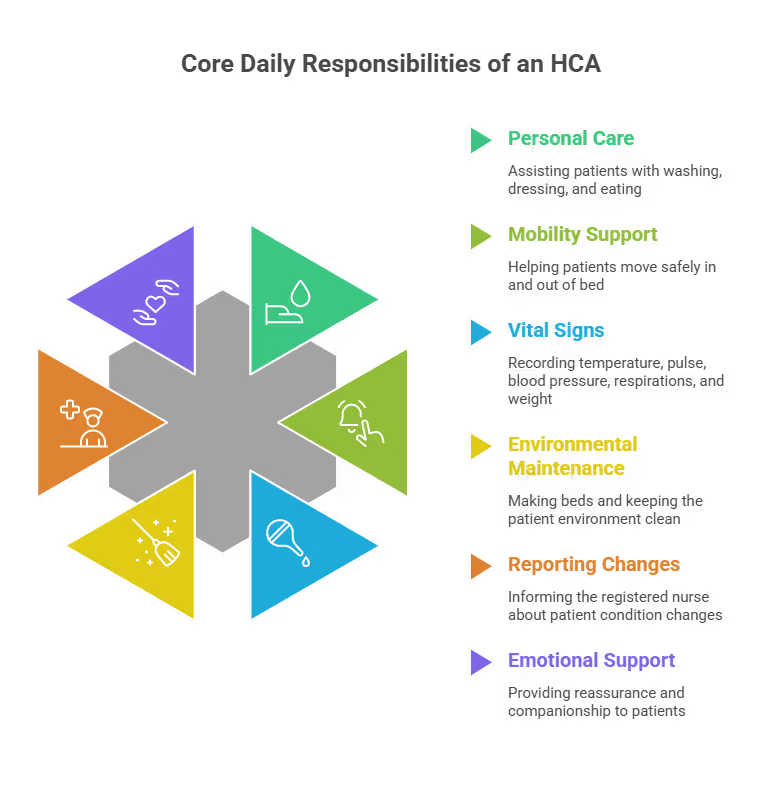
Healthcare Assistants support registered professionals. They provide personal care, monitor basic observations, assist with mobility, and maintain the dignity and safety of patients across hospital, community, and care home settings.
Core daily responsibilities
In a hospital, an HCA may:
In a GP surgery or health centre, duties may include sterilising equipment, restocking clinical rooms, processing laboratory samples, and supporting health promotion activities.
How settings differ
Hospital HCAs work within structured ward environments alongside qualified nurses and wider clinical teams. Care home HCAs carry a higher proportion of personal care duties and build longer-term relationships with residents. Community HCAs often visit patients in their own homes and work with greater independence, within agreed care plans.
Professional boundaries
Healthcare Assistants work under the supervision of registered professionals. They do not diagnose conditions, prescribe treatment, or make clinical decisions. Their role supports care delivery. They escalate concerns to qualified colleagues when needed.
A common misconception holds that experienced HCAs take on clinical responsibilities without oversight. In practice, an employer defines the HCA’s scope. The registered professional responsible for care retains accountability.
Do you need qualifications to become a Nursing Assistant in the UK?
There are no fixed national academic requirements for Healthcare Assistant roles. Employers look for literacy, numeracy, values alignment, and a commitment to completing workplace-based training such as the Care Certificate.
How employer recruitment works
Healthcare Assistant recruitment is employer-led. Each organisation sets its own entry criteria. One NHS Trust may request GCSEs in English and Maths. A care home employer may focus entirely on values, attitude, and relevant experience.
No law requires an HCA to hold a specific academic qualification before starting work. This differs from regulated professions such as nursing, where NMC registration and an approved qualification are legal requirements.
GCSE expectations
Many NHS employers list GCSEs in English and Maths at Level 4 or above as desirable rather than essential. These are employer preferences, not statutory requirements.
Apprenticeship routes
The Healthcare Support Worker apprenticeship standard lets individuals earn while completing workplace training alongside a qualification. This route suits those who prefer a supported, structured learning model.
Experience versus qualifications
Employers value demonstrable experience, whether paid or voluntary, more than standalone certificates purchased online. Care work, support roles, or healthcare volunteering show values and practical ability that self-study cannot replicate.
Read each job description carefully. Required and preferred criteria are different. Many entry-level HCA roles require only the right to work in the UK, a satisfactory DBS check, and a commitment to completing workplace training.
What is the Care Certificate: and is it legally required?
The Care Certificate is a set of induction standards used in England to confirm that support workers demonstrate safe, competent care. Employers expect it, but it is not a standalone legal licence.
Background and development
Skills for Care, Skills for Health, and Health Education England developed the Care Certificate together. It launched in 2015 following the Cavendish Review, which identified gaps in induction training after high-profile care failures.
It applies primarily in England. Scotland, Wales, and Northern Ireland maintain separate induction frameworks for social care, though some employers across all four nations use the Care Certificate as a benchmark.
Framework versus qualification
The Care Certificate is a workforce framework, not a regulated qualification. It has no awarding body in the traditional sense. It does not appear on the Regulated Qualifications Framework (RQF). Completing it does not grant a licence to practise.
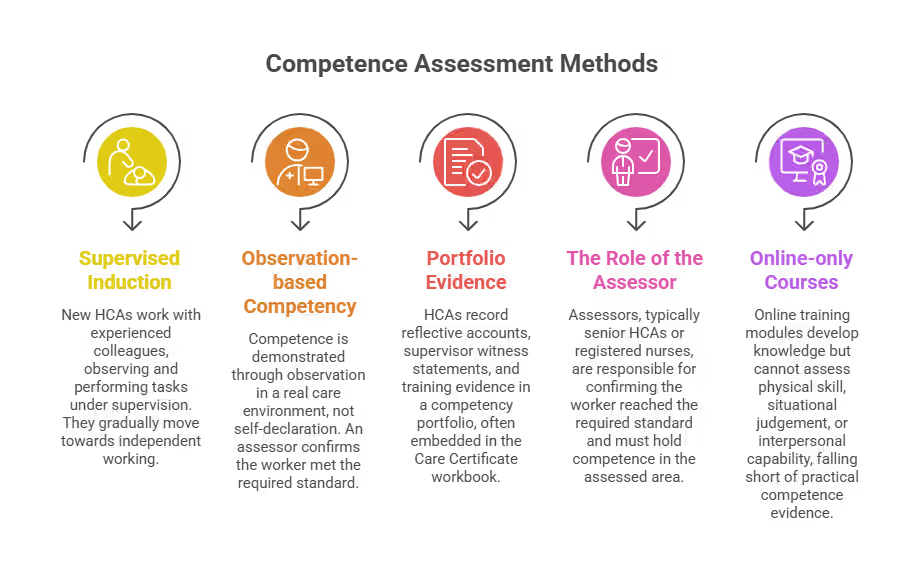
Several commercial providers sell “Care Certificate courses” and imply that completing their online product makes a learner “certified.” It does not. Completing the Care Certificate requires workplace-based assessment and sign-off by a competent assessor. Online learning modules support knowledge development. They cannot replace observed, signed-off practice.
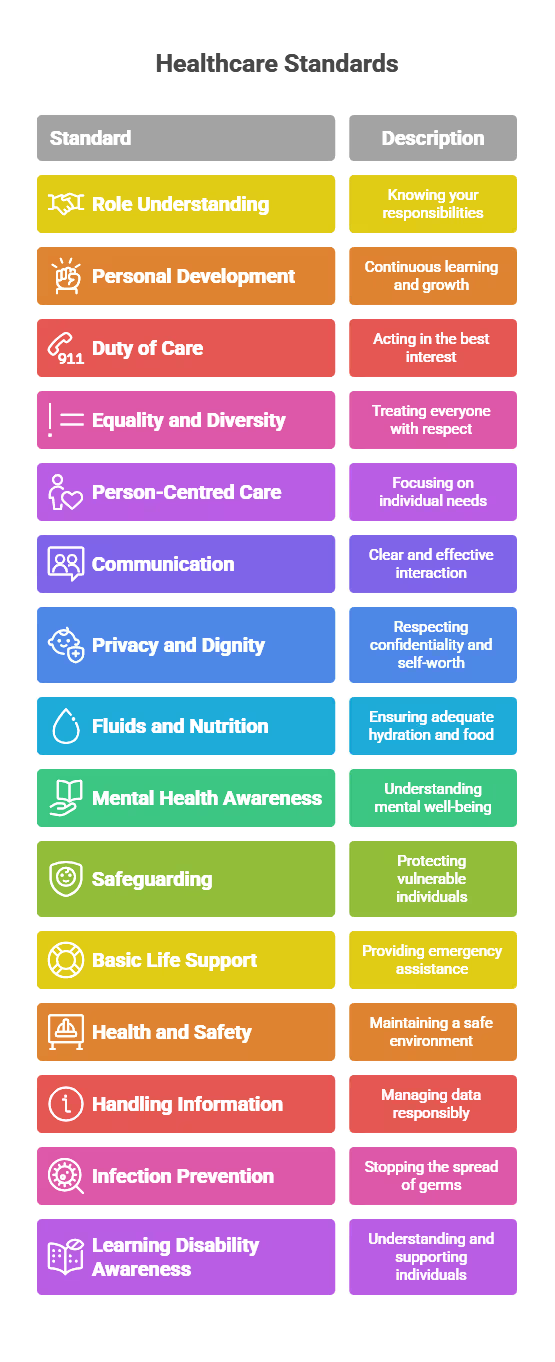
The 16 standards (updated March 2025)
In March 2025, the Care Certificate expanded from 15 to 16 standards. The sixteenth standard covers Learning Disability and Autism Awareness, aligned with the Oliver McGowan Mandatory Training requirements under the Health and Care Act 2022.
The 16 standards cover:
Any page still referencing 15 standards is out of date.
Workplace assessment and sign-off
Each standard demands evidence of competence through observed practice, reflective accounts, and assessor verification. The assessor must be a competent person within the employing organisation, such as a senior nurse, supervisor, or practice educator.
An automated online certificate does not count as completion of the Care Certificate. Completion requires face-to-face observation and documented sign-off.
Legal context: Regulation 18
Regulation 18 of the Health and Social Care Act 2008 (Regulated Activities) Regulations 2014 requires CQC-registered providers to deploy staff who are suitably qualified, competent, and skilled. Employers registered with the CQC must demonstrate staff competence to inspectors.
The Care Certificate is a widely used tool to evidence induction competence. Regulation 18 does not name it as a mandatory requirement by law. The employer carries responsibility for determining and evidencing staff competence.
How is competence assessed in practice?
Healthcare Assistants demonstrate competence through supervised practice, direct observation, and documented sign-off during their induction and probation period.
Under Regulation 18, the employer must confirm all regulated activity staff are competent. An online certificate from a commercial provider does not transfer that responsibility. The employing organisation remains accountable.
What checks are required before working in care?
Most Healthcare Assistant roles involve regulated activity. Employers require an appropriate Disclosure and Barring Service (DBS) check before the worker starts.
Enhanced versus standard DBS checks
HCAs who work directly with children or adults in care settings typically need an Enhanced DBS check with a barred list check. This is the highest level available. It reveals spent and unspent convictions, cautions, reprimands, and inclusion on the adults’ or children’s barred list.
A standard DBS check reveals spent and unspent convictions and cautions but excludes barred list information. Standard checks apply to roles with less direct contact with vulnerable groups.
What regulated activity means
The Safeguarding Vulnerable Groups Act 2006 defines regulated activity. For adults, it covers providing personal care, health care, or social work to those who need it. Most direct patient-facing HCA roles meet this threshold.
Employer responsibility for safe recruitment
The employer holds legal responsibility for carrying out appropriate pre-employment checks. They must not allow a person to begin regulated activity until a satisfactory DBS check arrives, unless they meet the statutory conditions for portability.
Safeguarding duties also link to the Care Act 2014, which places obligations on local authorities to protect adults at risk of abuse or neglect. Safe recruitment supports the wider safeguarding framework.
Roles with purely administrative or domestic duties and no direct patient contact may require a lower level of check. Read each job specification carefully and speak to the employer’s HR team if you are uncertain.
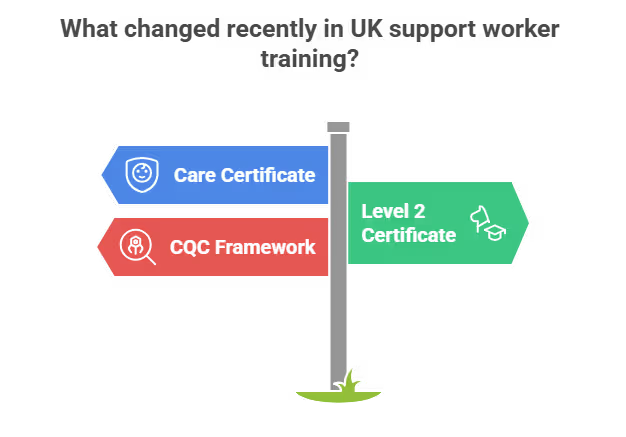
What changed recently in UK support worker training?
Recent updates include the expansion of the Care Certificate to 16 standards and the launch of the Level 2 Adult Social Care Certificate qualification in England.
The March 2025 Care Certificate update
The Care Certificate gained its sixteenth standard in March 2025. It covers Learning Disability and Autism Awareness, aligned with the Oliver McGowan Mandatory Training requirements. Employers or providers still referencing 15 standards have not updated their materials.
The Level 2 Adult Social Care Certificate
The Level 2 Adult Social Care Certificate is a regulated qualification introduced in England as part of the government’s adult social care workforce reform. It replaces some earlier Level 2 qualifications in this area. It is designed to give frontline social care workers a recognised credential.
This is a regulated qualification listed on the RQF. It has an awarding body and formal assessment processes. That distinguishes it from the Care Certificate framework.
The Level 2 Adult Social Care Certificate is not currently mandatory for all adult social care workers in England. Employers may require it as part of their recruitment or development requirements, but no law currently compels every worker to hold it.
Funding for the qualification is available through the Learning and Development Support Scheme (LDSS), which the Department of Health and Social Care administers. Eligible workers may access up to £1,500 toward the cost of the course. Speak to your employer about accessing this funding.
Care Certificate versus Level 2 Certificate
These two things serve different purposes. The Care Certificate is an induction framework covering fundamental safe practice. The Level 2 Adult Social Care Certificate is a regulated qualification providing broader knowledge and skills. Workers may hold both, either, or neither, depending on their employer’s requirements and their own development pathway.
The CQC Single Assessment Framework
The CQC replaced its previous inspection methodology with the Single Assessment Framework. Inspectors now assess providers against quality statements across six themes: safe, effective, caring, responsive, well-led, and how well the provider uses resources. Staff competence, training records, and induction evidence form part of the evidence base. Employers who still reference 15 Care Certificate standards may face questions during inspection.
How much does a Healthcare Assistant earn in the UK?
Healthcare Assistant pay varies by employer and setting. NHS roles align to Agenda for Change pay bands, with most HCAs starting at Band 2 or Band 3.
Agenda for Change
The NHS uses the Agenda for Change (AfC) framework to set pay for most NHS staff, excluding doctors, dentists, and senior managers on separate contracts. Pay bands run from Band 1 to Band 9. Healthcare Assistants typically start at Band 2. Senior or more experienced HCAs move to Band 3.
Each band contains pay points. Staff progress through pay points annually, subject to their employer’s development review process. AfC pay scales update following national negotiations. For current rates, check the NHS Employers website directly.
NHS versus independent sector
Independent sector employers, including private hospitals and care homes, do not follow AfC. Pay across the independent sector varies by employer, region, and care type. Some larger private providers align broadly to AfC bands. Others operate separate pay scales.
Shift patterns and earnings
A standard NHS working week for an HCA runs 37.5 hours. Shifts include early starts, late finishes, nights, and weekends. AfC pay includes enhancements for unsocial hours, which increases overall earnings.
A note on salary figures
Some competitor guides publish specific annual salary figures without a credible, current source. Salary data changes each year and differs between regions, employers, and trusts. Treat any single figure published without a clear source date and URL with caution.
What are the career progression routes?
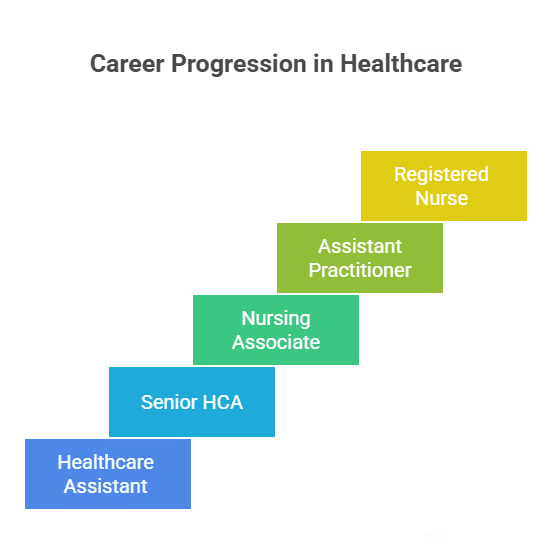
Nursing Associate
The Nursing Associate role sits at a higher level than the HCA. The NMC regulates it. Training takes two years and leads to a foundation degree. During training, workers typically sit at AfC Band 3 and move to Band 4 on qualification.
The Nursing Associate apprenticeship runs at Level 5. Qualified Nursing Associates can use their training and qualifications toward a shortened nursing degree or Nursing Degree Apprenticeship, creating a route to full NMC registration. The role currently exists primarily in England.
Nursing Degree Apprenticeship
The Nursing Degree Apprenticeship takes four years. Individuals qualify as Registered Nurses through an employer-funded, work-based route. Apprentices study at an NMC-approved university and complete practice placements across settings. On completion, they register with the NMC at AfC Band 5.
Both NHS and independent sector employers can sponsor this route. Check NHS Jobs and the Find an Apprenticeship service for available vacancies.
Assistant Practitioner
Assistant Practitioners (sometimes called Associate Practitioners) operate at a higher level than HCAs but hold no NMC regulation. Training takes 18 to 24 months and leads to a foundation degree. Pay during training sits at AfC Band 3, rising to Band 4 on qualification.
Assistant Practitioners may use their foundation degree as Accreditation for Prior Learning (APL) when applying for undergraduate degree programmes, potentially shortening the path to Registered Nurse status. Individual universities determine APL decisions.
Progression takes effort
Progression into any of these roles requires meeting entry criteria set by employers and universities. Time served as an HCA does not guarantee advancement. Academic ability, employer support, available funded places, and individual applications all shape outcomes.
Can you become a nurse from this role?
Yes. Many Healthcare Assistants progress to nursing through approved apprenticeship or degree pathways, provided they meet academic and professional entry requirements.
Entry requirements
Entry to pre-registration nursing programmes requires evidence of academic ability. Most programmes ask for a minimum of five GCSEs at Level 4 or above, including English and Maths, alongside A-levels, a Level 3 qualification, or equivalent academic evidence. Requirements vary by university.
Applicants must also demonstrate values and behaviours aligned with the NMC Code. Prior HCA experience strengthens an application. It does not replace academic entry requirements.
Employer-funded routes
Many NHS Trusts and some independent sector employers fund nursing training for existing HCA staff. Funded places are limited and competitive. Speak with your line manager, practice development team, or HR department about opportunities within your organisation.
Nursing Associate versus Registered Nurse
These are distinct regulated roles. A Nursing Associate holds NMC registration under the nursing associate part of the register. A Registered Nurse holds separate registration. The two roles carry different scopes of practice and different training requirements.
Completing a Nursing Associate programme does not automatically make someone a Registered Nurse. It does provide a recognised pathway toward that goal.
No fast-track route to NMC registration exists that bypasses an approved programme. Any provider claiming otherwise does not describe a legitimate NMC-approved pathway.
What should you look for in a training provider?
Choose providers who align with recognised UK standards, state their regulatory status clearly, and distinguish between CPD courses and regulated qualifications.
Framework versus regulated qualification
Ask any training provider two direct questions: Is this course a regulated qualification listed on the RQF? Which awarding body quality-assures it?
A regulated qualification carries a specific qualification number searchable on the Ofqual register. A CPD course does not. Neither is inherently better for every purpose. The difference matters when an employer specifies a regulated qualification at a particular level.
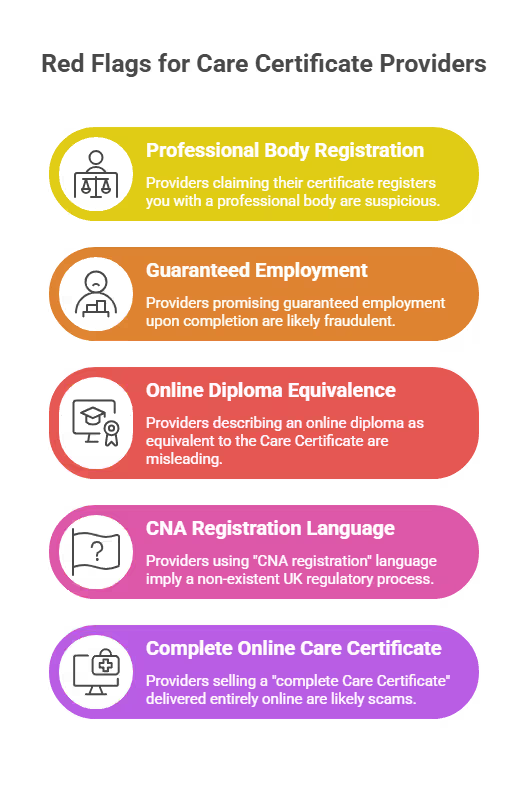
Red flags to look out for
Steer clear of providers who:
Awarding body recognition
Check that a recognised awarding body quality-assures the qualification. Examples include NCFE, CACHE, City and Guilds, and Pearson. The awarding body name should appear on the certificate. The qualification should appear on the learner’s national learning record.
Employer recognition
Before you enrol, confirm that employers in your target area recognise and value the qualification. Speak to local NHS Trusts, care home groups, or community care providers about which qualifications they accept. That conversation saves time and money.
Practical application: what is the first realistic step?
The most practical first step is applying for entry-level Healthcare Assistant roles or apprenticeships while preparing to complete employer-based induction and required checks.
Where to find roles
NHS Jobs (jobs.nhs.uk) lists HCA vacancies across NHS Trusts in England. Equivalent portals cover Scotland (NHS Scotland Recruitment), Wales (NHS Wales Jobs), and Northern Ireland. Many care home and domiciliary care employers advertise directly on their own websites and on general job boards.
The Find an Apprenticeship service (gov.uk) lists healthcare support worker and Nursing Associate apprenticeship vacancies.
Volunteering builds your application
Voluntary work in a care or health setting gives you genuine experience. It also helps you confirm whether the role suits you. NHS Trusts and hospices recruit volunteers regularly. Local voluntary services organisations connect people with community care opportunities.
Focus your CV on the right things
A strong HCA application demonstrates relevant experience, an understanding of care values, and awareness of the role’s physical and emotional demands. Focus on specific examples of supporting others, working as part of a team, and handling responsibility. A long list of online qualifications does not outweigh direct caring experience.
Prepare for values-based interviews
NHS recruitment commonly uses values-based interview questions aligned to the NHS Constitution. Prepare examples from your personal or professional experience that show compassion, respect, commitment to quality, and teamwork. Review the NHS values in advance. Connect them to real situations you have experienced.
Frequently Asked Questions
Is CNA registration required in the UK?
No. No CNA registration process exists in the UK. "Certified Nursing Assistant" is not a protected title. No UK regulatory body issues a CNA licence. The equivalent roles are Healthcare Assistant, Nursing Support Worker, or Clinical Support Worker. Employers conduct their own recruitment and induction processes, which include DBS checks, references, and completion of the Care Certificate.
Is the Care Certificate a qualification?
No. The Care Certificate is a workforce induction framework, not a regulated qualification. It has no awarding body and does not appear on the Regulated Qualifications Framework. Completing it demonstrates that a worker met 16 induction standards through observed practice and supervisor sign-off. It does not function as a licence to practise or a transferable credential in the same way as an RQF qualification.
How long does the Care Certificate take to complete?
There is no fixed national timeline. Skills for Care guidance suggests most workers complete it within 12 weeks of starting employment. Employers set their own timescales. Completion depends on the pace of induction, assessor availability, and how quickly the worker demonstrates competence across all 16 standards in their specific setting.
Can I complete the Care Certificate entirely online?
No. The Care Certificate requires direct observation of practice by a competent assessor in a real care environment. Online learning modules support knowledge development across the 16 standards. They cannot replace the observed, signed-off competency assessment the framework requires. Providers selling a "complete Care Certificate" as a fully online product do not describe something employers or regulators will accept as meeting the framework.
Do I need GCSEs to become a Healthcare Assistant?
GCSEs in English and Maths appear on many NHS job descriptions as desirable, not as a fixed legal requirement. Requirements vary between organisations. Some employers accept equivalent evidence of literacy and numeracy. Where a specific job description lists GCSEs as essential, meet that requirement to be considered for that role.
What is Band 2 in the NHS?
Band 2 is a pay level within the Agenda for Change framework. It is the starting band for most entry-level Healthcare Assistants. Each band contains pay points that staff move through annually. Current Band 2 salary rates appear on the NHS Employers website. Band 3 roles carry greater responsibility and a higher pay rate.
What is the difference between an HCA and a Nursing Associate?
A Healthcare Assistant is a non-regulated support worker role with no mandatory professional registration. A Nursing Associate is a regulated professional registered with the NMC, trained to foundation degree level over two years, and working at a higher level of clinical responsibility than an HCA. The Nursing Associate role currently exists primarily in England. It represents a distinct step in career progression, not a direct extension of the HCA role.
Is the Level 2 Adult Social Care Certificate mandatory?
No. The Level 2 Adult Social Care Certificate is not currently mandatory for all adult social care workers in England. It is a regulated qualification that some employers include in their development frameworks. Specific employers may require it as a condition of employment or progression. Check individual employer requirements rather than assuming universal obligation.
Do I need an enhanced DBS check?
Most HCA roles involving direct patient contact in regulated activity require an Enhanced DBS check with a barred list check. This is the highest level of DBS check and is processed by the Disclosure and Barring Service. The employer determines the appropriate check level for each role. Roles without direct patient contact may require a lower level of check.
Can international applicants become Healthcare Assistants in the UK?
Yes, provided they hold the legal right to work in the UK. International applicants must meet the same employer-set requirements as domestic applicants, including DBS checks, right-to-work documentation, and, where required, evidence of English language proficiency. Immigration status determines eligibility to work. Confirm your visa conditions before you apply.
Is previous experience required?
Many entry-level HCA roles do not require prior formal healthcare experience. Employers value any caring or support experience, whether paid or voluntary. That experience demonstrates values, practical understanding, and commitment. A lack of paid experience is not a barrier where an applicant shows relevant personal experience and clear motivation for the role.
What is supervised practice?
Supervised practice is a period of working alongside a qualified or experienced colleague while developing skills. The supervisor watches the worker's practice, offers guidance, and confirms competency before the worker takes on tasks independently. It forms a central part of both Care Certificate completion and ongoing competency development for HCAs.
Can I work part-time as a Healthcare Assistant?
Yes. Part-time contracts exist across NHS and independent sector settings. Many employers offer flexible working arrangements, including bank contracts where staff work as and when required. NHS Bank and agency work offer additional flexibility but may not include the employment benefits attached to substantive contracts.
What is regulated activity?
Regulated activity is a legal term defined under the Safeguarding Vulnerable Groups Act 2006. For adults, it covers providing personal care, health care, or social work to those who need it. Most direct patient-facing HCA positions meet this threshold. This threshold triggers the requirement for an Enhanced DBS check with a barred list check.
Who regulates Healthcare Assistants?
Healthcare Assistants in the UK are not personally regulated by a professional body. No equivalent of NMC registration exists for HCAs. The employing organisation holds regulatory accountability through registration with the CQC for providers in England. CQC assesses whether organisations meet legal requirements, including safe staffing standards under Regulation 18. Individual HCAs are accountable through their employment contract and employer policies.
What is the Nursing Degree Apprenticeship?
The Nursing Degree Apprenticeship is a four-year programme. Individuals qualify as Registered Nurses while employed and earning. Apprentices study at an NMC-approved university and complete practice placements. On successful completion, they register with the NMC. Both NHS and independent sector employers can sponsor apprentices. Places are competitive and employer-funded.
Can I move from an HCA role to Nursing Associate?
Yes. The Nursing Associate apprenticeship is a common progression route for experienced HCAs in England. Applicants must meet entry requirements set by the employer and training provider. These typically include demonstrable experience in a health or care setting, literacy and numeracy evidence, and employer sponsorship. The programme takes two years and leads to NMC registration as a Nursing Associate.
What is the difference between the Care Certificate and a diploma?
The Care Certificate is an induction framework assessed in the workplace. A diploma such as the Level 2 or Level 3 Diploma in Health and Social Care is a regulated qualification delivered by an approved provider, listed on the RQF, and quality-assured by an awarding body. Employers may require, fund, or value either or both depending on the role and their workforce development priorities.
Do online nursing assistant diplomas carry value in the UK?
An online diploma may build knowledge and show personal commitment to development. Its value to employers depends on whether it is a regulated qualification from a recognised awarding body. An unregulated CPD certificate obtained entirely online carries limited weight in NHS recruitment compared to direct care experience, employer-completed competency assessments, or RQF-listed qualifications. Check the qualification's regulatory status before you purchase.
What is the first step if I have no experience and no qualifications?
Apply for entry-level Healthcare Assistant roles or healthcare apprenticeships. Seek voluntary experience in a care setting. Employers who use values-based recruitment assess attitude, communication, and commitment alongside formal credentials. Building direct care experience and completing an employer-led induction gives you more value in the job market than purchasing online certificates.
Authority Clarification
This guide references UK legislation, workforce frameworks, and regulatory guidance. Sources include the Health and Social Care Act 2008 (Regulated Activities) Regulations 2014, the Safeguarding Vulnerable Groups Act 2006, the Care Act 2014, and the Health and Care Act 2022. It separates legal requirements from employer or regulatory guidance where that distinction matters.
No statement in this guide overstates legal obligations. Where a requirement exists in law, this guide says so. Where a standard is widely adopted by employers but not legally mandated, this guide makes that clear. Salary information appears in structural terms rather than specific figures, as pay rates change each year and vary by employer, region, and contract type. Consult NHS Employers, Skills for Care, and relevant regulatory body websites for current data.