




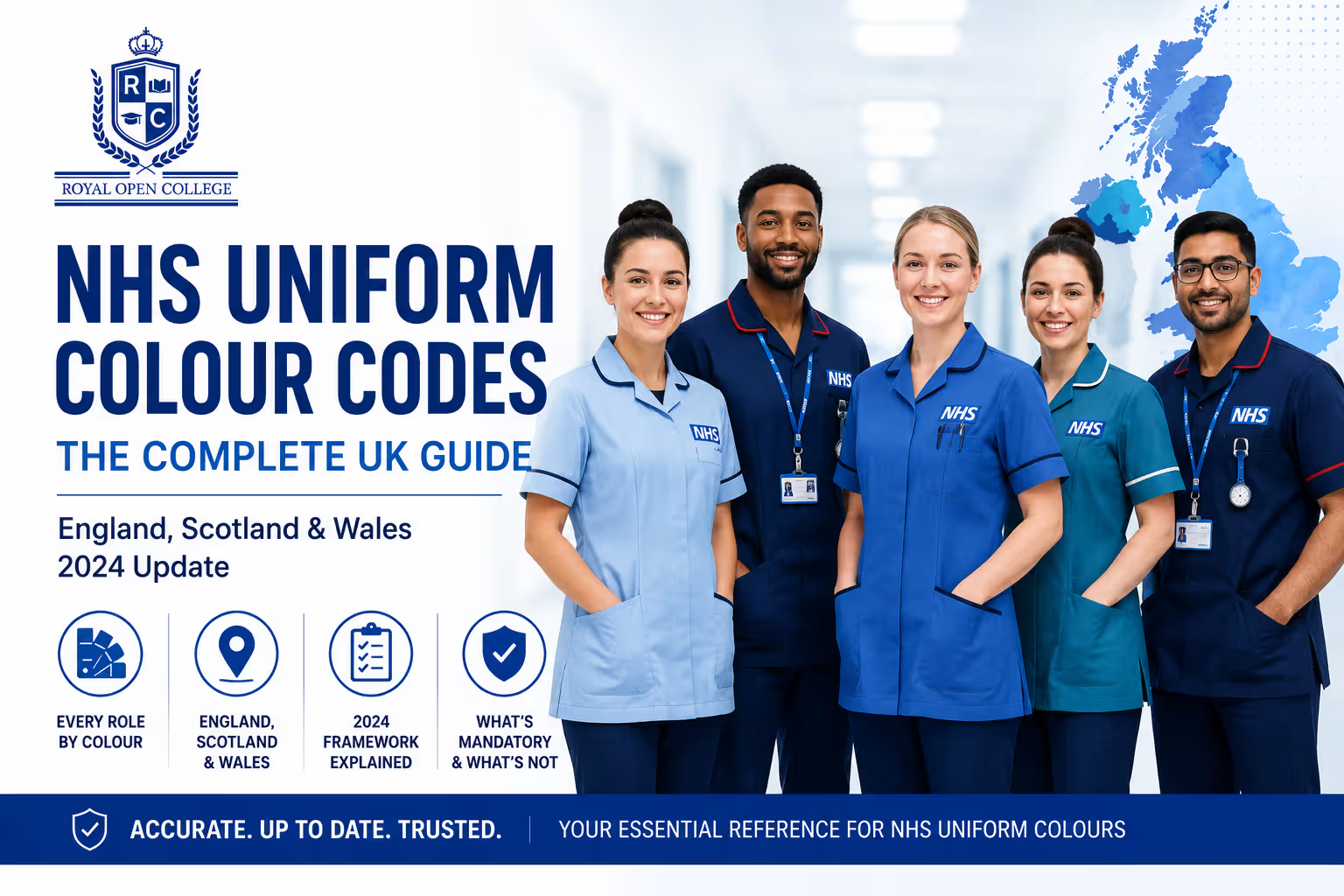


Your first day on an NHS ward. You look around and count seven different shades of blue before the morning handover finishes.
A patient calls to the person in navy, asking whether she is the nurse in charge. She is not. She is a team leader. The registered nurse in hospital blue is two bays down. Down the corridor, a cloud blue learner gets asked to prescribe medication by a relative who had no idea learners do not prescribe.
Nobody in this scenario is wrong for being confused. The colour system is more precise than most people realise, and the rules change depending on which part of the UK you are in.
This guide gives you the full, accurate picture. You will find correct role-by-colour assignments for England, Scotland, and Wales as three entirely separate systems. You will find out which systems are mandatory and which are not. You will also find direct corrections for the colour assignment errors that multiple competing pages are currently publishing as fact.
TL;DR: Five Key Facts Before You Read Further
- England introduced a national uniform framework in 2024 through NHS Supply Chain. The framework is not mandatory. Each Trust decides whether and when to adopt it.
- Scotland has operated a mandatory national uniform system since 2010. Its colours differ entirely from England.
- Wales has operated a mandatory national system since 2011. Its system also differs from England.
- Uniform colour reflects your professional group and clinical role, not your Agenda for Change pay band.
- Within nursing and midwifery in England, five distinct shades of blue each identify a different role.
Is NHS Uniform Colour Coding a Legal Requirement?
NHS uniform colour coding is not primary legislation in any UK nation. No single law states which colour a nurse must wear. In Scotland and Wales, the colour system is nationally mandated through government policy. In England, the national framework is guidance each Trust chooses whether to adopt.
England
Guidance-based. The NHS National Healthcare Uniform framework, led by NHS Supply Chain in collaboration with the Department of Health and Social Care and NHS England, is a national recommendation. Each Trust in England decides independently whether and when to adopt it. Trusts not yet adopting the new framework continue under their own local uniform dress codes.
Scotland
Mandatory. The Scottish Government issued DL(2018)4, the National Uniform Policy, Dress Code and Laundering Policy, through the Health Workforce and Strategic Change Directorate. All NHS Boards in Scotland must implement the national uniform. Boards are not permitted to create alternative colour identities for staff groups covered by the policy.
Wales
Mandatory. The All Wales NHS Dress Code Policy requires all NHS Wales health boards to follow the designated national uniform. Certain groups of staff must wear the approved All Wales uniform at all times while on duty. No substitute uniforms are permitted.
The key distinction: Scotland and Wales operate nationally mandated systems with no Trust-level discretion on colour. England operates a national framework with Trust-level adoption. This is the fact most other sources on this topic fail to state.
What Are NHS Nurse Uniform Colour Codes?
NHS uniform colour codes are a visual system for identifying clinical roles without a word being spoken. Each professional group wears a specific base colour. In most cases, a specific trim colour adds a second layer of identification. Patients, relatives, and colleagues use these colour combinations to identify who is standing in front of them before anyone introduces themselves.
The system exists to solve a real clinical communication problem. NHS wards are fast-paced environments. Patients recovering from procedures, relatives under pressure, and colleagues moving between departments all need to locate the right person quickly. A colour-coded uniform system reduces confusion and speeds up communication.
Two things the system is not:
- Not UK-wide. England, Scotland, and Wales each operate separate colour systems with different role assignments. A colour identifying a registered nurse in England identifies a different role in Scotland.
- Not based on pay bands. Your uniform colour reflects your professional group and the clinical role you hold. Your colour does not change when your Agenda for Change pay band changes.
Before 2024, NHS England had no national standard at all. Over 50 different shades of blue and more than 30,000 different uniform styles were in use across England’s 212 NHS Trusts. The same shade of navy meant different roles at different hospitals. A clinician moving between Trusts often found their existing uniform was the wrong colour entirely. The 2024 national framework, led by NHS Supply Chain, is the first attempt to fix this across England.
NHS Uniform Colour Codes in England: The 2024 National Framework
England operated without a national uniform standard for decades. Each of its 212 NHS Trusts chose its own colour palette independently. This produced over 30,000 different uniform variations and more than 50 different shades of blue in use across the country, often assigning the same shade to different roles in different hospitals.
NHS Supply Chain launched the National Healthcare Uniform programme to address this. Development started in 2019. A 2021 consultation with more than 50,000 healthcare professionals shaped the framework. The framework officially started on 3 June 2024 and runs until 2 June 2029. Version 6 of the colourways document, published October 2024, sets out 15 colourways and 12 Allied Health Profession trim colours, covering approximately 600,000 clinical wearers across England.
The NHS spends around £23 million per year on uniforms. The framework aims to deliver a saving of 30 to 50 percent through national procurement, standardised designs, and sustainable fabrics, including recycled polyester and cotton sourced through the Better Cotton Initiative.
One fact to state clearly before the colour breakdown: the new England framework is not mandatory. Each NHS Trust in England decides whether and when to adopt the framework.
The Four Core Colour Groups in England
The framework organises all clinical roles into four professional colour groups:
Nursing and Midwifery: The Five Shades of Blue Explained
This is the most searched and most misunderstood part of the topic. Five distinct shades of blue exist within nursing and midwifery alone. Each shade identifies a different role, not a different seniority level within the same role.
| Role | Base Colour | Trim Colour |
|---|---|---|
| Learner | Cloud blue | Navy |
| Nursing Associate | Sky blue | Sky blue |
| Registered Nurse | Hospital blue | Navy |
| Registered Midwife | Postman blue | Navy |
| Team Leader | Navy | Dark red |
Two additional senior roles within nursing and midwifery:
Healthcare Assistants, Support Workers and Matrons
Healthcare Assistants and Clinical Healthcare Support Workers wear lilac with navy trim under the national England framework.
This correction needs to be stated directly. Multiple competing pages and one currently-ranking source assign green to healthcare assistants in England. Green was used under some older Trust-level systems. Under the current national framework (NHS Supply Chain Version 6, October 2024), the correct colour for healthcare assistants and support workers is lilac with navy trim. Not green.
Matrons wear purple with navy trim. This is a clearly distinct shade from the lilac worn by support workers.
Pharmacy Colours Under the New England Framework
For many NHS Trusts, the national framework introduces a clinical uniform for pharmacists for the first time. At London North West University Healthcare NHS Trust, which began its rollout in June 2025 and distributed more than 5,000 uniforms across three hospital sites, the trust specifically noted this as the first time pharmacists were required to wear a clinical uniform there.
Healthcare Science Colours Under the New England Framework
Allied Health Profession Colours Under the New England Framework
All Allied Health Professions (AHPs) use either a ruby or white base colour. The trim colour identifies the specific specialism. The split between ruby and white bases came from a survey of 26,804 AHP workers, representing a 67 percent response rate of the total AHP workforce in England. Most AHPs voted for dark magenta (now called ruby). Physiotherapists and Occupational Therapists voted for white.
| AHP Role | Base Colour | Trim Colour |
|---|---|---|
| Physiotherapist | White | Navy |
| Occupational Therapist | White | Bottle green |
| Prosthetist / Orthotist | White | Hospital blue |
| Dietitian | Ruby | Hospital blue |
| Speech and Language Therapist | Ruby | Postman blue |
| Orthoptist | Ruby | Black |
| Osteopath | Ruby | Cloud blue |
| Operating Department Practitioner | Ruby | Sky blue |
| Music, Art and Drama Therapist | Ruby | Sherwood green |
| Podiatrist | Ruby | Royal blue |
| Diagnostic Radiographer | Ruby | Eau-de-nil |
| Therapeutic Radiographer | Ruby | White |
Is the New England Framework Mandatory?
No. The National Healthcare Uniform framework is guidance-based. Each Trust in England decides whether and when to adopt it.
Some Trusts began rollouts in 2024. Others are transitioning through 2025 and 2026. The framework contract runs until June 2029. Until your Trust adopts the new framework, your Trust’s existing local dress code policy remains in force.
What Happens During the Transition Period?
During the transition, staff at the same hospital site wear both old and new uniforms simultaneously. Bedfordshire Hospitals NHS Trust, which began distributing new uniforms from 5 January 2026, states on its uniforms page: during the transition, some colleagues might still be wearing the older style. If you are not sure who you are speaking to, ask.
For new starters in England: do not rely on any colour chart, including this guide, without confirming what your specific Trust currently uses. Contact your Trust’s HR or uniform team directly.
Which colour system applies to you?
Follow NHS Scotland national uniform (DL (2018) 4)
Mandatory. No Board discretion.
Follow All Wales Dress Code Policy
Mandatory. No Health Board discretion.
Has your Trust adopted the NHS National Healthcare Uniform?
NHS Uniform Colour Codes in Scotland
Scotland introduced a mandatory national uniform in 2010. The governing document is the Scottish Government’s DL(2018)4, the National Uniform Policy, Dress Code and Laundering Policy, issued by the Health Workforce and Strategic Change Directorate. All NHS Boards in Scotland must implement this system. Boards are not permitted to create alternative colour identities or extend colours to roles outside the policy’s assignments.
Scotland’s colour system is entirely separate from England’s. The two systems share no colour assignments.
| Staff Group | Uniform Colour |
|---|---|
| Registered Nurses (NMC-registered) and registered Dental Nurses | Cornflower blue |
| Senior Charge Nurses, Hospital at Night Nurse Practitioners in charge of the ward, Senior Midwives, Community Nurse Team Leaders | Navy blue |
| Clinical Nursing Managers (Band 8A and above) | Smoked berry burgundy |
| Nursing, Midwifery and AHP Students | Silver grey with university or college embroidery |
| Registered Allied Health Professionals | Mediterranean blue with professional role embroidered on tunic |
| Healthcare Scientists, Pharmacy Technicians, Dental Care Professionals, Orthopaedic Practitioners | Ocean blue with professional role embroidered on tunic |
| All unregistered staff and healthcare support workers | Pale sky blue |
| Non-clinical staff including catering, domestic, porters, admin and clerical | Mid green |
| Catering and domestic supervisors | Dark green |
Three critical points from DL(2018)4:
- Navy blue in Scotland is a specific role designation. The policy states the navy blue uniform does not correspond directly with Agenda for Change bands, and Boards must not extend it to other specialist or senior nurses, even those working at the same or higher band as the Senior Charge Nurse.
- Smoked berry burgundy was introduced following the Vale of Leven Report to make senior nurse leadership clearly visible to patients and the public. This colour applies only to Clinical Nursing Managers of Band 8A and above. It is not a general senior nurse colour and cannot be used for any other staff group.
- AHPs in Scotland have their specific professional role embroidered on their Mediterranean blue tunic. Unregistered AHP support staff wear pale sky blue with optional department embroidery under local policy.
All clinical staff wear the national uniform at all times. This is mandatory across all NHS Scotland settings.
NHS Uniform Colour Codes in Wales
Wales introduced a mandatory national uniform system in 2011 under the All Wales NHS Dress Code (Free to Lead, Free to Care), developed by the Welsh Government. The policy applies to all NHS Wales health boards. No other guide currently ranking for this topic covers Wales accurately. This section fills that gap.
Under the All Wales framework, designated groups of staff must wear the approved All Wales uniform at all times while on duty. No substitute uniforms are permitted. Staff who persistently breach the policy face disciplinary action under their health board’s procedures.
| Staff Group | Colour and Notes |
|---|---|
|
🧑⚕️
Head of Nursing
|
Navy with red trim
|
|
👩⚕️
Registered Nurses
|
Blue (specific shade designated under All Wales framework and health board policy)
|
|
🩺
Healthcare Support Workers
|
Designated colour under All Wales framework
|
|
🎓
Students (nursing, midwifery, AHP)
|
Designated student uniform with educational institution identification
|
|
👨💼
Non-clinical staff
|
Designated non-clinical colours under All Wales framework
|
Key distinctions for Wales:
The head of nursing in Wales wears navy with red trim. This differs from equivalent senior roles in England, where navy with dark red trim identifies team leaders and advanced nurse practitioners. It also differs from Scotland, where smoked berry burgundy identifies Clinical Nursing Managers of Band 8A and above.
Nurses working in paediatric units in some settings wear health board-issued child-friendly tabards over their standard uniform, where the health board approves this. These tabards require the same laundering standards as the standard uniform.
The All Wales Dress Code also sets presentation expectations for staff who do not wear a clinical uniform, requiring a professional standard of dress from all staff across clinical and non-clinical roles.
If you work in NHS Wales or are applying for a role within a Welsh health board, contact your health board directly for the current All Wales colour assignments for your specific role.
How Do NHS Uniform Colours Differ Across England, Scotland and Wales?
Three separate systems exist. No single colour chart covers all three. The comparison table below focuses on the most commonly searched roles. Pay attention to the mandatory status column at the bottom. This is the most frequently misunderstood aspect of the entire topic.
| Role | England (2024 Framework) | Scotland (DL(2018)4) | Wales (All Wales Policy) |
|---|---|---|---|
| Registered Nurse |
Hospital blue, navy trim
|
Cornflower blue
|
Blue (health board designation)
|
| Healthcare Assistant / Support Worker |
Lilac, navy trim
|
Pale sky blue
|
Designated colour
|
| Student (nursing / midwifery / AHP) |
Cloud blue, navy trim
|
Silver grey, university embroidery
|
Designated student uniform
|
| Senior / Lead Nurse |
Navy, dark red trim (Team Leader)
|
Navy (Senior Charge Nurse only)
|
Navy with red trim (Head of Nursing)
|
| Pharmacist |
Bottle green, navy trim
|
Ocean blue (within HC Science group)
|
Designated colour
|
| Allied Health Professional (e.g. Physiotherapist) |
White, navy trim
|
Mediterranean blue
|
Designated colour
|
| Framework Status | Guidance only. Trust adoption voluntary. | Mandatory. No Board discretion. | Mandatory. No Health Board discretion. |
Do NHS Pay Bands Determine Your Uniform Colour?
No. Under the national frameworks for England, Scotland, and Wales, Agenda for Change pay bands and uniform colours are entirely separate systems.
Your uniform colour reflects your professional group and clinical role. The colour does not change when your pay band changes.
A direct example from England: a Band 5 Registered Nurse and a Band 5 Nursing Associate work at the same pay level but wear different colours. The Registered Nurse wears hospital blue with navy trim. The Nursing Associate wears sky blue with sky blue trim. The colour reflects professional registration and role, not the pay band number.
Why Does the Band vs Colour Confusion Exist?
Some NHS Trusts in England not yet adopting the national framework still use band-based colour systems in their local policies. Rotherham Doncaster and South Humber NHS Foundation Trust, as recently as its August 2025 policy update, assigns Band 5 nurses hospital blue, Band 6 nurses navy blue, and Band 7 nurses navy blue with gold piping. These are Trust-level decisions valid at that Trust until the Trust formally adopts the national framework.
Once a Trust adopts the national framework, band-based colour assignments are replaced by role and profession-based assignments.
In Scotland, DL(2018)4 addresses this directly. The policy states the navy blue uniform does not correspond with Agenda for Change bands, and NHS Boards must not extend it to other specialist or senior nurses practising at the same or higher band as the Senior Charge Nurse.
Common Myths About NHS Uniform Colours
Several NHS uniform colour myths circulate widely online. Some appear on pages currently ranking at the top of search results for this topic. The corrections below are based on NHS Supply Chain Version 6 October 2024, the Scottish Government DL(2018)4, and the All Wales Dress Code Policy.
Healthcare assistants wear green uniforms in the NHS.
Under the national England framework, healthcare assistants and support workers wear lilac with navy trim. Green was used in some older Trust-level systems. Pages assigning green to healthcare assistants in England are using outdated colour assignments from pre-2024 Trust-level policies.
Yellow, turquoise, pink, orange, and brown are standard NHS uniform colours for named roles.
These colours do not appear in any NHS national policy document. They are not in the NHS Supply Chain colourways document, the NHS Scotland DL(2018)4, or the All Wales Dress Code Policy. Any source assigning these colours to named NHS roles is publishing fabricated colour codes with no policy basis.
Your pay band determines your uniform colour.
The national framework assigns colour by professional group and role, not by band. Some Trusts in England still use band-based local systems, but the national framework removes this approach for Trusts adopting the new system.
NHS uniforms are the same across the UK except Scotland.
Wales has operated its own mandatory national system since 2011. Three entirely separate systems exist. No single colour chart covers all three accurately.
The new England framework is now standard across all NHS Trusts.
The framework is guidance-based and runs until June 2029. Trusts adopt it on their own timeline. Many Trusts are still operating local policies, and some are mid-transition with staff wearing both old and new uniforms at the same site.
What Do NHS Uniform Colours Mean for Patients?
The NHS colour system is designed partly for you as a patient or relative. It gives you a way to identify who is caring for you before anyone introduces themselves.
Under the national England framework, here is a quick identification guide:
One important note for patients visiting an NHS hospital in England right now: you might see staff in both old and new uniforms on the same ward. The rollout is ongoing through 2025 and into 2026. Bedfordshire Hospitals NHS Trust puts this plainly on its uniforms page: during the transition, some colleagues might still be wearing the older style, so if you are not sure who you are speaking to, ask.
In Scotland and Wales, the national systems have been in place for over a decade. Colour recognition is more consistent at those sites.
The most important step: if you are ever unsure who you are speaking to, ask the staff member directly. NHS staff at every site will confirm their role for you.
Key Summary: NHS Nurse Uniform Colour Codes
NHS uniform colours are not one system. They are three separate systems across three nations, each with different rules, different colour assignments, and different levels of authority.
Here is what you need to carry forward from this guide:
- England introduced the National Healthcare Uniform framework in 2024 through NHS Supply Chain. The framework is guidance-based and not mandatory. Each Trust decides whether and when to adopt it. The framework runs until June 2029.
- Scotland has operated a mandatory national uniform since 2010 under the Scottish Government’s DL(2018)4. NHS Boards must follow the national uniform. Boards cannot create alternative colour identities for any staff group covered by the policy.
- Wales has operated a mandatory national uniform since 2011 under the All Wales Dress Code Policy. Designated staff must wear the approved uniform at all times. No substitutes are permitted.
- Uniform colour reflects your professional group and clinical role. Pay bands and uniform colours are entirely separate systems.
- In England, five distinct shades of blue exist within nursing and midwifery alone. Cloud blue, sky blue, hospital blue, postman blue, and navy each identify a different role.
- Healthcare assistants in England wear lilac with navy trim under the national framework. Not green.
- During the transition in England, staff at the same site wear both old and new uniforms. If you are unsure who you are speaking to, ask.
- No single colour chart applies across England, Scotland, and Wales. Always confirm the policy at your specific Trust or health board before your first day.
If you are starting a nursing career and need a Level 3 qualification to access a nursing degree, speak to our team about the Access to Higher Education Diploma in Nursing today.
FAQ
Q: Why do some nurses wear different shades of blue?
A: In England under the 2024 national framework, five distinct shades of blue identify different nursing and midwifery roles. Cloud blue is for learners, sky blue for nursing associates, hospital blue for registered nurses, postman blue for midwives, and navy for team leaders and advanced nurse practitioners. Each shade identifies a specific professional role, not a seniority level within the same role.
Q: Is the new NHS uniform mandatory in England?
A: No. The National Healthcare Uniform framework is guidance-based, and each Trust in England decides whether and when to adopt it. Trusts not yet adopting it continue to follow their own local dress code policies. The framework contract runs until June 2029.
Q: Are NHS uniform colours the same in Scotland and Wales as in England?
A: No. All three nations operate entirely separate systems with different colour assignments and different mandatory status. Scotland and Wales both have mandatory national systems. England operates a guidance-based framework with Trust-level adoption.
Q: What colour uniform does a healthcare assistant wear in the NHS?
A: Under the current England national framework (NHS Supply Chain Version 6, October 2024), healthcare assistants and support workers wear lilac with navy trim. Some older Trust-level systems in England still assign green to this role, which is why the confusion persists online.
Q: What colour does a nursing associate wear?
A: In England under the 2024 framework, nursing associates wear sky blue with sky blue trim. This is a distinct shade from the hospital blue with navy trim worn by registered nurses, and the distinction reflects the difference in professional registration between the two roles.
Q: What colour is the NHS student nurse uniform?
A: In England, student nurses wear cloud blue with navy trim, typically with their university or college embroidered on the tunic. In Scotland, nursing, midwifery and AHP students wear silver grey with navy trousers and their university or college embroidered on the tunic under DL(2018)4.
Q: Does navy blue mean the same thing in England and Scotland?
A: No. In Scotland, navy blue is restricted to Senior Charge Nurses and specific Hospital at Night Nurse Practitioner roles. The Scottish policy explicitly states it must not be extended to other specialist or senior nurses. In England under the national framework, navy is worn by team leaders and advanced nurse practitioners, which are different role designations.
Q: What colour do pharmacists wear in the NHS?
A: Under the England national framework, pharmacists wear bottle green with navy trim. Pharmacy Technicians wear Sherwood green with navy trim. In Scotland, pharmacy technicians are grouped within the Healthcare Science category and wear ocean blue. For many English Trusts, the national framework introduces a clinical uniform for pharmacists for the first time.
Q: What is the smoked berry burgundy uniform in Scotland?
A: Smoked berry burgundy is worn only by Clinical Nursing Managers of Band 8A and above in NHS Scotland. The colour was introduced following the Vale of Leven Report to make senior nurse leadership clearly visible to patients and the public. This is not a general senior nursing colour and no other staff group wears it.
Q: What does a patient do if they are not sure what role a staff member holds?
A: Ask the staff member directly. During the England transition period, mixed old and new uniforms at the same site are common and expected. Bedfordshire Hospitals NHS Trust advises clearly: if you are not sure who you are speaking to, ask, and staff are happy to confirm their role.
Q: My Trust still uses different colours. Is that correct?
A: Yes. In England, adoption of the national framework is a Trust-level decision and is not mandatory. Until your Trust formally adopts the new framework, your Trust's existing local uniform policy is valid and correct for your site. Contact your HR or uniform team to confirm which policy applies at your Trust right now.
Q: Can NHS staff choose their own uniform colour?
A: No. Uniform colours are assigned by professional group and role under national or local policy. In Scotland and Wales, staff must wear the nationally designated uniform at all times. In England, the applicable assignments come from either the national framework (for adopting Trusts) or the Trust's local dress code policy.
Q: Why was the NHS uniform system changed in England?
A: Before 2024, NHS England had over 30,000 different uniform styles and more than 50 shades of blue in use across 212 Trusts. The NHS spent approximately £23 million per year on fragmented uniform procurement, with costs varying hugely between Trusts. The national framework addresses all three problems through standardisation, national procurement, and a single coherent colour system.
Q: Are doctors included in the new NHS uniform framework?
A: No. Medical professionals are outside the scope of the NHS National Healthcare Uniform framework. The framework covers nursing, midwifery, pharmacy, healthcare science, and allied health professions. Doctors typically wear scrubs in clinical areas or their own clothing, with identity badges as the primary identification.
Q: Do the new uniform rules apply in community and mental health settings too?
A: Yes. The scope of the NHS National Healthcare Uniform covers all Trust settings, including acute, community, and mental health. If your Trust has adopted the framework, the colour assignments apply across all settings where you wear a clinical uniform.
Starting a Career in NHS Nursing? Your Next Steps
If you are preparing for a nursing career, your uniform colour is one of the first practical questions you will face on placement.
The single most important step before your first day is to contact your Trust directly and confirm its current dress code policy. Do not rely on a general colour chart. England is mid-transition. The colour assignments at your specific Trust depend on which policy your Trust currently follows, and this varies from Trust to Trust.
What to Expect as a Student Nurse in England
Your cloud blue uniform is typically arranged by your university or your placement Trust. Under the national framework, student nurse tunics carry your university or college embroidery. Your university will advise you on placement-specific requirements and whether your Trust has adopted the national framework.
What to Expect as a Student in Scotland
Nursing, midwifery and AHP students in Scotland wear silver grey tunics with navy blue trousers. The tunic carries your university or college embroidery. This is mandatory under DL(2018)4 and applies across all NHS Scotland placements regardless of which Board you are placed with.
What to Expect as a Student in Wales
The designated student uniform in Wales is set under the All Wales Dress Code Policy. Your university and placement health board will confirm the specific requirements for your placement. As in Scotland, the Welsh system is mandatory and no substitutes are permitted.
Working Towards Your Nursing Qualification
If you want to enter nursing but do not yet hold the Level 3 qualifications needed to apply for an NMC-approved nursing degree, our Access to Higher Education Diploma in Nursing provides an A Level equivalent pathway designed for adults returning to education. Speak to our team today to find out whether this route is right for you.
Sources: NHS Supply Chain National Healthcare Uniform Colourways Version 6, October 2024. Scottish Government DL(2018)4 National Uniform Policy, Dress Code and Laundering Policy. All Wales NHS Dress Code (Free to Lead, Free to Care). Bedfordshire Hospitals NHS Trust Uniforms page, January 2026. London North West University Healthcare NHS Trust, June 2025. Pennine Care NHS Foundation Trust Uniform page. NHS Supply Chain Healthcare Uniform framework page, updated November 2025.