






Information sharing
Your DSL certificate is nearly two years old. Your setting has new safeguarding risks, fresh local procedures, and updated guidance to follow. The date on the certificate matters. Your current knowledge matters more.
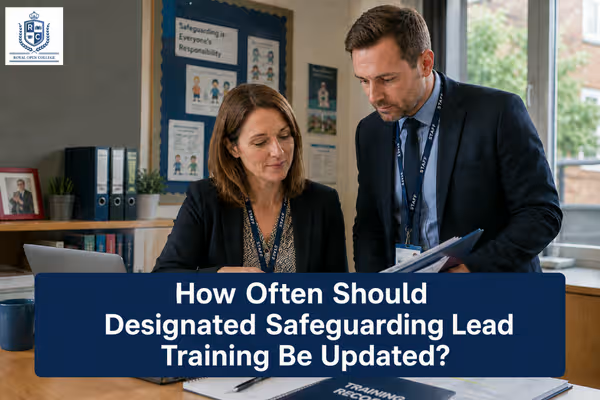
In England schools and colleges, Designated Safeguarding Lead training should be updated at least every 2 years. DSLs and Deputy DSLs should also refresh safeguarding knowledge and skills at least annually. Annual updates do not replace formal refresher training.
This guide explains the update cycle, what KCSIE expects, how annual updates work, when to update sooner, and what employers should record.
TL;DR:
If you remember one thing, remember this. DSL training has two update layers. Formal DSL refresher training, at least every 2 years in England schools and colleges. Annual knowledge refresh, at least once a year.
Extra updates, when guidance, local policy, risks, roles, or inspection findings change. Deputy DSLs follow the same training standard as DSLs. Early years, healthcare, care, Wales, Scotland, and Northern Ireland use different rules, terms, or frameworks.
A yearly safeguarding briefing is useful, but it does not replace formal refresher training. Your employer, local authority, safeguarding partners, and sector guidance should shape the final training plan.

What does Designated Safeguarding Lead training mean?
Designated Safeguarding Lead training prepares the appointed lead to manage safeguarding concerns in a school, college, early years setting, or similar child-facing service.
The DSL guides staff, handles concerns, records actions, refers to children’s social care, and works with other agencies. The role needs strong knowledge of safeguarding procedures, local referral routes, and clear decision-making.
What does a DSL need to know?
A DSL needs clear knowledge of:
🛡️
Core DSL knowledge
Prevent awareness
Online safety
SEND related risks
LADO procedures
Case conferences
Multi agency working
Child protection concerns
Local threshold documents
Early help and referral routes
The DSL does not work alone. They lead the safeguarding response inside the setting and link with outside agencies when a concern needs further action.
Does a certificate make someone a DSL?
No. A training certificate shows learning took place. Your employer appoints the DSL and checks whether the person has the right training, skill, confidence, and local knowledge for the role. A course helps build competence. The workplace gives the role.
Is DSL training every 2 years or every year?
This is where many pages confuse readers. Formal training and yearly updates are different. You need both in the right setting.
Formal refresher vs annual update
| Type of update | Usual timing | Purpose |
|---|---|---|
|
🔄
Formal DSL refresher training
|
At least every 2 years | Refresh role-specific DSL duties, decisions, referrals, and records |
|
📅
Annual knowledge refresh
|
At least annually | Keep up with national guidance, local practice, and new risks |
|
⚡
Additional update
|
When needed | Respond to new guidance, local issues, inspection findings, or case review learning |
Mini timeline
DSL training update cycle
Stage 1: Starting the role
A new DSL or Deputy DSL completes role-specific training before starting, or as soon as possible after appointment.
begin hereStage 2: During the first year
The DSL keeps up with local safeguarding updates, briefings, e-bulletins, policy changes, and DSL meetings.
stay updatedStage 3: Every year
The DSL refreshes knowledge and skills at least annually. This keeps practice current between formal courses.
annual checkStage 4: By the second year
The DSL completes formal refresher training to update role-specific knowledge, decisions, referrals, and records.
formal refreshStage 5: Earlier if needed
Training should happen sooner when guidance, local procedure, risk, inspection feedback, or role duties change.
do not waitWhy this cycle matters
This cycle matters because safeguarding practice does not stand still. New risks appear. Local procedures shift. Referral pathways change. A DSL needs current knowledge, not old notes from a course taken two years ago.
What does KCSIE say about DSL and Deputy DSL training?
Keeping Children Safe in Education, known as KCSIE, is the key statutory guidance for schools and colleges in England. It says DSLs and deputies should complete training for the role, and this training should be updated at least every 2 years.
DSLs and deputies should also undertake Prevent awareness training. This matters because Prevent sits inside safeguarding practice and helps staff respond to radicalisation concerns.
Do Deputy DSLs need the same training?
Yes. A Deputy DSL needs the same standard of training because they give cover, guide staff, and handle safeguarding actions when needed.
Deputy does not mean lower risk. A deputy might take the lead during absence, respond to a disclosure, speak with children’s social care, or guide a staff member through a concern. Lower training creates a weak point in safeguarding practice.
What counts as refreshing knowledge and skills?
Annual refresh does not need to mean the same full course every year. It means the DSL keeps knowledge current.
Examples include:
E-bulletins
readDSL meetings
meetLocal safeguarding briefings
briefReading KCSIE updates
updatePrevent updates
PreventCase review learning
reviewLocal authority training
trainSafeguarding partnership updates
partnerStaff training preparation
preparePolicy review sessions
policyEmployers should keep evidence of formal training and yearly updates. Ofsted or internal leaders might ask for training records, certificates, renewal dates, and proof of local safeguarding learning.
Does this apply to early years, healthcare, care, and other UK settings?
The 2 year DSL rule is clearest for England schools and colleges. Early years also needs careful attention. The EYFS statutory framework links safeguarding training to Annex C and includes a 2 year renewal route.
In childminding settings, the childminder often holds the lead safeguarding role. Training should match EYFS expectations and local authority guidance.
Healthcare and care settings often use safeguarding competency frameworks, named professionals, designated professionals, employer training matrices, and regulator expectations. School-style DSL wording does not always fit NHS, GP, care, or adult safeguarding settings.
Wales, Scotland, and Northern Ireland also use different safeguarding titles and training systems. Wales uses national safeguarding training standards. Scotland and Northern Ireland use their own child protection language and procedures.
Check your nation, sector, employer policy, and local safeguarding procedures before relying on one broad rule.
When should DSL training be updated sooner than 2 years?
The 2 year cycle is a minimum guide for formal refresher training in England schools and colleges. Some situations need earlier or extra training.
Update sooner when:
You start as a new DSL or Deputy DSL
new roleKCSIE, EYFS, or Working Together guidance changes
guidanceYour local safeguarding partnership changes thresholds or referral routes
local routeYour setting has an inspection finding linked to safeguarding
inspectionA serious incident changes local learning
incidentA safeguarding practice review changes guidance
reviewYou return after a long absence
returnPrevent risks change
PreventOnline safety or AI risks change
digital riskFiltering and monitoring duties change
monitoringYour employer updates the safeguarding policy
policyYour training matrix shows a gap
training gapA good DSL does not wait for the certificate date when practice changes. If the role changes, the risk changes, or the procedure changes, training should follow.
What should an annual DSL safeguarding update include?
An annual DSL update should keep your practice current between formal refresher courses. It should focus on live risks, local process, and changes affecting decisions.
📘
Useful annual update topics
✓
KCSIE updates
✓
Working Together updates
✓
EYFS safeguarding changes
✓
Local threshold documents
✓
Referral pathways
✓
Children’s social care processes
✓
Escalation procedures
✓
LADO thresholds
✓
Prevent awareness
✓
Online safety and AI risks
✓
SEND and extra vulnerability
✓
Information sharing
✓
Recording concerns
✓
Case review learning
Annual updates often happen through DSL forums, staff meetings, briefings, e-bulletins, supervision, CPD, or local authority sessions.
Keep proof of these updates. A date, topic, provider, and short note on learning applied in practice helps more than a certificate alone.
For example, a DSL might attend a local briefing on referral thresholds, then update the staff safeguarding flowchart. This record shows learning moved into practice.
Is Level 3 safeguarding the same as DSL training?
Level 3 safeguarding and DSL training often overlap, but they are not always the same. Level 3 safeguarding builds higher safeguarding knowledge. DSL training must match the lead role, your setting, local procedures, referral duties, and employer expectations.
When Level 3 safeguarding helps
Level 3 safeguarding suits staff who need stronger knowledge of child protection concerns, reporting duties, recording, and workplace safeguarding procedures.
Royal Open College’s Safeguarding Children Level 3 course suits learners who need higher child safeguarding knowledge.
When DSL-specific training is needed
A DSL or Deputy DSL needs training focused on leading safeguarding practice.
Royal Open College’s Designated Safeguarding Lead (DSL) course and Safeguarding Children Level 3 Designated Safeguarding Lead (DSL) course suit readers looking for DSL-focused CPD.
Employers still decide whether a course matches their setting, local expectations, and role requirements.
For wider workplaces covering children and adults, Level 3 Safeguarding Children and Vulnerable Adults fits broader CPD needs. For senior safeguarding leadership, Level 5 Designated Safeguarding Lead (DSL) belongs in advanced development, not routine renewal for every DSL.
What records should employers keep for DSL training updates?
Good safeguarding records help leaders show training is current, planned, and linked to practice. Keep more than a certificate folder.
Training evidence checklist
0 / 12 collected
✓
DSL and Deputy DSL names
✓
Course title and provider
✓
Completion date
✓
Renewal date
✓
Certificate
✓
Learning outcomes
✓
Annual update record
✓
Local authority briefings
✓
DSL forum attendance
✓
Prevent awareness record
✓
Safeguarding policy briefing record
✓
Training matrix entry
Also record how learning feeds into practice. For example, note changes to referral routes, staff guidance, or policy wording after a local safeguarding update. This gives leaders a clearer view of competence and renewal planning. Certificates matter. A training matrix matters more. Practice evidence matters too.
How should you choose the right DSL refresher training?
Choose training by role and setting first. A new DSL usually needs full role training. An experienced DSL usually needs refresher training. A Deputy DSL needs the same standard as the DSL.
Flowchart, choosing the right route
Start with your role
New DSL or Deputy DSL
Choose full DSL training
Existing DSL or Deputy DSL close to 2 years
Choose DSL refresher training
DSL or Deputy DSL needing yearly update
Choose annual safeguarding update, DSL briefing, or local safeguarding session
Staff member needing stronger safeguarding knowledge
Choose Level 3 safeguarding
Senior leader with strategic safeguarding duties
Choose advanced DSL CPD
Still unsure
Check your employer policy, local authority guidance, safeguarding partnership advice, and training matrix.
Local authority or safeguarding partnership training helps with thresholds, referrals, and local procedures. Online CPD gives flexible learning where your employer accepts the evidence.
Royal Open College courses work best as learning routes, not as automatic proof of appointment. Check your employer’s training policy before booking.
Summary
DSL training works best when you treat renewal as an ongoing cycle, not a single certificate.
In England schools and colleges, update formal DSL training at least every 2 years. Refresh DSL and Deputy DSL knowledge at least annually. Update sooner when guidance, local procedures, risks, or role duties change.
Check your employer policy, local authority guidance, safeguarding partnership expectations, and sector framework before booking training. Keep records, not only certificates.
FAQ’s
Q: Does DSL training expire after 2 years?
A: DSL certificates often show a completion date, not always an expiry date. In England schools and colleges, formal DSL training should be updated at least every 2 years, so leaders should plan renewal before training becomes out of date.
Q: Do DSLs need safeguarding training every year?
A: DSLs should refresh safeguarding knowledge and skills at least annually. This annual update is separate from the formal DSL refresher training cycle.
Q: Does an annual safeguarding update replace DSL refresher training?
A: No. Annual updates keep knowledge current between formal training dates. They do not normally replace the 2 year DSL refresher training expectation.
Q; Do Deputy DSLs need the same refresher training as DSLs?
A: Yes. Deputy DSLs should train to the same standard because they handle cover, guide decisions, and respond when required. Lower training for deputies creates risk.
Q: Is Level 3 safeguarding enough for a DSL?
A: Level 3 safeguarding helps with higher safeguarding knowledge. DSL training still needs to match the lead role, local procedures, employer policy, and sector guidance.
Q: Should a new DSL take refresher training or new to role training?
A: A new DSL usually needs full role-specific DSL training. Refresher training suits someone who already completed DSL training and needs to update existing knowledge.
Q: What should be included in DSL refresher training?
A: DSL refresher training should cover KCSIE, referrals, thresholds, information sharing, Prevent, online safety, SEND, multi agency work, local procedures, and safeguarding records. Local authority content helps with local thresholds and escalation routes.
Q: Can DSL refresher training be completed online?
A: Online refresher training suits many CPD needs where the employer accepts the evidence. Check local authority, safeguarding partnership, and workplace requirements before relying on online training alone.
Q: What happens if DSL training is out of date?
A: Out of date training weakens safeguarding decisions, referrals, records, and staff guidance. Leaders should arrange refresher training, record the action, and update annual safeguarding evidence.
Q: Does this guidance apply to healthcare safeguarding leads?
A: Healthcare often uses safeguarding competency frameworks, employer training matrices, and named or designated professional roles. School DSL wording does not transfer neatly into NHS or care settings.