





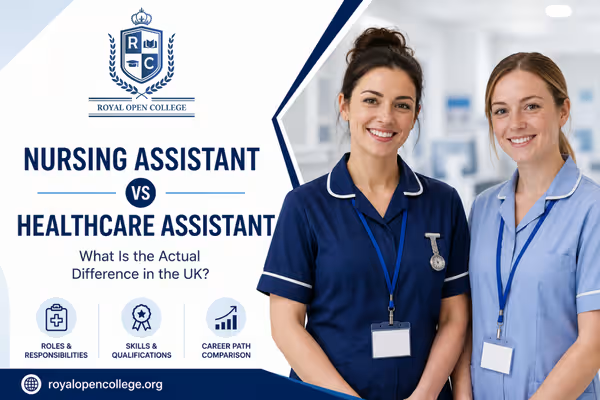



James opens NHS Jobs on a Sunday evening. He finds two posts at the same hospital, on the same ward, with the same shift pattern. One says “Nursing Assistant, Band 3.” The other says “Healthcare Assistant, Band 2.” The duties look almost identical. He spends an hour trying to figure out which one to apply for, and why they have different names at all.
James is not confused. The situation genuinely is unclear, and it has been for years across the UK. This guide gives you the honest answer most pages avoid. It explains what both roles involve, why the titles vary, where real differences appear, and how to plan your career from here.
TL;DR
- Nursing assistant and healthcare assistant usually describe the same unregistered support worker role in the UK
- NHS Health Careers officially lists both as variations of the healthcare support worker title
- Neither title is regulated or protected by law
- The real difference between posts is the NHS band and the duties listed in the advert, not the title
- The Nursing Associate is a separate, NMC-regulated role at Band 4 and is NOT the same as a nursing assistant
- DBS checks are a legal requirement for both roles; the Care Certificate is not
Is There an Official UK Difference Between These Two Roles?
There is no legal or regulatory distinction between a nursing assistant and a healthcare assistant in the UK.
NHS Health Careers, the official NHS careers platform, uses “healthcare support worker” as the umbrella term for both titles. Neither title is regulated by the Nursing and Midwifery Council (NMC). Neither appears on a national professional register. Both sit within what NHS England calls the non-registered workforce.
The CQC regulates the services that employ these workers through the Health and Social Care Act 2008 Regulated Activities Regulations 2014. Regulation 18 on Staffing requires providers to ensure their staff are competent, trained, and supervised. Compliance sits at the service level, not the individual licence level.
It is important to separate law from guidance here:
- Law (legal requirement): DBS checks for roles involving vulnerable adults and children
- Quality and inspection standard (not law): The Care Certificate, expected by CQC during induction
- Employer policy: NVQ qualifications, preferred by many employers but not universally mandated
The Francis Inquiry (2013) and the subsequent Cavendish Review found serious inconsistencies in how healthcare assistants and support workers were trained across England. This led directly to the creation of the Care Certificate in 2015. The RCN has called for formal regulation of all healthcare support workers since that report. As of 2026, no mandatory national register exists.
What Do Both Roles Actually Involve?
Both nursing assistants and healthcare assistants are frontline, unregistered care workers who support patients with personal care, basic clinical observations, and daily needs under the supervision of a Registered Nurse or another qualified professional.
Neither role requires NMC registration. Neither holds a nationally regulated professional title. Both sit within the non-registered workforce and are governed through CQC-regulated services rather than individual professional licences.
The CQC confirms in its GP Mythbuster guidance on healthcare assistants that both roles carry a duty of care and a legal responsibility to patients. The employing organisation holds vicarious liability. Your employer is legally accountable for ensuring you are trained, supervised, and working within your confirmed competence at all times.
The day-to-day work is hands-on, patient-facing, and essential to NHS delivery.
What Tasks Do Both Roles Share?
Regardless of the title on the contract, both roles typically involve:
- Helping patients wash, dress, and move safely using appropriate handling techniques
- Recording observations including temperature, pulse, blood pressure, and respirations
- Supporting patients at mealtimes and monitoring fluid intake
- Maintaining clean patient areas and reporting any supply shortages
- Reporting changes in a patient’s condition to the responsible Registered Nurse
- Providing reassurance and companionship to patients and their families
- Following infection prevention and control procedures on every shift
- Completing accurate care records and documentation after each patient interaction
Practical Example: A Morning on the Ward
At 6:45am, a healthcare assistant arrives on an NHS ward. She attends the nursing handover, helps a patient wash and dress, records temperature and pulse, and notices a change in the patient’s breathing. She reports this to the Registered Nurse immediately. Many NHS trusts would call this exact worker a nursing assistant. The duties are the same. The title depends on the trust.
Why Are There Two Different Job Titles?
The UK has no formal legal or regulatory distinction between a nursing assistant and a healthcare assistant. The title on a job advert reflects employer preference, regional convention, or historical naming, not a nationally defined role difference.
NHS Health Careers, the official NHS careers platform, states directly that healthcare support workers are “sometimes referred to as healthcare assistant, nursing assistant or midwifery assistant, depending on the setting.” This is the authoritative answer to the question most people are asking.
Experienced NHS staff across the UK confirm the same point. The same duties appear under different job titles in different NHS trusts. Some organisations have used “nursing assistant” for decades and never changed it. Others use “healthcare assistant” as the default. Others use “clinical support worker” or “healthcare support worker.” The terms “nursing auxiliary” and “auxiliary nurse” are older names for the same role, still found in some NHS organisations and care homes.
There is no national register for either title. No protected title exists. Every employer sets their own naming convention.
Does the Setting Change the Title Used?
To a limited degree, yes. “Nursing assistant” tends to appear more often in hospital and acute trust settings. “Healthcare assistant” is used more broadly across hospitals, care homes, GP surgeries, and community services. A different title does not mean a different job. The setting shapes the duties. The title does not.
A care home calls the same role a care assistant. A GP surgery calls it an HCA. An acute ward calls it a nursing assistant. The work remains support-level, unregistered, and supervised in all of them.
Where Real Differences Do Appear: Band, Not Title
The genuine difference between support worker posts is not the title. It is the NHS Agenda for Change band assigned to the post.
NHS Agenda for Change (AfC) is the national pay and grading framework covering most NHS staff. Every role is assigned to one of nine bands based on the level of responsibility, required skills, and knowledge. Band 2 and Band 3 are the most relevant for support worker roles.
NHS Employers is clear on the distinction. Band 2 focuses primarily on personal care and direct patient support under close supervision. Band 3 involves a wider range of delegated clinical tasks, performed under the supervision of a registered professional, with greater day-to-day autonomy.
This means a post advertised as “Nursing Assistant, Band 3” carries broader clinical responsibilities than a post advertised as “Healthcare Assistant, Band 2,” even though “nursing” sounds more senior. The band tells you the scope. The title does not.
Progression from Band 2 to Band 3 is NOT automatic. It requires applying for a Band 3 post and demonstrating the required competencies. Time served alone does not move you up a band.
Band 2 vs Band 3: Side-by-Side Comparison
Explore the key differences between NHS Band 2 and Band 3 roles, including responsibilities, supervision levels, salaries, and common job titles.
| Feature | Band 2 | Band 3 |
|---|---|---|
| Primary focus | Personal care and daily living support | Delegated clinical tasks and support |
| Clinical tasks | None expected at entry level | Physiological observations, some procedures |
| Supervision level | Close and direct supervision required | More autonomous, still supervised |
| 2026/27 starting salary (England) | £24,465 per year | £25,760 per year |
| Common job titles | Healthcare assistant, care support worker | Senior HCA, nursing assistant, clinical support worker |
A Real-World Example
Two workers are on the same NHS ward. One is a Band 2 healthcare assistant. The other is a Band 3 nursing assistant. The Band 2 worker helps a patient wash and dress, assists at mealtimes, and makes the bed. The Band 3 worker does all of those tasks and also records blood pressure, temperature, and respirations, then reports structured observations directly to the nurse. Same ward. Different bands. Different titles. Different scope. The band explains the difference. The title does not.
The Role People Often Confuse With Both: Nursing Associate
A Nursing Associate is NOT a nursing assistant. They are two entirely different roles with different registration requirements, different NHS bands, and a different training pathway.
This is the most widespread mistake across every competitor page on this topic.
A nursing assistant is an unregistered support worker. No NMC registration is required. The role is not regulated at the individual level.
A Nursing Associate is a registered professional. They must register with the Nursing and Midwifery Council before working in the role. To become a Nursing Associate, you complete a two-year Foundation Degree-equivalent programme, typically delivered as an apprenticeship. Nursing Associates sit at Band 4 under Agenda for Change, with a 2026/27 starting salary of £28,392 per year.
The Nursing Associate role was created to bridge the gap between the unregistered HCA workforce and Registered Nurses. It is a defined step up, not a variation of the support worker role.
The confusion happens because both job titles contain the word “nursing” and both involve patient care. Some people assume a Nursing Associate is what a nursing assistant becomes after enough experience. That is not correct. A Nursing Associate requires a structured two-year training programme, a formal qualification, and NMC registration before taking up the post at all.
Nursing Assistant vs Nursing Associate: What Is the Difference?
Understand the key differences between a Nursing Assistant (HCA) and a Nursing Associate, including NHS banding, regulation, training requirements, and career progression.
| Feature | Nursing Assistant / HCA | Nursing Associate |
|---|---|---|
| Regulated by NMC? | No | Yes |
| NHS band | 2 or 3 | 4 |
| Training before role starts | Care Certificate during induction | 2-year Foundation Degree programme |
| Registered professional? | No | Yes |
| How they relate | Starting role | Progression route from HCA |
What Qualifications Do You Need to Get Started?
There are no set entry requirements for either role. NHS Health Careers confirms this directly. Most employers expect good literacy and numeracy, and many ask for GCSEs in English and Maths or an equivalent qualification.
Some employers accept relevant care experience in place of formal qualifications. You do not need a degree. You do not need a prior NHS background in most cases.
The Care Certificate (Updated March 2025: Now 16 Standards)
The Care Certificate is the recognised induction standard for healthcare assistants and nursing assistants in England. It was introduced in 2015 following the Francis Inquiry (2013) and the Cavendish Review, which identified serious inconsistencies in how new support workers were trained across health and social care.
In March 2025, the Care Certificate was updated. It now covers 16 standards, not 15. Most websites, including all main competitor pages on this topic, still cite 15 standards. That information is outdated.
The new Standard 16 covers Awareness of Learning Disability and Autism. It was added to align with the Oliver McGowan Mandatory Training requirements under the Health and Care Act 2022. The Care Certificate was developed jointly by Skills for Care, NHS England, and Skills for Health.
16 Care Certificate Standards
Key facts every applicant needs to know:
- The Care Certificate is NOT a legal requirement
- The CQC expects employers to use it as part of induction for new support workers
- Your employer must assess you in the workplace and sign off all 16 standards
- An external training provider cannot sign off your Care Certificate on your employer’s behalf
- The Care Certificate does not appear on the Regulated Qualifications Framework (RQF)
- It is an induction framework, not a formal qualification
DBS checks ARE a legal requirement for both roles because both involve working with vulnerable adults and children. This is a separate legal category from the Care Certificate and must not be treated as the same thing.
NVQ Level 2 and Level 3 in Health and Social Care
These are the most relevant vocational qualifications for both roles. NVQ Level 2 suits entry-level support work. Many employers list it as preferred for Band 2 posts. NVQ Level 3 strengthens Band 3 applications and supports further progression.
NVQs are assessed in the workplace. They appear on the Regulated Qualifications Framework. They are nationally recognised qualifications with formal awarding bodies behind them.
CPD Certificates vs NVQ: What Is the Difference?
Compare CPD Certificates and NVQ Qualifications to understand how they differ in workplace assessment, NHS recognition, qualification status, and job applications.
| Feature | CPD Certificate | NVQ Qualification |
|---|---|---|
| Assessed in the workplace? | No | Yes |
| Listed on the RQF? | No | Yes |
| Recognised by NHS for recruitment? | Personal development only | Yes, for employment |
| Issued by external provider? | Yes | Via regulated awarding body |
| Equivalent to NVQ for job applications? | No | Yes |
Many online training providers provide CPD-accredited courses with descriptions suggesting they qualify you for NHS roles. They do not replace NVQ qualifications for job applications. If a job description asks for “NVQ Level 2 or equivalent,” a CPD online certificate does not meet that requirement.
Where Do These Roles Work?
Both nursing assistants and healthcare assistants work across a wide range of settings in the UK. The NHS Long Term Workforce Plan projects that more than 204,000 new support workers will be needed over the next 15 years, with demand strong across every UK region.
Settings where both roles appear:
- NHS hospital wards including acute, surgical, mental health, and maternity units
- GP surgeries and primary care networks
- Residential and nursing care homes across the private sector
- Community health teams and domiciliary (home-based) care services
- Hospices and palliative care settings
- Private hospitals and independent healthcare providers
- Mental health units and learning disability services
As a general pattern, “nursing assistant” appears more often in hospital and trust-based job postings. “Healthcare assistant” is used more broadly across care homes, GP practices, and community services. Neither pattern is a rule. Read the full job description to understand what each post involves, not just the title.
What Comes Next: Career Progression Routes
Both titles sit on the same career pathway. Your job title does not determine where you go next. Your band, experience, and qualifications do.
The NHS and the RCN have mapped clear development routes for support workers at every stage. NHS England recruited 46,000 healthcare support workers as part of a national programme, and the sector continues to expand structured development pathways through apprenticeships.
From Band 2 to Band 3
Build your competencies, gain experience, and work towards an NVQ Level 2 qualification. Then apply for a Band 3 post when one becomes available. Moving from Band 2 to Band 3 requires applying for and succeeding in a new role. It is not a pay increment that arrives automatically with time served.
From Band 3 to Nursing Associate
The Nursing Associate apprenticeship is the most structured route from support worker to registered professional. You stay employed while you train. The programme runs for two years. You achieve a Level 5 Foundation Degree-equivalent qualification. On completion, you register with the NMC and move to Band 4.
From Nursing Associate to Registered Nurse
Nursing Associates train further to become Registered Nurses through the Nursing Degree Apprenticeship. You work and study at the same time over three to four years. On completion, you qualify as a Registered Nurse and join the NMC register at Band 5.
CAREER PROGRESSION
AT A GLANCE
Healthcare Support Worker to Registered Nurse
Nursing Assistant vs Healthcare Assistant: Which Should You Apply For?
In most cases, you do not need to choose between the two titles. Search for both, and compare posts by band and duties, not by name.
When you search on NHS Jobs, use all four title variations:
- Healthcare Assistant
- Nursing Assistant
- Healthcare Support Worker
- Clinical Support Worker
All four appear within the same role family. Limiting your search to one title means missing posts you are equally qualified and eligible to apply for.
Once you find a post you want, ask these three questions before applying:
- What band is it? The band tells you more about scope and pay than the title does.
- What does a typical shift involve? The duties section in the job description shows exactly what you will do day to day.
- What is the progression route? Some posts have structured development pathways built in. Ask at interview stage if the advert does not make this clear.
Both titles lead to the same career pathway. Both use the same induction standard. Choose the post that matches the setting, band, and duties you want, not the one with the title that sounds more senior.
Summary
- Nursing assistant and healthcare assistant are two names for the same unregistered support worker role in the UK
- NHS Health Careers confirms both titles sit under the healthcare support worker umbrella
- Neither title is regulated or protected by law in England
- The NHS band and job description tell you far more than the title alone
- Band 2 focuses on personal care; Band 3 includes broader delegated clinical tasks under supervision
- Moving from Band 2 to Band 3 requires a new role application, not automatic pay progression
- The Nursing Associate is a separate, NMC-regulated, Band 4 role requiring a two-year programme
- The Care Certificate now covers 16 standards following the March 2025 update, not 15
- The Care Certificate is not a legal requirement; DBS checks are
- Online CPD certificates and NVQ qualifications are not equivalent for job applications
- Both roles lead to the same career pathway: Band 3, Nursing Associate, Registered Nurse
FAQ
Q: Are nursing assistant and healthcare assistant the same job in the UK?
A: In most cases, yes. NHS Health Careers uses "healthcare support worker" as the official umbrella term and lists nursing assistant and healthcare assistant as alternative names for the same role family. The title on a job advert reflects employer preference, regional convention, or NHS trust culture. There is no formal regulatory or legal distinction between the two titles anywhere in UK law or NHS policy.
Q: Is a nursing assistant more senior than a healthcare assistant?
A: Not necessarily. Seniority in the NHS is determined by the Agenda for Change band assigned to the post, not the job title. A Band 3 post with the title "healthcare assistant" carries more clinical responsibility and a higher salary than a Band 2 post with the title "nursing assistant." Always check the band in the job description before assuming one title outranks the other.
Q: What is a Nursing Associate and is it the same as a nursing assistant?
A: No, these are two entirely different roles. A Nursing Associate is a registered professional who must hold NMC registration before working in the post. The role sits at Band 4 and requires a two-year Foundation Degree-equivalent programme to complete. A nursing assistant is unregistered, typically starts at Band 2 or Band 3, and requires no prior formal qualification to apply.
Q: Do you need qualifications to become a healthcare assistant in the UK?
A: No set entry requirements exist for either role, and NHS Health Careers confirms this directly. Most employers expect good literacy and numeracy skills, and some ask for GCSEs in English and Maths or an equivalent. Your employer will support you to complete the Care Certificate during induction. Holding an NVQ Level 2 in Health and Social Care before applying will strengthen your application.
Q: Is the Care Certificate a legal requirement?
A: No. The Care Certificate is a quality and induction standard, not a legal requirement. The CQC expects employers to use it as part of new staff induction, but no law compels you to hold it before starting work. It is also worth knowing that the Care Certificate does not appear on the Regulated Qualifications Framework. DBS checks, by contrast, are a legal requirement for both roles.
Q: What is the difference between Band 2 and Band 3 healthcare support roles?
A: Band 2 focuses on personal care and daily patient support under close, direct supervision. Band 3 involves a broader range of delegated clinical tasks, including physiological observations, carried out with greater autonomy under a registered professional. Moving from Band 2 to Band 3 requires applying for a new post and demonstrating the wider competency set. Time served in a Band 2 post does not trigger an automatic pay uplift.
Q: What is the difference between an online CPD certificate and an NVQ qualification?
A: Yes, and there is a clear, structured pathway to follow. The Nursing Associate apprenticeship is the most accessible route, taking two years to complete and leading to NMC registration at Band 4. From there, the Nursing Degree Apprenticeship allows you to continue training while employed, leading to Registered Nurse status at Band 5. Neither step is automatic, and both require a formal application and employer support.
Q: Can I take a Level 4 course even if my role does not require it?
A: An NVQ is a nationally recognised vocational qualification assessed in the workplace and listed on the Regulated Qualifications Framework. A CPD certificate records personal development from online study but is not workplace-assessed and does not appear on the RQF. The two are not equivalent for NHS job applications. If a job description asks for NVQ Level 2 or equivalent, a CPD online certificate does not meet that requirement.
Q: What is a healthcare support worker in the NHS?
A: It is the official NHS umbrella term for all unregistered frontline support roles, including nursing assistants, healthcare assistants, and clinical support workers. NHS Health Careers uses this term to describe the full range of support posts sitting below Registered Nurse level. All of these roles share the same induction standard, the same career pathway, and the same unregistered status under UK law and NMC regulation.
Q: How long does the Care Certificate take to complete?
A: There is no fixed time limit set by law or national guidance. Your employer leads the assessment process, and completion typically happens within the first six months of starting work. All 16 standards must be met and signed off by your employer before the certificate is awarded. An external training provider can support your learning but cannot sign off or issue the certificate on your employer's behalf.
Q: Is there a national register of healthcare assistants in the UK?
A: No. Neither healthcare assistants nor nursing assistants are registered with a national professional body in England. The RCN has called for formal regulation of all healthcare support workers since the Francis Report in 2013, but no mandatory national register has been introduced. Regulation currently sits at the service level through CQC oversight of the employing organisation, not at the level of the individual worker.