


The term Level 3 covers different types of health and social care course, and that distinction matters more than most course listings make clear. Ofqual-regulated diplomas and CPD-accredited certificates share a level label but operate within entirely different regulatory frameworks.
The Health and Social Care Level 3 Diploma from Royal Open College is CPD-accredited rather than a regulated qualification. This guide covers both course types as they apply in England; the right choice depends on role, employer requirements, and career stage. Different regulatory frameworks apply in Scotland, Wales and Northern Ireland.
Quick Recap
- Ofqual-regulated diplomas and CPD certificates both use the Level 3 label but differ substantially.
- Workplace assessment varies between regulated adult social care qualifications; awarding organisations set the requirements.
- Training requirements depend on role, employer and setting, not a named commercial course alone.
What separates an Ofqual-regulated diploma from a CPD certificate at Level 3?
The core difference is regulatory standing. Ofqual-regulated qualifications are offered by Ofqual-recognised awarding organisations and appear on England’s Regulated Qualifications Framework; CPD-accredited certificates are professional development tools reviewed by independent CPD bodies and issued outside that framework entirely.
The Regulated Qualifications Framework
↻ Hover or tap to read
The Regulated Qualifications Framework is England's national system for classifying qualifications. Ofqual regulates qualifications and the awarding organisations that provide them. Regulated qualifications appear on Ofqual's publicly searchable register, which identifies the qualification number, level, awarding organisation, and Total Qualification Time. Some qualifications also carry a credit value.
CPD-accredited certificates
↻ Hover or tap to read
CPD stands for Continuing Professional Development. A CPD-accredited certificate is normally issued by the training provider for a course reviewed by an independent CPD accreditation body. It is not issued or regulated by Ofqual, and its purpose is to support ongoing professional knowledge rather than confer formal regulatory standing.
Assessment requirements
Regulated Level 3 adult social care qualifications can involve formal assessment, tutor or assessor support, and depending on the specific qualification, a workplace component. Requirements differ between qualifications and awarding organisations. The features of one regulated programme should not be assumed to apply to another.
CPD-accredited courses generally focus on professional knowledge and development. Assessment methods vary and may include online tests, assignments, reflective activities, or other provider-set tasks depending on the course.
Verifying Level 3 regulatory status
A course’s Level 3 label alone is not evidence that it carries Ofqual-regulated status. That must be verified separately before making any commitment.
Is Level 3 always the right starting point in adult social care?
Not automatically. For people new to adult social care in England, Level 3 is not the default entry point within the current Care Workforce Pathway.
Government guidance identifies a new-to-care role category within the pathway. The Level 2 Adult Social Care Certificate is identified as a suggested learning programme for many people beginning in the sector. The appropriate starting point depends on the role, employer, and the learner’s existing experience.
Specific Level 2 Adult Social Care Certificate qualifications are currently listed as eligible under the Adult Social Care Learning and Development Support Scheme. Eligibility depends on the exact qualification, employer, employee and current scheme conditions.
Alongside the qualifications framework, the Care Certificate provides a separate recommended baseline of knowledge, skills, and behaviours for health and adult social care support workers. Its standards were refreshed in 2025 and now comprise 16 standards. The Care Certificate and the Level 2 Adult Social Care Certificate are related but are not the same award.
Some regulated Level 3 adult care qualifications are designed for workers taking on greater autonomy or responsibility. A CPD course carrying a Level 3 label may support more advanced knowledge, but that title alone does not establish occupational level or competence.
Starting Level — Quick Summary
New to care → Level 3 isn’t the default starting point
Level 2 route → Suggested for many new entrants
Funding → Some Level 2 qualifications may be eligible • conditions apply
Care Certificate → Separate baseline • 16 standards
Level 3 → May suit greater autonomy or responsibility • CPD label ≠ competence
How do regulated Level 3 qualifications handle workplace assessment?
Differently, and the difference matters. Requirements depend on the qualification and awarding organisation, so no single rule applies across all regulated Level 3 health and social care programmes.
Workplace assessment in regulated qualifications
Competence-based Level 3 Diplomas in Adult Care assess practical ability by requiring learners to demonstrate occupational competence in a live care setting. Practical outcomes may require direct observation, workplace evidence, and testimony from people with appropriate occupational competence. The exact requirements are set by each awarding organisation’s current qualification specification.
Where a workplace element is required, learners show how they apply knowledge in practice rather than only through knowledge-based assessment. The specification sets out what this involves for each qualification.
How CPD-accredited courses differ
CPD-accredited courses do not normally require a placement or assess occupational competence in a live care setting. They primarily build professional knowledge and awareness, making them accessible to people not yet employed in care.
Before committing to a regulated programme, read the awarding organisation’s qualification specification. It confirms the assessment methods, units, and mandatory practical requirements for that qualification.
What do care employers in England look for?
Training requirements vary by role, service type, and level of responsibility. No single standard applies across every care provider or setting in England.
🧑⚕️
Requirements for different care roles
For staff starting in care, the Care Certificate provides a recommended foundation of knowledge. Employers typically set additional requirements based on the risks linked to the role and the nature of the service they deliver.
For senior, specialist, or supervisory positions, some employers specify a regulated diploma as a minimum requirement. Some eligible Level 3 regulated qualifications may also attract employer funding under the Adult Social Care Learning and Development Support Scheme. Eligibility depends on the specific qualification, employer circumstances, and current scheme conditions, not the Level 3 label alone.
🏛️
What CQC requires from care providers
Employer requirements are also shaped by the wider regulatory framework. Health and social care policy in England sits with the Department of Health and Social Care. The regulatory framework governing registered providers sits with CQC, which under Regulation 18 of the Health and Social Care Act 2008 (Regulated Activities) Regulations 2014 requires providers to have suitably qualified, competent, skilled, and experienced staff alongside appropriate training and development.
CQC does not designate a specific commercial Level 3 course as a universal requirement. Its focus is whether providers can demonstrate that each worker is suitably trained and competent for their role.
How do you check whether a Level 3 health and social care qualification is regulated?
The most reliable step is to search Ofqual’s register of regulated qualifications. Every qualification regulated by Ofqual in England is listed there with its number, level, awarding organisation, and Total Qualification Time. If a course does not appear on that register, it is not an Ofqual-regulated qualification.
The awarding organisation’s published qualification specification adds further detail. This document covers units, assessment methods, and any mandatory requirements such as workplace evidence, and is usually available directly from the awarding organisation’s website.
By contrast, CPD bodies operate separately from Ofqual. The accreditation they award reflects their own assessment of course quality, not a regulatory designation from a statutory body. Treating CPD accreditation as equivalent to Ofqual regulation leads to confusion about what a certificate actually represents.
Some providers use Level 3 in course titles or marketing without the course appearing on the RQF. A quick register search removes that ambiguity before any financial commitment is made.
What should you ask before enrolling on a Level 3 health and social care course online?
Start by confirming what the target role requires. Training expectations vary by care setting, job level and employer. Checking before enrolment helps avoid choosing an unsuitable course.
Does the employer require an Ofqual-regulated qualification, or will a CPD certificate meet the role’s requirements?
If the course includes a workplace element, is access to a suitable England-based care setting confirmed before enrolment?
Is the qualification eligible under the Adult Social Care Learning and Development Support Scheme, and are the employer and employee eligible?
What are the assessment, tutor support and completion requirements, and will they fit around existing commitments?
Does “Level 3” indicate an RQF-regulated level or simply the provider’s course label?
Those answers also shape how realistic the timeline is. Online delivery can make both course types more manageable alongside shift patterns, but regulated programmes may still involve assessor scheduling, submission deadlines, or workplace coordination that affects the overall timetable.
What are the most common mistakes when comparing Level 3 health and social care courses?
Provider marketing rarely explains what the Level 3 label actually means in regulatory terms. For learners who invest time and money in a course that does not match their employer’s requirement or career stage, that gap has real practical consequences.
⚖️ Assuming all Level 3 courses carry equal employer weight
Both types use the same level label but differ significantly in regulatory standing and how care employers assess them during recruitment and staff development.
🏷️ Treating CPD accreditation as equivalent to Ofqual regulation
A CPD certificate is not an Ofqual-registered diploma. Some employers accept CPD evidence for certain roles; others specify a regulated qualification. Confirming this before enrolment prevents a costly error.
📜 Assuming a certificate confirms workplace competence
Online knowledge-based learning builds professional understanding but does not assess how someone performs in a live care environment. Competence is judged by employers and supervisors, and in regulated programmes, by qualified workplace assessors.
📋 Overlooking the specific assessment requirements of the chosen qualification
Not all regulated Level 3 programmes have identical structures. A workplace element that could prevent completion can only be identified by reading the qualification specification before enrolment.
🪜 Skipping the Level 2 pathway
For people new to adult social care, Level 3 may not be the appropriate starting point for their current role or level of experience. The Level 2 Adult Social Care Certificate is identified as a suggested learning programme for many people entering the sector.
Studying through Royal Open College (CPD learning)
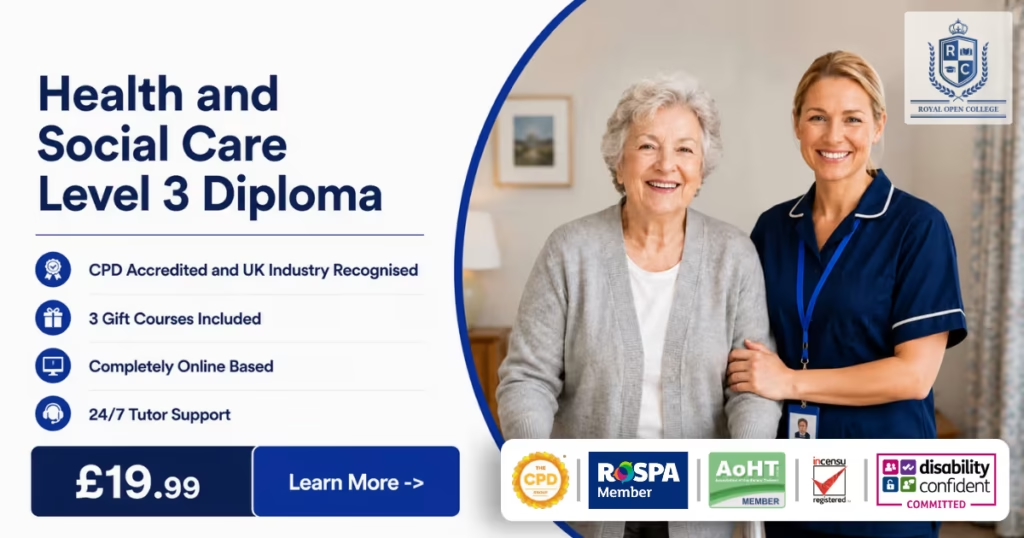
Royal Open College offers the Health and Social Care Level 3 Diploma as a CPD-accredited online course. Modules address care planning, safeguarding, person-centred care, infection prevention, mental health, medication administration, communication, and legal and ethical responsibilities.
The course is self-paced with a multiple-choice exam, instant results, and free retakes. Successful learners can order a CPD-accredited certificate.
No prior qualifications are required to enrol. The course suits people preparing to enter health and social care, existing care workers refreshing knowledge in specific topic areas, and those who need documented evidence of continuing professional development for an employer or professional portfolio.
However, this course is not on the Regulated Qualifications Framework and is not regulated by Ofqual. Learners who need an Ofqual-regulated Level 3 qualification should identify a programme on the RQF and confirm its full requirements before enrolling.
Before choosing any Level 3 health and social care course online, confirm what your role and employer actually require. That single check determines which course type genuinely fits your situation.