




🌷Spring Sale! Get any Course for £11.99 Only!
Offer ends soon! 00 : 00 : 00
Use Coupon Code 👇
SPRING98
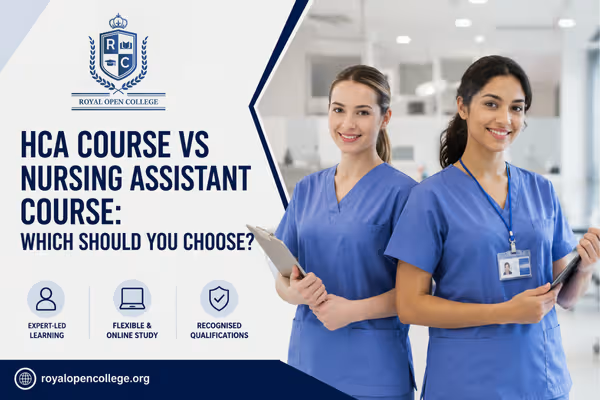
HCA Course vs Nursing Assistant Course: Which Should You Choose?

HCA Course vs Nursing Assistant Course: Which Should You Choose?

Two courses. Similar price. Different titles. Before you spend money on either, read this. In the UK, HCA courses and nursing assistant courses lead to the same role. What NHS employers check is the qualification type behind the course, not the name on the listing. This guide explains the difference between regulated and unregulated qualifications, what the Care Certificate actually

Two course listings. Same price range. Near-identical descriptions. One says HCA course. The other says nursing assistant course. Neither listing explains the real difference between them.

Here is the answer: both lead to the same entry-level healthcare support worker role in the UK. The title on the course listing is not the decision. The qualification behind the listing is.

This guide walks you through what qualification type NHS employers look for, what the Care Certificate actually is, and which course choice fits your specific career goal.

TL;DR: Key Facts Before You Read On

  • In the UK, HCA courses and nursing assistant courses lead to the same unregistered support worker role
  • The qualification type behind the course matters more than the name on the listing
  • A regulated RQF diploma carries more employer recognition than an unregulated CPD certificate
  • The Care Certificate is not a course you buy. Your employer assesses you against 16 workplace standards during induction.
  • DBS checks are a legal requirement for both roles. The Care Certificate is not.
  • NVQ qualifications have been replaced by RQF-regulated diplomas. NHS employers accept both terms.
  • A Nursing Associate is a separate NMC-registered role at Band 4. Neither course leads there without a separate two-year programme.
  • The NHS Healthcare Support Worker Apprenticeship is employer-funded. You earn a salary while you train.
Are These Two Courses Actually DifferAent?

Are These Two Courses Actually DifferAent?

 In the UK, HCA courses and nursing assistant courses cover the same core content and lead to the same unregistered support worker role. NHS Health Careers, the official NHS careers platform, lists both as naming variations of the healthcare support worker title. There is no formal regulatory or legal distinction between the two terms anywhere in UK law or NHS policy.

The same role appears in job listings under several different names depending on the employer, trust, and region:

🏥 Healthcare assistant (HCA)
🩺 Nursing assistant
💙 Healthcare support worker (HCSW)
📋 Clinical support worker
🤝 Nursing auxiliary
👨‍⚕️ Auxiliary nurse

Neither title is legally protected. Neither requires registration with the Nursing and Midwifery Council (NMC), the body responsible for registering nurses and nursing associates in the UK. Both sit within what NHS England describes as the non-registered workforce.

The takeaway for anyone choosing a course is straightforward. Stop comparing course titles. Focus on the qualification the course leads to instead.

Why Different Titles?

Training providers choose course titles based on search behaviour and target audience, not regulated role definitions. “Nursing assistant course” attracts learners interested in hospital and ward-based work. “HCA course” attracts a broader audience across NHS, care home, and community settings.

A provider listing a Nursing Assistant Level 3 Diploma is not offering something formally different from a Healthcare Assistant Level 3 Diploma. The title is a marketing choice. Check the awarding body, the qualification level, and the RQF registration status before making any decision about where to enrol.

What to Look for in a Course Before You Enrol

Before buying any HCA or nursing assistant course, check three things. First, check whether the qualification is on the Regulated Qualifications Framework. Second, confirm which awarding body issues the certificate. Third, find out whether the course includes a workplace assessment component.

The Regulated Qualifications Framework, or RQF, is a national register of qualifications regulated by Ofqual. NHS trusts and care employers use the RQF when assessing whether a candidate’s qualification meets their person specification. A qualification on the RQF carries formal recognition across England. A CPD certificate does not.

Regulated Qualifications vs CPD Certificates: What Is the Difference?

Feature
RQF-Regulated Qualification
CPD Certificate
Regulated by Ofqual
✓ Yes
✕ No
Listed on the national qualification register
✓ Yes
✕ No
Workplace assessment required
✓ Yes
✕ No
Issued by a regulated awarding body
✓ Yes (NCFE CACHE, Highfield, Pearson)
✕ No (private provider)
Meets "NVQ Level 2 or equivalent" in job descriptions
✓ Yes
✕ No, in most cases
Useful for personal development
✓ Yes
✓ Yes

VQ qualifications have been replaced by RQF-regulated diplomas. The current equivalent of NVQ Level 2 is the Level 2 Diploma in Care (RQF). The current equivalent of NVQ Level 3 is the Level 3 Diploma in Adult Care (RQF). NHS employers still use the NVQ wording in older job descriptions, and RQF-regulated diplomas meet this requirement directly.

Here is a practical example. You apply for a Band 2 NHS healthcare assistant post. The job description states: “NVQ Level 2 in Health and Social Care or equivalent, desirable.” You hold a CPD-accredited online diploma. Most NHS shortlisting panels will not treat a CPD certificate as equivalent to an NVQ or RQF diploma. A learner holding an RQF Level 2 Diploma from NCFE CACHE or Highfield has a stronger application at shortlisting stage.

Four Questions to Ask Before You Buy a Course

?
1. Is the qualification Ofqual-regulated and listed on the RQF? Ask for the qualification reference number.
2. Which awarding body will issue the certificate? Look for NCFE CACHE, Highfield, Pearson, or City and Guilds.
3. Does the course include workplace assessment, or is the learning theory-only? Theory-only delivery does not produce a full RQF diploma.
4. What does the certificate say on the face of it? Does the document name the qualification title, level, and awarding body?
A provider unable to answer all four questions with specific, verifiable details warrants serious caution before you commit any money.

Does the Course Title Affect Which Jobs You Can Apply For?

The course title does not affect which NHS jobs you can apply for. The qualification type and level behind the course does.

A course leading to RQF Level 2 in Health and Social Care strengthens applications for NHS Band 2 posts. A course leading to RQF Level 3 strengthens applications for Band 3 posts. A CPD-only course strengthens neither in NHS recruitment terms.

What Does Band 2 and Band 3 Mean When You Are Choosing a Course?

NHS Agenda for Change is the NHS pay framework that assigns a band to each role based on its responsibilities. Healthcare assistants and nursing assistants typically sit at Band 2 or Band 3.

Band 2
£25,272 per year

Personal care and daily support under direct supervision

RQF Level 2 or equivalent
Band 3
£25,760 per year

Broader delegated clinical tasks with more autonomy

RQF Level 3 preferred
Band 4
£28,392 per year

Nursing Associate, assistant practitioner

Separate two-year programme required
Source: NHS Employers, Agenda for Change pay scales, effective 1 April 2026.

Moving from Band 2 to Band 3 requires applying for a Band 3 post and demonstrating the required competencies. Time served alone does not move you up a band. Completing an RQF Level 3 qualification strengthens a Band 3 application. The qualification alone does not guarantee a Band 3 role.

If NHS employment is your goal, choose a course leading to an RQF-regulated qualification. A CPD certificate alone is not the right tool for this purpose.

What Is the Care Certificate and Should You Buy a Course for It?

The Care Certificate is a set of 16 workplace standards your employer assesses you against during induction. This is not a course you purchase before starting a job. You complete the standards on the job. A competent assessor from your employing organisation observes you in practice and signs off each standard.

Many training providers sell “Care Certificate courses” online. These products are preparation resources and study aids. Completing an online Care Certificate preparation course does not mean you have completed the Care Certificate. Your employer must carry out the full assessment. An external training provider cannot sign off the standards on your employer’s behalf.

The Care Certificate was introduced in 2015 following the 2013 Francis Inquiry and the Cavendish Review, both of which identified serious inconsistencies in how new healthcare workers were trained across England. Skills for Care, Skills for Health, and NHS England developed the framework jointly to establish a consistent national baseline for new starters in health and social care.

Is the Care Certificate a Legal Requirement?

The Care Certificate is NOT a legal requirement. DBS (Disclosure and Barring Service) checks ARE a legal requirement for roles involving vulnerable adults and children. These are two separate obligations from two separate categories of law. Do not treat them as the same thing.

The Care Quality Commission (CQC) expects employers to use the Care Certificate as an induction standard under Regulation 18 of the Health and Social Care Act 2008 (Regulated Activities) Regulations 2014. This is a CQC inspection expectation embedded in employer obligations. The Care Certificate is not a statute passed by Parliament.

What Are the 16 Care Certificate Standards?

The Care Certificate was updated in March 2025 from 15 to 16 standards. Any provider or online page still citing 15 standards is out of date.

The 16 Care Certificate standards are:

01–04
  • Understand your role
  • Your personal development
  • Duty of care
  • Equality, diversity, inclusion and human rights
05–08
  • Work in a person-centred way
  • Communication
  • Privacy and dignity
  • Fluids and nutrition
09–12
  • Awareness of mental health, dementia and learning disability
  • Safeguarding adults
  • Safeguarding children
  • Basic life support
13–16
  • Health and safety
  • Handling information
  • Infection prevention and control
  • Awareness of learning disability and autism (added March 2025)

Standard 16 was added under the Oliver McGowan Mandatory Training requirements set out in the Health and Care Act 2022. Assessment of all 16 standards requires face-to-face observation and documented sign-off by a competent assessor within your employing organisation. An automated online certificate does not count as completing the Care Certificate.

Should You Choose an Online Course or a Workplace-Based Qualification?

The question is not whether a course is online or in person. The question is whether the course leads to an RQF-regulated qualification with a workplace assessment component or only to a CPD certificate.

Online study works well for the theory part of an RQF-regulated diploma. You complete written units, case studies, and assignments at your own pace. A qualified assessor then observes you in your workplace and confirms competence against each unit. Both theory and workplace observation are required for the full regulated qualification. Theory alone does not complete an NVQ or RQF diploma.

A standalone online CPD course delivers theory only. There is no assessor observation, no workplace sign-off, and no Ofqual-regulated outcome. This type of course has genuine value as background learning before you start a role. The certificate produced does not carry the same weight with NHS employers as an RQF-regulated diploma when both are placed side by side in a job application.

What About the NHS Healthcare Support Worker Apprenticeship?

The NHS Healthcare Support Worker Apprenticeship is a Level 2 programme where your employer funds the full training cost. You earn a salary from day one. From August 2025, the minimum programme duration was reduced to eight months following a Department for Education reform. The Growth and Skills Levy, which replaced the Apprenticeship Levy in April 2025, gives NHS employers greater flexibility to fund these programmes.

Key benefits of the apprenticeship route:

  • No course fees for the learner
  • Regulated qualification as the outcome
  • Real NHS induction experience from your first week
  • Clear progression pathway toward Band 3, Nursing Associate, or assistant practitioner roles

Career Progression Pathway

NHS band pathway
Entry Level
Band 2: Healthcare Assistant or Nursing Assistant
Care Certificate completed during induction. DBS check required by law.
With RQF Level 3 qualification
Band 3
Senior HCA or Nursing Assistant
Broader delegated clinical tasks, greater autonomy
Three routes forward from Band 3
Route A
Nursing Associate Apprenticeship
Duration2 years
Pay while trainingBand 3
Band on completionBand 4
NMC registeredYes
Qualification outcomeLevel 5 Foundation Degree equivalent
Next step availableShortened Nursing Degree Apprenticeship
Route B
Assistant Practitioner Programme
Duration18 to 24 months
Pay while trainingBand 3
Band on completionBand 4
NMC registeredNo
Qualification outcomeFoundation Degree
Next step availableNursing Associate or degree route
Route C
Nursing Degree Apprenticeship
Duration3 to 4 years
Pay while trainingPaid throughout
Band on completionBand 5
NMC registeredYes
Qualification outcomeBSc (Hons) in Nursing
Next step availableRegistered Nurse at Band 5

What If Your Goal Is to Become a Nursing Associate?

Neither an HCA course nor a nursing assistant course leads directly to the Nursing Associate role. A Nursing Associate is a separate NMC-registered professional. The confusion between the two is one of the most widespread mistakes in this area, and choosing a course based on a misunderstanding of the Nursing Associate role leads to wasted time and money.

Feature Healthcare Assistant or Nursing Assistant Nursing Associate
NMC registered No Yes
NHS band Band 2 or 3 Band 4 (Band 3 while training)
Training before starting the role Care Certificate during induction Two-year Foundation Degree programme
How to apply Apply on NHS Jobs directly Apply via employer or NHS trust for the apprenticeship programme
Starting salary 2026/27 £25,272 (Band 2) £28,392 (Band 4)
Source: NHS Employers, Agenda for Change pay scales, effective 1 April 2026.

The Nursing Associate role was created to bridge the gap between unregistered support workers and Registered Nurses. Completing an HCA or nursing assistant course gives you a strong foundation to start your healthcare career. Moving into the Nursing Associate role requires a separate two-year application and training process.

The RCN career pathway resource and the NMC programme search both provide full details of approved Nursing Associate training providers. If the Nursing Associate role is your goal, speak to your employer or a local NHS trust about the Nursing Associate Apprenticeship route before investing in any standalone course.

Which Course Should You Choose?

The course title matters less than the qualification behind the listing. Base your choice on your employment goal, not the name on the course page. Here are three clear decision scenarios to guide your thinking.

Decision Scenarios: Match Your Goal to the Right Course

Scenario 1: You Want NHS Band 2 Posts

Your priority is a course leading to RQF Level 2 in Health and Social Care, formally listed as the Level 2 Diploma in Care (RQF). Awarding bodies to look for include NCFE CACHE, Highfield, and Pearson. Alternatively, apply directly for an NHS Healthcare Support Worker Apprenticeship at Level 2, which costs you nothing and produces a regulated qualification. A CPD-only online diploma is not the right tool for this employment goal.

Scenario 2: You Want to Strengthen Your CV for Band 3 Roles

Choose a course leading to RQF Level 3 in Health and Social Care, formally listed as the Level 3 Diploma in Adult Care (RQF). This qualification strengthens Band 3 applications and signals a commitment to professional development. Completing RQF Level 3 does not guarantee a Band 3 post, but the qualification puts you in a stronger position at shortlisting.

Scenario 3: You Want to Progress Toward Nursing Associate

Start with an RQF-qualified HCA or nursing assistant role to build real workplace experience. Once employed, apply separately for a Nursing Associate programme through your employer or NHS trust. An online CPD course does not prepare you for this pathway. The starting point for Nursing Associate progression is a supported employer application, not a standalone training purchase.

Before You Enrol: A Quick Checklist

Confirm the following before paying for any course:

The qualification is Ofqual-regulated and appears on the RQF
The awarding body is named (NCFE CACHE, Highfield, or Pearson are the most common)
The course includes a workplace assessment component for RQF-level qualifications
The certificate face clearly states the qualification title and level
The provider confirms the qualification meets NHS person specification requirements for the band you are targeting

Summary and Next Steps

The course title is a marketing label. The qualification behind the course is what NHS employers check at shortlisting. Before enrolling in any course, confirm the qualification is Ofqual-regulated and listed on the RQF, identify the awarding body by name, and check whether workplace assessment is included in the programme.

If funding is a concern, explore the NHS Healthcare Support Worker Apprenticeship through NHS Jobs or gov.uk/apply-apprenticeship before paying for a standalone course. If you are ready to search for RQF-regulated options, look for Level 2 or Level 3 Diploma in Care (RQF) courses from NCFE CACHE, Highfield, or Pearson, or speak directly to your local NHS trust about employer-funded training routes.

What To Next

The course title is a marketing label. The qualification behind the course is what NHS employers check at shortlisting. Before enrolling in any course, confirm the qualification is Ofqual-regulated and listed on the RQF, identify the awarding body by name, and check whether workplace assessment is included in the programme.

If funding is a concern, explore the NHS Healthcare Support Worker Apprenticeship through NHS Jobs or gov.uk/apply-apprenticeship before paying for a standalone course. If you are ready to search for RQF-regulated options, look for Level 2 or Level 3 Diploma in Care (RQF) courses from NCFE CACHE, Highfield, or Pearson, or speak directly to your local NHS trust about employer-funded training routes.

FAQ

Are HCA courses and nursing assistant courses the same thing?

Yes. Both cover the same core content and lead to the same unregistered support worker role in the UK. The title reflects provider preference and regional naming conventions, not a qualification distinction. NHS Health Careers confirms both fall under the healthcare support worker umbrella.

No. The qualification type the course leads to is what NHS shortlisting panels assess. Whether the course produces an RQF-regulated qualification or a CPD certificate is the distinction employers care about. The course name carries no formal weight in NHS recruitment.

CPD certificates show completion of a study programme and have genuine personal development value. They do not replace RQF-regulated qualifications when a job description asks for NVQ Level 2 or equivalent. Always check the person specification before enrolling.

No. The Care Certificate is completed in the workplace during induction, and your employer assesses you against 16 standards through observed practice. An external training provider cannot sign off these standards on your employer's behalf.

The Care Certificate covers 16 standards following the March 2025 update by Skills for Care, Skills for Health, and the Department of Health and Social Care. Most online pages and providers still cite 15 standards, which is now out of date. Standard 16 covers Awareness of Learning Disability and Autism.

Choose a course leading to an RQF-regulated qualification at Level 2 or Level 3 in Health and Social Care. The NHS Healthcare Support Worker Apprenticeship is also a strong route, as the employer funds the full training cost and you gain a regulated qualification while earning.

No. A Nursing Associate requires a separate two-year Foundation Degree programme and NMC registration before taking up the Band 4 role. Neither an HCA course nor a nursing assistant course leads to the Nursing Associate role without this additional process.

NVQ qualifications, now replaced by RQF-regulated diplomas, are assessed in the workplace by a qualified assessor and issued by regulated awarding bodies such as NCFE CACHE, Highfield, and Pearson. CPD certificates are issued by private providers, are not on the RQF, and are not equivalent to NVQ qualifications for NHS job applications.

Yes. The NHS Healthcare Support Worker Apprenticeship is employer-funded, meaning no course fees for the learner. You earn a salary while training and receive a regulated qualification on completion. Visit gov.uk/apply-apprenticeship to search for current vacancies near you.

No formal entry requirements are nationally mandated for either role. Most employers and course providers prefer GCSE-level English and Maths or functional skills equivalents. Previous care experience is helpful but not a formal requirement in most cases.

No. CNA stands for Certified Nursing Assistant and is a US qualification title. CNA does not exist as a protected or recognised credential in the UK. The equivalent UK roles are healthcare assistant and healthcare support worker. If you see a provider advertising a "CNA course" in the UK, treat this with caution and ask what qualification the course actually leads to.

Recent Blogs

What Does a Safeguarding Level 4 Certificate Cover?

What Does a Safeguarding Level 4 Certificate Cover?

A Safeguarding Level 4 Certificate is built for practitioners in designated or lead roles. The certificate covers complex abuse recognition, the LADO process, multi-agency working, supervision, and adult safeguarding under the Care Act 2014. Aligned with Working Together to Safeguard Children 2026, this guide breaks down every topic area, who needs the certificate, and what you learn to do.

How Long Does a Nursing Assistant Course Take in the UK?

How Long Does a Nursing Assistant Course Take in the UK?

Nursing assistant training in the UK ranges from a few hours to 18 months. The right route depends on whether you are employed, how your training is funded, and what qualification you need. This guide maps every real UK pathway with honest timelines, updated Care Certificate information for 2025, and practical guidance on choosing the route that works for you.

How Long Does Safeguarding Level 4 Training Take Duration, Format and Renewal

How Long Does Safeguarding Level 4 Training Take? | Duration, Format and Renewal

Level 4 safeguarding training takes 1 to 2 days in instructor-led settings or 7 to 40 hours online. The intercollegiate framework, not commercial providers, sets the standard for named professionals. This guide covers how duration varies by format, why the 3-year renewal figure is accurate, and what to check with your ICB before booking. Built on ICD 2025 and RCN Adults ICD 2024.