
Who comes? Ask for named carers.
What to check
Ask the Agency
Who will visit, and how do you handle a change of carer?
Good SignNamed carers, an introduction before a new carer starts and a way to tell family








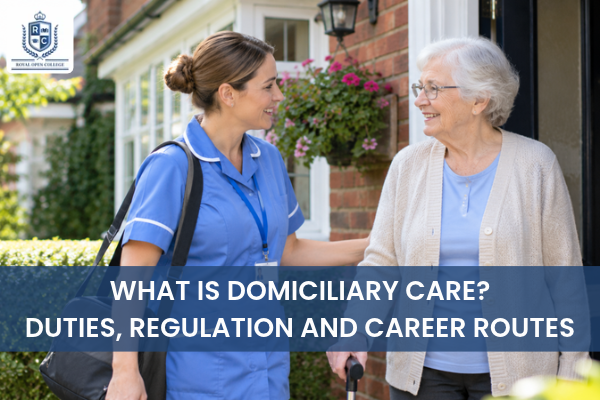
Domiciliary care is professional care in your own home. Trained care workers visit at agreed times and help with tasks such as washing, dressing, meals and medicines reminders.
A written care plan sets out each visit. Regulation differs across England, Scotland, Wales and Northern Ireland, so the rules you rely on depend on where you live. Home help, which covers housework only, is a separate service.
Read on to see what carers do on a visit, how UK regulation works, how to arrange care and where a care career leads. You also get four questions to ask any provider or employer.
Many people drawn to home care start by learning how care plans, records and safe moving and handling fit into a visit. Royal Open College offers the Domiciliary Care Support Worker course for this. You study online at your own pace with no prior experience, and the course is CPD-accredited.

Domiciliary care is paid care and support in your own home, delivered in agreed visits by trained care workers. The NHS homecare guide describes this as help with daily tasks at home from a paid carer, so you keep your independence.
A typical package might include a morning visit for washing and breakfast, a lunchtime meal visit and a bedtime visit. The care plan sets the number and length of visits. Adults of every age use the service, including older people, disabled adults and people recovering after illness.
The word comes from the Latin domicilium, meaning home. You will also see home care, homecare and visiting care, which usually mean the same service. The CQC calls providers homecare agencies, also called domiciliary care agencies. A care plan is the written record of your needs and the help agreed.
Domiciliary care usually includes personal care, which means help with washing, eating and using the toilet, plus:
Domiciliary care does not usually include:
In most UK usage, domiciliary care and home care mean the same thing, but agencies define the terms differently. Read the care plan, not the label. Four services often get mixed up, so this list shows where each one happens and what to ask.
Visiting care has limits. Ask for a care plan review when you notice falls, missed meals, confusion about medicines or a carer raising new concerns. Someone who needs supervision through the night, or nursing care several times a day, might need a different service.
A visiting carer follows your care plan, helps with tasks such as washing, dressing, meals and medicine reminders, then records the visit. The plan sets the help agreed, so each visit follows the same pattern. Good agencies update the plan when your needs change.

Agencies run visits in different ways. This example shows a morning visit with an unnamed client. Length depends on the care plan, and no standard visit time exists. Use the five steps to judge what a good visit looks like in your own home.
Step 5 includes reporting worries, and safeguarding concerns follow the same rule: record facts and report them. To learn what counts as a concern, try Royal Open College’s Safeguarding Decision Tree. This tool does not replace your employer’s procedures or the emergency services.
Needs help to wash and dress because of reduced mobility.
Carer helps with a wash at the sink, lays out clothes and checks skin for sore areas.
Morning visit, with an agreed window and planned length.
Carer notes what was done and any change in mood, appetite or movement.
Medicines support covers three different jobs. The CQC guidance on managing medicines for home care providers says carers give this support only when the care plan records the task and only with the right training. Ask which job your plan includes.
Link every visit to the Visit Check: who comes, when, how long and what gets recorded. These four questions cover the problems families raise often. Section 6 turns them into a table you take to your agency or council.
In England, a provider delivering personal care must register with the Care Quality Commission, and the other UK nations have their own regulators. The CQC personal care registration sets out who must register. Inspectors rate services Outstanding, Good, Requires improvement or Inadequate.
Registration has exemptions. Introductory or employment agencies, which only introduce you to a carer, fall outside it. Care workers acting as individuals are also outside registration. Never assume every agency is registered. Check the provider on the regulator’s website before you sign anything.
| Nation | Regulator of the Service | Worker Register (Check Locally) |
|---|---|---|
| England | Care Quality Commission | No national register |
| Scotland | Care Inspectorate | Scottish Social Services Council |
| Wales | Care Inspectorate Wales | Social Care Wales |
| Northern Ireland | RQIA | Northern Ireland Social Care Council |
Check the date of the rating. A Homecare Association analysis found only 29.7% of homecare locations in England held an up-to-date CQC rating in August 2025. CQC data from 2024 put 86% of rated homecare services at Good or Outstanding, so a rating means less when it is years old.
Regulated does not mean perfect. The CQC asks five questions of every service: safe, effective, caring, responsive and well-led. Read the report for all five, and check what inspectors found at the time.
In England, you ask your council for a free care needs assessment or arrange care yourself, and who pays depends on that assessment and a financial assessment. The steps below describe England. Scotland, Wales and Northern Ireland differ, so check locally.
Ask your council for a care needs assessment
The council checks whether your needs meet national eligibility rules
A financial assessment shows what you might pay
Choose a provider or take direct payments
Review the plan when your needs change
You might pay privately at any time. Ask for the assessment anyway, because the council must give advice even when you pay for your own care.
The council checks three conditions before looking at your money. All three must apply.
The listed outcomes cover eating and drinking, personal hygiene, using the toilet, getting dressed, keeping your home safe and clean, relationships, work or learning, community access and caring duties. The Care Act 2014 and the Care and Support (Eligibility Criteria) Regulations 2015 set these rules.
If your needs do not meet the rules, ask for the decision in writing with advice on other support. Before the assessment call, write down:
After eligibility, a financial assessment shows what you might pay, and the council might fund part or all of the cost after a means test. Direct payments let you arrange care yourself, which makes you an employer with legal duties.
Disability benefits such as Attendance Allowance and Personal Independence Payment are not means-tested. Rules differ by nation, so check locally.
The NHS guide gives a range of £15 to £30 an hour, last reviewed in January 2024. Newer published averages reach higher figures and vary by area, visit length and time of day. Ask any agency for a written quote and a list of extra charges.
Example only: four 30-minute visits a day at £30 an hour costs £60 a day or £420 a week.
Scotland provides free personal care at home for adults the council assesses as needing this service. English councils offer free reablement for up to six weeks after hospital. The October 2026 Budget announced plans for a National Care Service for England with free personal care and no start date.

Check the provider’s CQC registration and latest report, then ask four questions about every visit: who comes, when, how long and what gets recorded. The Visit Check turns these questions into a short list. Take the list to the assessment call.
Use this table when you compare providers or review your own care. The good signs reflect how the CQC describes good home care. Write the answers down and compare them across providers. Differences between agencies often show up in the answers.
Who comes? Ask for named carers.
Who will visit, and how do you handle a change of carer?
Good SignNamed carers, an introduction before a new carer starts and a way to tell family
When? Ask for a time window and a late-call rule.
What is the visit window, and what happens if the carer runs late?
Good SignA set time window, a call when a carer runs late and a backup plan
How long? Ask for the visit length in your care plan.
How long is each visit, and how does the plan record this?
Good SignVisit length matches the care plan, with no routine shortening
What is recorded? Ask who reads the notes.
How do carers record visits and who reads the notes?
Good SignNotes after every visit and a manager who reviews them
Check visit length against official guidance. Care Act statutory guidance says visits of 15 minutes or less are not appropriate for people who need intimate care, such as washing or using the toilet. Ask the council and agency how they set visit times.
Ombudsman decisions show the same faults again and again: late, short and missed visits, many different carers and thin records. Keep your own notes. Write the date, the planned time, the real arrival time and what the carer did or missed. Notes give your complaint evidence.
Call 999 or ask a neighbour or relative to check in
Ask for a new arrival time and the reason, in writing
In England, complain first to the agency or, if the council arranges your care, to the council. Ask for a written reply. If the answer does not help, go to the Local Government and Social Care Ombudsman, which covers self-funded care too. Other nations have their own ombudsmen.
Tell the CQC about your experience as well. If someone is at immediate risk, call 999. For other safeguarding concerns, contact the council’s adult safeguarding team. You might have a right to an independent advocate if you find assessments hard and have no one to help.
Domiciliary care work means travelling between people’s homes and helping them, often on your own. Employers set the entry requirements, so ask each one what they require. Demand is high. Domiciliary care had a vacancy rate of about 9.1% in 2025/26, against 6.2% across adult social care.
Most employers ask for a DBS check, proof of the right to work and an induction. Some roles need a driving licence. Rural rounds often need a car, while many urban providers use walking rounds, so ask before you apply. A degree is usually not required.
The Care Certificate has 16 standards since March 2025. Employers assess you on knowledge and on real workplace practice, so the employer leads this process. Skills for Health and NHS England publish the standards. A separate Level 2 Adult Social Care Certificate is an Ofqual-regulated qualification.
Registration depends on the nation. Scottish support workers in care at home services must register with the SSSC within six months of starting. Wales and Northern Ireland also run worker registers, and England has none. Check your nation’s rules before you start.
Before you apply, test your readiness. Royal Open College’s Nursing Assistant Career Readiness Checker covers care support roles through some scenario questions and returns a report with next steps. The report does not promise a job, and employers still set their own checks.
Rotas follow the day. Morning visits help people wash, dress and eat breakfast. Lunch and tea visits cover meals and medicines reminders. Evening visits help people get ready for bed. A shift often holds several visits in a row, with short travel gaps between them.
The work has hard parts: lone working, weather, tight travel gaps and emotional strain. The work also has rewards. A 2025 Wellbeing Survey of more than 2,000 care workers found 87% feel they make a real difference to the people they help (The Care Workers’ Charity).
GOV.UK guidance says care workers must receive at least the minimum wage for time at appointments plus travel between them. Travel from home to the first visit does not count. Ask how the employer pays travel and what the rota allows.
Pay varies by employer, so compare the hourly rate, travel pay and guaranteed hours.
Skills for Care lists training, a relevant qualification and a contract without zero hours among five factors affecting turnover.
Ask each employer about all three before you accept an offer. Their answers show how much help new carers get.
England also plans a Fair Pay Agreement for adult social care. The Employment Rights Act 2025 allows a negotiating body of employers and unions to agree pay and conditions. Talks are due from April 2027, so check GOV.UK for updates.
Progression often runs from care worker to senior carer, supervisor, coordinator and registered manager. A registered manager is the person the CQC registers to run the service day to day. Employers choose their own routes, so ask about training and promotion at interview.
Write down your four Visit Check questions before the assessment call: who comes, when, how long and what gets recorded. If you plan to work in the role, ask each employer about induction, travel pay and records too.
If you want to learn how care plans, records and safe moving and handling fit into a visit, explore Royal Open College’s Domiciliary Care Support Worker course. The course is a CPD course, not an Ofqual-regulated qualification, and does not replace employer induction or the Care Certificate.
A: Personal care at home is free in Scotland for adults assessed as needing it. England, Wales and Northern Ireland use different charging rules, and English councils might charge after a financial assessment. NHS Continuing Healthcare and short-term care after hospital are separate routes with their own eligibility.
A: Domiciliary care is social care, which councils and private agencies arrange. The NHS pays only in specific cases, such as NHS Continuing Healthcare. The NHS also runs short-term recovery services after hospital.
A: Costs depend on area, visit length and time of day. The NHS guide gives £15 to £30 an hour, last reviewed in January 2024, and newer published averages reach higher figures. Four 30-minute visits a day at £30 an hour costs £420 a week, so ask for a written quote.
A: The care plan sets the length. The NHS guide says care ranges from an hour a week to several hours a day. No standard visit length exists, so ask the agency for the planned time in writing.
A: You are free to ask, but continuity is a request and not a right. Agencies work with care teams and rotas. Ask how the agency keeps carers consistent and tells you about changes.
A: Call the agency office or on-call number straight away and ask when a carer will arrive. If anyone is at risk, ask a relative or neighbour to check in, or call 999 in an emergency. Then follow the complaint steps in section 6.
A: The answer depends on the employer. Rural rounds often need a car, while some urban providers use walking or public transport rounds. Check the job advert before you apply.
A: No. An agency employs and manages carers and, in England, registers with the CQC when delivering personal care. A carer you employ directly, including through direct payments, makes you the employer, with duties such as pay and insurance.
A: The answer depends on the nation. Scotland, Wales and Northern Ireland have worker registers, while England has no national register for care workers. Check the current rules for your nation.
All Categories
Top Courses

Health Care

Health and Social Care

The Health and Safety at Work Act 1974 is the main workplace safety law in Great Britain. This guide explains the duties in sections 2 to 9, who the Act covers, and how the written policy rule works for small employers. You also see how codes of practice fit, and what enforcement and penalties look like.

NHS guidance sets no fixed entry requirements for trainee phlebotomists in the UK. Employers usually train you on the job and sign off your competence locally. This guide compares NHS trainee posts, apprenticeships and private courses, shows how to read job adverts, explains who signs you off, and sets out what a certificate does and does not prove.

Phlebotomy training teaches you how to take blood samples safely. This guide covers what UK phlebotomy training involves, from theory and practice on training arms to supervised blood draws, entry requirements, the types of phlebotomy courses available and how to choose one that suits your career goals.










Payment methods possible


Company Registration No : 14422633
Copyright © 2026 Royal Open College. All Right Reserved.
Offer Ends In!
Copy Your Coupon
Added to cart
Check out our shop to see what's available
Not a member yet? Register now
Are you a member? Login now