Check the basics
Two GCSEs help, and employers run a DBS check.




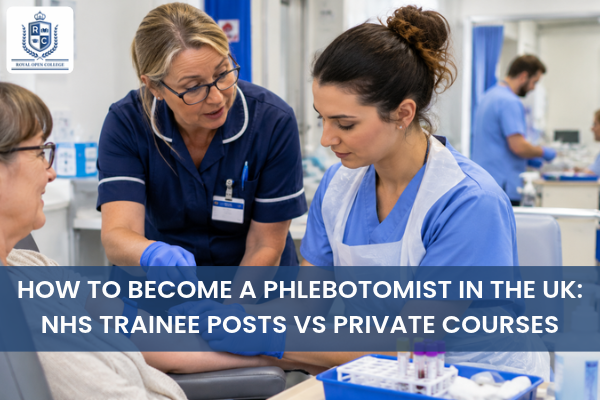
To become a phlebotomist in the UK, apply for an NHS trainee post. Employers train you on the job, and no fixed entry requirements apply. A private course is optional, and no course guarantees a post. Your employer signs off your blood draws, not your certificate.
Some job adverts still ask for prior training, which is why NHS trainee posts and private courses confuse applicants. Read your local adverts first, then pick the route they reward. Read on for six steps, a head-to-head table of both routes, sign-off rules and 2026/27 England pay.
If you feel unsure about the medical terms, Royal Open College’s Phlebotomy and Venipuncture Training course gives you a calm place to start. You study online at your own pace, sit a multiple-choice exam and earn a CPD certificate. The course teaches theory only, so your employer still signs you off.
A phlebotomist takes blood samples from patients for testing. The UK sets no fixed entry requirements. Employers train phlebotomists on the job and sign off competence themselves. Posts usually start at Band 2 or Band 3. No private course guarantees an NHS post.
From checking entry basics to employer sign-off
Two GCSEs help, and employers run a DBS check.
Build care or volunteering experience.
Trainee post, healthcare assistant, apprenticeship or course.
Match your CV to the essential criteria.
Train and take supervised draws with a mentor.
Win sign-off from your employer and keep your competence current.
Pay source: NHS Employers — 2026/27 pay scales

A phlebotomist takes blood samples from patients so labs run tests. You work in hospitals, GP surgeries, outpatient clinics and community teams. Phlebotomy skills also lead to work with blood donation services such as NHS Blood and Transplant. Private hospitals and clinics also employ phlebotomists.
You check each patient’s identity, explain the procedure and take consent. You select a vein, draw blood and label every sample. You follow infection control rules every time. You then record the sample and send the sample to the lab.
Employers want calm communication, a steady hand and attention to detail. You meet nervous patients, children and older adults, so you explain each step clearly. Employers also look for a responsible attitude to health, safety and hygiene. Each skill appears in the advert’s person specification.
Follow six steps in order. Each step names the action, the people involved and the proof you collect. The flowchart shows the full path, and the short notes below explain each step. Dates stay flexible because each trust and each role runs on its own timeline.
GCSEs, DBS and health checks.
Employers usually ask for at least two GCSEs or equivalent. They also run a DBS check and an occupational health review before you start. Trusts review immunisation records, including hepatitis B, and offer screening for hepatitis B, hepatitis C and HIV to new healthcare workers.
Build experience next. Volunteer in an NHS or care setting for a few hours a week, or take a healthcare assistant post. Care, customer and patient contact all count. A college health and social care course also helps, though no course is required.
Before you choose where to volunteer, check your starting point. Our Nursing Assistant Career Readiness Checker walks you through 15 questions on experience, patient care scenarios and safeguarding. The report shows a readiness percentage and areas to strengthen. Treat the report as planning help, not a job promise.
Pick one of four routes in the next section. Then read five local adverts and note the essential criteria. Match your CV to each one. Apply to every nearby trust, health board and GP practice, because each employer sets its own list of needs.
Training starts with theory and practice on a training arm. You then draw blood from patients with a mentor beside you. Your employer signs you off once you meet the local standard. Some trusts renew competence yearly, and Nottingham University Hospitals sets a one-year certificate.
Four routes lead to a phlebotomy post. You apply for a trainee post directly, start as a healthcare assistant, complete an apprenticeship or take a course first. The table shows who signs you off on each route. Read across a row to compare entry, pay and sign-off.
| Route | What You Need | Pay While You Learn | Who Signs You Off |
|---|---|---|---|
|
🏥
Direct trainee post
|
Usually two GCSEs or equivalent | Band 2 or Band 3 | Your employer |
|
🤝
Healthcare assistant first
|
Care experience helps | Band 2 or Band 3 | Your employer |
|
🎓
Apprenticeship
|
English and maths targets | Apprentice wage, often 12 to 18 months | Your employer |
|
📚
Course or college first
|
Course fees and time | None while you study | Your future employer |
Scotland and Wales run their own routes. Scotland offers Modern Apprenticeships in Healthcare Support at SCQF Level 6 and uses a PVG check. NHS Scotland Band 2 starts at £26,696 in 2026/27. Wales advertises trainee posts through health boards such as Betsi Cadwaladr.
Two adverts with the same title ask for different things. Read the three parts: essential criteria, desirable criteria and training promises. Each part shows whether the employer trains from scratch or hires people who are already trained. The wording below mirrors real NHS adverts.
Open the person specification in each advert first. Apply when you meet the essential criteria, even if you miss the desirable ones. If every local advert asks for prior training, a course starts to make sense. If most adverts offer training, save your money and apply.
Lead your CV with care, customer or patient contact. Answer each essential criterion with one example in your supporting statement. Name the trust and the team you apply to. Keep the statement to one page and check spelling twice before you send.
Prepare four interview answers:
Choose a trainee post if you have no prior training and the adverts near you do not ask for training. Choose a private course when an advert asks for prior training or you want a private clinic or GP surgery post.
| Factor | NHS Trainee Post | Private Course |
|---|---|---|
| Cost to you | Paid role, no course fee | Course fees, so ask for the full price in writing |
| Pay while you learn | Band 2 or Band 3 (Band 2 is £25,272 in England, 2026/27) | None while you study |
| Who signs you off | Your employer | Your future employer, never the course |
| What the route proves | You worked safely in a real clinical team | You completed training, with no proof of safe practice on patients |
| Job guarantee | None. You still apply and interview | None. A trust running its own course states plainly the course gives no job guarantee |
| Main risk | Competition for posts | Paying for a certificate employers do not ask for |
| Best suited to | Beginners with no prior training | Applicants for adverts asking for training or for private roles |
Three quick decisions to help you choose your next step. Start by reading five local phlebotomist adverts.
This activity offers guidance based on your answers, not confirmation of employment or course eligibility.
The two routes are not exclusive. Some people do both in sequence with a course for theory, then a trainee post for supervised practice and sign-off. Pick the order your local adverts reward. Whatever you choose, ask what the employer accepts before you pay.
Check before you pay:
Our guide to phlebotomy training covers course types and how to choose one. This article adds the head-to-head criteria. Read both before you spend money, because the course guide explains the formats and this page shows how employers judge them.
Your employer signs you off. A trained mentor watches your draws, records them and confirms you work safely alone. The sign-off applies to your employer. Another trust runs its own checks before you work unsupervised. At Nottingham University Hospitals, a competence certificate lasts one year.
A compact 5-step pathway from theory to renewal. Click any stage to explore what happens at that point in the sign-off process.
Supervised draw counts vary by trust. Policies set between 5 and 20 successful draws before sign-off, depending on the employer and the skill. These examples come from published NHS trust policies and course pages. Always ask your own trust for its number.
Certificates come in three types. Each proves something different, and none replaces your employer’s sign-off. Check which type a provider issues before you pay. A certificate helps you apply, but only your employer confirms you work safely on live patients.
Many trust competence documents map to the national standard for obtaining venous blood samples, coded SFHCHS132. The standard covers consent, patient identity, equipment, infection control and documentation. Ask your trust which version applies to its trainees. Reading the standard before an interview shows you understand the job.
After sign-off you work on your own in your team. You take samples across clinics, wards or community settings and keep your competence current. Some trusts renew competence yearly, so keep your draw log up to date and complete any renewal your employer sets.
With experience you move to senior phlebotomist, team leader or manager roles. Senior phlebotomists take on more complex work. Team leaders and managers lead the team. Band 4 posts pay £28,392 to £31,157 in England for 2026/27. Check the advert band before you apply.
Phlebotomy skills also lead to work with NHS Blood and Transplant. The National Association of Phlebotomists and the Institute of Biomedical Science offer networking and training. In Scotland, NHS Lothian’s healthcare support apprenticeship leads to an HNC route and then university study.
Children and older adults sit in your clinic queue, so you also learn to spot signs of harm and report them. Our Safeguarding Decision Tree lets you rehearse the decision. Pick a concern type and answer the scenario questions. The tree does not replace your employer’s procedures.

To become a phlebotomist in the UK, apply for an NHS trainee post. Employers train you on the job, and no fixed entry requirements apply. A private course is optional, and no course guarantees a post. Your employer signs off your blood draws, not your certificate.
Some job adverts still ask for prior training, which is why NHS trainee posts and private courses confuse applicants. Read your local adverts first, then pick the route they reward. Read on for six steps, a head-to-head table of both routes, sign-off rules and 2026/27 England pay.
If you feel unsure about the medical terms, Royal Open College’s Phlebotomy and Venipuncture Training course gives you a calm place to start. You study online at your own pace, sit a multiple-choice exam and earn a CPD certificate. The course teaches theory only, so your employer still signs you off.
Training adverts repeat a few claims. Check each one against an official source before you pay. The six below appear across course pages and online guides. Each has a quick test you finish in minutes. Use the list when you compare providers.
Six marketing claims to question before paying for phlebotomy training. Tap a claim to reveal the check.
Silence after ten applications points to a pattern, not bad luck. Check three things. Your CV needs proof of care, customer or patient contact. Your application needs to answer each essential criterion. Your search needs to cover every nearby trust and health board.
Keep the course question for last. If every advert near you asks for prior training, a course with live practice fits your goal. If not, extra experience and sharper applications help more than a certificate.
Start with the path: check the basics, build experience, pick a route, apply and win sign-off. A trainee post teaches you the skill and signs you off. A course adds theory before you start or while you apply. Ask each employer what training they accept before you pay.
Royal Open College offers the Phlebotomy and Venipuncture Training course as CPD learning. The course covers theory only. The course is not a regulated qualification and includes no supervised blood draws, so your employer still signs off your competence. Use the course to prepare, then apply for posts.
A: In England for 2026/27, Band 2 pays £25,272, Band 3 pays £25,760 to £27,476 and Band 4 pays £28,392 to £31,157. Posts usually start at Band 2 or Band 3. Scotland, Wales and Northern Ireland set pay separately.
A: A trainee post starts when you are hired. Sign-off arrives once you meet your trust’s supervised draw count, which trusts set between 5 and 20 successful draws. An apprenticeship route often runs 12 to 18 months.
A: Yes. Two Level 2 apprenticeships lead to phlebotomy work: Healthcare Science Assistant and Healthcare Support Worker. The first is described as specialising in phlebotomy, and the second leads to a trainee phlebotomy role.
A: Phlebotomists work in hospital wards, outpatient clinics, GP surgeries and community teams. Some work for blood donation services such as NHS Blood and Transplant. Private hospitals and clinics also employ them.
A: No fixed rule applies, but employers usually ask for at least two GCSEs or equivalent. Without them, care work or a health and social care course builds your record. Check each advert for its exact criteria.
A: Yes. NHS employers run a DBS check as part of pre-employment checks. Trusts also review your immunisation record, including hepatitis B, and offer screening for hepatitis B, hepatitis C and HIV to new healthcare workers.
A: Check each person specification before you book a first aid course. A first aid certificate adds to your application but does not replace phlebotomy training. Spend money only when an advert asks for the certificate.
A: No. Online study covers theory, but blood-taking needs supervised practice on a training arm and on patients. Your employer signs off the practice.
A: Yes. GP practices training assistants use a training arm first, then a volunteer or patient under a mentor. The mentor signs off the skill. Private clinics set their own rules, so ask each clinic for its rules.
A: Trainee posts have no set entry requirements, and no upper age limit appears in national guidance. Some apprenticeships cap age, such as NHS Lothian’s programme for ages 16 to 24, or 29 for care experienced applicants and applicants with a disability. The NOCN Level 3 Diploma in Phlebotomy sets a minimum age of 18.
All Categories
Top Courses

Health Care

Health and Social Care
Phlebotomy training teaches you how to take blood samples safely. This guide covers what UK phlebotomy training involves, from theory and practice on training arms to supervised blood draws, entry requirements, the types of phlebotomy courses available and how to choose one that suits your career goals.

No official ranking of Level 3 safeguarding adults providers exists. The 2024 framework suggests eight hours over three years, with at least half participatory. Check employer acceptance, evidence, accreditation wording and reporting before you enrol.

Working Together to Safeguard Children 2026 is England’s current statutory safeguarding guidance. Schools and colleges also follow Keeping Children Safe in Education 2026. A new information sharing duty began on 30 September 2026. Which documents apply depends on your role and setting.








Payment methods possible


Company Registration No : 14422633
Copyright © 2026 Royal Open College. All Right Reserved.
Offer Ends In!
Copy Your Coupon
Added to cart
Check out our shop to see what's available
Not a member yet? Register now
Are you a member? Login now