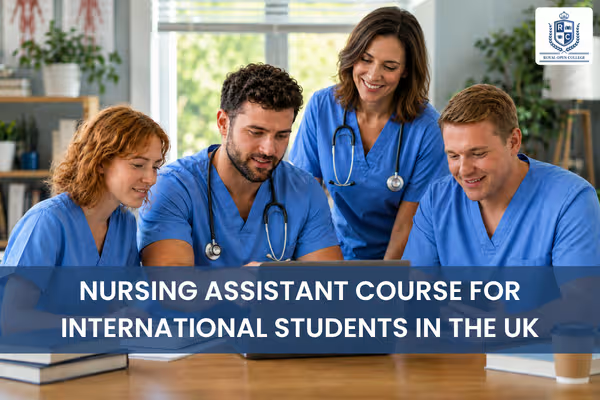
Nursing Assistant Course for International Students in the UK

Nursing Assistant Course for International Students in the UK

International learners in any country are able to study a UK CPD nursing assistant course online with no visa, no IELTS, and no entry requirements. This guide explains CPD vs Ofqual regulation, what UK employers actually check beyond a certificate, what the 2025 visa policy changes mean for working in UK care, and the Care Certificate update every care worker

Amara is a healthcare worker in Nigeria. She wants to study a UK-recognised nursing assistant course online to prepare for a future move to England. Her first question is straightforward: do I need a UK visa to study this course?

The answer is no. You do not need a UK visa to study an online CPD nursing assistant course. You enrol from your home country, study at your own pace, and receive a CPD-accredited certificate on completion, with no IELTS requirement, no entry qualifications, and no visa application needed.

This guide covers CPD (continuing professional development) online courses specifically, not university nursing degrees. Those are a different route entirely. Whether you are outside the UK studying online, already in the UK on a Student visa, or exploring post-study work options, this guide explains what the course covers, what your certificate means to UK employers, what changed in 2025 around visa routes, and what practical steps you need to take to work in UK care.

TL;DR: Key Points for International Students

  • You do not need a UK visa to study an online CPD nursing assistant course from anywhere in the world.
  • CPD (continuing professional development) accreditation is not the same as an Ofqual-regulated qualification. They are different products with different purposes, different costs, and different standing with employers.
  • A CPD certificate alone does not give you the right to work in UK care. You also need the legal right to work in the UK, which depends on your immigration status.
  • The overseas Health and Care Worker visa route for care workers closed to new overseas applicants on 22 July 2025. This affects post-study plans for learners outside the UK.
  • International students on a UK Student visa are generally permitted to work up to 20 hours per week during term time, subject to individual visa conditions confirmed via UKCISA.
  • The Care Certificate now has 16 standards as of March 2025. Any source that still states 15 standards is using the outdated pre-2025 framework.

What Is a Nursing Assistant in the UK?

A nursing assistant in the UK is an unregistered healthcare support worker who assists nurses and clinical teams with patient care across hospitals, care homes, GP surgeries, and community settings.

The job title is not protected by law. Employers use several different titles for the same type of role.

📋

You will see vacancies advertised as:

🏥

Healthcare Assistant

HCA
🤝

Healthcare Support Worker

HSW
🩺

Clinical Support Worker

CSW
💊

Nursing Support Worker

NSW
🧑‍⚕️

Care Assistant

CA

None of these titles requires NMC (Nursing and Midwifery Council) registration. There is no single mandatory qualification set by law for these roles. Employers set their own requirements, though most expect a relevant CPD qualification, Care Certificate completion during induction, and an enhanced DBS check.

Many international searchers use the term “CNA” or “certified nursing assistant.” This is a US and Canadian classification. UK employers do not use the CNA title, and there is no CNA certification system in the UK. If you have searched for “CNA course UK” or “certified nursing assistant UK,” a CPD nursing assistant diploma covers the equivalent foundational knowledge for entry-level UK care roles.

Nursing Assistant vs Nursing Associate: What Is the Difference?

These two roles are frequently confused. The difference is significant.

A nursing assistant is an unregistered role. No NMC registration is required, and no degree is needed. Employers set their own hiring criteria.

A nursing associate is a registered, legally protected role in England and Wales. It requires a two-year Foundation Degree or completion of the Nursing Associate Apprenticeship. Nursing associates join the NMC register under the nursing associates part of the register. Using the title “nursing associate” without NMC registration is an offence under UK law.

A CPD nursing assistant diploma prepares you for the unregistered nursing assistant or HCA role. It does not lead to nursing associate status or NMC registration.

Do International Students Need a UK Visa to Study a Nursing Assistant Course?

No. You do not need a UK visa to study an online CPD nursing assistant course.

Online CPD courses are not sponsored educational programmes. They are self-directed professional development products available globally. There is no visa requirement, no IELTS threshold, and no formal entry qualification needed to enrol. A learner in any country enrols online, pays the course fee, and studies entirely at their own pace from wherever they are.

This is different from studying a nursing degree at a UK university. University nursing programmes are NMC-approved, campus-based, and require a UK Student visa, an IELTS score, and formal entry qualifications such as A-levels or equivalent. These are two completely different routes. If a page you have found mixes them, it is conflating two separate things.

Completing an online CPD nursing assistant course does not grant you a UK visa or right to work. The course and your immigration status are entirely separate. Holding a CPD certificate does not improve your visa eligibility in any way. If you want to live and work in the UK after completing the course, your ability to do so depends on your immigration circumstances, not on your qualification.

For individual visa guidance, visit GOV.UK or speak to a qualified UK immigration adviser. UKCISA (UK Council for International Student Affairs) provides guidance specifically for international students on study and work rights in the UK.

What Is CPD Accreditation and What Does It Mean for UK Employers?

What Is CPD Accreditation and What Does It Mean for UK Employers?

CPD stands for continuing professional development. A CPD-accredited certificate confirms that a course meets recognised professional development standards. It is not a regulated qualification on the Ofqual (Office of Qualifications and Examinations Regulation) framework, and the two are not the same thing.

UK healthcare employers, including NHS Trusts, care homes, GP surgeries, and private healthcare providers, recognise CPD-accredited certificates as evidence of professional learning and commitment to care standards. For entry-level HCA and nursing assistant roles, a CPD diploma is a widely accepted credential in job applications.

A CPD certificate shows employers that you have studied the knowledge areas relevant to patient care. It does not prove workplace competence on its own. Workplace competence is assessed by employers through induction, supervision, and Care Certificate completion.

What a CPD certificate provides:

  • A recognised credential for UK healthcare job applications
  • Evidence of knowledge in patient care, infection control, safeguarding, and clinical support
  • Alignment with NHS Healthcare Support Worker competency frameworks and Skills for Care guidance
  • A structured knowledge foundation for Care Certificate induction on employment

What a CPD certificate does not provide:

  • NMC registration or any professional regulated status
  • The legal right to work in the UK
  • Equivalence to an Ofqual-regulated qualification
  • Automatic or substitute completion of the Care Certificate

CPD Course vs Ofqual-Regulated Qualification: A Quick Comparison

A learner in Accra completes a CPD Level 3 Nursing Assistant Diploma online over six weeks. She receives a digital certificate and adds it to her CV. A worker in Manchester completes an Ofqual-regulated Level 3 Diploma in Healthcare Support over 15 months through a training provider, with workplace observations and formal assessments signed off by a supervisor.

These are not the same product.

Quick Overview
Feature
CPD Nursing Assistant Course
Ofqual-Regulated Level 3 Healthcare Support Diploma
Delivery
100% online, global access
Work-based or blended, UK-based
Duration
Weeks to a few months
6 to 24 months
Entry Requirements
None
Employer and work placement typically required
Cost
Low, typically under £30
£1,987 to £2,568
Assessment
Online multiple-choice questions
Workplace observation and formal assessment
Regulatory Framework
CPD accreditation
Ofqual-regulated, sits on the RQF
Employer Recognition
Entry-level care roles
Broader formal recognition
Both are legitimate training products. They serve different purposes, different learner profiles, and different stages of a care career. The CPD route is the accessible global entry point. The Ofqual-regulated route is the more formally assessed, work-based UK progression route.

What Does a UK Nursing Assistant Course Cover?

A Level 3 CPD nursing assistant course covers the core knowledge areas UK healthcare employers expect from entry-level support staff.

A well-structured course at this level includes:
🩺
Patient care fundamentals and person-centred approaches
🦠
Infection prevention and control procedures aligned with NHS safety standards
🛡️
Safeguarding adults and children, including UK safeguarding legislation and the six principles of safeguarding
💊
Medication handling awareness and safe administration basics
💬
Effective communication with patients, families, and multidisciplinary teams
⚠️
Health and safety responsibilities in clinical environments
🫁
Anatomy and physiology basics
🧠
Dementia care awareness and mental health support
🥗
Nutrition, hydration, mobility, and elimination support
❤️
Oxygenation and emergency procedures including CPR
📋
Clinical documentation and record keeping
Course content aligns with NHS Healthcare Support Worker competency frameworks and reflects the expectations Skills for Care sets for adult social care workers in England.

The Care Certificate Is a Separate Requirement

The Care Certificate is a 16-standard induction framework, updated in March 2025 by Skills for Care, Skills for Health, and NHS England. Standard 16, introduced in 2025, covers Awareness of Learning Disability and Autism under the Oliver McGowan Mandatory Training initiative. 

Oliver McGowan Mandatory Training is a legal requirement for all CQC-regulated providers under the Health and Care Act 2022. The Oliver McGowan Code of Practice became final on 6 September 2025.

A CPD nursing assistant course builds the knowledge foundation that supports Care Certificate completion. It does not replace it. The Care Certificate is assessed by the employer in the workplace during the induction period. Skills for Care confirms that online learning alone cannot achieve the full Care Certificate. Any source suggesting a CPD course completes the Care Certificate requirement is incorrect.

Can International Students Work as Nursing Assistants in the UK?

Whether you can work as a nursing assistant in the UK depends entirely on your immigration status. Studying a CPD course and holding the legal right to work in the UK are two separate matters.

Use this decision pathway to identify your situation: Where are you based?

Outside the UK: You are free to study the CPD course online with no visa. To work in UK care, you need the right to work via an appropriate visa. The overseas care worker route closed on 22 July 2025. Visit GOV.UK for current visa options.

In the UK on a Student visa, you are generally permitted to work up to 20 hours per week during term time. A CPD nursing assistant diploma strengthens your CV for part-time care roles. Check your individual conditions with UKCISA.

In the UK on a Graduate or other visa, employed in care for 3 or more months, you are potentially eligible for the transitional Health and Care Worker visa switch until 22 July 2028. Eligibility is fact-specific. Visit GOV.UK.

Visa & UK Work Options

Amara completes the CPD nursing assistant course from Lagos. She wants to move to the UK and work in a hospital ward. She has her certificate. What are her options?

Completing the online course from your home country is permitted without any visa requirement. The course is accessible globally.

To work in a UK care role, you need the legal right to work. This requires the appropriate visa for your circumstances.

A major immigration policy change took effect on 22 July 2025. The overseas Health and Care Worker visa route for care workers (SOC code 6135) and senior care workers (SOC code 6136) closed to new overseas applicants. According to the Home Office Statement of Changes HC 997, employers are no longer permitted to submit entry clearance applications sponsoring new overseas hires in these roles.

The Skilled Worker route was restructured at the same time to require degree-level qualifications (RQF Level 6) for most occupations. Care worker roles do not meet this threshold and no longer qualify for new overseas recruitment.

Your CPD certificate strengthens your application once you have the right to work established. It does not create a visa route. For current immigration options relevant to your situation, visit GOV.UK and seek guidance from a qualified immigration adviser.
Priya is studying adult nursing at a UK university. She wants part-time HCA work to build clinical experience. She completes a CPD nursing assistant course to prepare her knowledge before applying.

Full-time degree-level students (RQF Level 6 or above) on a UK Student visa are generally permitted to work up to 20 hours per week during term time. Students on courses below degree level are usually limited to 10 hours per week. The British Council and UKCISA both confirm this as the standard position for Student visa holders.

The 20-hour limit applies across all employment combined. Holding two part-time jobs does not increase the weekly cap. The Home Office treats a week as running from Monday to Sunday. You are not permitted to work 30 hours one week and 10 the next. Each week must independently stay within the limit.

Care assistant and HCA roles fall within the permitted employment categories. A completed CPD nursing assistant diploma strengthens your CV for these part-time roles.

Check your individual visa conditions before taking up any employment. Your work conditions appear on your eVisa, biometric residence permit, or visa vignette. If you are unsure, contact your university's international student adviser or UKCISA directly.

Workers already in the UK on a Student or Graduate visa, who have been employed by a sponsoring care provider for at least three continuous months, are eligible to apply for the Health and Care Worker visa under transitional arrangements. According to the Home Office, these arrangements remain open until 22 July 2028.

A CPD nursing assistant course supports the employment side of this process. It does not affect visa eligibility. The transitional switch criteria are narrow and fact-specific. Do not assume eligibility without checking your individual circumstances against current GOV.UK guidance or consulting a qualified immigration adviser.

What Do UK Employers Require Beyond a CPD Certificate?

A CPD certificate is one part of what a UK employer needs to see before hiring you. Employers at NHS Trusts, care homes, GP surgeries, and private healthcare settings require the following before you start work.

Right to Work Check

UK employers are legally required to verify your right to work before you begin employment. This requirement comes from the Immigration, Asylum and Nationality Act 2006. The employer checks documents proving your right to work, which includes your eVisa, biometric residence permit, or passport with visa endorsement.

Failure to conduct this check, or hiring someone without the right to work, carries civil and criminal penalties for the employer. This check is non-negotiable and applies to all employees regardless of nationality.

GOV.UK publishes the full list of accepted right to work documents.

Enhanced DBS Check

Most nursing assistant and HCA roles involve working directly with vulnerable adults or children. Under the Safeguarding Vulnerable Groups Act 2006, these roles are classified as regulated activity.

Unregistered healthcare professionals, including nursing assistants and healthcare assistants in regulated activity settings, require an Enhanced DBS (Disclosure and Barring Service) check with a barred list check. NHS Trust DBS policy documents and GOV.UK guidance on DBS checks for adult social care roles confirm this is the appropriate level for direct patient-facing care work.

The employer arranges and initiates the DBS check during recruitment. You do not apply for an Enhanced DBS independently before getting a job. The DBS Update Service lets your certificate remain valid across employers if you register it.

Care Certificate Completion

Employers complete Care Certificate induction with all new care and support staff during the induction period. The Care Certificate has 16 standards as of March 2025. Standard 16 covers Awareness of Learning Disability and Autism under Oliver McGowan Mandatory Training.

The Care Certificate is assessed by the employer in the workplace. A CPD course builds the knowledge foundation. Skills for Care confirms it does not replace employer-led workplace assessment.

Professional References

Most employers require at least two references, including at least one professional reference. Academic references from a course tutor are not always accepted in place of employment references for clinical care roles.

What Jobs Can You Apply for After Completing a UK Nursing Assistant Course?

A CPD Level 3 Nursing Assistant Diploma prepares you for the following UK job roles:

✅ UK Job Roles

Healthcare Assistant (HCA) Nursing Assistant Healthcare Support Worker Clinical Support Worker Senior Care Assistant Domiciliary Care Worker Community Care Assistant
🚫

✕ Not Used in UK

UK employers do not typically use the titles below. These are US role titles and do not appear in NHS or UK care sector job postings.

CNA Patient Care Technician Geriatric Nursing Assistant Orthopaedic Nursing Assistant

Where These Roles Are Based

🏥

NHS hospitals

Band 2 and Band 3 roles on wards, in emergency departments, and in community services

🏠

Care homes and residential settings

Supporting elderly or disabled adults

🩺

GP surgeries

Assisting clinical staff with patient preparation and records

🏨

Private hospitals and independent clinics

🚗

Domiciliary care services

Delivering support in patients' homes

NHS Salary Context for 2026/27

NHS pay is set under the Agenda for Change (AfC) framework. NHS Employers confirmed pay bands for England on 12 February 2026 and took effect from 1 April 2026, with a 3.3 per cent consolidated pay rise across all bands.

Band
Typical Roles
Annual Salary 2026/27 (England)
🏥
Band 2
👩‍⚕️
Healthcare Assistant, Clinical Support Worker
💷
£25,272 (flat rate)
🏥
Band 3
🩺
Senior HCA, Clinical Support Worker with vital signs duties
💷
£25,760 to £27,476
🏥
Band 4
📋
Nursing Associate, Assistant Practitioner
💷
£28,218 to £31,196

Career Progression Pathway

🚀
START
📘
CPD Nursing Assistant Diploma (Foundation Entry)
👩‍⚕️
Senior Healthcare Assistant (Band 3)
🎓
Nursing Associate
(Foundation Degree / Nursing Associate Apprenticeship)
(Band 4 – NMC Registered)
🏥
Registered Nurse
(Registered Nurse Degree Apprenticeship / Approved Nursing Degree)
(Band 5)
END: Advanced Clinical Practice Pathway (optional further progression)

Misconceptions About UK Nursing Assistant Courses for International Students

Several common misunderstandings about this topic circulate online. Many come from US healthcare terminology being applied to a UK context, outdated immigration policy, or oversimplified course marketing.

01
COMMON MISCONCEPTION
Does a CPD Nursing Assistant Course Lead to NMC Registration?
✅ CORRECTION
No. A CPD nursing assistant diploma does not lead to NMC registration. NMC registration requires completing an approved nursing or nursing associate programme at a recognised UK higher education institution. The NMC sets the standards for approved programmes. Completing an online CPD course does not meet those standards. A CPD course prepares you for unregistered healthcare support roles. This is a different career level from registered nursing, and the two routes are not interchangeable.
02
COMMON MISCONCEPTION
Does Completing the Course Give You the Right to Work in UK Care?
✅ CORRECTION
No. Your right to work in the UK comes from your immigration status, not from any qualification you hold. UK employers are legally required to conduct right to work checks before employment begins under the Immigration, Asylum and Nationality Act 2006. A CPD certificate is a professional learning credential. It is not an immigration document and does not create work authorisation of any kind.
03
COMMON MISCONCEPTION
Is the Overseas Care Worker Visa Still Available to New Applicants After July 2025?
✅ CORRECTION
No. The overseas Health and Care Worker visa route for care workers and senior care workers closed to new overseas applicants on 22 July 2025. This is confirmed in the Home Office Statement of Changes HC 997. Employers are no longer permitted to sponsor new overseas hires under SOC codes 6135 and 6136. Online content that presents this visa as a straightforward post-study pathway for overseas learners is out of date. For current immigration options, visit GOV.UK.
04
COMMON MISCONCEPTION
Is a CNA Certificate From Another Country Directly Equivalent to a UK Qualification?
✅ CORRECTION
No. CNA certification is a US and Canadian classification. UK employers do not recognise it as a direct equivalent to UK training standards and employer requirements. International healthcare experience is valued, and employers take it into account. UK employers will still require right to work documentation, an Enhanced DBS check, and Care Certificate completion during induction regardless of prior international training or qualifications.

Summary Section &Key Takeaways

  • You do not need a UK visa to study an online CPD nursing assistant course. Any learner worldwide is able to enrol, study, and receive a certificate entirely online, with no IELTS requirement and no prior qualifications.
  • CPD accreditation and Ofqual regulation are different frameworks. A CPD certificate is employer-recognised for entry-level care roles in the UK. It does not sit on the Regulated Qualifications Framework (RQF) and does not carry the same standing as a regulated qualification.
  • The overseas Health and Care Worker visa route for care workers (SOC 6135) and senior care workers (SOC 6136) closed to new overseas applicants on 22 July 2025, as confirmed in the Home Office Statement of Changes HC 997. A CPD certificate does not create a visa pathway.
  • The Care Certificate has 16 standards as of March 2025. Standard 16 covers Awareness of Learning Disability and Autism under Oliver McGowan Mandatory Training. Any page stating 15 standards is using the pre-2025 framework and is out of date.
  • UK employers require more than a CPD certificate before hiring. Right to work checks under the Immigration, Asylum and Nationality Act 2006, an Enhanced DBS check with barred list, and Care Certificate induction are all required before you start work.
  • Full-time degree-level students on a UK Student visa are generally permitted to work up to 20 hours per week during term time across all employers combined, measured per Monday to Sunday week.
  • A nursing assistant is an unregistered role. A nursing associate is NMC-registered with a legally protected title. A CPD course does not lead to nursing associate status or NMC registration. The two roles are not the same, and the two routes are not interchangeable.
  •  

FAQ

Q: Do I need a UK visa to study a nursing assistant course online?

A: No. Online CPD nursing assistant courses are accessible globally without a UK visa, IELTS requirement, or prior qualification. Visa requirements only arise if you want to physically live and work in the UK, which is a separate matter from studying the course online.

A: Yes. CPD-accredited certificates are recognised by NHS Trusts, care homes, private hospitals, and community care providers as evidence of professional learning and knowledge. This recognition applies to entry-level role applications and is different from Ofqual regulation, which is a separate and more formal qualification framework.

A: CPD accreditation confirms a course meets professional development standards and is widely accepted by UK care employers. Ofqual-regulated qualifications sit on the Regulated Qualifications Framework (RQF), require formal workplace observation and assessment, and take 6 to 24 months to complete. Both are legitimate training products that serve different purposes.

A: Full-time degree-level students on a UK Student visa are generally permitted to work up to 20 hours per week during term time across all employers combined. You should check your individual visa conditions directly via UKCISA or your university’s international student adviser before starting any employment.

A: The Care Certificate is a 16-standard induction framework, updated in March 2025, assessed in the workplace by the employer during the induction period. A CPD nursing assistant course builds the knowledge base to support Care Certificate completion, but online learning alone does not replace the employer-led workplace assessment, as confirmed by Skills for Care.

A: A nursing assistant is an unregistered support role with no protected title. A nursing associate is an NMC-registered role with a legally protected title, requiring a two-year Foundation Degree or Nursing Associate Apprenticeship. Using the title “nursing associate” without NMC registration is a legal offence in the UK.

A: CNA (certified nursing assistant) is a US and Canadian classification. UK employers use the titles healthcare assistant, nursing assistant, or healthcare support worker. There is no CNA certification system in the UK, and UK job postings do not use the CNA title.

A: Yes. Most nursing assistant and HCA roles involve regulated activity as defined under the Safeguarding Vulnerable Groups Act 2006. These roles require an Enhanced DBS check with a barred list check. The employer arranges the check during recruitment; you do not apply for it independently before getting the job.

A: The overseas Health and Care Worker visa route for care workers (SOC 6135) and senior care workers (SOC 6136) closed to new overseas applicants on 22 July 2025, confirmed in the Home Office Statement of Changes HC 997. Employers are no longer permitted to sponsor new overseas hires in these roles under entry clearance.

A: Yes. Online CPD nursing assistant courses are accessible from anywhere in the world. No UK visa, IELTS score, or prior healthcare qualification is required to enrol and study.

A: The Care Certificate has 16 standards as of March 2025. Standard 16 covers Awareness of Learning Disability and Autism, developed under the Oliver McGowan Mandatory Training initiative. Any source that still states 15 standards is using the pre-2025 framework and is out of date.

A: Completion time varies by provider and study pace. A Level 3 CPD diploma typically takes between four and twelve weeks at a moderate pace, though learners with more time to study complete it faster. Most courses offer lifetime or 12-month access, so you set your own timeline.

A: Yes, through further study and progressive training. The typical pathway moves from nursing assistant or HCA to nursing associate via a two-year Foundation Degree or Nursing Associate Apprenticeship, then to registered nurse via an approved nursing degree or Registered Nurse Degree Apprenticeship. A CPD diploma does not qualify you as a registered nurse; it is the starting point for the progression route.

Start Your Training: Taking the Next Step

If you are ready to study, an online CPD nursing assistant course is accessible from anywhere in the world, with no UK visa, no IELTS requirement, and no prior qualifications needed to enrol.

The Level 3 Diploma in Nursing Assistant Complete Training from Royal Open College is a CPD-accredited programme covering 87 modules, aligned with NHS Healthcare Support Worker frameworks and Skills for Care guidance. You receive an instant digital CPD certificate on completion, with a printed hard copy available for an additional fee. The course is priced at £19.99.

Enrolment also includes four bonus CPD-accredited courses at no extra cost: Diploma in Adult Social Care, Mental Health Nursing Diploma, Neonatal Nursing Level 3 Diploma, and Care Planning and Record Keeping.

This course is CPD-accredited. It is not Ofqual-regulated and does not lead to NMC registration. Completing it does not grant the right to work in the UK. These are the facts, stated plainly, so you enrol knowing exactly what you are getting.

Enrol today and begin building the knowledge UK care employers expect.

Recent Blogs

Safeguarding_and_Child_Protection_UK_Guide

Safeguarding and Child Protection: UK Guide

Safeguarding is one of the most important responsibilities you can hold, whether you work with children, young people or vulnerable adults. This guide walks you through how safeguarding differs from child protection, which UK guidance applies to your setting and the role of a Designated Safeguarding Lead. You will also learn how to report concerns and choose the right CPD learning without confusing it with a regulated qualification.

Choosing a Safeguarding Course for Childcare Professionals

Choosing a Safeguarding Course for Childcare Professionals

Choosing the right safeguarding course depends on your role, your contact with children, and what your employer actually requires for the position. This guide covers common safeguarding training levels, current EYFS requirements for early years settings in England, the Designated Safeguarding Lead role, and how CPD learning fits alongside statutory safeguarding duties in daily practice.

Nursing Assistant Course Birmingham: Online Study Options Explained

Nursing Assistant Course Birmingham: Online Study Options Explained

Not all nursing assistant certificates carry the same weight with Birmingham employers. This guide covers the CPD versus Ofqual distinction no competitor explains, clarifies why an online course does not complete the Care Certificate, and gives you a clear picture of what Birmingham NHS trusts, care homes, and private providers check before offering you a role.