







Nursing Assistant Course London Online Options for Learners

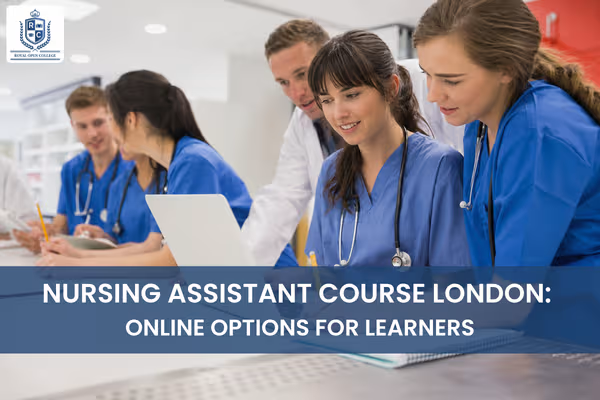
Nursing Assistant Course London: Online Options for Learners

Online nursing assistant training is the practical choice for London learners balancing shift work, family commitments, and commuting costs. This guide explains what CPD-accredited courses cover, how the Care Certificate's 16 standards work after the March 2025 update, what Band 2 NHS salaries look like with London weighting in 2026, and which free routes exist before you spend a penny.

London has more NHS trusts than any other region in England. It also has the longest average daily commute in the country: 80.6 minutes, according to Department for Transport data from 2024. For a healthcare assistant working rotating shifts across Inner or Outer London, travelling to a fixed classroom twice a week is not a realistic option for most people.

That gap between demand for nursing assistants and access to training is exactly why online CPD-accredited courses have become the default route for London learners. Affordable, self-paced, and accessible from any device, they fit around shift patterns, family commitments, and the practical realities of living and working in this city.

This guide covers what online nursing assistant courses include, how they compare to Ofqual-regulated qualifications, what London employers actually require in 2026, and the exact steps to take after you finish your training.

TL;DR

  • Online nursing assistant courses are CPD-accredited and widely accepted by NHS trusts, care homes, and private providers for entry-level roles in London.
  • CPD-accredited courses and Ofqual-regulated qualifications are different things. Neither is a legal requirement for nursing assistant employment.
  • The Care Certificate has 16 standards as of March 2025. Any page or course stating 15 uses an outdated framework.
  • Free routes exist for London learners, including RCN First Steps, the King’s Trust, and the Healthcare Support Worker Apprenticeship.
  • Your employer arranges your Enhanced DBS check during the hiring process. You do not pay for it independently before applying.

What does an online nursing assistant course cover?

A well-structured online nursing assistant course covers the core knowledge areas that NHS trusts and care providers in London look for in entry-level healthcare support workers.

In the UK, the titles nursing assistant and healthcare assistant refer to the same type of unregistered support role. Different employers use different job titles. Neither role requires registration with the Nursing and Midwifery Council. No previous experience or qualifications are required to enrol in a CPD-accredited online course. Most London learners complete the study in a few days to a few weeks, fitting it around existing work or family commitments.

Core topics covered in nursing assistant training

Good nursing assistant training groups content around the practical demands of the role.

A well-structured course covers:

01
🧼

Infection prevention and control, including hand hygiene and aseptic technique

02
🛡️

Safeguarding adults and children, UK legislation, and recognising abuse and neglect

03
💊

Medication awareness and safe handling principles

04
❤️

Patient care, including personal hygiene, mobility support, nutrition, and fluid balance

05
💬

Effective communication and teamwork in healthcare settings

06
⚠️

Health and safety responsibilities in care environments

07
🤝

Person-centred care and patient dignity

08
🧬

Basic anatomy and physiology, including immune system awareness

09
🧠

Mental health awareness and dementia care

10
📄

Documentation and accurate record keeping

These topic areas align with the Skills for Care framework for healthcare support workers. London NHS trusts and CQC-regulated care providers use this framework when setting entry-level hiring expectations.

What the assessment typically involves

Most CPD-accredited online nursing assistant courses use an online multiple-choice assessment with a standard pass mark of 60 percent. On passing, you receive a digital certificate immediately. No clinical placement is required as part of the online course itself.

Misconception to correct: Completing an online nursing assistant course does not replace your employer’s induction or Care Certificate sign-off. Your course builds your knowledge base. Your employer assesses your competence in practice once you begin work. These are two separate processes.

Why do London learners choose online nursing assistant courses?

London learners choose online training for three straightforward reasons: cost, time, and flexibility.

The average London commute takes 80.6 minutes per day, according to Department for Transport data from 2024. That is the highest daily commute time in the UK. A classroom-based nursing assistant course in central London adds that travel time on top of study hours, plus rail fares that rose 4.6 percent in March 2025. For a learner on an entry-level income, those costs remove classroom study as a realistic option.

London also has the most shift-heavy healthcare workforce in England. NHS trusts across North East London, North West London, South East London, South West London, and North Central London all operate on rotating rota patterns. A Band 2 healthcare assistant working nights and weekends has no predictable weekday schedule to plan classroom attendance around. Online self-paced study removes the fixed-timetable problem entirely.

There is a third factor specific to London. Skills for Care data for 2023/24 shows that 36.1 percent of adult social care posts in London were filled by workers from outside the UK and European Economic Area. That is the highest proportion of any English region. For overseas workers settled in the UK, a CPD course delivers UK-aligned training content without requiring a specific immigration status. Right to work is a separate matter, confirmed by your employer at the point of hiring.

London NHS trusts and private care providers accept CPD-accredited certificates alongside practical experience for entry-level roles. That acceptance is an employer decision, not a nationally mandated requirement. Online study builds your knowledge. Practical experience builds your employability. Both matter to London employers.

CPD-accredited or Ofqual-regulated which do you need

CPD-accredited or Ofqual-regulated: which do you need?

For most entry-level nursing assistant and healthcare assistant roles in London, neither is legally required before starting work. Understanding the difference helps you choose the right option for your goals and budget.

What CPD accreditation means in practice

CPD stands for Continuing Professional Development. A CPD-accredited course has been reviewed by an independent accrediting body, such as the CPD Certification Service, and confirmed to meet professional development standards. The accreditation is not government-regulated. It is a quality signal that confirms the course content is structured, relevant, and appropriate for professional use.

CPD-accredited nursing assistant courses:

  • Typically cost £15 to £50
  • Take hours to a few weeks to complete
  • Use online text-based modules and multiple-choice assessments
  • Award a digital certificate immediately on completion
  • Carry no entry requirements

NHS trusts, care homes, and GP practices across London accept CPD certificates as evidence of learning and professional initiative for entry-level positions. No law specifies a mandatory course type before employment as a nursing assistant in England.

When an Ofqual-regulated qualification is worth considering

Ofqual is the government regulator of qualifications in England. An Ofqual-regulated qualification sits within the Regulated Qualifications Framework at a defined level. These qualifications are assessed to national standards, carry formal academic recognition, and are portable between employers.

Feature CPD-accredited course Ofqual-regulated qualification
Typical cost £15 to £50 £1,987 to £2,568
Duration Hours to weeks 6 to 24 months
Delivery Fully online, self-paced Online or work-based with observed assessments
Assessment method Multiple-choice quiz Formal assessed tasks and workplace observations
Employer portability Accepted by many employers Nationally recognised across all sectors
Mandatory for NHS Band 2 roles No No
Government regulated No Yes, by Ofqual

The Level 2 Adult Social Care Certificate, launched in June 2024 by the Department of Health and Social Care and Skills for Care, is an Ofqual-regulated qualification for adult social care workers. It takes 6 to 8 months to complete and requires employer involvement throughout. Eligible employers claim up to £1,540 per worker through the Learning and Development Support Scheme for 2025/26.

What is the Care Certificate and does an online course cover it?

The Care Certificate is a 16-standard induction framework for people new to health and social care in England. Skills for Care, Skills for Health, NHS England, and the Department of Health and Social Care updated it in March 2025.

Important correction: Many online courses and websites still state the Care Certificate has 15 standards. This is incorrect. The framework was updated in March 2025. The correct number is 16 standards. Any content stating 15 reflects the pre-2025 framework and should not be treated as current guidance.

The 16 Care Certificate standards: what they cover

The 16 standards address the knowledge, skills, and behaviours expected of all new health and social care workers across England:

✏️

16 Care Certificate Standards

01
🧑‍💼

Understand your role

02
📈

Your personal development

03
⚖️

Duty of care

04
🌍

Equality and inclusion

05
🤝

Working in a person-centred way

06
💬

Communication

07
🔒

Privacy and dignity

08
🥗

Fluids and nutrition

09
🧠

Awareness of mental health, dementia, and learning disability

10
🛡️

Safeguarding adults

11
👶

Safeguarding children

12
❤️

Basic life support

13
⛑️

Health and safety

14
📂

Handling information

15
🦠

Infection prevention and control

16
♾️

Awareness of learning disability and autism (added March 2025)

Standard 16 was introduced following the Oliver McGowan Mandatory Training initiative. The Oliver McGowan Code of Practice became final on 6 September 2025 under the Health and Care Act 2022. This standard is now the benchmark CQC uses to assess compliance with learning disability and autism training across all registered services. Full implementation across CQC-registered services was required from July 2025.

Why your employer signs off the Care Certificate, not your course provider

The Care Certificate is employer-delivered and employer-signed. Your employer assesses your competence against each of the 16 standards during your workplace induction, not your online course provider.

An online nursing assistant course prepares you for the Care Certificate by covering the knowledge within those 16 standards. That preparation is genuinely valuable. It means you arrive at your induction with confidence and context. Skills for Care is clear on this point: eLearning alone does not provide full achievement of the Care Certificate. Your employer signs off each standard once you demonstrate the required knowledge and behaviours in your actual work setting.

Are there free and funded routes into nursing assistant work for London learners?

Yes. London learners have access to several free or employer-funded routes into nursing assistant and healthcare assistant work. These complement a paid CPD course rather than replace it.

RCN First Steps

The Royal College of Nursing offers First Steps, a free online learning tool for healthcare support workers. It is mapped to National Occupational Standards and covers safeguarding, accountability, delegation, infection prevention, confidentiality, consent, and clinical skills. Access requires a free RCN account. RCN members receive a downloadable completion certificate on finishing the programme. First Steps is a solid starting point but does not produce a standalone portable CPD certificate for job applications unless you hold full RCN membership.

The King’s Trust

The King’s Trust runs programmes that connect young adults to major employers, including NHS trusts. Through partnerships with NHS organisations such as Barts Health NHS Trust in London, the King’s Trust supports eligible young people, typically aged 16 to 30, with work experience, mentoring, and pathways into Band 2 NHS roles. This route is free of charge. Visit kingstrust.org.uk for current programme availability in your area.

Healthcare Support Worker Apprenticeship

From 1 August 2025, the Level 2 Healthcare Support Worker Apprenticeship has a confirmed minimum duration of 8 months, approved by Skills England following legislative change. Adult apprentices aged 19 and over no longer need Level 2 Functional Skills to complete the programme. The apprenticeship is employer-led and paid from day one. You need an employer willing to sponsor you before you start.

Level 2 Adult Social Care Certificate

The Level 2 Adult Social Care Certificate is an Ofqual-regulated qualification for people working in adult social care settings. Launched in June 2024, it takes 6 to 8 months and involves employer-based assessment throughout. Eligible employers claim funding through the Learning and Development Support Scheme.

All free routes require either an employer or a programme sponsor before you begin. A paid CPD course offers something none of them do: a self-directed route that produces a portable certificate before your first job application.

What do nursing assistants earn in London?

Nursing assistants in London earn above the England national average because the NHS Agenda for Change pay framework includes a High Cost Area Supplement (HCAS), commonly known as London weighting, added on top of the standard base salary.

April 2026 figures confirmed by NHS Employers:

NHS Band Typical Role England Base Salary Inner London Total (Approx.) Outer London Total (Approx.)
🏥
Band 2
Entry healthcare assistant £25,272 £30,326 £29,063
👩‍⚕️
Band 3
Entry senior HCA £25,760 £30,912 £29,624
Band 3
Top of band senior HCA £27,476 £32,971 £31,598

Inner London HCAS is 20 percent of basic salary. Outer London HCAS is 15 percent. HCAS is pensionable and taxable. Your take-home after pension, tax, and National Insurance is approximately 55 to 70 percent of the gross supplement.

NHS unsocial hours enhancements add further pay for evening, weekend, and bank holiday shifts. For a Band 2 healthcare assistant on a London rota, these uplifts add meaningful additional income throughout the year.

Agency and bank healthcare assistant roles in London advertise from around £12.21 per hour. These often pay above Band 2 NHS rates but without NHS pension contributions or employment benefits. Domiciliary and community care roles in London generally sit at the lower end of the earnings range at entry level. Salary progresses as you gain experience, take on additional responsibilities, or move to a Band 3 position.

What should you do after completing an online course?

Completing your online nursing assistant course is the starting point, not the finish line. Three practical steps follow immediately.

🗺️

Your next steps after completing your course:

1
🎓

Step 1

Complete your online nursing assistant course and receive your digital CPD certificate.

2
🖥️

Step 2

Create your NHS Jobs profile at jobs.nhs.uk. Add your certificate details: course title, accrediting body, level, and date of completion. List all relevant experience, including voluntary work, family caregiving, or previous care roles.

3
📋

Step 3

Apply for Band 2 healthcare assistant and nursing assistant roles across London NHS trusts and private care providers. Your employer confirms your right-to-work documents at the interview stage.

4
🔍

Step 4

Your employer initiates your Enhanced DBS check as part of pre-employment screening. You provide identity documents. You do not pay for this independently.

5
🏥

Step 5

Start work and complete your 16-standard Care Certificate induction with your employer.

NHS Jobs profile

Go to jobs.nhs.uk and create your profile. Under qualifications, add your CPD certificate with the name of the accrediting body, the course title, the qualification level, and the date of completion. List any relevant experience, including voluntary work, family caregiving, or previous care roles. NHS trusts assess applications on both qualifications and demonstrated relevant experience.

Right to work

Your employer confirms your right to work at the point of hiring. You do not need to initiate this process before submitting applications. For guidance on accepted right to work documents in the UK, visit GOV.UK.

DBS Enhanced check

Most patient-facing nursing assistant and healthcare assistant roles require an Enhanced DBS check with a barred list check. You do not apply for an Enhanced DBS check independently. Your employer applies on your behalf during pre-employment screening. Do not pay for a self-initiated Enhanced DBS check before receiving a job offer.

Bank and agency routes offer a practical way to build clinical experience alongside your certificate. NHS Professionals places bank staff across more than 55 NHS trusts, including multiple London trusts. Registering with an NHS staffing bank while applying for permanent roles gives you paid clinical exposure that strengthens future applications.

Summary Section Key Takeaways

  • Online nursing assistant courses are CPD-accredited, self-paced, and widely accepted by London NHS trusts and care providers for Band 2 entry-level roles. No law in England requires a specific qualification before starting work as a nursing assistant.
  • The Care Certificate has 16 standards as of March 2025, not 15. Standard 16 covers awareness of learning disability and autism under the Oliver McGowan Mandatory Training initiative. Any page or course stating 15 uses an outdated framework.
  • CPD-accredited courses cost £15 to £50 and take hours to weeks to complete. Ofqual-regulated qualifications cost £1,987 to £2,568 and take 6 to 24 months. Both serve different purposes and neither is mandatory for nursing assistant employment.
  • Band 2 healthcare assistants in Inner London earn approximately £30,326 gross per year from April 2026, including the 20 percent High Cost Area Supplement on top of the £25,272 base salary. Band 3 roles in Inner London reach approximately £30,912 to £32,971.
  • Free routes into NHS work exist for London learners. These include RCN First Steps, King’s Trust NHS employment programmes, and the Healthcare Support Worker Apprenticeship, which carries a minimum duration of 8 months from August 2025.
  • Your employer arranges and pays for your Enhanced DBS check during pre-employment screening. You do not apply for it independently or pay for it before receiving a job offer.
  • Combining an online CPD certificate with relevant care experience and a complete NHS Jobs profile gives you the strongest starting position for Band 2 healthcare assistant roles across London.

Where to start: online nursing assistant training for London learners

London has over 30 NHS trusts and a healthcare workforce with real, ongoing staffing needs at entry level. Skills for Care data for 2024/25 shows 111,000 vacant adult social care posts across England, with a homecare vacancy rate above 10 percent. Entry-level healthcare assistant roles exist across every London borough.

An online CPD-accredited nursing assistant course gives you the knowledge foundation to apply with confidence. It costs a fraction of a classroom programme, fits around any schedule, and produces a portable certificate you add to your NHS Jobs profile immediately on passing.

If you are ready to start, the Level 3 Diploma in Nursing Assistant Complete Training from Royal Open College is a CPD-accredited, self-paced online course built for UK learners. It covers 87 modules across patient care, infection control, safeguarding, medication awareness, communication, and health and safety. No entry requirements apply. The course costs £19.99. Your digital CPD certificate is available for download immediately after you pass the final assessment.

A CPD certificate is your starting point. Combine it with relevant care experience, build your NHS Jobs profile, and begin applying for Band 2 healthcare assistant roles across London.

FAQ

Q: Is an online nursing assistant course recognised by NHS employers in London?

A: Recognition depends on the employer and the course accreditation, not the mode of delivery. CPD-accredited courses are widely accepted for entry-level healthcare assistant roles across NHS trusts, care homes, and private providers in London. No national mandate requires a specific course type before starting employment.

A: A nursing assistant is an unregistered support role with no NMC registration requirement. A nursing associate is a regulated profession in England, registered with the Nursing and Midwifery Council, requiring a two-year Foundation Degree from an NMC-approved provider. Completing a CPD nursing assistant course does not lead directly to nursing associate registration.

A: A CPD course is accredited by an independent body for professional development purposes and is not government-regulated. An Ofqual-regulated qualification sits within the Regulated Qualifications Framework at a defined level and is assessed to national standards. Both are accepted by employers, and the right choice depends on your career goals, timeline, and budget.

A: 16 standards. Skills for Care updated the framework in March 2025. Standard 16 covers awareness of learning disability and autism, introduced under the Oliver McGowan Mandatory Training initiative. Any content stating 15 standards reflects the pre-March 2025 framework and is no longer current.

A: No. The Care Certificate is employer-delivered and employer-signed. An online course prepares you by covering the knowledge within the 16 standards, but your employer signs off the completed Care Certificate only once you demonstrate each standard in your workplace during induction.

A: A Band 2 healthcare assistant in Inner London earns approximately £30,326 gross per year from April 2026, which includes the 20 percent HCAS supplement on a £25,272 base salary. Band 3 roles in Inner London reach approximately £30,912 to £32,971. Unsocial hours enhancements add further pay for shift workers on evening, weekend, and bank holiday rotas.

A: No. Your employer arranges the Enhanced DBS check as part of the pre-employment process, and you provide identity documents when requested. Do not pay for a self-initiated Enhanced DBS check before receiving a job offer. For general information on DBS checks, visit GOV.UK.

A: Yes. RCN First Steps is free and mapped to National Occupational Standards. The King’s Trust runs NHS employment programmes for eligible young adults in London. The Healthcare Support Worker Apprenticeship is employer-paid from day one. A paid CPD course provides a self-directed, portable certificate you earn independently before your first application.

A: No. CPD-accredited online nursing assistant courses have no entry requirements and are open to complete beginners. Basic English literacy is needed to work through the course material, and a genuine interest in healthcare and patient care is the main practical prerequisite.

A: Study time depends on the course and your pace. Most CPD nursing assistant courses list between 6 and 15 hours of estimated study time. Learners in full-time work typically finish in a few days to a few weeks, with no fixed deadlines or submission dates to plan around.

Recent Blogs

Safeguarding Courses with Certificates Recognised Across UK Councils

Safeguarding Courses with Certificates Recognised Across UK Councils

Safeguarding certificate recognition depends on your role, workplace responsibilities and employer requirements. Explore how different training levels, CPD learning and safeguarding expectations vary across sectors, helping you choose suitable training that supports your professional responsibilities and workplace needs.

Flexible Safeguarding Courses for UK Professionals

Flexible Safeguarding Courses for UK Professionals

Flexible safeguarding courses make it easier for professionals to study around shifts and other commitments. The right option depends on the learner’s role, setting and employer requirements. Online, self-paced CPD learning can strengthen safeguarding knowledge, but completing a course alone does not prove workplace competence or meet every regulatory requirement.

Affordable Safeguarding Training Options for Volunteers UK

Affordable Safeguarding Training Options for Volunteers UK

Safeguarding responsibilities vary across volunteer roles, so training should reflect the level of contact, risk and decision-making involved. This guide explores affordable learning options and explains how organisations choose training that suits different responsibilities. It also clarifies that completing a CPD course demonstrates learning but does not constitute a regulated qualification or prove workplace competence.