NHS job adverts and trust career pages
NHS job adverts and trust career pages use nursing assistant or healthcare assistant.




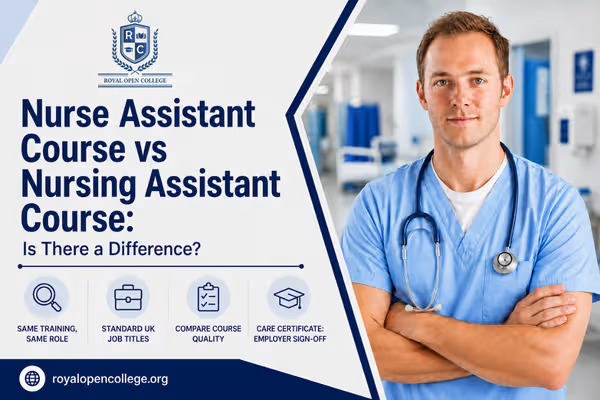
A learner once emailed a training provider asking for a refund. She had finished a nursing assistant course, then spotted a nurse assistant course elsewhere and believed she had studied the wrong one. She had not. Both names describe identical training for the same UK support role, and her certificate held the same value either way.
Her mistake cost her nothing, but the doubt cost her weeks of confidence. This guide removes the doubt in one read. You will learn why two names exist, which one appears in NHS adverts, and the six checks separating strong courses from weak ones.

No. Both names describe the same training for the same unregistered healthcare support role. No UK awarding framework, regulator, or employer treats the two phrases as different qualifications. The difference between any two specific courses comes from the provider, never from the name.
NHS Health Careers confirms the wider point about job titles. Healthcare support workers carry slightly different titles depending on the trust, including healthcare assistant, nursing assistant, and midwifery assistant. The National Careers Service goes further and lists nursing assistant and nursing auxiliary as alternative titles for the healthcare assistant role. The titles belong to one role family.
No. Both names describe the same training for the same unregistered healthcare support role. No UK awarding framework, regulator, or employer treats the two phrases as different qualifications. The difference between any two specific courses comes from the provider, never from the name.
NHS Health Careers confirms the wider point about job titles. Healthcare support workers carry slightly different titles depending on the trust, including healthcare assistant, nursing assistant, and midwifery assistant. The National Careers Service goes further and lists nursing assistant and nursing auxiliary as alternative titles for the healthcare assistant role. The titles belong to one role family.
Course names mirror this. Providers pick whichever phrasing they prefer, and some list several courses for the same role under different names. Hold on to one rule through the rest of this guide: if two courses differ in quality, the cause sits in the modules, the accreditation, and the provider, not in the words nurse and nursing.
Both phrases are correct English descriptions of a course for the same role. Nursing assistant is the established UK job title, while nurse assistant is a simpler construction people naturally type when searching.
The grammar explains the split in two sentences. In nurse assistant, the word nurse acts as a describing word, an assistant connected to nurses. In nursing assistant, the word nursing names the field, an assistant working in nursing. Both make sense, so both survive in everyday use.
Usage follows a clear pattern across the UK:
NHS job adverts and trust career pages use nursing assistant or healthcare assistant.
Job boards like Indeed and NHS Jobs follow the same convention.
Course catalogues mix both, since providers write for searchers as well as employers.
Search habits produce nurse assistant because shorter phrases come to mind first.
American content adds a third layer of confusion.
American content adds a third layer of confusion. US sources use nurse aide and Certified Nursing Assistant (CNA), and these terms leak into UK search results. If you have seen CNA in your research, a later section explains why this credential does not apply in the UK.
UK employers use nursing assistant, healthcare assistant, or healthcare support worker, and none of them treat these names as different qualifications. NHS trusts choose their own job titles, which is the entire reason the variation exists.
Most of these roles sit at NHS Band 2 or Band 3 under Agenda for Change. From April 2026, Band 2 pays £25,272 and Band 3 runs from £25,760 to £27,476, based on NHS Employers pay scales for England. The National Careers Service quotes a matching range of £25,000 for starters rising to £27,000 with experience.
One practical insight follows from this table. Read the duties and requirements in every job advert instead of the title, because two adverts with different titles often describe identical work. Matching your application to the duties wins interviews. Matching to the title wins nothing.
Judge any course on its accreditation, module substance, provider credibility, and refund terms. The name on the sales page tells you nothing about quality. These six checks tell you everything.
Amara ran her two listings through this checklist. The Nurse Assistant Course showed no accreditation body and no refund terms. The Nursing Assistant Diploma named its CPD certification, listed 87 modules, and offered a validation tool. The names told her nothing. The checklist made the decision for her.
No. The Care Certificate is a workplace induction standard assessed by your employer, not a certificate any online course awards. A good course prepares you for the knowledge behind the standards, and your employer signs off your competence on the job.
This distinction matters because many course pages word this misleadingly, and even AI generated search summaries repeat the error. Here is how the Care Certificate works in practice.
The Care Certificate covers 16 standards, expanded from 15 in March 2025. The new Standard 16 covers learning disability and autism awareness, aligned with the Oliver McGowan Mandatory Training requirement. Skills for Care maintains the standards framework.
Your employer enrols you in the Care Certificate during induction.
A supervisor or assessor observes you performing care tasks against each standard.
Your employer signs off each standard once you demonstrate competence.
The full sign off usually completes within your first 12 weeks in post.
An online course teaches you the theory behind safeguarding, infection control, communication, and the other standards. This preparation genuinely helps, since you arrive at induction already knowing the material. But preparation and assessment are different things. Any page claiming a remote course includes or awards the Care Certificate is describing something no provider has the authority to deliver.
Most online nursing assistant courses, under either name, are CPD accredited training rather than Ofqual regulated qualifications. Honest providers state this plainly, and the difference shapes what your certificate does for you.
The definitions take two sentences each. CPD accreditation means an independent body has reviewed the course as structured continuing professional development. Ofqual regulation means the qualification sits on a government framework with set assessment standards, like the NCFE CACHE Level 2 Certificate in Healthcare Support Services offered through apprenticeships.
A fair objection arises here. If CPD courses are not regulated qualifications, do they hold any value at all? They do, within their honest limits.
What a CPD accredited course gives you:
What a CPD accredited course is not:
For context, the Level 2 Adult Social Care Certificate launched in June 2024 as an Ofqual regulated qualification completed through employers. Workplace routes carry the regulated options. Online CPD courses carry the preparation. Both have a place when providers describe them truthfully.

A nursing assistant is an unregistered UK support role. A nursing associate is an NMC registered role with a protected title. A CNA is an American credential with no UK equivalent. Mixing these three titles causes real harm to career planning.
The nursing associate role requires a two year foundation degree and registration with the Nursing and Midwifery Council. The role sits at NHS Band 4, paying £28,392 to £31,157 from April 2026, and bridges the gap between support workers and registered nurses. No short online course leads to this title.
The CNA confusion needs a firm correction. Certified Nursing Assistant is a US credential earned through state approved programmes and state exams. The UK has no CNA register, no CNA exam, and no CNA status. Some UK course providers still sell training using CNA language, and some openly base their content on US standards. Treat any UK page promising CNA certification as a sign to apply the checklist above with extra care.
For a full breakdown of how the nursing assistant role compares with the healthcare assistant role day to day, read our nursing assistant vs healthcare assistant guide.
You apply for nursing assistant or healthcare assistant roles, complete the Care Certificate in post, and build from there. The course is the preparation stage, and the sequence after enrolment follows a predictable path.
The journey runs in this order:
Finish your course
›Apply for Band 2 support roles
›Your employer arranges your DBS check
›Complete workplace induction
›Achieve Care Certificate sign off within around 12 weeks
›Gain experience in post
›Progression from there follows the NHS career ladder:
Nursing assistant or HCA (Band 2)
›Senior healthcare assistant (Band 3)
›Nursing associate via a two year foundation degree (Band 4)
›Registered nurse via a degree or apprenticeship route (Band 5)
›NHS Health Careers confirms this route, noting healthcare support workers train toward assistant practitioner or nursing associate roles, and progress to degree level professions with the right academic evidence. No employer requires a course before you apply, since trusts hire without formal qualifications. The course strengthens your application and shortens your learning curve once you start.
If you are ready to start, the Level 3 Diploma in Nursing Assistant Complete Training from Royal Open College covers 87 modules of CPD accredited preparation, with more than 7,900 learners enrolled and a certificate validation tool employers check in seconds. Enrol, prepare, and walk into your first care role ready.

A: Yes. Both names describe the same unregistered healthcare support role in the UK. Neither title is protected, and employers treat them as one role family alongside healthcare assistant.
A: Neither name carries more weight. Employers read the course content, the accreditation, and the provider, so a well structured course under either name serves your CV equally.
A: No. Anyone working in a support role uses whichever title their employer assigns. Nursing associate and registered nurse are the protected, NMC registered titles.
A: No. CNA is an American state credential with no UK register or exam. The UK route is a healthcare assistant or nursing assistant role plus the Care Certificate completed with your employer.
A: No law or employer rule requires one. NHS trusts hire support workers without formal qualifications, though a structured course strengthens your application and prepares you for interviews.
A: No. Your employer assesses all 16 Care Certificate standards in the workplace and signs off your competence. An online course prepares you for the knowledge behind those standards.
A: Most online courses under either name are CPD accredited, not Ofqual regulated. Check the provider’s accreditation page for the named certifying body before you enrol.
A: They belong to the same training family under different labels, since both prepare you for the same support role. Compare modules and accreditation rather than the titles.
All Categories
Top Courses

Health Care

Health and Social Care
The order of draw sets the sequence for filling blood tubes. Learn why the sequence exists, how additive carryover changes results, what research shows for vacuum tubes and syringes and why UK hospital charts differ. Butterfly and capillary rules and the steps after a mistake follow.

Venepuncture takes a blood sample, and the needle comes out. Cannulation leaves a small tube in the vein for treatment. This guide compares what each procedure involves, what needs checking afterwards and how long a cannula stays in. You also learn who is allowed to perform each in the UK, and how training and workplace sign-off usually work in practice.

Book safeguarding children Level 3 training by matching each role to sector guidance and employer policy. Choose a course your employer accepts, enrol each person and record completion dates. Level 3 is a competency level, not a single national qualification. Requirements differ between health, education and care settings.






Royal Open College provides high-quality online courses covering a variety of topics along with certificates issued by top organisations.
Quickly and easily check the validity of your
Royal Open College course certificates with Royal Open College’s Course Certificate Validator tool.


Payment methods possible


Copyright © 2026 Royal Open College. All Right Reserved.
Offer Ends In!
Copy Your Coupon
Added to cart
Check out our shop to see what's available
Not a member yet? Register now
Are you a member? Login now