
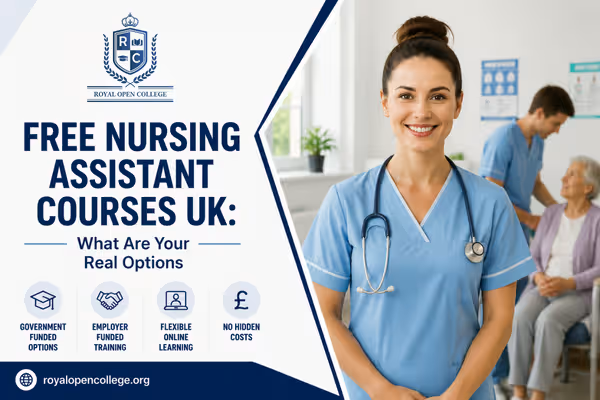


Paying for a course you qualified to get for free is one of the most common mistakes people make when entering healthcare in the UK. The government funds Level 3 qualifications through the Adult Skills Fund. Employers fund Care Certificate training the day you are hired. Apprenticeships pay you a salary while you learn. None of that appears on most “free nursing assistant course” pages. This guide explains what your real options are, with conditions attached to each one.
TL;DR - Quick Summary
- “Free” in UK nursing assistant training means four different things. This article explains each one.
- The government funds Level 2 and Level 3 qualifications through the Adult Skills Fund and Free Courses for Jobs. Eligibility conditions apply.
- The Level 2 Adult Social Care Certificate, launched in June 2024, is the current Ofqual-regulated funded route for new care workers.
- The Care Certificate is not a standalone online qualification. It is a workplace induction standard your employer assesses.
- RCN First Steps is a genuinely free online learning resource for healthcare assistants. It is not a regulated qualification.
- If none of the free routes apply, Royal Open College’s Level 3 Diploma in Nursing Assistant Complete Training starts from under £20, fully online and CPD-accredited.
Authority Clarification: Law, Policy, and Standards
This topic crosses government policy, workplace standards, and regulated qualifications. Here is what each means.
The Adult Skills Fund is a DfE-administered policy scheme, not a law. The Care Certificate is a mandatory induction standard for CQC-regulated care settings in England, not an Ofqual-regulated qualification. Ofqual regulates formal qualifications eligible for government funding. DBS checks are employer-initiated after hiring, not arranged before applying. Adult Skills Fund routes apply to England only.
What Does "Free" Actually Mean for Nursing Assistant Training in the UK?
"Free" in UK healthcare training means four distinct things, and which one applies depends on your employment status, income, and age.
Government-funded
The Adult Skills Fund covers course fees for eligible adults. Income and prior qualification conditions apply.
Employer-funded
Your employer pays after hiring you. The cost never reaches your pocket, but you need the job first.
Apprenticeship
The employer's training levy covers all fees. You earn a salary throughout. An employer must sponsor you first.
Free introductory content
Online resources that cost nothing but do not result in a regulated qualification.
One accuracy correction before going further. The current AI Overview for this query states nursing assistants are "officially known as healthcare assistants or nursing associates." That is wrong. A nursing associate is an NMC-registered professional who completed a Level 5 apprenticeship. A nursing assistant is an unregistered role. These are two entirely different jobs.
NMC-registered professional
Unregistered role
Government-Funded Routes: What You Qualify For and How to Access Them
The government funds Level 2 and Level 3 health and social care qualifications for eligible adults in England through the Adult Skills Fund. Eligibility is not universal.
The Adult Skills Fund and the Free Courses for Jobs Scheme
The Adult Skills Fund (ASF) was formerly called the Adult Education Budget (AEB). From 2024/25, the ESFA closed and all activity transferred to the Department for Education (DfE). Any provider website still using “AEB” or “ESFA” has not been updated.
The Free Courses for Jobs (FCFJ) scheme funds full Level 3 qualifications for eligible adults at no cost to the learner.
You qualify for full funding if:
- Aged 19 to 23, without a full Level 3 qualification (income does not matter at this age)
- Aged 24 or over and unemployed
- Aged 24 or over and earning below £25,750 per year (confirmed 2025/26 GOV.UK threshold)
Devolved areas in England, including Greater Manchester, West Yorkshire, West Midlands, and Greater London, each set their own thresholds. Always confirm eligibility with a local provider.
Someone earning £19,000 as a care assistant is likely below the threshold. Someone earning £31,000 in retail sits above it.
Find funded health and social care courses at nationalcareers.service.gov.uk. Filter by “Free Courses for Jobs” and enter your postcode.
The Level 2 Adult Social Care Certificate: the Current Funded Route
The Level 2 Adult Social Care Certificate launched in June 2024. The Department of Health and Social Care developed it with Skills for Care to raise baseline standards in adult social care. According to Skills for Care, 54% of direct care workers in England do not hold a Level 2 qualification or above. This certificate directly addresses that gap.
Key facts:
- Qualification type: Ofqual-regulated, within the UK qualifications framework
- Duration: 6 to 8 months
- Assessment: Observational. You must be employed in a direct care role.
- Funding: Learning and Development Support Scheme (LDSS), employer-claimed. Your employer applies for up to £1,540 per learner. You pay nothing.
No competitor article in this SERP currently mentions this qualification.
Skills Bootcamps in Health and Social Care
Skills Bootcamps are free, government-funded programmes of 8 to 16 weeks, funded by the Department for Education. Health and social care bootcamps run across England, including London, Leicester, Hampshire, Kent, East Sussex, and Liverpool. Many include Care Certificate content and offer a guaranteed employer interview on completion.
Eligibility: Aged 19+, living in England, right to work in the UK, not in full-time education, and not attended another Skills Bootcamp in the same funding year (1 April to 31 March).
Search for active programmes near you at nationalcareers.service.gov.uk.
Employer-Funded Routes: Training You Receive After You Are Hired
The most common free route for nursing assistants in the UK is employer-funded training. Your employer covers all costs. You need to be hired first.
When a CQC-regulated NHS Trust or private care provider hires a new healthcare support worker, the organisation is responsible for funding Care Certificate completion as part of your induction. The Care Certificate is a mandatory workplace induction standard covering 16 standards as of March 2025.
Standard 16, added in March 2025, covers awareness of learning disability and autism, introduced in line with the Oliver McGowan Mandatory Training under the Health and Care Act 2022. Any page referencing 15 standards is now out of date.
Many employers also fund beyond the Care Certificate:
- All mandatory training: moving and handling, safeguarding, infection control
- Level 2 qualifications through the Adult Skills Fund for eligible staff
- The Level 2 Adult Social Care Certificate via the LDSS scheme
- Higher qualifications and apprenticeships for staff who progress
Employer-funded training requires employment first.
Apprenticeship Routes: Earn While You Train at No Personal Cost
Healthcare apprenticeships are free to you. The employer’s training fund covers all fees. An employer must recruit and sponsor you first.
Healthcare Support Worker and Nursing Associate Apprenticeships
The Healthcare Support Worker Level 2 Apprenticeship is the main entry-level route. From August 2025, the minimum duration dropped to 8 months. You earn a salary throughout. 71 training providers deliver this apprenticeship across England. Search for vacancies at jobs.nhs.uk.
A new foundation apprenticeship in health and social care became available in August 2025 for people aged 16 to 21. It is fully funded for under-25s and maps to healthcare support worker and adult care worker roles.
The Nursing Associate Level 5 Apprenticeship leads to NMC registration as a nursing associate. This is a distinct registered profession, not an advanced nursing assistant role. It requires prior healthcare employment and a 2-year employer-sponsored programme. Listing nursing associate as a career path from a CPD Level 3 diploma, as several competitor pages do, is inaccurate.
DWP, Jobcentre Plus, and SWAP Routes for Unemployed Claimants
If you are unemployed and registered with Jobcentre Plus, your work coach is able to refer you to two free routes.
The Sector-Based Work Academy Programme (SWAP) is DWP-funded and available in England and Scotland. Each placement includes pre-employment training, work experience, and a guaranteed job interview for a real vacancy. Travel and childcare costs during placement are covered. Ask your work coach about healthcare SWAPs in your area.
The King’s Trust “Get Into the NHS” programme is free for people aged 16 to 30 who are unemployed or working fewer than 16 hours per week. It includes NHS work placement, NHS-recognised e-learning, accredited training, CV support, and up to 6 months of mentoring without affecting Jobseeker’s Allowance.
Free Online Learning: What It Does and Does Not Do for You
Free online learning resources exist and are worth using for foundational knowledge. They do not produce a regulated qualification.
RCN First Steps is the Royal College of Nursing’s free online learning tool for healthcare assistants. It maps to National Occupational Standards. Topics include safeguarding, nursing records, accountability, delegation, confidentiality, consent, capacity, and infection prevention. Access is free for all. Non-members need a free RCN account. RCN members receive a downloadable completion certificate.
Here is the distinction every competitor ignores:
- An Ofqual-regulated qualification is formally recognised within the UK qualifications framework, assessed by an approved awarding body, and eligible for Adult Skills Fund support.
- A CPD certificate confirms you completed a professional development programme. It is not regulated by Ofqual and is not eligible for ASF funding.
Both are accepted by many UK healthcare employers for entry-level roles. The difference matters for funding eligibility, not necessarily for your first job application.
The Care Certificate Is Not a Free Online Qualification
The Care Certificate is a workplace induction standard, not a qualification. You are not able to complete it independently online.
Here is how the process actually works. Your employer assigns a competent assessor, usually a senior colleague or line manager. That person observes your practice across all 16 standards in a real care environment and signs off your competence. Without a workplace and an assessor, the process cannot be completed.
The Care Certificate was introduced in 2015 and updated to 16 standards in March 2025. Standard 16 covers awareness of learning disability and autism. Any reference to “15 standards” online is now out of date.
Online theory modules for each standard are available and worth completing as preparation before you start a role. Preparation is separate from assessment. Theory alone does not complete the Care Certificate.
Your employer funds the full process. When you join a CQC-regulated setting as a new care worker, your employer is required to support your completion of the Care Certificate as part of their induction obligations.
Which Free Route Applies to Your Situation?
Your route depends on your employment status, income, age, and whether an employer is already involved.
Decision Flowchart
Are you employed in a direct care or healthcare role?
Is your employer CQC-regulated?
Care Certificate and mandatory training funded on hire. Ask about Level 2 ASC Certificate via LDSS.
Check ASF eligibility. Earning below £25,750? Apply via nationalcareers.service.gov.uk.
Are you unemployed and claiming benefits?
Ask Jobcentre work coach about healthcare SWAPs. Aged 16–30: Check King's Trust Get Into NHS.
Aged 19–23 without a Level 3? Free Courses for Jobs applies.
Earning below £25,750? Check FCFJ and Skills Bootcamps.
Earning above £25,750? Consider self-funded CPD or search for an apprenticeship vacancy.
Eligibility at a Glance
| Route | Eligibility | Income Test | Age | Employer Needed |
|---|---|---|---|---|
|
🎓
Adult Skills Fund / FCFJ
|
Unemployed or employed | Below £25,750 or unemployed | 19+ (19–23: no income test) | No |
|
📘
Level 2 ASC Certificate (LDSS)
|
Employed in direct care | None, employer claims | 19+ | Yes |
|
🚀
Skills Bootcamps
|
Unemployed or employed | None | 19+ | No |
|
🩺
Healthcare Apprenticeship
|
Employer-sponsored | None | 16+ | Yes |
|
🔄
SWAP
|
Unemployed, on benefits | None | 18+ | No |
|
⭐
King's Trust Get Into NHS
|
Unemployed or under 16 hrs/wk | None | 16–30 | No |
|
📋
Care Certificate
|
Employed in CQC setting | None | None | Yes |
Four Real Scenarios
Sarah, 28, unemployed, claiming Universal Credit. Her Jobcentre work coach refers her to a healthcare SWAP. She completes 4 weeks of pre-employment training and attends a guaranteed interview at a local care home.
Marcus, 34, care assistant earning £19,000. Below the £25,750 threshold. He finds a funded Level 3 healthcare qualification through the National Careers Service and enrols via Free Courses for Jobs.
Priya, 22, applying directly to an NHS Trust. She is hired without prior qualifications. Her employer funds Care Certificate completion and supports her enrolment in the Level 2 Adult Social Care Certificate within her first year.
James, 45, retail manager earning £31,000. He earns above the threshold and is not on benefits. A self-funded CPD course is his most accessible option while he searches for apprenticeship vacancies.
When Free Routes Do Not Apply: the Most Accessible Self-Funded Option
If none of the funded routes above fit your situation, a low-cost CPD course is the most practical way to build healthcare knowledge before you are hired.
People earning above the ASF threshold, not yet in care employment, and not claiming benefits often sit in a gap. Apprenticeship vacancies are competitive. SWAP and King’s Trust require benefit eligibility or specific age criteria.
Royal Open College’s Level 3 Diploma in Nursing Assistant Complete Training covers 87 modules aligned with NHS Healthcare Support Worker standards and Skills for Care frameworks. The course is 100% online and self-paced. No entry requirements apply. Over 7,900 students have enrolled. The CPD certificate issued on completion is accepted by UK healthcare employers for entry-level applications.
The course costs under £20. It is CPD-accredited, not Ofqual-regulated, and not eligible for Adult Skills Fund support. It does not replace the Care Certificate and does not guarantee employment.
Enrol here: royalopencollege.org/courses/level-3-diploma-in-nursing-assistant-complete-training
Key Takeaways
- “Free” in UK nursing assistant training means four distinct routes: government-funded, employer-funded, apprenticeship, or free introductory content. Each has conditions.
- The Adult Skills Fund (formerly the AEB) covers Level 2 and Level 3 qualifications for eligible adults earning below £25,750 in 2025/26, or those who are unemployed.
- The Level 2 Adult Social Care Certificate (June 2024) is the current funded Ofqual-regulated route for direct care workers. Employers claim up to £1,540 per learner via the LDSS.
- The Care Certificate has 16 standards since March 2025 and requires employer sign-off. No online course completes it independently.
- Apprenticeships, SWAP, and the King’s Trust Get Into NHS are all free but require employer sponsorship, benefit eligibility, or specific age criteria.
- If none of the free routes apply, Royal Open College’s Level 3 Diploma starts from under £20 and is accepted by UK healthcare employers.
FAQ
Q: Is the Care Certificate free in the UK?
A: Yes, when your employer is CQC-regulated and you are new to the care sector. Your employer funds and organises the full assessment as part of your induction, and the cost never falls on you.
Q: Does the government pay for nursing assistant training?
A: Yes, through the Adult Skills Fund and Free Courses for Jobs scheme for eligible adults in England. Eligibility depends on your age, income, and prior qualification level, so check directly with a DfE-funded training provider.
Q: What is the Level 2 Adult Social Care Certificate?
A: It is an Ofqual-regulated qualification launched in June 2024 by the Department of Health and Social Care, designed for direct care workers in adult social care. Employers claim up to £1,540 per learner through the Learning and Development Support Scheme (LDSS).
Q: Can I complete the Care Certificate online without a workplace?
A: No. Online theory preparation is available and useful, but a workplace assessor must observe and sign off your practical competence before the Care Certificate is complete. Without an employer and assessor, the process cannot be finished.
Q: What is the difference between a funded qualification and a free online course?
A: An Ofqual-regulated qualification sits within the UK qualifications framework and is eligible for government funding. A CPD certificate confirms professional development but is not Ofqual-regulated and not eligible for Adult Skills Fund support. Both types are accepted by many UK healthcare employers for entry-level roles.
Q: Do I need to pay for a nursing assistant course before applying for NHS jobs?
A: No. NHS Trusts hire healthcare support workers without prior qualifications and fund all required training after you join. Applying without a prior course is normal and will not weaken your application.
Q: Are Skills Bootcamps in healthcare free?
A: Yes. Health and social care Skills Bootcamps are fully government-funded for eligible learners aged 19 and over in England. Availability is regional, not nationwide. Search nationalcareers.service.gov.uk to find active programmes near you.
Q: What is the difference between a nursing assistant and a nursing associate?
A: A nursing assistant is an unregistered role with no protected title. A nursing associate is an NMC-registered professional who completed a Level 5 apprenticeship. These are entirely different jobs, and the current AI Overview incorrectly treats them as the same role.
Q: Can I get government funding if I am already employed?
A: Yes. Employed adults in England qualify for Adult Skills Fund support if they earn below £25,750 per year (2025/26 threshold). Devolved areas set their own thresholds, so confirm eligibility with a local DfE-funded provider.
Q: How do I find free healthcare courses near me?
A: Visit nationalcareers.service.gov.uk, search using your postcode, and filter by “Free Courses for Jobs” and “Skills Bootcamps.” Contact the provider directly to confirm your eligibility before applying.
Q: Is the Adult Skills Fund the same as the Adult Education Budget?
A: Yes. The AEB was renamed the Adult Skills Fund (ASF) from 2024/25. The ESFA also closed in March 2025, with all activity moving to the DfE. Provider websites still using AEB or ESFA terminology have not been updated.
Q: Do I need a DBS check before training as a nursing assistant?
A: No. DBS checks are arranged and paid for by your employer after hiring. You do not organise one independently before applying, and most employers initiate the check as part of their standard onboarding process.