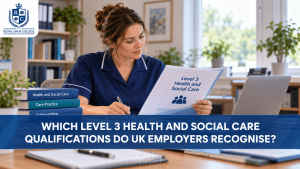









Sarah searches “NHS healthcare assistant jobs” one afternoon. Three training provider websites appear at the top. Each one tells her the same thing: she needs a Level 3 Health and Social Care qualification before she applies. One course costs £299. Another promises she will be “NHS-ready” in four weeks. She closes the laptop, unsure whether to spend the money or hold off.
Here is what those sites will not tell you. NHS England’s own published guide for prospective healthcare support workers states this directly: “There are no set entry requirements to become a HCSW; an individual’s personal skills and values are most vital to success in the role.” Not a diploma. Not an NVQ. Not a Level 3 certificate of any description.
This guide gives you the NHS-sourced answer. You will find out what qualifications matter, what the Care Certificate involves, when Level 3 genuinely helps your career, and how to read an NHS Jobs listing so you know exactly what a specific role needs before you apply.
TL;DR: The Short Answer
- NHS England confirms there are no set entry requirements for healthcare support worker roles. You do not need Level 3 before you apply.
- The Care Certificate is a 16-standard induction framework you complete after joining. Your employer awards it during your induction period, not before.
- Level 3 adds real value for Band 3 roles and career progression. For most Band 2 entry posts, Level 3 is not listed as an essential requirement.
- A CPD-accredited online Level 3 certificate is not the same as an Ofqual-regulated RQF qualification. NHS employers treat them differently.
Do You Need a Level 3 to Work as an NHS Support Worker?
NHS England’s published guide on becoming a healthcare support worker states the position clearly: “There are no set entry requirements to become a HCSW.” Health Careers NHS, the official NHS careers website, confirms the same. No formal qualification requirement exists for most NHS healthcare support worker entry posts.
This does not mean qualifications are irrelevant. They are not a formal condition for applying. Individual NHS Trusts write their own person specifications. Some Band 3 posts list Level 3 as desirable. Desirable and essential are two entirely different things.
Here is what separates them:
- Essential criteria are minimum requirements. Without meeting an essential criterion, your application will not reach the interview stage.
- Desirable criteria are preferences. Not meeting a desirable criterion does not block your application or remove your eligibility.
- Level 3 Health and Social Care rarely appears in the essential column for entry-level Band 2 posts.
The Care Certificate is the formal induction standard all new NHS healthcare support workers work toward after they join their employer. Your employer delivers and awards the certificate during your induction. You do not need to hold the Care Certificate before applying.
Commercial training providers have a financial interest in telling you to buy a Level 3 course before you apply. The NHS does not require one. Check the actual person specification on NHS Jobs for the specific role you want. You will see this for yourself.
What Is an NHS Support Worker Role?
Healthcare Support Worker, shortened to HCSW, is the umbrella term the NHS uses across a range of clinical and patient-facing support roles. Your job title depends on the Trust you join and the setting you work in. Titles reflect the setting, not your qualification level.
Common NHS job titles include:
- Healthcare Assistant (HCA)
- Clinical Support Worker (CSW)
- Nursing Assistant
- Maternity Support Worker (MSW)
- Theatre Support Worker
- Mental Health Support Worker
HCSWs work closely with registered nurses, midwives, and allied health professionals. Duties vary by setting. In a hospital ward you monitor vital signs, assist with personal hygiene, support patient mobility, take blood samples, and complete basic documentation. In a GP surgery you perform health checks, process lab samples, sterilise equipment, restock consulting rooms, and share health information with patients and carers.
The scope of HCSW roles extends well beyond ward-based nursing support. HCSWs work alongside physiotherapists, radiographers, podiatrists, occupational therapists, speech and language therapists, and dieticians. Most online content overlooks this breadth entirely.
One important distinction: “support worker” is a broad term used across the NHS, adult social care, and private care settings. An NHS HCSW operates within NHS employment standards, the Agenda for Change pay framework, and the Care Certificate induction system. Social care support workers operate under a different framework with different entry routes. This guide focuses on NHS roles specifically.
Where Do NHS Support Workers Work?
What Are the Actual Entry Requirements for NHS Support Worker Roles?
The NHS does not set a universal qualification requirement for HCSW roles. What the NHS does require is a set of pre-employment checks every successful candidate goes through. These are the six NHS employment check standards.
The Six NHS Employment Check Standards
- Identity check: confirmation of who you are using government-issued photographic identification
- Right to work: proof of your legal right to work in the UK
- Professional registration and qualification check: applies only where the specific post requires a qualification or professional registration
- Employment history: your employment or training history for the past three years, with references where available
- Criminal record check: a Disclosure and Barring Service (DBS) check, a legal requirement for all patient-facing NHS roles
- Work health assessment: a self-report health screening to confirm fitness for the role
A DBS check is a legal pre-employment requirement. Level 3 Health and Social Care does not appear on this list.
For most Band 2 entry posts, the key criteria are your values, communication skills, and basic literacy and numeracy. GCSEs in English and maths are helpful and occasionally specified by individual Trusts. NHS England describes them as “in some cases required,” not universally essential. Values-based recruitment is standard across NHS Trusts. At interview you demonstrate NHS values: compassion, respect, teamwork, and reliability. Examples from paid work, voluntary experience, or personal life are all accepted and actively encouraged.
What Happens on Your First Day?
New HCSW starters are classed as supernumerary during their induction period. This means you observe, shadow, and build confidence before you take on tasks independently. You are not expected to arrive fully competent. NHS England confirms this clearly in its published HCSW guide.
Your Trust allocates a mentor on your ward or in your department. A HCSW development educator offers pastoral support. Regular peer support visits happen during your first weeks. You begin working toward your Care Certificate during this induction period. The busy environment of a clinical area is structured around you learning, not performing from day one.
What Is the Care Certificate and How Does It Relate to Level 3?
The Care Certificate is the national induction standard for all new healthcare support workers in England. You do not need to hold it before applying for any NHS HCSW role. Your employer delivers and awards it after you join.
The Care Certificate was developed jointly by Health Education England, Skills for Care, and Skills for Health. In March 2025, the standards were updated alongside the introduction of the new Level 2 Adult Social Care Certificate qualification. The update was co-produced by the Department of Health and Social Care, NHS England, Skills for Care, and Skills for Health.
The Care Certificate now covers 16 standards. Many online sources still state 15. That figure is outdated as of March 2025. Standard 16, covering Awareness of Learning Disability and Autism, was added to reflect requirements under the Health and Care Act 2022.
All 16 standards require both theoretical learning and workplace-based practical assessment. You do not complete the Care Certificate through an online exam alone. An employer assessor observes you performing real care activities before the certificate is awarded. External training providers do not sign off the Care Certificate on behalf of your employer. Final sign-off is always the employer’s responsibility.
The Care Quality Commission reaffirmed in December 2022 that CQC expects the Care Certificate to be in use across all health and social care providers. CQC looks for evidence of Care Certificate completion under its safe staffing quality statement.
Care Certificate vs Level 3: What Is the Difference?
Feature | Care Certificate | Level 3 RQF Diploma |
What It Is | Induction framework | Regulated vocational qualification |
Purpose | Baseline competence for new starters | In-depth knowledge and practical skills |
When You Gain It | After joining, during induction | Through study or apprenticeship |
Awarded By | Your employer | An Ofqual-regulated awarding body |
Regulatory Status | Non-accredited, CQC-expected | Ofqual-regulated, listed on the RQF Register |
Replaces The Other | No | No |
The Care Certificate and a Level 3 Diploma serve different purposes at different stages of a HCSW career. Neither replaces the other.
CPD Certificate vs RQF Qualification: Does It Matter to the NHS?
Not all Level 3 Health and Social Care courses carry the same weight. The label “Level 3 Diploma” appears on courses with different regulatory status. The difference matters when NHS employers assess your application.
Three types dominate the market:
- Ofqual-regulated RQF qualifications: These appear on the Regulated Qualifications Framework. Ofqual, the Office of Qualifications and Examinations Regulation, regulates them. Each carries a unique qualification number and is listed on the Ofqual Register. These are formal, regulated qualifications that NHS Trusts recognise.
- CPD-accredited courses: CPD stands for Continuing Professional Development. A CPD-accredited label confirms a course meets professional learning standards. CPD accreditation does not mean the course is Ofqual-regulated or appears on the Register of Regulated Qualifications.
- QLS-endorsed courses: The Quality Licence Scheme endorsement confirms academic quality. QLS endorsement is not the same as Ofqual regulation.
How to Verify Whether a Qualification Is Ofqual-Regulated
Follow these steps before purchasing any Level 3 course:
- Go to register.ofqual.gov.uk
- Search for the qualification title
- Look for a regulated qualification number in the results
- A result with a qualification number confirms Ofqual regulation
- No result means the course holds CPD or QLS status only
A CPD-accredited course has genuine value. It demonstrates professional commitment and covers relevant subject matter. For a Band 2 entry role where Level 3 does not appear on the person specification, a CPD course strengthens your CV without adding unnecessary cost.
For a Band 3 post where the person specification requires “a regulated Level 3 Diploma in Healthcare Support,” only an Ofqual-regulated RQF qualification satisfies the requirement. A CPD certificate does not meet a specification written in those terms.
NHS Trusts assess qualifications based on regulatory status and alignment with the NHS Knowledge and Skills Framework. Always check the specific person specification before purchasing any course.
Band 2 vs Band 3: What Do NHS Pay Bands Mean for Qualifications?
Quick Table
Points | Band 2 | Band 3 |
Typical Roles | Healthcare Assistant, Nursing Auxiliary, CSW | Senior HCA, Emergency Care Assistant, CSW Higher Level |
Starting Salary (England) | £23,615 (2025-26) | £24,937 (2026-27) |
Level 3 On Person Spec | Rarely listed as essential | Sometimes listed as desirable |
How Level 3 Is Gained | Rarely needed at entry | On the job or via apprenticeship after joining |
Typical Entry Route | Direct application | Progression from Band 2 with experience |
Agenda for Change does not set qualification requirements for individual roles. Each NHS Trust writes its own person specifications. Always read the specific listing for the specific post.
How to Check What a Specific NHS Trust Requires
Go to jobs.nhs.uk. Search for the role title and your preferred location. Open the full job listing and download the person specification document separately from the job description. In the person specification, look at the essential and desirable columns. The essential column tells you what you must have to be shortlisted. The desirable column tells you what strengthens your application without blocking you from applying.
When Does Level 3 Actually Help?
Level 3 is not a pre-employment gate for most NHS support roles. In specific situations, a regulated Level 3 qualification is a genuine and practical career asset.
Level 3 Adds Real Value When:
- You are applying for a Band 3 post where Level 3 or equivalent experience is listed as desirable and you want to present the strongest possible application
- You already work at Band 2 and want to prepare for progression to Band 3 or a specialist support role
- You are competing in a large candidate pool where a regulated qualification helps you stand out alongside strong applications from equally experienced candidates
- You plan to pursue Nursing Associate training or a Registered Nursing Degree Apprenticeship, where a track record of academic commitment strengthens your case
Level 3 Adds Less Value When:
- You are applying for a standard Band 2 entry post where Level 3 does not appear on the person specification at all
- You are considering spending money on a CPD-accredited online course before applying, under the belief this changes your eligibility for roles where Level 3 is not required
The most cost-effective route for most people is clear. Apply for Band 2 roles without prior Level 3 qualification. Join the NHS. Complete the Care Certificate during induction. Pursue Level 3 through employer-funded routes while earning a salary.
The NHS funds your progression from within. Waiting until you are inside the system to pursue Level 3 saves you money and gives you workplace evidence to strengthen your qualification portfolio at the same time.
How to Get Level 3 While Working as an NHS Support Worker
The NHS provides structured qualification pathways for staff already in post. You do not need to fund or complete Level 3 training before you join.
Level 2 Healthcare Support Worker Apprenticeship
Level 3 Senior Healthcare Support Worker Apprenticeship
This is the progression standard for experienced HCSW staff ready to move toward Band 3 and beyond. In 2024, the funding for this apprenticeship increased to a maximum of £9,000. Previously capped at £5,000, the lower amount made quality delivery difficult and caused some providers to stop offering it. The higher funding has widened access. 101 approved training providers currently offer this apprenticeship across England.
The Level 3 apprenticeship has six specialist pathways:
- Adult Nursing Support
- Maternity Support
- Mental Health Support
- Theatre Support
- Children and Young People
- Allied Health Profession Therapy Support
End-point assessment includes a two-hour observed practice session with questions and a 60-minute professional discussion supported by a portfolio of evidence. The apprenticeship awards a regulated Level 3 Diploma in Healthcare Support on completion.
Many NHS Trusts also offer trust-funded training, in-house development programmes, and the Higher Development Award, a personal development programme for NHS support workers at all levels designed to build readiness for further progression.
Find live apprenticeship vacancies at jobs.nhs.uk and at findapprenticeshiptraining.apprenticeships.education.gov.uk.
Can I Progress Beyond Band 3 Without a Degree?
Yes. The NHS provides structured routes beyond Band 3 without a traditional university application. Nursing Associate training runs through a Level 5 apprenticeship at Band 4. The Registered Nursing Degree Apprenticeship opens the pathway to Band 5. Foundation degrees and allied health professional routes are also accessible through employer support. Your Trust’s education and development team is the right starting point for guidance on what is available in your area.
Summary: What to Do Next
The position is straightforward. You do not need a Level 3 qualification before you apply for most NHS support worker roles.
Your next step depends on where you are right now:
No formal health or social care qualifications: Search NHS Jobs for Band 2 Healthcare Assistant or Clinical Support Worker roles in your area. Open the person specification. Check the essential criteria. Apply if you meet them. The NHS recruits on values, attitude, and basic skills for most entry-level posts.
You hold a CPD-accredited Level 3 certificate: Include it on your application as evidence of professional commitment and subject knowledge. Understand it carries different regulatory weight than an Ofqual-regulated RQF diploma. For most Band 2 roles, it strengthens your application without being listed as a requirement.
You hold an Ofqual-regulated Level 3 RQF Diploma: You are well placed for both Band 2 entry roles and Band 3 posts where Level 3 appears as desirable on the person specification. Your qualification carries formal regulated status and is recognised across NHS Trusts.
Once you are in post, speak to your Trust’s education and development team about funded apprenticeship routes and in-house training programmes. The most affordable and practical route to Level 3 and beyond runs through your employer, not a course purchased before you ever start.
Search for NHS Healthcare Support Worker roles at jobs.nhs.uk and find career guidance and entry information at healthcareers.nhs.uk.
Frequently Asked Questions
Q: Can I apply for an NHS support worker job without any qualifications?
A: Yes. NHS England states there are no set entry requirements for healthcare support worker roles. The practical criteria for most Band 2 posts are your values, basic literacy and numeracy, and a clear DBS check.
Q: What is the Care Certificate and do I need it before I apply?
A: The Care Certificate is a 16-standard induction framework you complete in the workplace after joining an NHS employer. Your employer delivers and awards it during your induction period, so you do not need to hold it before applying.
Q: Is an online CPD Level 3 Health and Social Care diploma recognised by NHS employers?
A: CPD-accredited courses are not Ofqual-regulated qualifications and do not appear on the Register of Regulated Qualifications. When a Band 3 post specifically requires a regulated Level 3 Diploma, a CPD certificate does not meet that specification.
Q: Do I need Level 3 for a Band 3 NHS support worker role?
A: Some Band 3 person specifications list Level 3 as desirable, not essential, and many Trusts will actively support you to gain the qualification on the job. Many Band 3 staff progressed from Band 2 and completed Level 3 through the Senior Healthcare Support Worker apprenticeship after joining.
Q: What is the difference between a Level 2 and Level 3 NHS apprenticeship for support workers?
A: The Level 2 Healthcare Support Worker apprenticeship is the entry-level standard, now taking as little as eight months from August 2025. The Level 3 Senior Healthcare Support Worker apprenticeship is the progression standard for experienced staff moving toward Band 3 responsibilities and beyond.
Q: How long does the Care Certificate take to complete?
A: The Care Certificate is typically completed within a 12-week induction period, though timescales vary between NHS Trusts. The certificate requires both theoretical learning and practical workplace assessment, and your employer confirms competence in all 16 standards before awarding it.
Q: Can my social care Level 3 experience count toward NHS support worker roles?
A: Social care experience is valued and relevant to NHS employers. Whether a specific qualification from a social care setting is accepted depends on the individual Trust’s person specification, so check the listing for the specific role you are applying for.
Q: What does "desirable" mean on an NHS person specification?
A: Desirable criteria are preferences, not requirements. A candidate who meets all essential criteria and lacks a desirable qualification is fully eligible for interview and competitive for the role.
Q: Can I become a nurse if I start as an NHS support worker?
A: Yes. NHS Trusts actively support HCSWs into nursing through the Registered Nursing Degree Apprenticeship, secondments, and university degree routes. HCSW experience is a well-recognised and valued pathway into registered nursing across the NHS.
Q: What is the NVQ Level 3 in Health and Social Care and is it still valid?
A: NVQ Level 3 is a legacy term widely used in conversation and on older job descriptions. Current regulated qualifications use the Regulated Qualifications Framework (RQF) and are titled Level 3 Diploma in Health and Social Care or equivalent. Both are Ofqual-regulated, and employers recognise them as equivalent.
Q: Do NHS Trusts fund Level 3 qualifications for existing staff?
A: Many NHS Trusts offer funded apprenticeship routes and in-house training for staff already in post. The Level 3 Senior Healthcare Support Worker apprenticeship, funded at up to £9,000, is the primary structured route. Speak to your Trust’s education and development team about available options in your area.
Q: Where should I look for NHS support worker vacancies?
A: NHS Jobs at jobs.nhs.uk is the primary source for all NHS Trust vacancies in England. Health Careers NHS at healthcareers.nhs.uk provides role guidance, entry information, and links to live vacancies. Individual NHS Trust websites also advertise their own recruitment directly.