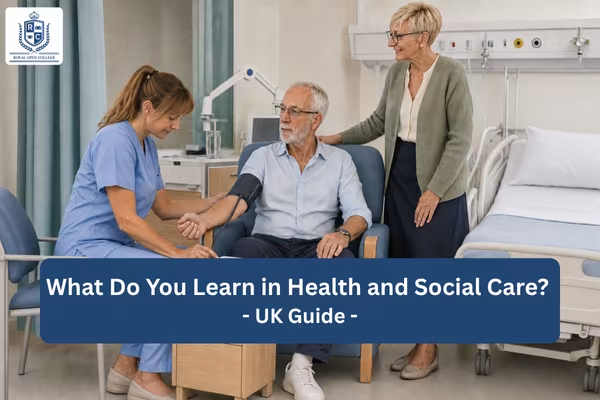
You learn how to support people, and how to do it safely. That covers communication, safeguarding, respecting someone’s choices, infection control, and enough about the body and mind to notice when something changes.
Another important area is care law, consent, records and confidentiality. How far you go depends on the route. A degree, an apprenticeship, an employer induction and a CPD course such as Royal Open College’s Health and Social Care Level 3 Diploma can cover similar ground and lead to different forms of recognition. Rules differ across the four UK nations too.
Quick Recap
What does health and social care actually mean?
Health and social care brings together health services that support physical and mental health with social care that supports daily living, independence, choice and wellbeing.
In reality, the two overlap. Someone leaving hospital may need help with washing, cooking or managing medicines at home, and much of that support sits within social care rather than medical treatment.
Course content reflects the overlap. You study the body and the mind alongside rights, dignity, communication and person-centred support.
Examples tend to be drawn from a range of settings: care homes, hospitals, home care, supported living and community services.
Those settings do not work in the same way. Consent matters everywhere, but how it is applied depends on the person's needs, the setting and the type of support involved.
You also learn who uses these services: older people, people with physical or learning disabilities, people with mental health needs, and children and families.
Needs vary widely within every group. Good care responds to the individual rather than assuming that everyone with a similar condition needs the same support.
Courses may also cover how care is arranged and funded. Depending on circumstances, support can be publicly funded, privately funded or provided informally by unpaid carers.
What subjects commonly appear in health and social care courses?
A handful of themes appear across many health and social care courses. They reflect common responsibilities in care roles.
Listening, explaining clearly and adapting to different needs.
Putting a person's preferences, rights and choices first.
Recognising abuse or neglect and knowing how to report concerns.
Treating people fairly and respecting difference.
Infection prevention, risk assessment and safer working.
Basic anatomy, common conditions and how ageing affects health.
Anxiety, depression, stress and emotional wellbeing.
Understanding dementia and how it affects daily life.
Different support and communication needs.
Accurate notes and careful handling of personal information.
Duty of care, mental capacity and difficult decisions.
Health promotion may also appear: nutrition, physical activity, prevention, and factors that influence health and wellbeing.
Higher levels usually involve greater complexity, depth and independence. Ofqual’s level descriptors expect Level 3 learning to handle less routine situations than Level 2.
Care planning is a good illustration. Early study tends to cover what a care plan contains. More advanced learning looks at how plans are developed, reviewed and adapted as needs change.
Longer courses may add specialist grounding in areas such as long-term conditions, dementia care, or end-of-life care, plus teamwork and multi-agency working.
What UK laws, regulators and standards might you study?
Depending on the UK nation, you may study care, capacity, equality, health and safety and data protection law, alongside the regulators and standards that apply to health and social care services. You are not training to be a lawyer. The aim is narrower: recognise when a situation raises a legal duty, and know who to tell.
Care law
Which laws you meet depends on where you are. The Care Act 2014 covers England, and section 42 places a duty on the local authority to make safeguarding enquiries once the statutory conditions are met.
Wales works to its own framework under the Social Services and Well-being (Wales) Act 2014, and Scotland and Northern Ireland have separate arrangements again.
Capacity & wider law
Capacity law splits along similar lines. The Mental Capacity Act 2005 applies in England and Wales, providing a framework for decisions involving people who lack capacity to make a particular decision. Scotland uses the Adults with Incapacity (Scotland) Act 2000.
Some law reaches wider than care itself. The Equality Act 2010 applies in England, Scotland and Wales, with separate equality law in Northern Ireland. The Health and Safety at Work etc. Act 1974 applies in Great Britain, while Northern Ireland has its own 1978 Order.
Data protection is governed mainly by the UK GDPR and Data Protection Act 2018, as amended by the Data (Use and Access) Act 2025.
Regulation & staffing
Regulation is a different layer from legislation. In England, the Care Quality Commission regulates health and adult social care services.
One important staffing requirement is Regulation 18. It requires providers to deploy sufficient numbers of suitably qualified, competent, skilled and experienced staff, who must receive the support, training, professional development, supervision and appraisal their roles need.
UK regulators
The arrangements differ elsewhere. Scotland's Care Inspectorate regulates care services, while Healthcare Improvement Scotland has healthcare inspection and regulatory functions. In Wales, Care Inspectorate Wales regulates social care and Healthcare Inspectorate Wales oversees healthcare. Northern Ireland's RQIA covers both.
Registration
Registration splits in much the same way. Many social care roles in Wales, Scotland and Northern Ireland must register with Social Care Wales, the SSSC or NISCC, and registered workers have to follow their regulator's code or standards.
England is the outlier. It does not currently require professional registration for most adult social care worker roles, though some professionals working in social care are separately regulated.
The key distinction is that law, regulation, regulatory guidance, sector guidance and employer policy do not carry the same legal weight.
Does the type of course change what you learn?
Yes. The type of course can change what you study, how deeply you cover it, how you are assessed and what the learning is recognised as. The topic list can look nearly identical on the surface.
Health & Social Care Learning Routes
Wales offers a GCSE in Health and Social Care, and Childcare. BTECs are widely available. T Levels in England include a mandatory industry placement of at least 315 hours.
University study may add research methods, policy analysis and management.
Employment combined with structured learning. The systems differ: England uses occupational standards, while Wales and Scotland use apprenticeship frameworks.
An induction framework for staff who are new to care.
Shorter self-paced learning that builds knowledge without awarding a regulated qualification.
The Care Certificate is worth pausing on. Skills for Care updated the standards in March 2025, moving from 15 to 16 by adding learning disability and autism awareness.
It sets induction standards rather than awarding a qualification. Workers are assessed on what they know and what they do, and the employer is responsible for making sure that assessment happens properly.
A separate Level 2 Adult Social Care Certificate qualification now sits alongside it. That one is Ofqual-regulated and includes observational assessment. The similar names cause confusion, but they are not the same thing.
So check the route, not the title. If you need a regulated qualification, use the relevant official database. The Register of Regulated Qualifications covers England and Northern Ireland, Wales has Qualifications in Wales (QiW), and Scotland has the Qualifications Scotland Accreditation database.
Look at how it is assessed, too. Written tests and observed workplace practice evidence different things.
If you already work in care, ask your employer what your role requires and whether study support is available.
What do you learn at work rather than on a course?
At work, you learn how to apply care knowledge safely, follow local procedures and demonstrate competence in real situations. Some parts of care work are difficult to evidence through reading alone.
Moving and handling, medicines support and emergency procedures may require role-specific training, supervision and competence checks at work. In England, CQC expects staff supporting people with medicines to be trained and competent.
Employers and regulated providers must make sure staff are competent for the duties they perform. Qualifications and professional regulators may also assess competence.
Workplace learning also covers local systems. Services may have their own safeguarding reporting routes, care planning software and incident forms, while mandatory training can vary by employer and setting.
Induction, supervision and day-to-day learning help staff understand these procedures. Where appropriate, staff should remain supervised until they can demonstrate the required competence.
Supervision and reflective learning can then continue alongside experienced colleagues.
This does not reduce the value of studying. It explains why course learning and workplace learning are designed to complement each other.
What do people often misunderstand about this topic?
Most of the confusion comes down to language. Course titles can sound alike, while terms such as “diploma”, “certificate” and “accredited” are used in different ways across the sector. This can make it difficult to understand what a course actually provides.
A CPD certificate is not automatically a regulated qualification. A level label or the word "Diploma" does not establish regulated status.
The Care Certificate sets induction standards rather than awarding a qualification.
A knowledge-only or CPD course does not by itself demonstrate workplace competence.
CQC regulates relevant services in England. It does not approve individual courses.
Care Act 2014 duties apply in England. Other UK nations have separate legal frameworks.
NVQ is an older qualification term in England, although it still appears in some qualification titles. Scotland continues to use SVQs.
Where a qualification or employer requires a placement or observed workplace evidence, online study alone cannot meet that requirement.
Studying through Royal Open College (CPD learning)
Royal Open College provides online CPD learning through its Health and Social Care Level 3 Diploma, covering areas such as safeguarding, person-centred care, communication, infection control, care planning and record keeping.
The course may support knowledge development, but it is not a regulated qualification. It does not provide professional registration or a licence to practise.
It may be useful for people exploring the sector, refreshing existing knowledge or preparing for further study.
CPD learning does not replace employer induction, workplace training, supervision, competency assessment, role-specific qualifications or statutory requirements.
Employers decide what learning and qualifications they accept for individual roles. Where professional registration or a specific qualification is required, those requirements still apply.