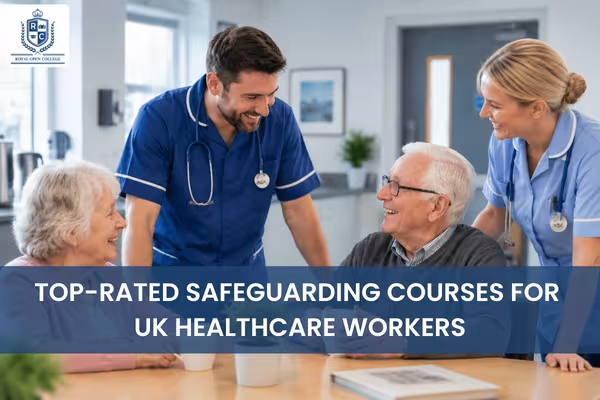


The top-rated safeguarding courses for UK healthcare workers are those that match the learner’s role, safeguarding responsibilities and appropriate competency level, rather than simply having the highest reviews. Current healthcare competency frameworks describe different levels of safeguarding knowledge and skills for different types of work.
To support different learning needs, Royal Open College offers CPD courses that include Safeguarding Level 4 for professionals with complex safeguarding responsibilities and the Level 5 Designated Safeguarding Lead course for deeper strategic knowledge. However, course titles alone should not determine your choice. Check your role and employer requirements before selecting training.
Quick recap
- Healthcare staff need safeguarding knowledge and competencies appropriate to their roles and contact with people at risk.
- Safeguarding competency frameworks describe different levels of knowledge, but the right level depends on your role and setting.
- A CPD certificate records learning. It does not by itself prove workplace competence or satisfy every employer requirement.
What counts as a top-rated safeguarding course?
A top-rated safeguarding course is one that matches your role, responsibilities and relevant healthcare competency requirements.
Reviews show learner experience, but a high rating does not show whether the training suits your particular healthcare role.
Look closely at the syllabus and intended audience, and check whether the provider clearly explains the purpose, level and recognition of the training.
You should also check whether your employer accepts the training, since organisations often set their own learning pathways and local procedures.
Who needs safeguarding training in healthcare?
Healthcare staff need safeguarding knowledge and skills appropriate to their roles, but the required level depends on their responsibilities and contact with people at risk.
For adult safeguarding, the intercollegiate framework describes Level 1 as the foundation competency for all healthcare staff. Level 2 applies to staff who regularly contact patients, families, carers or the public and need a deeper understanding of safeguarding concerns.
Child safeguarding requirements depend on the type of work staff carry out. Healthcare staff who encounter children but do not provide their clinical care are expected to have Level 2 competencies, while professionals delivering clinical services to children and young people are expected to demonstrate Level 3 competence.
These competency expectations apply across healthcare safeguarding training routes used by nurses, care workers and allied health professionals. However, the required depth of learning depends on the role, setting and safeguarding responsibilities involved.
Safeguarding Training Level
What do safeguarding Levels 1 to 5 mean?
Safeguarding runs from Levels 1 to 5, each one going a bit deeper than the last. Level 1 starts with basic awareness. From there, the responsibility builds step by step, all the way up to Level 5: strategic leadership. The level that matters is the one that fits your role.
Safeguarding Levels and Responsibilities
1–2
Levels 1 and 2: recognition and response
Level 1 establishes core safeguarding awareness, helping staff recognise possible concerns and understand their responsibilities. Level 2 develops the ability to respond appropriately, including recognising vulnerability, knowing local referral pathways and escalating concerns.
The exact expectations differ between adult and child safeguarding frameworks. This is why choosing training solely because it carries a particular number can be misleading.
3
Level 3: clinical safeguarding responsibilities
Level 3 should not automatically be described as "DSL training" in healthcare.
For adult safeguarding, Level 3 applies to healthcare staff involved in assessing, planning, delivering or evaluating care where safeguarding concerns exist, as appropriate to their role.
For child safeguarding, Level 3 applies to healthcare professionals delivering clinical services to children and young people. Some adult mental health and substance misuse services also fall within this level because their work can significantly affect children.
4–5
Levels 4 and 5: specialist and strategic responsibilities
Levels 4 and 5 relate to higher safeguarding responsibilities rather than simply greater patient contact.
In the current child safeguarding framework, Level 4 covers professionals providing senior safeguarding leadership or holding additional safeguarding responsibilities. Examples include senior or named doctors and nurses and safeguarding leads.
Level 5 concerns senior strategic leadership and system response.
Adult safeguarding competency frameworks also use higher levels for specialist and strategic roles. Level 4 includes specialist named professionals and safeguarding leads, while Level 5 covers designated professionals.
Is safeguarding training a legal requirement?
Yes, safeguarding training is a legal requirement for CQC-registered providers in England, who must ensure staff receive training suited to their role, including safeguarding knowledge where relevant.
In England, CQC Regulation 13 requires providers to protect people from abuse and improper treatment, including giving staff safeguarding training as part of induction that is relevant and suitable for their role.
Regulation 18 also requires staff working in regulated activities to receive the support, training and supervision necessary for their duties. Neither regulation names a specific commercial safeguarding course or level.
Safeguarding competency frameworks and employer policies help organisations decide what level of knowledge and training staff need for their roles.
Requirements also vary across England, Scotland, Wales and Northern Ireland because safeguarding arrangements and guidance differ between nations.
What mistakes should you avoid when choosing training?
The biggest mistake is choosing a safeguarding course based only on its level number rather than your actual role and responsibilities.
Other common misunderstandings include:
Assuming every healthcare worker needs the same safeguarding level.
Treating Level 3 as automatic designated safeguarding lead training.
Choosing Level 4 simply because it sounds more advanced.
Treating CPD learning as a regulated qualification.
Assuming a certificate alone demonstrates workplace competence.
Treating employer policies as legal requirements.
Assuming one course automatically meets all CQC expectations.
The best approach is to consider your daily duties, the people you support and the safeguarding responsibilities linked to your role.
How should you choose the right safeguarding course?
Choose safeguarding training based on your role and duties rather than the course level or rating alone.
A healthcare assistant, registered nurse and safeguarding lead may work in the same organisation but require different learning outcomes. Consider whether you provide direct clinical care, assess concerns, make referrals or support colleagues with safeguarding decisions.
If you are unsure which training applies to your role, ask your employer or safeguarding lead which framework and level to follow before booking external training.
Studying through Royal Open College (CPD learning)
Royal Open College offers CPD safeguarding courses for professionals with different safeguarding responsibilities. Safeguarding Level 4 focuses on complex safeguarding practice, while the Level 5 Designated Safeguarding Lead course explores wider leadership and strategic responsibilities.
Both courses are structured around key areas that support confident safeguarding practice in professional settings. The Level 4 course covers safeguarding legislation and guidance, risk assessment, responding to disclosures, multi-agency working and record-keeping. The Level 5 course builds on these areas with greater focus on safeguarding leadership, oversight and organisational practice.
Choosing the right course depends on your role, workplace setting and safeguarding responsibilities. Your employer’s guidance can help you identify the learning that best fits your professional needs.