
Nursing Assistant Course: Entry Requirements (UK)

Nursing Assistant Course: Entry Requirements (UK)

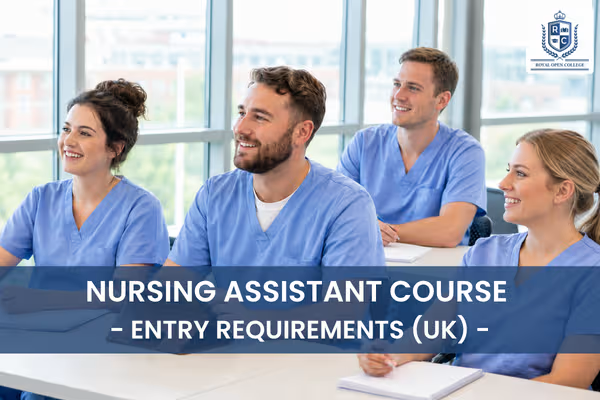
Most independent nursing assistant courses in the UK usually require a minimum age of 16 or 18 and basic English skills. Entry requirements for formal college courses, apprenticeships and NHS healthcare assistant roles vary and may include GCSEs, previous experience or workplace training.

A minimum age of 16 or 18 and basic English are usually the main requirements to enrol in an independent nursing assistant course in the UK. Most providers ask for very little beyond that.

Royal Open College’s Nursing Assistant Diploma follows the same approach. It supports CPD learning rather than acting as a professional qualification. Formal college courses, apprenticeships and NHS roles set their own separate requirements, which can include GCSEs or direct employment first.

Quick recap

  • Independent CPD nursing assistant courses usually ask only for a minimum age and basic English skills, without requiring GCSEs.
  • Formal college courses, apprenticeships and NHS employment each set their own separate entry requirements, so the rules differ by route.
  • A CPD course builds useful knowledge, while employers assess workplace competence through their own training, supervision and induction once you start work.

What are the basic entry requirements for an independent nursing assistant course?

For most independent nursing assistant courses, the main entry requirements are a suitable age and enough English to complete the learning. Beyond that, entry rules are usually flexible. 

Age and English language requirements

🔞
16/18

Minimum age requirement

Providers usually set a minimum age of 16 or 18, though this varies between courses and providers. This is a provider policy rather than a specific UK law about nursing assistant training.

✍️

You need enough written English to read the course material, follow instructions and complete short multiple-choice assessments.

🔎

Each provider publishes its own entry policy on the course page, so it's worth checking the specific requirements before you sign up.

🌍

If English is your second language, some providers may offer additional guidance or ask for evidence of language ability.

What else do providers usually ask for?

💻
Computer
📱
Tablet or phone
📊
Stable internet
connection
💻

You'll need a device such as a computer, tablet or phone, plus a stable internet connection, since most independent courses run entirely online through a learner portal.

🤝
Providers also look for genuine interest in care work.
🌱 Patience
✅ Reliability
📖 A willingness to learn
💡

Patience, reliability and a willingness to learn matter more than any formal background at this stage, since the course starts from the basics.

Do you need GCSEs or previous experience to start?

Most independent CPD nursing assistant courses welcome learners without requiring GCSEs or previous care experience. Complete beginners, career changers and people already working in care can all typically apply.

This open approach reflects the CPD model, building knowledge and confidence rather than replacing a formal qualification. If you’re applying for a specific job, though, some employers still prefer candidates with relevant care experience or a recognised qualification.

If you already work in a related role, such as a support worker, this kind of course can help you move into more hands-on patient care.

Some exposure to a real care setting, even through volunteering, adds practical understanding for learners planning to move into paid care work. It also shows employers you understand what the role involves before you apply. Once you know who can enrol, the next question is what the training itself covers.

What does nursing assistant training usually cover?

Nursing assistant training usually covers practical patient care alongside safety topics such as infection control and safeguarding. Course structure varies, but the main themes stay fairly consistent across providers.

Core topics included in the training

Beyond hands-on patient care and safety basics, most courses also build communication skills and cover mobility support, personal hygiene, nutrition and recognising changes in someone’s condition.

Communication modules often focus on listening skills, working respectfully with families, and supporting a person’s dignity and independence during everyday tasks.

Some courses touch on medication awareness, record-keeping, and understanding common health conditions such as dementia or diabetes, though depth varies by provider.

This knowledge also helps explain where a course fits within a wider healthcare career pathway, which the next section covers.

How this knowledge fits into starting the job

A course like this builds foundation knowledge. Hands-on clinical competence is developed separately, through workplace practice, supervision and employer-led assessment once you’re in a real care setting.

Think of it as preparation rather than the final step. Most employers still run their own induction, supervision and Care Certificate training once you join, regardless of any CPD course you’ve completed beforehand.

A completed course can still help at the interview stage. It shows you’ve taken the initiative to learn the basics before applying for roles, and gives you a head start when your employer’s own training begins.

Nursing Assistant Training - Quick View
📚
Course Knowledge
🩺 Patient care
🛡️ Infection control
🔐 Safeguarding
💬
Essential Skills
🤝 Communication
🚶 Mobility support
🥗 Hygiene & nutrition
💊
Extra Awareness
📝 Records
🧠 Dementia & diabetes
💊 Medication awareness
🏥
Workplace Development
🚀 Interview support
👥 Supervision
📋 Employer assessment
🎓 Care Certificate training
⚠️ Course learning ≠ workplace competence
🏥 Practical skills develop through workplace practice

How do requirements change for college courses and apprenticeships?

College courses and apprenticeships typically ask for GCSEs, most often grades 9 to 4 (equivalent to A* to C) in English and maths. Some providers accept equivalent qualifications instead. College courses are usually classroom-based with work placements, studied full-time or part-time before you apply for roles.

What apprenticeship routes involve

Apprenticeship routes, such as the Healthcare Support Worker Level 2 Apprenticeship, combine paid work with structured training. You earn a wage while you study, and entry requirements are usually set by the individual employer or training provider.

With experience, some progress onto the Senior Healthcare Support Worker Level 3 Apprenticeship, which builds on the same foundations with more responsibility.

Which route suits you best?

Both routes suit people who want a structured, recognised pathway into a specific job, alongside their studies. Independent CPD courses work differently, focusing on flexible, self-paced learning rather than a guaranteed job placement.

Which route suits you best depends on your circumstances. Someone who needs to earn while training may prefer an apprenticeship. Someone looking for structured study may choose a college course, while someone exploring care work may start with a CPD course.

Can you become a healthcare assistant without doing a course first?

Yes. Independent courses are only one pathway into the role. The NHS and many care employers hire healthcare assistants first, then provide the required training on the job.

How NHS employment-first hiring works

NHS trusts often hire healthcare assistants before any formal training happens. According to NHS Health Careers, there are no set entry requirements for the role itself.

In practice, though, employers usually expect good literacy and numeracy, and some ask for GCSEs or a healthcare qualification such as a BTEC or NVQ. Relevant experience from paid or voluntary care work strengthens an application, though it isn’t always essential.

Roles involving direct contact with vulnerable adults or children may require a DBS check, depending on the role and level of contact, as part of standard safer recruitment practice. Once you’re hired, training happens through supervised shifts, workplace learning and the Care Certificate, rather than a course you complete beforehand.

What is the Care Certificate?

The Care Certificate is an induction framework for new health and social care support staff. It sets out 16 standards covering topics such as safeguarding, communication and infection control.

Employers usually deliver and assess the Care Certificate in the workplace after you start. It’s a workplace assessment rather than something you complete through an independent online course alone, though CPD learning can help you prepare.

Many employers aim to complete the Care Certificate with new staff within around 12 weeks of starting, as general good practice, though the exact timeframe can vary by employer and role.

Is nursing assistant training a legal requirement?

UK law requires employers to give staff appropriate training, but it doesn’t name a specific nursing assistant course or qualification as mandatory. For CQC-registered providers in England, this comes from Regulation 18 of the Health and Social Care Act 2008 (Regulated Activities) Regulations 2014, which sets out the training and support staff must receive for their role.

This distinction matters most for anyone assuming a CPD certificate carries the same weight as a licence to practise.

Are ‘nursing assistant’ and ‘healthcare assistant’ protected job titles?

‘Nursing assistant’ and ‘healthcare assistant’ are open job titles that UK employers can use freely. You’ll see both terms, along with healthcare support worker, used for broadly similar roles.

Titles such as registered nurse and nursing associate work differently. The Nursing and Midwifery Council (NMC) regulates these professions, so practising under those titles requires registration first.

Understanding this difference matters for enrolment too. A CPD course in nursing assistant training leads to CPD learning, not NMC registration or an equivalent professional licence. That’s why the training you actually need comes down to your specific role instead.

What decides the right level of training for a role?

Job responsibilities decide the right level of training, not a single fixed rule. Someone with supervisory or safeguarding duties usually needs more depth than an entry-level support role.

Employers weigh factors such as contact with people at risk, decision-making responsibilities, local safeguarding procedures and the needs of the people being supported. These factors, more than any job title, shape what training someone actually needs.

A senior care worker, team leader or designated safeguarding lead, for example, may need training beyond what a new starter completes in their first few weeks. The exact requirement comes from the employer, based on the risks linked to that specific role.

What are the common mistakes people make about nursing assistant training requirements?

Most mistakes about nursing assistant training come from treating flexible, employer-set rules as if they were fixed. Getting these wrong can waste time and money, or create false confidence about what a certificate proves.

Common Misunderstandings About Nursing Assistant Training

👩‍⚕️

Training requirements

Assuming every nursing assistant role needs the same level of training, when employers set their own requirements based on responsibilities.

⚖️

Entry rules and UK law

Confusing a provider's entry rules with UK law, when most requirements come from the employer or training organisation, not legislation.

📜

CPD and regulated qualifications

Treating a CPD-accredited certificate as a regulated qualification, when it supports learning rather than granting professional status.

🛡️

Certificate and competence

Believing a certificate alone proves competence, when employers still assess skills through induction, supervision and practice.

📘

Induction framework vs CPD course

Overlooking the difference between an induction framework, like the Care Certificate, and an independent CPD course, which serve different purposes.

🎯

Course and job expectations

Expecting one short course to guarantee a job offer, when employers also weigh experience, references and how candidates perform at interview.

Studying through Royal Open College (CPD learning)

Royal Open College offers a Nursing Assistant Diploma for learners who want to build foundation knowledge before applying for care roles. The course supports CPD learning, covering topics such as patient care, infection control, safeguarding and communication skills.

This type of study helps you understand the basics of the role. It works alongside, rather than replacing, the training, supervision and competency checks that employers provide once you start work.

Always check the training requirements for your role, whether that’s your employer’s policy or what’s listed for a job you’re applying to. Some settings ask for the Care Certificate or role-specific induction alongside any independent learning you complete.

That still leaves flexibility. Learning at your own pace, from home, suits people juggling work, family or other commitments while they explore a move into care. Whatever route you choose, the right training builds confidence for your first day on the job.

Recent Blogs

Best Healthcare Assistant Courses Online: A UK Guide

Best Healthcare Assistant Courses Online: A UK Guide

The best online healthcare assistant courses cover patient care, safeguarding, infection prevention and communication. This guide explains what to look for, how CPD training fits into a healthcare career and how it compares with apprenticeships and employer-led training.

Nursing Assistant Salary by Region: UK Pay Guide

Nursing Assistant Salary by Region: UK Pay Guide

Nursing assistant salaries vary by region, NHS band and employer type, typically falling between £24,000 and £31,000 a year. England, Scotland, Wales and Northern Ireland each have their own NHS pay arrangements, while eligible London roles receive high-cost area supplements. Private hospitals, care homes and agencies set their own pay scales.

Best Online Nursing Assistant Courses

Best Online Nursing Assistant Courses in the UK

There is no single online course that makes someone a certified nursing assistant in the UK, since CNA is a US credential. UK learners can build core care knowledge through CPD-accredited courses, but nursing assistant and healthcare assistant roles may also require workplace induction, supervised practice and employer-led competency checks.