



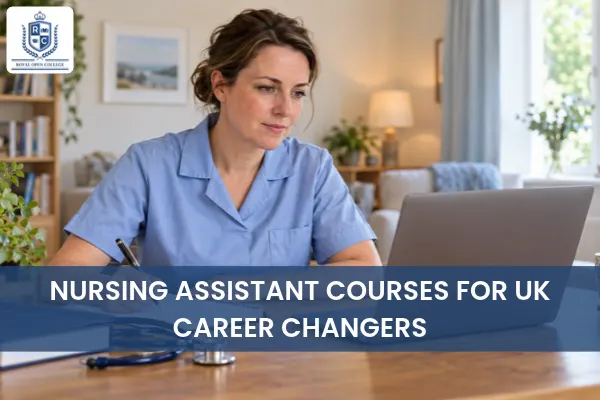


Royal Open College and Learnera offer online nursing assistant courses that explicitly include career changers. These courses welcome wider learner groups rather than serving career changers exclusively. Their flexible delivery lets you explore healthcare knowledge alongside your current work.
Moving into healthcare can reveal gaps in your knowledge of everyday patient support. Royal Open College’s Level 3 Diploma in Nursing Assistant Complete Training covers safeguarding, infection prevention, personal care and communication. Its self-paced online format with tutor support helps you study around existing commitments. This CPD learning builds knowledge alongside the workplace training your intended role requires.
Quick Recap
- Career changers are included among the intended learners for both providers’ nursing assistant courses.
- Choose course content around your target role rather than its level label alone.
- CPD learning builds knowledge but does not replace supervised practice or workplace competence checks.
Both providers explicitly welcome career changers onto their online nursing assistant courses. Their course descriptions offer a starting point for comparing the subjects and support available.
Provider | Course | Relevant Features |
Royal Open College | Level 3 Diploma in Nursing Assistant Complete Training | Self-paced online CPD study with tutor support |
Learnera | Nursing Assistant Level 3 Diploma | Online CPD study that welcomes beginners and career changers |
A course welcoming career changers is different from providing a dedicated career change programme. Look beyond the audience description to understand how the learning addresses your starting point. For example, someone leaving office work might need explanations of personal care and infection prevention.
Before deciding, ask how tutors support learners without healthcare experience. Also establish whether any advertised career support includes individual feedback or general application resources. These details help you judge how well the course supports your move into a different sector.
What Should A Nursing Assistant Course Cover For Career Changers?
A nursing assistant course should explain patient support, communication, safeguarding and infection prevention in accessible language. These subjects help newcomers understand care responsibilities before encountering them in a workplace.
Start with the curriculum rather than the number of modules. Look for explanations of dignity, consent and responding when someone needs help. Everyday care topics should also explain personal hygiene, mobility, nutrition and hydration.
Communication deserves particular attention when moving from another sector. Supporting someone who feels frightened or struggles to express their needs requires a thoughtful approach. Learning should explain listening, respecting preferences and sharing concerns with the appropriate colleague.
Clinical subjects need clear boundaries too. Studying medication or oxygen therapy introduces knowledge rather than permission to perform those tasks. Look for content explaining supervision, reporting concerns and staying within your assigned responsibilities.
Do Career Changers Need A Specific Nursing Assistant Qualification?
Career changers do not need one nursing assistant qualification required by every UK employer. Entry criteria vary between vacancies, so your intended job determines which training deserves consideration.
Read the essential and desirable criteria separately. Essential requirements identify what applicants need for that vacancy. Desirable criteria describe additional attributes the employer would welcome.
A course’s “Level 3” title alone does not establish its qualification status. CPD learning supports knowledge development, while regulated qualifications have separately defined requirements and recognised awarding arrangements. Establish which type your chosen course provides before comparing it with a vacancy.
How Can You Compare Training With A Real Vacancy?
Compare training with a vacancy by matching its learning outcomes against the employer’s stated criteria. This makes the decision more useful than choosing the most impressive course title.
For example, imagine a vacancy listing communication skills and previous care experience as essential. Someone leaving customer service could describe relevant communication examples from their work. However, completing an online knowledge course would not supply the missing care experience.
That applicant could ask the recruitment team what experience they accept. The answer helps identify whether volunteering, another entry role or further training would address the gap.
What Workplace Training Will You Still Need?
You will still need induction and training matched to your duties and workplace procedures. This connects introductory learning with the people, equipment and reporting systems used in your setting.
Your employer should explain which tasks you can perform and what supervision you need. Practical checks help establish whether you can apply learning safely during patient care.
For example, learning about mobility online differs from helping someone move using their agreed care plan. Workplace training addresses the equipment and assistance required for that person.
The Care Certificate provides a framework for introductory knowledge, skills and behaviours. Its current framework contains 16 standards, with assessment covering both knowledge and performance.
The Care Certificate assessment guidance explains how employers and assessors check these areas. This helps distinguish completing online learning from demonstrating safe practice.
How Can You Fit Nursing Assistant Study Around Your Current Job?
Self-paced online study can help you fit nursing assistant learning around your current job. However, flexibility also depends on access arrangements, assessment deadlines and the support available.
Before enrolling, establish when tutors respond and how you contact them. Someone studying after evening shifts may need support arrangements that work without live daytime attendance.
Also review how the course presents its material. Sample lessons can help you judge whether explanations feel clear when healthcare terminology is unfamiliar. Confirm any accessibility support you need before committing.
Finally, request a breakdown of enrolment, assessment and certificate charges. Understanding the complete cost helps you compare options fairly without relying on the advertised headline alone.
What Mistakes Should Career Changers Avoid When Choosing Training?
Career changers should avoid buying training before confirming what their intended role actually requires. Otherwise, a convenient course can leave the main barrier to employment unresolved.
Studying through Royal Open College (CPD learning)
The Level 3 Diploma in Nursing Assistant Complete Training supports CPD learning for people exploring healthcare support work. Its educational purpose is to introduce care principles through subjects including safeguarding, communication and infection prevention.
Use those learning outcomes to identify which gaps the course could help you address. This is CPD study rather than a regulated qualification and completion alone does not establish workplace competence.
Before enrolling, select a vacancy that interests you and highlight its training requirements. Ask the recruitment team whether this learning addresses those requirements or whether you need another route.