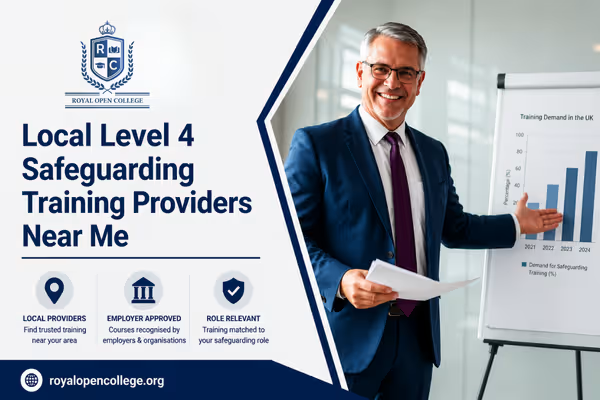
Finding a Level 4 safeguarding training provider near you can feel confusing because local courses, online CPD, NHS routes, education training, and regulated qualifications can all appear in the same search results. The key is to choose training that matches your role, setting, employer requirements, and local safeguarding procedures.
For flexible online learning, Royal Open College’s Safeguarding Level 4 course can help you build knowledge of child and adult safeguarding, risk assessment, disclosures, referrals, record keeping, MCA, DoLS and multi-agency working. It is CPD learning, so it should sit alongside employer induction, local procedures, workplace sign-off, or regulated qualifications where those are needed.
Quick recap
Where can I find Level 4 safeguarding training near me?
Start close to your workplace. Ask your manager, safeguarding lead, registered manager, school trust, HR team, local authority, Safeguarding Adults Board, or local safeguarding children partnership.
These routes are often the safest place to begin because safeguarding is not just about theory. It also involves local referral routes, thresholds, forms, escalation steps, and multi-agency procedures.
You can also search online using terms such as “Level 4 safeguarding training near me”, “DSL training near me”, “adult safeguarding lead training”, “named professional safeguarding training”, and “online Level 4 safeguarding CPD UK”.
What does Level 4 safeguarding training usually mean?
Level 4 usually means advanced safeguarding learning.
It is often aimed at people who do more than basic awareness training.
This may include:
However, “Level 4” is not always used in the same way by every provider. In one setting, it may mean CPD training. In another, it may mean healthcare competency training, local multi-agency training, or a regulated qualification.
CPD training
Healthcare competency training
Local multi-agency training
A regulated qualification
Should I choose local training or online CPD?
Choose local training if your role depends on local procedures. This is common in schools, care services, NHS settings, charities, councils, and organisations that work closely with children, young people, or adults at risk.
Choose online CPD if you want flexible learning, need to refresh your understanding, or want to build confidence before taking on more safeguarding responsibility.
Many learners benefit from both. Online CPD helps you understand the subject clearly. Local or employer-led training helps you apply it correctly in your own workplace.
What should Level 4 safeguarding training cover?
A good Level 4 safeguarding course should go beyond recognising abuse. It should help you understand what to do next. Look for topics such as:
Child safeguarding
Adult safeguarding
Adults at risk
Neglect
Exploitation
Domestic abuse
Disclosures
Recording concerns
Reporting concerns
Referrals
Escalation
Information sharing
Risk assessment
Mental Capacity Act
DoLS
Professional boundaries
Safer practice
Multi-agency working
For Leadership Roles
It should also touch on:
- Supervision
- Policy awareness
- Decision-making
- Safeguarding culture
- How to support staff who raise concerns
Does CQC require Level 4 safeguarding training?
CQC expects health and social care providers to make sure staff receive safeguarding training that is suitable for their role. It does not usually say that every worker must hold one exact “Level 4” certificate.
This is why the role matters. A care assistant, senior care worker, registered manager, nurse, and safeguarding lead may all need different levels of training. Employers decide what is suitable by looking at the job, risk level, service type, and local safeguarding arrangements.
Is CPD Level 4 the same as a regulated qualification?
No, not always. This is where many people get confused.
A CPD course supports professional knowledge and awareness. A regulated qualification follows a formal awarding body framework. Some jobs may accept CPD evidence. Others may ask for a specific regulated qualification, local authority course, NHS training, or employer-approved programme.
Before booking, check the wording in the job advert or training policy. If it says “regulated qualification”, do not assume a CPD certificate will be enough
Common mistakes when searching near you
Check Whether the Course Fits Your Role
The biggest mistake is booking the first course that appears online without checking whether it fits your role.
“Near Me” Does Not Always Mean Classroom Training
Another mistake is thinking “near me” must mean classroom training. Many UK learners now study safeguarding online, especially when they need flexible CPD. But local training may still be needed if your employer requires local procedures.
A Certificate Alone Does Not Make Someone a Safeguarding Lead
A certificate alone does not make someone a safeguarding lead. Employers also look at experience, confidence, judgement, record keeping, reporting, supervision, safer recruitment awareness, and the ability to follow procedures when a real concern appears.