

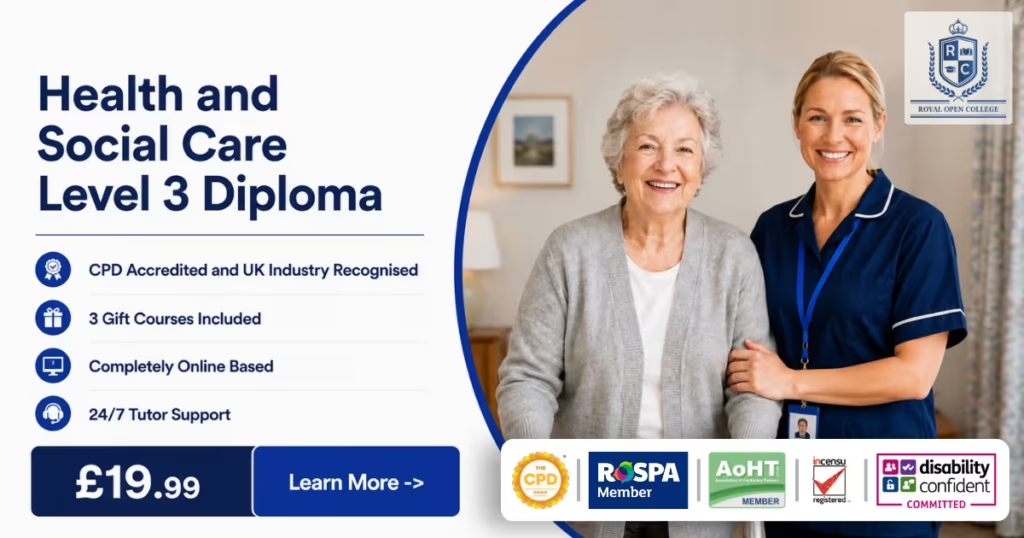


Several UK providers deliver Level 3 Health and Social Care courses through online portals with virtual tutor contact. Royal Open College’s Health and Social Care Level 3 Diploma is one CPD-accredited option, designed for aspiring and existing care workers who need flexibility in their study.
Within online Level 3 provision, the learning model and recognition vary significantly between providers. Knowledge-based courses can often be completed fully online, while some regulated occupational qualifications combine digital learning with workplace-based evidence. Understanding the difference between CPD-accredited courses, QLS-endorsed programmes and regulated qualifications helps you choose the option that best fits your role and employer requirements.
Quick Recap
- Level 3 Health and Social Care courses vary in accreditation, assessment style and how the certificate may be used.
- Virtual learning support can include automated marking, tutor guidance, written feedback or support from a dedicated assessor.
- The main options covered here are CPD-accredited courses, QLS-endorsed programmes and regulated qualifications.
What does "virtual learning support" actually mean?
Virtual learning support means the guidance, resources and feedback you receive through an online learning platform. The type of support available depends on the provider and how the course is delivered.
✏️ Common Forms of Virtual Learning Support
A web-based learning portal
with flexible access
Pre-recorded lessons
or written learning materials
Online assessments
with automatic results or tutor feedback
Messaging tools
for course-related questions
Clear response times
for tutor replies and assignment feedback
Some providers give learners access to a named tutor or assessor throughout the course, while others use a wider support team during set hours. The best option depends on how much guidance you prefer and whether your employer expects a particular type of learning or assessment support.
What course types do Level 3 providers offer online?
The providers in this comparison mainly offer three types of Level 3 learning: CPD-accredited courses, QLS-endorsed programmes and regulated qualifications. Each follows a different approach to assessment and recognition, which can affect how the certificate is used for professional development, employment or further study.
CPD-accredited Level 3 courses
CPD, which stands for Continuing Professional Development, is separate from statutory qualification regulation. CPD accreditation bodies operate their own schemes and criteria, and CPD-accredited courses do not become regulated qualifications through that accreditation.
These courses can support ongoing professional learning and help learners build a record of structured development. Whether a CPD certificate meets an employer’s requirements depends on the role, the organisation’s training policies and the care setting.
QLS-endorsed programmes
QLS endorsement sits outside Ofqual regulation. The Quality Licence Scheme is managed by Skills and Education Group and operates in the non-regulated market, where it evaluates provider quality processes and enables endorsed Certificates of Achievement.
QLS endorsement does not prescribe a fixed assessment method. Online Learning College, for example, assesses learners through six tutor-marked written assignments, which differs from providers using mainly multiple-choice tests.
Ofqual-regulated qualifications
In England, Ofqual-regulated qualifications sit within the Regulated Qualifications Framework (RQF). Northern Ireland also uses the RQF through CCEA Regulation. Wales has Qualifications Wales, while Scotland has Qualifications Scotland Accreditation.
Competence-based Level 3 Adult Care qualifications normally require evidence that the learner can apply knowledge in practice. Exact assessment requirements depend on the awarding organisation and qualification. Regulated qualifications with an academic structure, such as the OTHM Level 3 Foundation Diploma in Health and Social Care, use coursework-based assessment and can support progression to further study.
🧭 Three Level 3 Health and Social Care Learning Routes
CPD-accredited courses
Support professional development but do not become regulated qualifications.
QLS-endorsed programmes
Provide quality endorsement through a non-regulated scheme with endorsed Certificates of Achievement.
Ofqual-regulated qualifications
Provide formally recognised qualifications within regulated frameworks with structured assessment.
Which providers offer Level 3 Health and Social Care with virtual learning support?
Several UK providers offer Level 3 Health and Social Care learning through online platforms, although the amount of virtual and workplace-based learning varies between course types. The details below reflect current public information. Learners should check accreditation and qualification status directly with any provider before enrolling.
CPD-accredited and QLS-endorsed providers
Royal Open College, Apex Learning and StudyHub offer CPD-accredited Level 3 programmes with flexible online study and tutor support. Apex Learning is listed as an approved QLS provider; whether this specific course carries QLS endorsement should be confirmed directly with Apex before enrolling on that basis.
Academy for Health and Fitness currently describes its Level 3 Health and Social Care course as both CPD-certified and QLS-endorsed.
Online Learning College offers a QLS-endorsed course assessed through six tutor-marked assignments. Its own course information places the programme in the non-regulated market rather than within the regulated qualifications system.
Oxford College offers a distance-learning Level 3 Health and Social Care Diploma with QLS or Accord endorsement options, sitting outside Ofqual regulation.
Occupational and regulated providers
TutorCare advertises a Highfield Level 3 Diploma in Adult Care delivered through an online e-portfolio with a dedicated assessor. The previous Highfield qualification 610/1372/9 closed to new registrations on 31 March 2026, while the current GOV.UK list includes Highfield qualification 610/7045/2. Learners should confirm which qualification number applies to new registrations.
Virtual Healthcare Training advertises the TQUK Level 3 Diploma in Adult Care 610/0103/6 with online learning and workplace observations. GOV.UK records that new registrations for this qualification closed on 31 March 2026. Prospective learners should confirm the current qualification used before enrolling.
Online Business School delivers the OTHM Level 3 Foundation Diploma in Health and Social Care, qualification 603/6776/3, a 60-credit Ofqual-regulated qualification assessed through coursework and designed to support further study.
What support structures do online training centres typically provide?
Among the providers reviewed here, virtual support ranges from asynchronous tutor contact and automated assessment feedback to dedicated assessor support for regulated occupational routes. The amount and type of contact varies between providers.
Online Learning College publishes targets of one working day for messages and five working days for assignment feedback. Some CPD providers also offer tutor support for course-related questions, with availability sometimes limited to weekdays.
TutorCare assigns a dedicated vocational assessor to support learners with their online portfolio throughout the Level 3 Adult Care diploma. The provider also offers email and telephone support during the programme.
Before enrolling, check the provider’s support arrangements, particularly if regular tutor contact or assessment guidance is important to you.
How does accreditation type affect employer recognition?
Accreditation and qualification status can affect how a certificate is used by care employers, because CPD learning, QLS-endorsed programmes and regulated qualifications serve different purposes. The right course depends on your role, employer and career goals.
What do CPD certificates mean to care employers?
Whether a CPD certificate satisfies a specific employer depends on their policies, the role applied for and the care setting’s expectations. Employers may accept CPD learning as evidence of training or professional development, but this varies between organisations and roles.
In England, CQC Regulation 18 requires registered providers to have suitably qualified, competent and experienced staff with appropriate training and development in place. It does not designate CPD certificates as automatically meeting those requirements.
Skills for Care, the workforce development body for adult social care in England, notes that training alone does not guarantee a worker can apply what was taught. A CPD learning record can still be a useful professional tool alongside workplace experience and employer assessment.
When might a regulated qualification be required?
A regulated Level 3 qualification may be specifically required for certain progression routes or roles where formal qualification status is named. Unlike CPD certificates, regulated qualifications have formal regulatory status and may appear explicitly in job descriptions or programme requirements.
The Lead Adult Care Worker Level 3 apprenticeship, for example, includes a Level 3 Diploma in Adult Care as part of its requirements. For learners pursuing university progression, the OTHM Level 3 Foundation Diploma carries academic credit that CPD-accredited courses do not.
What should you check before enrolling with an online Level 3 provider?
Before enrolling, check the course’s accreditation type, your employer’s requirements and the current status of any regulated qualification.
Accreditation Type
Ask whether the course is CPD-accredited, QLS-endorsed or an Ofqual-regulated qualification. These categories carry different implications for employer recognition and progression pathways. If the provider's certificate page does not make this clear, contact them directly before enrolling.
Your Employer's Requirements
Care providers may set additional or role-specific training requirements based on duties and risk, alongside any legal and regulatory requirements that apply. Confirm what your employer accepts before selecting a course.
Current Qualification Status
For regulated qualifications in England, search Ofqual's Register of Regulated Qualifications using the qualification number. GOV.UK's adult social care funding lists can also help identify eligible qualifications and any registration closure dates.
What are the common mistakes learners make when choosing a Level 3 course?
Several misunderstandings about Level 3 Health and Social Care training can lead learners to choose a course that does not match their role or progression goals. These five mistakes are easier to avoid once you understand how the different types of Level 3 provision work.
Treating CPD accreditation as equivalent to a regulated qualification.
CPD certificates provide evidence of learning and professional development, while regulated qualifications have formal status within the relevant qualifications framework. Some employers or progression routes may specifically require a regulated qualification.
Assuming all Level 3 courses are equivalent.
CPD-accredited courses, QLS-endorsed programmes and regulated qualifications can differ in assessment approach, regulatory status and how they may be used for employment or further study.
Assuming a certificate proves workplace competence.
A certificate can show that training has been completed. Workplace competence is assessed separately where the role requires evidence that knowledge and skills can be applied in practice.
Skipping a check of employer requirements.
Care providers may set additional or role-specific training requirements alongside applicable regulatory expectations. Checking these requirements before enrolling helps you choose suitable training.
Choosing a provider mainly on price.
A CPD course and a regulated qualification serve different purposes. Comparing accreditation status, assessment requirements and progression value is more useful than comparing cost alone.
Studying through Royal Open College (CPD learning)
Royal Open College delivers the Health and Social Care Level 3 Diploma as a CPD-accredited online programme. Topics include safeguarding, person-centred care, infection control, communication, mental health support, dementia care, risk management and care planning.
The programme suits aspiring care workers, existing care staff who want to formalise their knowledge, and family carers who need structured learning that fits around other commitments. Modules are self-paced and delivered through an online portal, with tutor support and personalised feedback included. There are no formal entry requirements.
This is a CPD-accredited programme rather than an Ofqual-regulated qualification. It can support professional development and provide evidence of structured CPD learning. Learners should check the training or qualification requirements for their employer and care setting before enrolling.