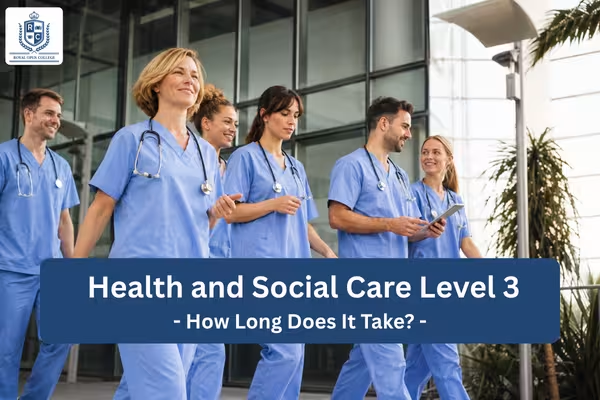
Health and Social Care Level 3 has no single duration. It depends entirely on the type of course you choose. A CPD course may take only hours or weeks to complete. A regulated Level 3 qualification, however, can take around one to two years. The difference comes down to structure, assessment method and whether workplace evidence is required.
Not every course called “Level 3” leads to the same outcome. Some learners need flexible knowledge development rather than formal workplace assessment. Royal Open College’s Health and Social Care Level 3 Diploma is self-paced CPD learning. It builds structured knowledge around care topics without the portfolio and placement requirements of a regulated qualification.
Quick recap
- CPD and regulated Level 3 courses serve different purposes.
- Regulated diplomas typically take one to two years.
- Course completion does not prove workplace competence.
What does "Level 3 Health and Social Care" actually mean?
“Level 3” describes the demand of the learning, not how large the course is or how long it takes to complete. This distinction often causes confusion. Ofqual, which regulates qualifications in England, treats qualification level and qualification size as separate measures.
A short CPD course and a large regulated diploma can both use “Level 3” in their description. However, they are not the same type of programme, so comparing them by duration alone can be misleading. Health and Social Care Level 3 options can include college-based programmes, regulated work-based qualifications and online CPD learning.
Each route has its own structure, assessment method and study timeline. Understanding which type of programme you are considering makes it easier to estimate how long it may take and whether it suits your learning or career goals.
How long do regulated Level 3 care qualifications take?
Regulated Level 3 qualifications in adult social care in England often take around one to two years to complete. These qualifications go beyond knowledge tests. They also assess how you apply skills in real care settings, so gathering the required evidence takes time.
The NCFE CACHE Level 3 Diploma in Adult Care is a useful current example. NCFE states that learners typically complete it in 12 to 24 months. Learners need to be working, volunteering or completing a suitable practical placement as part of the qualification, because workplace evidence forms an important part of the assessment.
Total Qualification Time is also a guide rather than a fixed completion period. Some learners may finish sooner than others depending on their working pattern and access to assessment opportunities. However, everyone still needs to complete the required assessment evidence in full.
A separate qualification, the NCFE CACHE Level 3 Certificate in Health and Social Care, is normally completed in one year. It carries 734 hours of Total Qualification Time and requires a minimum of 75 hours in a real work environment. This shows that even regulated Level 3 programmes can have different completion times depending on their size and structure.
Qualification titles and specifications can also change over time. If you are comparing Level 3 options in England, check the current qualification details rather than relying on older course descriptions.
1–2 years
Diploma: 12–24 months
Work • volunteering
placement • assessment
Guide only
not a fixed finish date
Certificate ≠ Diploma
check current details
What about the term "NVQ Level 3"?
“NVQ Level 3” is an older term that people still commonly use when referring to work-based Level 3 care qualifications. In England, NVQ is no longer recognised as a distinct qualification type, although the term still appears in some qualification titles and job adverts.
For adult social care, current Level 3 Diplomas in Adult Care serve a similar occupational purpose by developing and assessing knowledge and competence linked to care work. This is why employers and learners may still use “NVQ Level 3” informally even when the qualification carries a different official title. Skills for Care currently lists the Level 3 Diploma in Adult Care among the main adult social care qualifications.
If a job advert asks for an NVQ Level 3, check exactly which qualification the employer accepts. You can also use the Register of Regulated Qualifications on GOV.UK to confirm the official title, awarding organisation and regulated status.
How long do college-based Level 3 programmes take?
College-based Level 3 Health and Social Care programmes usually take one or two academic years, depending on the qualification and whether you study full-time or part-time. A larger programme such as a BTEC National Extended Diploma is typically studied over two years full-time.

Other Level 3 certificates and diplomas may be completed in one year. The NCFE CACHE Level 3 Certificate in Health and Social Care, for example, is normally completed within a year and includes a required work placement.
Where a programme includes placement hours, the overall timeline may also depend on placement availability and college or provider timetabling. This means completion time depends on more than how quickly you progress through the course content.
How long does an online CPD Level 3 course take?
Online CPD Level 3 courses can often be completed in a few hours, days or weeks. How quickly you finish depends on the amount of content and how much time you can dedicate to studying. They are usually much shorter than regulated qualifications because they focus on knowledge development rather than assessing occupational competence in the workplace.
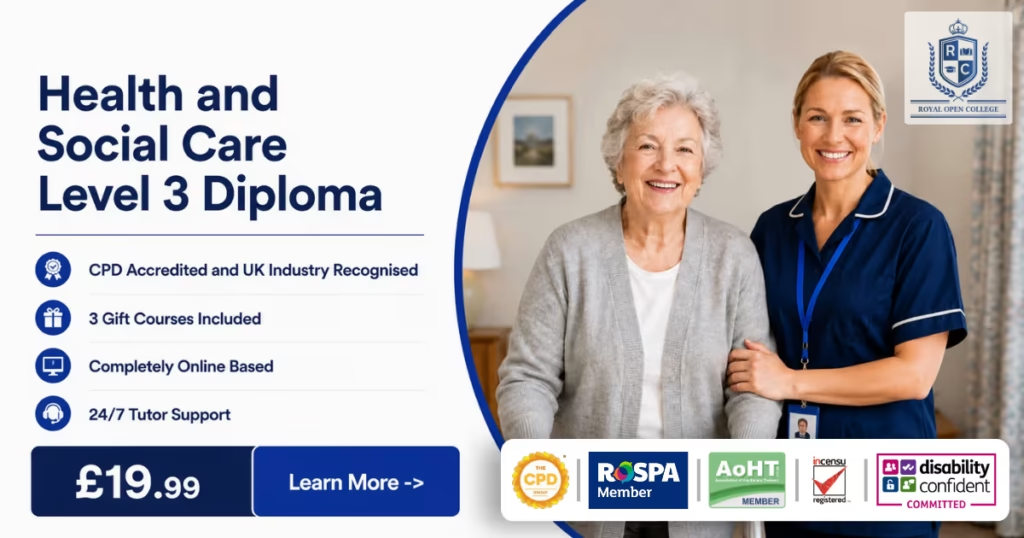
Royal Open College’s Health and Social Care Level 3 Diploma includes approximately 6 hours and 30 minutes of structured course content and is studied entirely online at your own pace. Learners receive 12-month access, so the course can fit around shift work, family commitments or other responsibilities.
Some learners complete the course in a few days of focused study, while others spread the learning over several weeks. There is no placement to arrange and no portfolio of workplace evidence to build.
A CPD course may use “Level 3” to describe its learning content, while a regulated Level 3 qualification has its level formally assigned under the qualifications framework. They are not equivalent. The shorter study time reflects a different educational purpose rather than a faster route to the same qualification.
Does it matter which type you choose?
Yes. The right option depends on what you need the course to do for you.
If you are building subject knowledge, refreshing your understanding of care principles or completing CPD requested by an employer, an online CPD course may be suitable. If a role specifically requires a regulated Level 3 diploma, however, a CPD certificate is not a direct substitute.
For example, a care worker who wants to strengthen their understanding of safeguarding or person-centred care may find that CPD meets their immediate learning goal. Someone applying for a senior support worker role that asks for a regulated diploma will need a longer route with formal assessment.
Employer expectations can also vary. Some senior care roles may require a regulated Level 3 qualification or expect you to be working towards one, while other roles may focus more on experience, competence and role-specific training.
Before enrolling, check what your target employer actually requires. If regulated status matters for the role, confirm the qualification through the Register of Regulated Qualifications on GOV.UK.
→ CPD course
→ Regulated qualification
What are the common mistakes people make about Level 3 duration?
The biggest mistake is assuming that “Level 3” describes one standard course with one standard timeline. It does not. Qualifications at the same level can differ greatly in size, assessment and study time, so choosing by the course title alone can be misleading.
Common misunderstandings include:
⏱️ Assuming all Level 3 courses take the same time.
Level describes the demand of the learning, not its duration. For example, the current NCFE CACHE Level 3 Diploma in Adult Care has 580 hours of Total Qualification Time, while a CPD course may contain only a few hours of structured learning.
🎓 Assuming “Diploma” always means regulated.
A course title alone does not confirm regulatory status. If this matters for your goal, check the qualification through the official Register of Regulated Qualifications.
⚖️ Comparing CPD hours with Total Qualification Time.
These figures describe different types of learning and should not be treated as equivalent when comparing courses.
🧑⚕️ Treating course completion as proof of workplace competence.
Completing a course does not by itself show that you can perform care tasks safely without supervision. Practical competence also develops through workplace experience, assessment and practice.
🏢 Ignoring placement and workplace evidence.
Regulated care qualifications may require learners to work, volunteer or complete a practical placement so they can provide the evidence needed for assessment. This can affect how long the qualification takes to complete.
🗺️ Applying England-specific information across the whole UK.
Qualification regulation differs across the UK. GOV.UK directs learners to separate systems for Wales and Scotland rather than treating England’s regulated qualifications register as universal.
Studying through Royal Open College (CPD learning)
Royal Open College’s Health and Social Care Level 3 Diploma is an online CPD course rather than a regulated qualification. It covers areas such as safeguarding, person-centred care, dementia, mental health, medication management, infection control, communication, record-keeping and legal and ethical responsibilities in care settings.
The course is CPD-accredited and self-paced, with 12-month access and no fixed class times. This makes it suitable for learners who want flexible, structured study, whether they are new to care, already working in the sector or returning after a break.
Completing the course supports professional development, but it does not replace workplace competency assessments, employer induction or any regulated qualification required for a particular role. Holding a qualification and demonstrating competence are related, but they are not the same thing.
If you are studying with a specific career goal in mind, check what employers in your target role actually require. For CPD and knowledge development, flexible online study may be a practical option. If a role requires a regulated Level 3 diploma, you will need a longer route that includes formal assessment and workplace evidence.