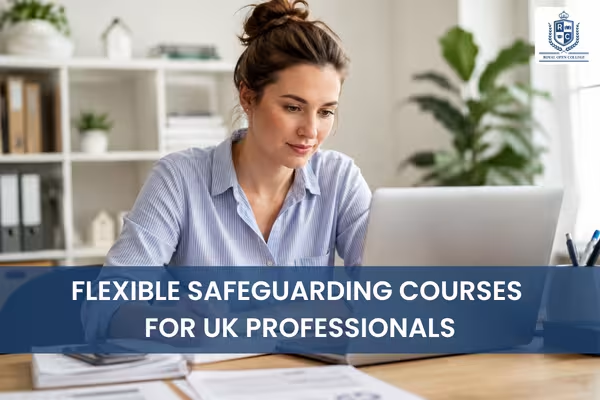


Flexible Safeguarding Courses for UK Professionals

Flexible Safeguarding Courses for UK Professionals

Flexible safeguarding courses make it easier for professionals to study around shifts and other commitments. The right option depends on the learner’s role, setting and employer requirements. Online, self-paced CPD learning can strengthen safeguarding knowledge, but completing a course alone does not prove workplace competence or meet every regulatory requirement.

The most flexible safeguarding courses for busy professionals are self-paced online courses, followed by live virtual and blended formats for those who prefer some guided input. Among these options, Royal Open College offers Safeguarding Level 4 for advanced safeguarding knowledge and Level 5 Designated Safeguarding Lead (DSL) for those developing leadership, referral, risk assessment and multi-agency responsibilities.

However, course suitability still depends on the learner’s role, workplace, safeguarding duties and employer requirements. Flexible delivery can make training easier to manage, but professionals may need different levels or types of safeguarding learning depending on the responsibilities they hold.

Quick recap

  • Online and self-paced safeguarding courses can make learning easier to fit around professional commitments.
  • Safeguarding training levels vary because responsibilities differ between roles and settings.
  • CPD learning develops knowledge, while employers may use further checks to assess workplace competence.

What makes a safeguarding course genuinely flexible?

A safeguarding course is genuinely flexible when learners can study at their own pace, avoid fixed classroom times and return to learning when their schedule allows.

Self-paced online courses can work well for shift workers because study does not depend on attending at a set time. Other flexible formats may include live virtual sessions, blended learning and employer-led refresher activities.

Clear modules, progress tracking and the ability to pause and resume learning can make study easier to manage. Mobile-friendly access may also help professionals learn away from a workplace computer. Even so, the course still needs enough depth to explain safeguarding concerns clearly and give learners a meaningful way to check their understanding.

Can safeguarding training be completed online?

Yes. Safeguarding training can be completed online when the course content, assessment and delivery method are suitable for the training and accepted within workplace arrangements.

For CQC-regulated services in England, Regulation 18 requires staff involved in regulated activities to receive appropriate support, training, professional development, supervision and appraisal so they can perform their duties. It does not prescribe one specific safeguarding course format.

Online learning can therefore form part of a wider training approach. Employers may combine it with induction, supervision, case discussion or workplace support where needed. Schools and colleges can take a similar approach, using different delivery methods while still meeting the safeguarding training expectations that apply to their staff.

Flexible Safeguarding Training

⏱️
Self-paced learning

Study around shifts and schedules without fixed classroom times.

📱
Flexible online access

Pause, resume and continue learning through mobile-friendly access.

📚
Clear learning structure

Modules, progress tracking and assessments help check understanding.

🏥
Workplace support

Online training can support induction, supervision and employer activities.

Who benefits most from flexible safeguarding training?

Care workers, nurses, education staff, managers, volunteers and safeguarding leads can benefit from flexible safeguarding training, especially when fixed classroom sessions are hard to attend.

Shift workers may find self-paced study easier to manage. Education staff can study outside teaching hours, while managers can pause and resume learning around other duties.

Online delivery can also help volunteers, community workers and professionals working across several locations by reducing the need to travel.

Employers may benefit too because staff working different schedules can access training more easily. The required depth still depends on the safeguarding responsibilities attached to each role.

What about schools and colleges?

In England, schools and colleges can use flexible safeguarding training, but the training must follow the expectations set out in Keeping Children Safe in Education 2026.

Staff need appropriate safeguarding and child protection training at induction, followed by regular updates to keep their knowledge up to date.

They also need to understand their setting’s safeguarding policies and procedures. Online or blended learning can support this by making training easier to access and revisit.

Designated safeguarding leads have wider responsibilities, so their training and support should reflect the specific duties of the DSL role.

Is safeguarding training legally required

Is safeguarding training legally required?

Yes, safeguarding training can be legally required in some roles and settings, although the law does not require every worker to complete a specific commercial safeguarding level.

For CQC-regulated services in England, Regulation 18 requires providers to give staff the training, support, supervision and professional development needed to carry out their duties.

Care Act statutory guidance adds role-specific expectations for adult safeguarding. It says organisations should provide training that reflects the responsibilities of staff and volunteers.

Neither framework says every worker must complete a course called Safeguarding Level 3 or Safeguarding Level 4.

Why does the UK nation matter?

The UK nation matters because safeguarding law and guidance are not the same across England, Scotland, Wales and Northern Ireland.

🏴
England
📘
Care Act 2014 In England, the Care Act 2014 sets out the adult safeguarding framework, while Working Together to Safeguard Children 2026 provides current guidance for safeguarding children.
🏫
Keeping Children Safe in Education 2026 Schools and colleges in England also follow Keeping Children Safe in Education 2026, which has been in force since 1 September 2026.
🏴 🏴
Scotland, Wales and Northern Ireland
If you work in Scotland, Wales or Northern Ireland, you should follow the safeguarding legislation, regulator guidance and local procedures that apply in your nation.

Does everyone need the same safeguarding level?

No. The depth of safeguarding learning varies with what someone is expected to recognise, report, decide or manage.

A frontline care worker may mainly need to recognise signs of abuse, respond appropriately and report concerns. A team leader may also support colleagues or handle escalation. Managers and safeguarding leads may need deeper knowledge of referrals, information sharing, risk decisions and multi-agency work.

Care Act statutory guidance reflects this role-based approach. It describes basic induction awareness, more detailed awareness training, specialist training for managers or those handling enquiries, and advanced learning for complex responses.

That is why one numbered commercial course level cannot apply to every safeguarding role.

Is CPD Level 4 the same as a regulated Level 4 qualification?

No. A CPD course labelled Level 4 is not automatically a regulated Level 4 qualification.

The government’s Register of Regulated Qualifications lets users check whether a qualification is regulated and find recognised awarding organisations. The register includes regulated qualifications in England and Northern Ireland.

Ofqual regulates recognised awarding organisations and qualifications within its remit. Simply using a level number in a CPD course title does not make that course a regulated qualification.

If an employer or role requires a regulated qualification, check the exact qualification title and awarding organisation rather than relying on the course level alone.

What should flexible safeguarding training cover?

Flexible safeguarding training should cover how to recognise abuse or neglect, respond to concerns, record information and follow the correct reporting procedures.

🛡️ Depending on the role
Disclosures Confidentiality Information sharing Local safeguarding processes

Depending on the role, learners may also need to understand disclosures, confidentiality, information sharing and local safeguarding processes. Adult safeguarding guidance in England expects training to reflect local policies, procedures and professional responsibilities.

🏫
Education staff

Education staff need safeguarding training that matches their workplace. Keeping Children Safe in Education 2026 explains how staff in schools and colleges should recognise concerns, report them, share information and keep accurate records.

💻
Flexible delivery

Flexible delivery makes these topics easier to study while keeping the practical knowledge learners need to handle safeguarding concerns properly.

What should more advanced safeguarding learning add?

More advanced safeguarding learning should cover the additional responsibilities involved in managing or making safeguarding decisions.

Depending on the role, this may include risk assessment, referrals, information sharing, multi-agency working and handling complex concerns. Care Act guidance also distinguishes specialist and advanced training for people dealing with enquiries, management duties or complex safeguarding responses.

Staff still need to understand their organisation’s reporting systems, safeguarding contacts and referral routes. National guidance provides the wider principles, while workplace procedures explain how to apply them locally.

How should employers choose suitable safeguarding training?

Employers should choose safeguarding training based on staff duties, safeguarding risks and the level of responsibility involved.

CQC Regulation 18 requires providers to ensure staff have the training, skills, competence and support needed for their roles.

When reviewing training needs, employers should consider whether staff work directly with children or adults at risk, receive disclosures, supervise others or make safeguarding decisions.

Local procedures and sector guidance also matter. An online course may explain national safeguarding principles, but staff still need to understand their organisation’s reporting and referral processes.

Training is most effective when learners can apply what they study to the procedures used in their workplace.

Does a safeguarding certificate prove competence?

No. A safeguarding certificate shows that someone has completed specified learning or passed an assessment, but it does not by itself prove workplace competence.

CQC Regulation 18 links competence with training, skills, supervision and professional development rather than course completion alone.

Employers may also use supervision, observation, reflective discussion or other appropriate checks to assess how well staff apply their knowledge.

A certificate can support a training record or CPD portfolio, but it is not a professional licence and does not guarantee safeguarding or CQC compliance.

What common mistakes should professionals avoid?

Professionals should avoid choosing safeguarding training based only on the course level, speed or certificate. The training still needs to match the purpose for which it is being taken.

🎨

Common mistakes include

01
🎓

treating a CPD course as a regulated qualification

02
🔍

choosing the shortest course without checking what it covers

03
🏛️

assuming an employer's internal rule is a national legal requirement

04
📜

believing one certificate guarantees CQC compliance

05
📋

overlooking workplace reporting and referral procedures

06
🔄

assuming training for one sector automatically meets another sector's requirements

For workplace training, check what evidence the employer expects before enrolling. If the requirement is unclear, ask the employer, safeguarding lead or relevant professional body which type of training is appropriate.

Studying through Royal Open College (CPD learning)

Royal Open College supports flexible CPD learning through courses such as Safeguarding Level 4 and Level 5 Designated Safeguarding Lead (DSL), giving learners different ways to develop safeguarding knowledge around their responsibilities.

Safeguarding Level 4 covers topics including abuse and neglect, risk assessment, disclosures, referrals, record-keeping, information sharing and multi-agency working. The Level 5 Designated Safeguarding Lead (DSL) course focuses more specifically on safeguarding leadership, including legislation, referrals, risk assessment, online safety and multi-agency collaboration.

Together, these courses offer structured learning for people who want to strengthen their safeguarding knowledge while studying around existing commitments. As CPD learning rather than regulated qualifications, they do not replace employer-specific training requirements or local procedures. Anyone studying for work should check the expectations that apply to their role and workplace.

Recent Blogs

Safeguarding Courses with Certificates Recognised Across UK Councils

Safeguarding Courses with Certificates Recognised Across UK Councils

Safeguarding certificate recognition depends on your role, workplace responsibilities and employer requirements. Explore how different training levels, CPD learning and safeguarding expectations vary across sectors, helping you choose suitable training that supports your professional responsibilities and workplace needs.

Affordable Safeguarding Training Options for Volunteers UK

Affordable Safeguarding Training Options for Volunteers UK

Safeguarding responsibilities vary across volunteer roles, so training should reflect the level of contact, risk and decision-making involved. This guide explores affordable learning options and explains how organisations choose training that suits different responsibilities. It also clarifies that completing a CPD course demonstrates learning but does not constitute a regulated qualification or prove workplace competence.

Nursing Assistant Course London Online Options for Learners

Nursing Assistant Course London: Online Options for Learners

Online nursing assistant training is the practical choice for London learners balancing shift work, family commitments, and commuting costs. This guide explains what CPD-accredited courses cover, how the Care Certificate’s 16 standards work after the March 2025 update, what Band 2 NHS salaries look like with London weighting in 2026, and which free routes exist before you spend a penny.