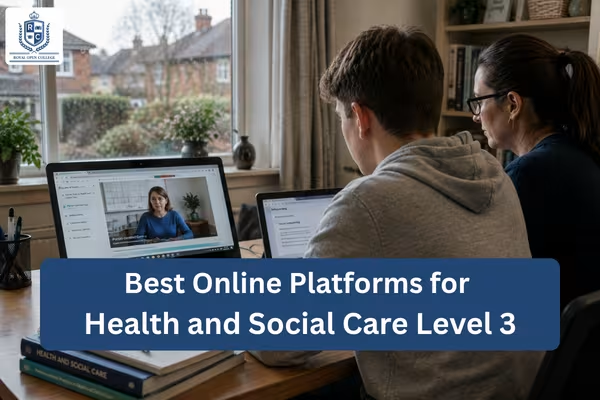

There’s no single best platform, and that’s the honest answer. It comes down to whether you need a regulated Level 3 qualification or CPD learning. Regulated qualifications such as the Level 3 Diploma in Adult Care are competence-based, so they include workplace assessment and can’t be completed through remote study alone.
CPD courses work differently. They’re built around knowledge and professional development, and you can study them without a care job. The Royal Open College Health and Social Care Level 3 Diploma sits in that second group. The right route depends on your goal, your role and any registration requirements that apply where you work.
Quick recap
- A CPD course titled “Level 3” is not a regulated qualification.
- Not everyone needs the same route; your goal and role help determine what you need.
- Online learning alone doesn’t demonstrate workplace competence; this requires appropriate practical assessment and workplace evidence.
What does studying health and social care Level 3 online actually involve?
There are two broad routes to understand: regulated qualifications and online CPD courses.
To understand the difference, it helps to unpack what “Level 3” actually means. In England, Level 3 describes a qualification level rather than one specific course. A levels, T Levels, Access to HE Diplomas and Level 3 diplomas can all sit at this level, but they differ in size, content and purpose.
Regulated qualifications in England are offered by recognised awarding organisations and listed on the Register of Regulated Qualifications. The Level 3 Diploma in Adult Care is a key competence-based qualification for adult social care, and Skills for Care’s criteria set out around 580 hours of total qualification time.
Because it’s competence-based, learners have to evidence what they can do in practice. Several outcomes require direct observation, including some that must be observed in person, so the qualification can’t normally be completed through remote study alone.
Online CPD courses sit outside that system. Many use quizzes or written assignments and can be studied without a care job. They mainly build subject knowledge rather than assess occupational competence.
Both routes can be useful, but they serve different purposes. The course title alone doesn’t always make that distinction clear.
What types of online platforms can you study with?
You can study with colleges, approved training centres, apprenticeship providers, distance learning colleges or online CPD platforms. Each suits a different starting point.
🏫 Further education colleges
Further education colleges deliver regulated qualifications through distance or blended learning, sometimes with funding for eligible learners.
✅ Approved training centres
Approved training centres hold approval from a recognised awarding organisation, such as NCFE CACHE, City & Guilds, TQUK, Highfield or NOCN, to deliver their regulated qualifications.
💼 Apprenticeship providers
Apprenticeship providers combine Level 3 study with a paid job. In England, the Lead Adult Care Worker apprenticeship is one current Level 3 route.
💻 Distance learning colleges
Distance learning colleges offer regulated qualifications, endorsed courses or a mixture of both. Assessment methods vary by course.
📘 Online CPD platforms
Online CPD platforms, including Royal Open College, offer self-paced Level 3 learning focused on knowledge and professional development.
For a regulated qualification, check both the training centre and the awarding organisation. Two centres may deliver the same qualification with different fees, support and study arrangements.
Once you know what type of provider you're considering, the next step is to check whether the course itself is regulated.
→How do you check if an online Level 3 course is regulated?
🔎 Start by checking the qualification through the official system for the UK nation where you plan to study or work.
Check Ofqual's Register of Regulated Qualifications.
CCEA Regulation regulates qualifications, while regulated qualifications can also be searched through the Register of Regulated Qualifications.

Check Qualifications Wales.
Check Qualifications Scotland Accreditation. The SCQF Register also provides information on credit-rated qualifications.
England and Northern Ireland share one register. Wales and Scotland run separate systems.
When comparing courses, you’ll also come across labels such as QLS endorsement and CPD accreditation. These mean something different from regulated qualification status.
QLS endorsement means the Quality Licence Scheme has reviewed the provider’s quality processes. Its endorsed courses sit in the non-regulated market and have no formal credit value.
CPD accreditation is separate from statutory qualification regulation. Different CPD accreditors assess learning against their own criteria, and CPD accreditation doesn’t place a course on the Regulated Qualifications Framework.
Both can support learning and professional development. Neither turns a course into a regulated qualification, whatever the course title says.
Which online platform suits your role and goals?
The best starting point is knowing what you actually need the course or certificate to do for you. That answer looks different depending on where you are in your care career right now.
✏️ Which route fits your situation?
👩⚕️
Already working in care, want to progress
If your role or progression plan calls for a competence-based qualification, the Level 3 Diploma in Adult Care may be the right route. You will need access to a suitable workplace because practical assessment forms part of the qualification. Eligible adult social care employers in England may also be able to claim reimbursement through the Adult Social Care Learning and Development Support Scheme for qualifications on the government's published eligible list.
🌱
New to the sector, not yet working in care
A fully online CPD course can help you build background knowledge before entering a care role. A workplace-assessed diploma, by contrast, requires access to an appropriate care setting so practical evidence can be collected.
🧑💼
Senior care worker or team leader
Supervisory duties can bring additional training or competency requirements in areas such as safeguarding, medicines and risk management. Before choosing anything, review your employer's training requirements to make sure you are selecting the right level for your current responsibilities.
🎓
Applying for a nursing degree
Universities set their own entry requirements, so the right route depends on the specific programme. Accepted options may include A levels, T Levels, BTECs or Access to HE Diplomas. Always check directly with the university before enrolling on any course with that goal in mind.
🤝
Personal assistant
If you are employed directly as a PA, the training and qualification expectations linked to your role can vary depending on your duties and employment arrangement. It is worth clarifying those expectations before committing to a course.
💗
Unpaid family carer
CPD learning can be a genuinely useful option if you want structured knowledge around care topics without needing a workplace-assessed qualification. Because there is no employer requirement attached to unpaid family caring, you have more flexibility in choosing what suits your learning needs.
What do online Level 3 health and social care courses cover?
✏️ Course content varies between providers, but common topics include:
Communication and person-centred care
01Safeguarding adults and reporting concerns
02Duty of care, consent and mental capacity
03Equality, diversity and dignity
04Infection prevention and control
05Health and safety, plus risk management
06Care planning and record keeping
07Dementia and mental health
08Medication awareness
09Competence-based diplomas include workplace assessment, while CPD courses mainly focus on knowledge and understanding.
Neither replaces employer induction. In England, the Care Certificate has 16 standards and involves assessment of both knowledge and workplace practice. The separate Level 2 Adult Social Care Certificate is an Ofqual-regulated qualification based on the same standards.
Do the same Level 3 rules apply across the UK?
No. The system differs across the four UK nations, which matters when a course is described as “UK recognised”.
England doesn’t require most frontline adult social care workers to join a statutory professional register. The Care Quality Commission regulates providers and registered services rather than operating a professional register for care workers.
Regulation 18 of the Health and Social Care Act 2008 (Regulated Activities) Regulations 2014 requires providers to make sure staff get the support, training, professional development, supervision and appraisal their duties need. It doesn’t name a course, a level or a provider.
Wales requires registration for specified social care roles. These include adult care home workers and domiciliary care workers. Social Care Wales also sets out the qualifications and other routes accepted for registration.
Scotland regulates much of the social care workforce through the Scottish Social Services Council. Workers in roles that require registration must gain an appropriate qualification within an agreed period if they do not already hold one.
Northern Ireland has its own Social Care Register through the Northern Ireland Social Care Council. Social Care Practitioners who are employed in Northern Ireland must register, and their application is endorsed by their employing organisation.
A course described as UK-wide may not meet the qualification or registration requirements in every nation. Check the requirements where you intend to work.
What are the common mistakes when choosing a Level 3 platform?
A common problem is choosing a course before checking what the certificate needs to achieve. The teaching may be useful, but the course can still be the wrong fit for a job, qualification or university goal. A few checks before you pay can prevent that mismatch.
✏️ Watch for these
The right route depends on your role, responsibilities and employer requirements.
The word "diploma" in a course title doesn't put it on the RQF.
CPD supports learning, but it doesn't replace the practical assessment and workplace checks that apply to your role.
Employers may set training requirements based on role and risk, but these are not automatically statutory duties.
No single course guarantees that a provider meets all the regulatory requirements that apply to its service.
You need a suitable setting to complete the required practical assessment.
An unregulated CPD course may not meet university entry requirements, so review the specific programme first.
Studying through Royal Open College (CPD learning)
Against that background, Royal Open College is an online CPD provider rather than an awarding organisation. Its Health and Social Care Level 3 Diploma is a CPD course, delivered fully online and assessed by an online exam with optional written assignments.
The course builds knowledge across core care topics, including safeguarding, person-centred care, communication, infection control and record-keeping. It suits people exploring the sector, unpaid carers, and working staff who want flexible refresher learning.
It’s worth being straightforward about the limits. CPD learning supports your understanding and shows commitment to development. It doesn’t make you competent on its own, replace any workplace assessment required for your role, or make the course a regulated qualification.
If registration applies to your role, see the UK differences section above and check the requirements that apply where you intend to work.