

Level 3 Health and Social Care Apprenticeship in the UK: How to Apply

Apply for a Level 3 health and social care apprenticeship by searching for live vacancies through your nation’s official apprenticeship service or asking your current employer about enrolment. Requirements, qualification names and application routes vary across England, Wales, Scotland and Northern Ireland, so always check the conditions of the specific vacancy.

To apply for a Level 3 health and social care apprenticeship in the UK, search for live vacancies through your nation’s official apprenticeship service and apply directly to the employer. If you already work in care, ask your employer whether it can enrol you through an approved training provider.

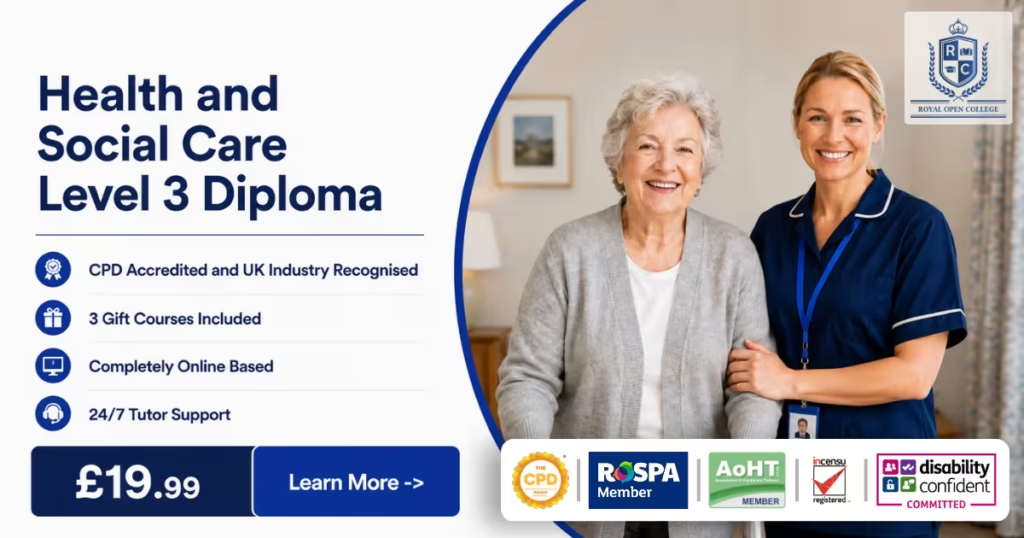
The application route depends on whether you live and work in England, Wales, Scotland or Northern Ireland, as each nation has its own apprenticeship frameworks, qualification names and eligibility rules. To build your subject knowledge before applying, you can study Royal Open College’s Level 3 Diploma in Health and Social Care online as flexible CPD learning.

Quick recap

  • Apprenticeships usually start from age 16, subject to national and vacancy requirements.
  • Qualifications, application routes and eligibility rules vary across the four UK nations.
  • Completion leads to recognised work-based qualifications under the relevant national framework.

What is a Level 3 health and social care apprenticeship?

A Level 3 health and social care apprenticeship is a paid job that combines hands-on care work with structured learning and workplace assessment. Because an apprenticeship is a paid job, an employer must be involved before the programme begins. Training follows the apprenticeship standard or framework used in your nation, rather than being a self-directed online course.

The content varies by nation and role, but common areas include safeguarding, duty of care, person-centred practice, communication, health and safety and supporting people with long-term conditions or complex needs.

In England, some workers progress from the Level 2 Adult Care Worker apprenticeship to Level 3. However, an employer may support direct Level 3 entry where the applicant has suitable experience.

What does the training actually cover?

The training covers the practical, professional and legal requirements of care work. Topics typically include safeguarding, person-centred care, communication, health and safety, infection control and supporting people with dementia or specific health conditions.

Assessors check that you can apply your knowledge in practice, not just recall it on paper. This is why being employed in a suitable care role is part of the programme design.

Is an apprenticeship the same as a college course?

No. A college course is a programme of study that may not have a paid job attached. An apprenticeship is employment first, with training built around the job you are doing.

You can study health and social care through a full-time college course or online CPD instead, but the course itself does not provide the paid employment and integrated workplace assessment included in an apprenticeship.

Who can apply for a Level 3 health and social care apprenticeship?

Apprenticeships are generally open to people aged 16 and over, with no standard upper age limit. However, eligibility also depends on the rules in your nation, your residency and education status and the conditions of the individual vacancy. You will normally need to hold, or be about to start, a relevant paid care role when the programme begins.

Entry requirements are not identical for every vacancy. Some employers ask for GCSEs at grade 4/C or above in English and maths. Others accept applicants without these qualifications and provide support to reach the required standard. Always follow the requirements stated in the vacancy advert.

This route suits care assistants, support workers and healthcare assistants looking to move into senior or supervisory roles. Career changers may also be eligible if they secure a relevant employed position.

Can you apply without previous care experience?

Applicants without previous care experience can sometimes apply for a Level 3 vacancy, though this depends on the employer and how competitive the position is. Many Level 3 apprentices have already worked at Level 2 or in a related care role.

If you have no care background, starting with a Level 2 apprenticeship or gaining voluntary experience may strengthen your application. Transferable skills involving communication, responsibility or supporting others are also worth highlighting in your personal statement.

What are the entry requirements across the UK?

Although the details differ, common considerations include a suitable employed role, any applicable English and maths requirements and disclosure checks appropriate to the position. The relevant standard, funding body and qualification also differ between nations.

Each nation operates its own apprenticeship system. Therefore, a route advertised in one nation may have different funding, eligibility and qualification requirements from a route available elsewhere in the UK.

🏴
England
Level 3 Diploma 18 Months Enhanced DBS
England's route is the Level 3 Lead Adult Care Worker apprenticeship, which includes a Level 3 Diploma in Adult Care. The current standard typically takes 18 months, excluding the end-point assessment period. Check the Skills England standard before applying because details can change.

Skills England has also published a revised version for future implementation. Applicants should therefore check which version applies to their planned start date.

You will receive protected off-the-job training during paid working time. The required training volume depends on the apprenticeship standard and any recognised prior learning.

The current standard requires the Enhanced DBS process to be completed and the result provided before starting. The employer assesses the information as part of its safer recruitment process.
🐉
Wales
Welsh Providers Entry Conditions Careers Wales
Wales offers its own health and social care apprenticeship pathways, with qualifications delivered through approved Welsh providers. Entry conditions depend on the framework, employer and role, so check the specific vacancy requirements.

Previous health and social care experience may be valued, and progression from a Level 2 route is common, although it is not a mandatory entry condition for every learner or employer. Careers Wales Apprenticeship Search lists current opportunities.
🏴
Scotland
SCQF Level 7 Workplace Practice PVG Scheme
Scotland's comparable social care route is the Social Services and Healthcare Modern Apprenticeship at SCQF Level 7. This is a Scottish qualification level and should not be treated as directly equivalent to England's Level 3 standard.

Candidates are generally expected to have completed the SCQF Level 6 Modern Apprenticeship or to possess equivalent qualifications or experience. Assessment is mainly based on workplace practice. For regulated roles, Scotland uses the Protecting Vulnerable Groups scheme rather than a DBS check.
🇬🇧
Northern Ireland
ApprenticeshipsNI Essential Skills AccessNI
Northern Ireland's Level 3 Health and Social Care framework is delivered through ApprenticeshipsNI. Under the current framework, you must be a new employee or have worked for the same employer for less than six months. This is a Northern Ireland programme condition, not a general UK rule.

Essential Skills in communication, application of numbers, and digital ICT sit alongside the main qualification. However, recognised prior qualifications may provide exemptions. AccessNI processes disclosure checks for roles in Northern Ireland.

How do you apply, step by step?

Applying for an apprenticeship is similar to applying for any other care job. You usually search through the appropriate official service, submit an application to the employer and attend an interview.

1
🔎

Search live vacancies

Search live vacancies using Find an Apprenticeship for England, Careers Wales Apprenticeship Search for Wales, Apprenticeships.scot for Scotland, or nidirect for Northern Ireland. Healthcare apprenticeships may also appear on NHS Jobs, NHS Scotland Jobs or HSCNI Jobs.

2
🏥

Ask your employer

If you already work in care, ask your employer whether it can enrol you through an approved or contracted training provider.

3
📝

Prepare a focused application

Prepare a focused application. Explain which care setting interests you and why you can manage employment and study together, rather than writing only that you want to help people.

4
💬

Attend an interview

Attend an interview. The employer usually looks for safe judgement, reliability and genuine readiness for care work.

5

Complete checks

Complete any disclosure and pre-employment checks requested within the employer's required timeframe.

Before you submit

Apprenticeship adverts often have firm closing dates and may close early, so confirm that the vacancy is still accepting applications before you begin.

If you already work in care, speak to your manager or learning and development team first. Some organisations offer apprenticeships to existing staff without advertising them publicly.

What does the apprenticeship involve, and how much will you be paid?

Most Level 3 health and social care apprentices combine paid care duties with structured off-the-job learning throughout the programme. This learning might involve college attendance, online study sessions or regular reviews with a workplace assessor, depending on the provider.

The apprentice minimum wage is £8.00 an hour from 1 April 2026 for apprentices under 19 and those aged 19 or over who are still in the first year of their apprenticeship. After the first year, apprentices aged 19 or over must receive at least the National Minimum Wage for their age.

Many care employers pay above the legal minimum. Check the advertised rate, shift enhancements and whether overnight or sleep-in duties are involved before accepting a position.

What happens when you finish?

Completing the apprenticeship requires satisfying the requirements of the included qualification and, in England, successfully completing the end-point assessment. These are related but separate: the qualification has its own assessment structure, while the end-point assessment covers the wider apprenticeship standard.

Possible next steps may include senior care roles, team leadership or further training at Level 4 or 5. Your employer or training provider can confirm which registration requirements or progression routes apply to your role and nation.

What if you can't get an apprenticeship straight away?

If there is no local vacancy or you do not yet have an employer, you can continue building relevant knowledge, experience and contacts while searching.

Volunteering in a care setting, contacting local care providers and learning about safeguarding and person-centred care may strengthen a future application.

Not every vacancy is advertised through a central service. Some care providers publish opportunities on their own websites or arrange apprenticeship training for existing employees. Contacting organisations in your area may therefore reveal options that you would otherwise miss.

Intake dates also vary between employers and training providers. Asking local providers which care organisations they work with and when recruitment may begin can help you time your application more effectively.

You could also consider applying for a paid care assistant role. Relevant employment experience may strengthen a later Level 3 apprenticeship application, although eligibility will still depend on the national programme, employer and vacancy requirements.

What are the common mistakes people make about Level 3 apprenticeships?

Confusion often arises when applicants mix up different types of training or assume that the same rules apply throughout the UK. This can lead them to follow the wrong route or describe their training inaccurately to a prospective employer.

🚫 Mistakes to Avoid — Before & During Your Application

watch out for these before you apply!

🗺️

Regional assumptions

Assuming the same framework, qualification name or duration applies throughout the UK.

🎓

CPD vs qualification

Treating a CPD course as equivalent to the regulated or recognised qualification included in an apprenticeship.

🛡️

Disclosure certificates

Claiming that a disclosure certificate gives a "clean" result. It provides information for the employer to consider when assessing your suitability.

💼

Employer in place

Expecting a training provider to start an apprenticeship without an employer in place.

🧭

Working conditions

Failing to check the shift pattern, personal care duties, travel requirements or working conditions before applying.

Studying through Royal Open College (CPD learning)

While searching for an apprenticeship, you may want to strengthen your background knowledge. Royal Open College’s Level 3 Diploma in Health and Social Care provides flexible online CPD learning covering safeguarding, person-centred care, communication and professional responsibilities.

It is a CPD course, not a regulated apprenticeship qualification, so completing it does not replace employer requirements, disclosure checks, workplace training or competency assessment. It can, however, help you approach an application with a stronger understanding of care principles and sector expectations.

Always check the specific requirements set by your chosen employer and apprenticeship training provider.

Recent Blogs

Free Exam Resources for Level 3 Health and Social Care

Free Exam Resources for Level 3 Health and Social Care

Your qualification route determines which free Level 3 Health and Social Care resources will help most. Pearson and NCFE past papers suit students preparing for written exams, while tutor2u and Study Rocket provide structured revision notes. Quizlet and Knowunity offer varied flashcard practice. Identifying your route first keeps your revision focused, relevant, and effective.

Career Progression Opportunities After a Health and Social Care Level 3 Qualification

Career Progression Opportunities After a Health and Social Care Level 3 Qualification

Level 3 health and social care learning can support progression from entry-level care into senior, specialist and NHS Healthcare Support Worker roles, alongside opportunities for further study and development. The right path depends on your experience, the setting you work in and whether you hold a regulated qualification or a CPD-accredited course.

Health and Social Care Level 3 Course Reviews: What Students Report

Health and Social Care Level 3 Course Reviews: What Students Report

Student reviews of Health and Social Care Level 3 courses commonly highlight flexible online study, career-relevant content and improved confidence. This article explains what reviews reveal about course content, recognition, career outcomes and common criticisms, including why CPD-accredited courses and regulated qualifications are not the same.