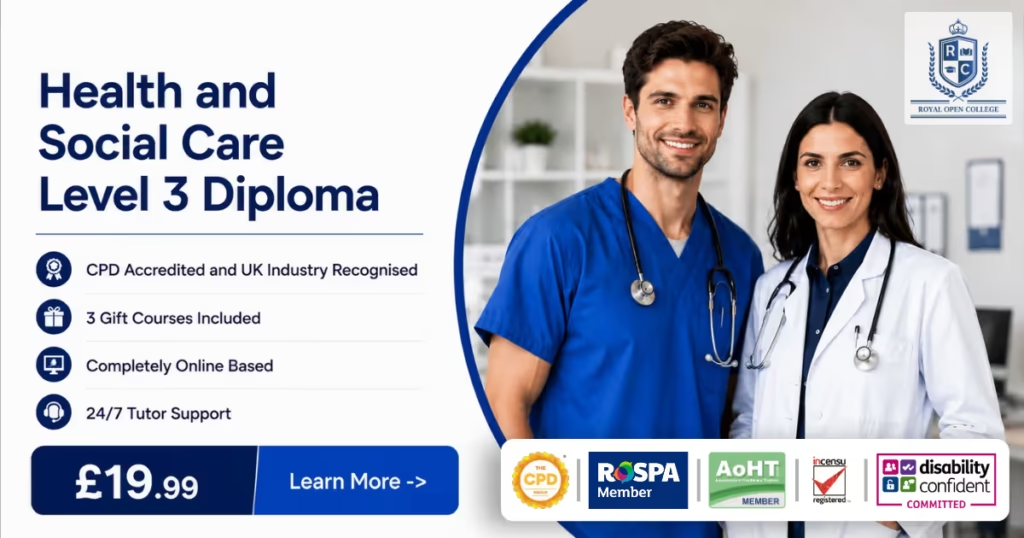

Searching for an affordable Level 3 health and social care course is easy, but knowing the right type takes a bit more thought. Royal Open College’s Health and Social Care Level 3 Diploma is one option, covering person-centred care, safeguarding, mental health, infection control, and other topics relevant to care practice.
Before enrolling, check which type of course your role and employer actually require. CPD learning and regulated qualifications serve different purposes in adult health and social care. The right choice depends on your career goal and the requirements linked to the role you want.
Quick Recap
What does a Level 3 health and social care course typically cover?
A Level 3 health and social care course introduces the core principles used across UK care settings. Courses commonly cover knowledge areas relevant to health and social care practice, including safeguarding, communication, and person-centred approaches.
Exact modules vary between providers. Some courses extend into dementia care, end-of-life care, and legislation affecting adult health and social care. Review the curriculum before enrolling to confirm it matches your learning needs and role.
The subject list is only part of the decision. The status of the certificate matters too.
What type of certification do these courses provide?
Some affordable online Level 3 health and social care courses provide a CPD-accredited certificate on completion. CPD stands for Continuing Professional Development. CPD accreditation is provided by independent bodies and does not make a course a regulated qualification.
Some providers also offer QLS (Quality Licence Scheme) endorsed courses. QLS endorsement is separate from Ofqual regulation, so it should not be confused with an RQF qualification.
Assessment and certification arrangements vary between providers. Before enrolling, check whether assessment fees and certificates are included in the course price. Many providers offer a digital certificate, while printed copies are available at an additional cost.
A provider may describe a course as aligned with CQC standards or NHS practice. This does not mean CQC or the NHS has approved or endorsed the course.
That distinction becomes clearer when CPD learning is compared with a regulated qualification.
What is the difference between a CPD course and a regulated qualification?
This is one of the most important distinctions to understand before choosing a course.
CPD-Accredited Level 3 Course
👆 Hover to reveal
Non-Regulated Learning
A CPD-accredited Level 3 health and social care course is a non-regulated learning programme. It develops your knowledge and provides a certificate of achievement, but it does not sit on the Regulated Qualifications Framework (RQF).
Level 3 Diploma in Adult Care (RQF)
👆 Hover to reveal
Regulated Qualification
A regulated qualification, such as the Level 3 Diploma in Adult Care (RQF), is formally regulated and delivered by a recognised awarding organisation. Occupational diplomas may require learners to demonstrate competence through workplace assessment or supporting evidence.
If a job advert or employer refers to an NVQ, check which current regulated qualification they accept. A CPD course will not replace a regulated qualification where one is specifically required.
Before paying for a regulated course, search the qualification title on the official register. Check the awarding organisation and qualification number rather than relying only on words such as “Level 3” or “Diploma” in the course title. This helps confirm exactly what type of qualification you are considering.
Once you know which type of course you need, the next step is deciding whether it fits your circumstances and career goals.
Who are Level 3 health and social care courses suitable for?
These courses are well suited to people entering or returning to the health and social care sector. Some CPD Level 3 courses have no formal entry requirements, although this varies between providers.
Where a CPD course is self-paced and fully online, learners can study around shifts, childcare and other commitments without attending a physical venue.
They are also a practical choice for
Care workers who want to strengthen their knowledge
Support workers looking to build skills across different care areas
Family carers wanting structured learning in care principles
Career changers moving into adult health and social care
International learners preparing for UK care employment
Employers seeking CPD options for staff development
A knowledge-based CPD course may not require a workplace placement. Occupational qualifications can have different assessment and workplace evidence requirements.
Whether that learning meets the requirements of a particular role depends on the employer and the job itself.
Does completing a Level 3 course meet employer requirements?
This depends on the employer, the role, and the care setting.
Employers may consider a CPD certificate as evidence of learning, but it does not replace any qualification, induction or competency requirement stated for the role.
Requirements vary across NHS trusts, private care providers and community services. There is no single standard for how employers evaluate a CPD certificate.
Some senior or supervisory roles may specify a regulated Level 3 Diploma in Adult Care or an equivalent qualification. In those cases, a CPD course is useful for knowledge development but does not substitute for the regulated route.
Always check the job description carefully. If you are already employed in care, ask your line manager or HR team what training level applies to your role before enrolling.
Employer policy is only one part of the picture. Legal and regulatory duties are separate and should be considered independently.
How does the Health and Social Care Act relate to training requirements?
The Health and Social Care Act 2008, together with the Health and Social Care Act 2008 (Regulated Activities) Regulations 2014, provides the legal framework for CQC regulation of care services in England.
Regulation 18 requires registered providers to ensure staff receive the support, training, professional development, supervision and appraisal needed for their duties. It does not prescribe a particular course level or commercial provider. What counts as appropriate depends on the person’s role, the service type, and the needs of people using the service.
The Care Act 2014 is separate legislation covering adult social care duties in England, including adult safeguarding responsibilities. It does not create a general requirement for care workers to hold a particular Level 3 CPD certificate.
Skills for Care publishes workforce development guidance and qualification information for adult social care in England. This is sector guidance rather than legislation.
Keeping CPD, regulated qualifications and employer requirements separate helps avoid several common mistakes when comparing courses.
What are the common mistakes when choosing a Level 3 health and social care course?
Many learners choose a course without fully understanding what the certificate is for and what it is not. That confusion can lead to wasted time, mismatched expectations, or gaps that emerge during a job application or CQC inspection.
🎓 Assuming CPD Level 3 equals NVQ Level 3
Assuming CPD Level 3 equals NVQ Level 3. They are different. Regulated adult care qualifications can include formal assessment and workplace evidence. A CPD certificate supports learning but does not automatically demonstrate assessed occupational competence.
🧑⚕️ Treating a certificate as proof of competence
Treating a certificate as proof of competence. Completing a course shows you have studied the material. Competence in a real care setting develops through supervised practice, experience, and employer assessment over time - not through a certificate alone.
🏥 Believing a course guarantees CQC compliance
Believing a course guarantees CQC compliance. CQC regulates care providers and may consider evidence of staff training, skills and competence. No single commercial course or certificate guarantees that a provider meets CQC requirements.
🔎 Not checking employer requirements before enrolling
Not checking employer requirements before enrolling. Some roles specify regulated qualifications. Enrolling on a CPD course when an RQF qualification is required will not meet that specification and will not progress your application.
🏷️ Confusing "aligned with CQC standards" with "CQC approved"
Confusing "aligned with CQC standards" with "CQC approved." A course can reflect CQC fundamental standards or Skills for Care frameworks without being formally endorsed by either organisation.
Studying through Royal Open College (CPD learning)
Royal Open College offers the Health and Social Care Level 3 Diploma as a CPD-accredited programme for learners across the UK. The course is delivered fully online with no fixed timetable, making it accessible for people to study around employment, family commitments, or shift-based schedules.
The curriculum covers areas relevant to adult health and social care, including safeguarding, person-centred care, infection control, dementia awareness, medication management, mental health support, and communication in care settings. These topics support knowledge development across a wide range of care settings and roles.
Enrolment also includes additional courses covering Care Certificate standards, care planning, observational skills, and equality and diversity.
Learners work through self-paced online modules and complete a multiple-choice assessment. A CPD-accredited digital certificate is available on successful completion and can be added to a CV or continuing professional development portfolio.
This is a CPD learning programme rather than a regulated RQF qualification. Completing the course builds professional knowledge, but does not replace workplace competency assessment or employer-led induction. Check with your employer or prospective employer what training or qualification requirements apply to your role before enrolling.