


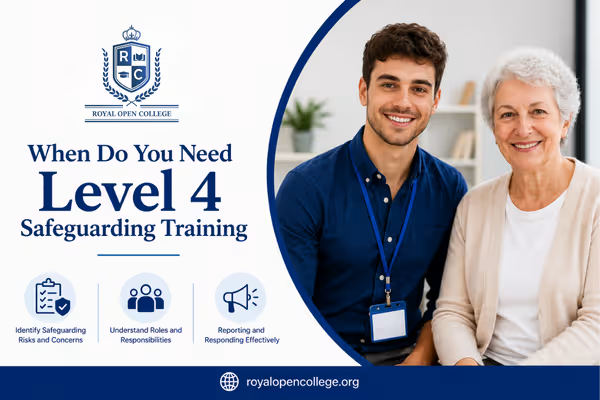



Three senior safeguarding professionals sat in a training room. A named nurse from an NHS trust. A GP practice safeguarding lead. A designated safeguarding lead from a secondary school. All three had been told they needed Level 4. Only two of them were right.
The GP practice safeguarding lead had attended Level 4 training for three years, based on advice her employer gave when she took the role. The RCGP safeguarding standards, updated in October 2024, confirm she needed Level 3 only. That is a common, costly mistake.
The answer to whether you need Level 4 depends entirely on your role and your sector. This guide separates healthcare, education, and social care clearly, names the specific roles in each, and corrects the mistakes most other guides repeat.
TL;DR: Level 4 Safeguarding at a Glance
- Level 4 safeguarding training is not required by all senior safeguarding staff.
- In healthcare, it applies to named professionals only, including named nurses, named doctors, named midwives, and Named GPs for safeguarding.
- GP practice safeguarding leads need Level 3 training, not Level 4. The RCGP safeguarding standards confirmed this in October 2024.
- In education, Designated Safeguarding Leads, deputies, headteachers, governors, and trustees need Level 4 equivalent training under KCSIE 2024.
- Level 3 is a prerequisite for Level 4 in every sector.
- “Level 4” means different things in healthcare, education, and social care. Each sector follows a separate framework.
- E-learning alone does not satisfy the intercollegiate framework requirement. At least 50% of Level 4 training must be participatory.
- Level 4 is a professional competency standard enforced through CQC and Ofsted inspection, not a legal requirement.
What Is Level 4 Safeguarding Training?
Level 4 safeguarding training is advanced training for professionals who hold named, designated, or specialist safeguarding roles. The focus moves away from managing individual cases. At Level 4, you lead safeguarding systems, advise colleagues, oversee training and governance, and hold accountability across an organisation or health system.
One point requires clarification before going further. “Level 4” is not a single universal qualification. The same label means different things depending on your sector.
In healthcare, Level 4 is defined by the intercollegiate competency framework, a shared set of competency standards produced and agreed across NHS royal colleges.
In education in England, Level 4 equivalent training aligns with the Designated Safeguarding Lead role under Keeping Children Safe in Education (KCSIE) 2024.
In social care, no single national standard defines Level 4 with the same precision.
A named professional is not an informal job title. In healthcare, the term refers to a formally designated role within an NHS trust or independent health provider. These roles carry specific responsibilities set out in the intercollegiate competency framework. Not every senior clinician with safeguarding duties holds a named professional role.
Level 3 is a prerequisite for Level 4 in all sectors. You need current Level 3 certification before undertaking Level 4 training.
Is Level 4 Safeguarding Training a Legal Requirement?
Level 4 training is not a legal requirement in the strict sense. No legislation requires named professionals or designated safeguarding leads to achieve Level 4 by a fixed deadline.
The law sets the duty to safeguard. The Care Act 2014 places a duty on organisations to safeguard adults at risk. The Children Act 1989 sets out duties relating to children and young people. These laws create the foundation, but they do not prescribe specific training levels by role.
The professional standards specifying Level 4 sit in the intercollegiate competency frameworks and statutory guidance, which are not legislation. What gives them force is inspection. The Care Quality Commission (CQC) inspects healthcare providers under Regulation 13 of the Health and Social Care Act 2008, checking whether training aligns with the intercollegiate framework. Ofsted checks whether DSL training in schools produces the outcomes required by KCSIE 2024.
Your employer’s policy often sets requirements above the intercollegiate minimum. Some NHS trusts require staff to train at a higher level than the framework specifies. Always check your employment terms and local safeguarding procedures alongside sector guidance.
The distinction to hold onto: law creates the duty. Frameworks define the standard. Inspection enforces the expectation. Level 4 sits in the second category, not the first.
Who Needs Level 4 Safeguarding Training in Healthcare?
In healthcare, Level 4 applies to named professionals. A named professional is a formally designated senior role within an NHS trust, independent health provider, or primary care organisation. The role carries clinical and leadership responsibility for safeguarding within the organisation. Named professionals advise staff, lead training, oversee governance, contribute to safeguarding audits, and hold accountability for the organisation’s safeguarding systems.
Children’s safeguarding: roles under the RCPCH ICD 2025
The RCPCH Intercollegiate Document fifth edition, published in autumn 2025, confirms Level 4 roles for children’s safeguarding:
The 2019 fourth edition of the ICD is now archived. Reference the 2025 fifth edition for all current competency requirements.
Adult safeguarding: roles under the RCN ICD 2024
The RCN Adult Safeguarding: Roles and Competencies for Health Care Staff, second edition, published August 2024, defines Level 4 as named professionals and equivalent roles identified within NHS-funded health services. These staff provide specialist advice, ensure appropriate safeguarding training exists within the organisation, and hold oversight responsibility for adult safeguarding arrangements.
All healthcare providers delivering services to children and young people must have staff fulfilling Level 4 roles. The RCPCH ICD 2025 states this as an organisational expectation, not a recommendation.
At least 50% of Level 4 training must be participatory. E-learning alone does not satisfy the intercollegiate framework. Participatory activities include face-to-face sessions, group case discussions, safeguarding forums, live webinars, and reflective practice on real cases. Record all activities in a learning log.
Does a GP Practice Safeguarding Lead Need Level 4?
No. This is the most common and most expensive misconception in primary care safeguarding.
GP practice safeguarding leads need Level 3 training, not Level 4. The RCGP safeguarding standards, published October 2024, state this directly: “GP practice safeguarding leads DO NOT require Level 4 or 5 safeguarding training. They require Level 3 training.”
The Level 4 role in primary care belongs to Named GPs for safeguarding. Named GPs are a formally designated role, currently existing in England only. They provide specialist safeguarding support to all general practice staff and GPs across a health system. A GP who leads safeguarding within their own practice does not hold a Named GP role unless formally designated as one by their organisation.
If you hold a GP role outside general practice, such as a position on an adoption panel, check the relevant intercollegiate document for requirements specific to your additional role.
Who Needs Level 4 Safeguarding Training in Education?
In education in England, Level 4 equivalent training applies to Designated Safeguarding Leads, deputy DSLs, headteachers, and governors and trustees with strategic safeguarding oversight.
England’s education sector no longer works to numbered safeguarding levels. KCSIE 2024, the statutory guidance from the Department for Education, does not prescribe “Level 4” by name. Instead, it defines required knowledge, skills, and responsibilities for DSL training. What most training providers describe as Level 4 standard corresponds to these KCSIE outcomes.
Under KCSIE 2024, DSL requirements are:
Governors and trustees hold strategic rather than operational responsibility. The governing board must appoint at least one member to hold strategic oversight of safeguarding arrangements. All governors and trustees receive safeguarding training at induction, updated regularly, enabling them to challenge practice and scrutinise effectiveness.
Ofsted does not approve specific training providers. Inspectors look for evidence the training content maps to their safeguarding inspection outcomes. A certificate alone does not demonstrate compliance. Your training provider should show exactly how its programme addresses KCSIE outcomes and Ofsted criteria.
Who Needs Level 4 Safeguarding Training in Social Care and the Voluntary Sector?
Social care and the voluntary sector do not have a single national framework prescribing Level 4 training with the same precision as the healthcare intercollegiate documents.
For CQC-regulated providers, senior managers overseeing safeguarding across a service are generally expected to hold Level 4 equivalent training. The exact requirement depends on the employer, the commissioner, and local safeguarding partnership expectations. CQC inspectors assess whether safeguarding arrangements are robust and appropriate to the service, including whether senior staff demonstrate appropriate competencies. Under the single assessment framework, launched April 2024, training and governance evidence falls under the “Safe” domain quality statements.
For the voluntary sector, NCVO guidance confirms no standardised accreditation for safeguarding training exists outside Ofsted and CQC-regulated settings. Organisations receiving statutory funding, or subject to inspection, must meet those bodies’ expectations. Others align training to their own safeguarding policy and the level of risk their work creates.
If you work in social care or the voluntary sector and are unsure about your training level, check with:
What Is the Difference Between Level 3 and Level 4 Safeguarding?
Level 4 is not Level 3 with more hours. The competencies are fundamentally different in character, not just in volume.
Level 3 prepares practitioners to manage safeguarding cases, make referrals, support colleagues, and lead safeguarding practice within a single setting. Level 4 requires strategic leadership, specialist advisory functions, governance accountability, and the capacity to advise and lead across an organisation or health system.
Level 3 vs Level 4 Safeguarding Roles
| Category | Level 3 | Level 4 |
|---|---|---|
| Role focus | Leading safeguarding in one setting | Named or designated specialist with system-wide accountability |
| Core responsibilities | Referrals, case management, staff support, policy creation | Advising practitioners, governance, audit, training oversight |
| Court proceedings | Contributes to processes | Provides specialist advice; understands expert witness role |
| Multi-agency work | Attends and contributes to meetings | Leads, commissions, and evaluates multi-agency training |
| Typical roles | DSL in a school, GP practice safeguarding lead | Named nurse, named doctor, Named GP (England) |
| Sector framework | KCSIE (education), employer policy | Intercollegiate framework (healthcare), KCSIE outcomes (education) |
| Prerequisite | Level 2 | Level 3 |
Level 4 also requires knowledge of safeguarding audit processes, Section 47 enquiries, Child Safeguarding Practice Reviews (England), Safeguarding Adults Reviews, Learning Reviews (Scotland), and how to challenge decisions made by other professionals in a multi-agency context. These competencies sit above Level 3 expectations across every sector.
Does Level 4 Safeguarding Apply Across All UK Nations?
The intercollegiate frameworks apply across all four UK nations, but each nation uses different terminology and different structures. Numbered levels (1 to 5) are most commonly used in England.
England
Numbered levels are widely used in healthcare and align with KCSIE in education. The intercollegiate frameworks apply to all NHS and independent health providers.
Wales
Social Care Wales leads the National Safeguarding Training, Learning and Development Standards. Wales uses six groups (A to F), not five. Group A is equivalent to Level 1. Group D is equivalent to Level 4. Group E is equivalent to Level 5. Group F covers all public sector leaders. Practitioners in Wales must reference the Social Care Wales framework and their Regional Safeguarding Board for training requirements. The relevant legislation is the Social Services and Well-Being (Wales) Act 2014.
Scotland
Scotland does not use numbered training levels. Training is competency-based, governed by the National Guidance for Child Protection in Scotland 2021 and the Adult Support and Protection (Scotland) Act 2007. Local Child Protection Committees and Adult Protection Committees oversee training standards.
Northern Ireland
Named GP roles equivalent to England apply. Healthcare practitioners follow the intercollegiate frameworks, adapted to local Health and Social Care Trust structures.
How to Know If Your Training Counts as Valid Level 4 Evidence
A CPD-accredited “Level 4 safeguarding course” purchased online does not automatically satisfy your employer, the CQC, or Ofsted. Valid evidence depends on whether training maps to the competency framework for your specific sector and role.
Here is what counts:
Healthcare (CQC-assessed settings):
- Training must align with the RCN adult ICD second edition (2024) for adult safeguarding roles, or the RCPCH ICD fifth edition (2025) for children’s safeguarding roles
- At least 50% of training must be participatory: face-to-face sessions, group case discussions, safeguarding supervision, live webinars, or structured reflective practice. Reading materials and e-learning modules count as non-participatory.
- CQC does not require certificated training alone. Since April 2024, CQC operates under the single assessment framework with 34 quality statements. Training evidence falls under the “Safe” domain.
- Maintain a training log recording: type of activity, date, duration, how the content maps to your competency level, and how you applied the learning.
Education (Ofsted-inspected settings):
- Training must produce learning outcomes aligned with KCSIE 2024 requirements and Ofsted’s safeguarding inspection criteria
- Keep your certificate alongside evidence showing how the training maps to those outcomes
- Ofsted does not approve specific providers. The responsibility to source appropriate training sits with you and your organisation.
A Practical Check Before Booking Level 4 Training
Before committing to any Level 4 course, put three questions to the provider:
Three questions to ask your training provider
- Which intercollegiate document or statutory guidance does this course map to?
- What percentage of the course is participatory, and what activities does that include?
- What evidence does this course produce for a CQC or Ofsted inspector?
A provider unable to answer all three clearly is unlikely to offer training meeting your requirements.
A Practical Check Before Booking Level 4 Training
Before committing to any Level 4 course, put three questions to the provider.
Do You Need Level 4? Use This Decision Guide
Start here: What sector do you work in?
Healthcare
Do you hold a named professional role (named nurse, named doctor, named midwife, named GP for safeguarding, named health professional in ambulance services, or medical adviser to an adoption agency)? YES: You need Level 4. Reference the RCN adult ICD 2024 and/or RCPCH ICD 2025 for your specific role. NO: Are you a GP practice safeguarding lead? YES: You need Level 3 only. Confirmed by RCGP safeguarding standards, October 2024. NO: Check your role against the intercollegiate framework or contact your professional body.
Education (England)
Are you a DSL, deputy DSL, headteacher, governor, or trustee? YES: You need Level 4 equivalent training. Reference KCSIE 2024. NO: Level 3 is likely sufficient. Confirm with your employer and check your role’s specific duties.
Social care or voluntary sector
Are you a senior manager responsible for safeguarding in a CQC-regulated service? YES: Level 4 is expected. Check with your employer, CQC, and local safeguarding board. NO: Level 3 is likely sufficient. Confirm with your employer and local safeguarding partnership.
Summary: Does Your Role Need Level 4?
The answer comes down to three checks. Identify your sector. Check your specific role against the relevant framework for your sector. Confirm with your employer or professional body where any doubt remains.
For healthcare, your reference points are the RCN Adult Safeguarding ICD second edition (August 2024) for adult roles, and the RCPCH Intercollegiate Document fifth edition (2025) for children’s safeguarding roles. For education in England, use KCSIE 2024. For social care and the voluntary sector, check with your local safeguarding board, employer, and CQC if you are a registered provider.
A Level 4 label on a course is a starting point. Your training must align with the competency framework for your role to count as valid evidence.
FAQ
Q: Does a GP practice safeguarding lead need Level 4 training?
A: No. The RCGP safeguarding standards, published October 2024, confirm GP practice safeguarding leads need Level 3 training only. Level 4 in primary care applies to Named GPs for safeguarding, a formally designated England-only role separate from the practice lead function.
Q: Is Level 4 safeguarding training legally required?
A: Level 4 is a professional competency standard, not a legal requirement. The Care Act 2014 and Children Act 1989 create the legal duty to safeguard, while intercollegiate frameworks and KCSIE define how that duty is met at role level. CQC and Ofsted enforce compliance through inspection.
Q: What is the difference between a named professional and a designated safeguarding lead?
A: A named professional is a formally designated healthcare role governed by the intercollegiate competency framework (RCN 2024 for adult safeguarding, RCPCH 2025 for children's safeguarding). A DSL is an education role governed by KCSIE 2024. They sit in different sectors, follow different frameworks, and carry different competency requirements.
Q: How often do you need to refresh Level 4 safeguarding training?
A: For DSLs in education, KCSIE 2024 requires formal training to be updated at least every two years, with knowledge refreshed annually. For healthcare named professionals, the intercollegiate framework sets competency expectations reviewed at annual appraisal, rather than a fixed certificate expiry cycle.
Q: Does Level 4 safeguarding apply in Scotland and Wales?
A: Scotland does not use numbered safeguarding levels. Training is competency-based under the National Guidance for Child Protection in Scotland 2021 and the Adult Support and Protection (Scotland) Act 2007. Wales uses six groups (A to F) through Social Care Wales. Group D is equivalent to Level 4.
Q: Do you need to complete Level 3 before Level 4 safeguarding training?
A: Yes. Level 3 is a prerequisite for Level 4 in all sectors. Training providers delivering Level 4 require evidence of current Level 3 certification at the point of booking.
Q: Does an online-only Level 4 safeguarding course meet the intercollegiate framework requirement?
A: No, not on its own. The intercollegiate framework requires at least 50% of Level 4 training to be participatory. E-learning modules are non-participatory by definition. A course delivered entirely online does not meet the healthcare framework requirement, regardless of its CPD accreditation.
Q: What evidence do I need to show Level 4 safeguarding training for a CQC inspection?
A: CQC inspectors do not require certificated training alone. Valid evidence includes learning logs, reflective notes, safeguarding forum attendance records, case discussion records, and supervision notes. Maintain a training log recording the type, date, duration, and how you applied each learning activity in practice.
Q: Does a headteacher or governor need Level 4 safeguarding training?
A: Yes. Under KCSIE 2024, headteachers and the designated safeguarding governor or trustee hold strategic safeguarding responsibility and must be trained to an appropriate level. DSLs and deputies refresh every two years with annual knowledge updates. Governors and trustees receive training at induction with regular updates thereafter.
Q: Can I count the same training session towards both child and adult Level 4 requirements?
A: Yes, where the session covers both adult and child safeguarding with equal weighting. The intercollegiate framework permits dual counting when equal treatment is given to both domains within one training activity. Record the dual application clearly in your training log.
Q: What is a named professional in safeguarding?
A: A named professional is a formally designated senior healthcare role within an NHS trust or independent health provider, responsible for leading safeguarding practice, providing specialist advice to colleagues, overseeing training, and contributing to governance. The term describes a specific role within the intercollegiate competency framework, not a general job title.
Q: How long is Level 4 safeguarding training valid?
A: There is no single fixed expiry date. In education, DSL training is valid for two years before formal refresh is required, with annual updates in between. In healthcare, the intercollegiate framework expects competencies to be reviewed at annual appraisal and maintained through ongoing participatory learning rather than a certificate renewal cycle