







What Is Safeguarding Level 4

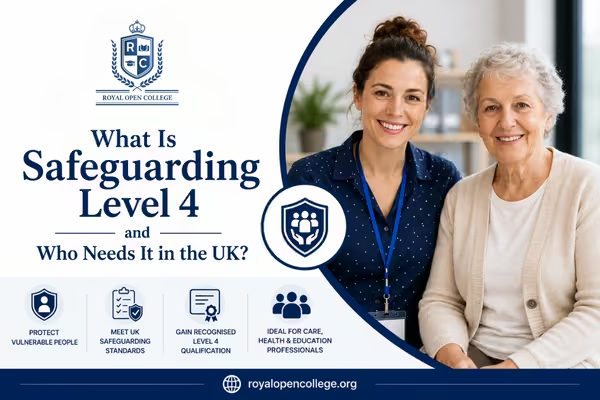
What Is Safeguarding Level 4 and Who Needs It in the UK?

Safeguarding Level 4 often sounds simple until you compare job titles, course pages, and employer guidance. This article cuts through that confusion. It shows who usually needs Level 4 in health and care, why ordinary practice safeguarding leads often sit at Level 3, how adult and child safeguarding differ, and what to check before paying for training.

A GP practice lead gets asked whether the team needs a Level 4 course. A named nurse in a trust checks a job plan and sees Level 4 listed. A training buyer reads three course pages and gets three different answers. That is where most confusion starts. The term appears simple, but the real answer depends on role, setting, and responsibility.

Many pages make Safeguarding Level 4 sound like a broad senior staff course. The current UK picture is narrower. In health and care, Level 4 usually points to a specialist safeguarding role with added leadership, advice, supervision, and governance duties. It does not fit every manager, every lead, or every member of staff with an interest in safeguarding.

This guide explains what Safeguarding Level 4 means, who usually needs it, who usually does not, how Level 4 differs from Levels 3 and 5, and what to check before you book a course. The focus stays on UK health and care practice, because that is where the term has the clearest meaning in current competency frameworks.

TL;DR / Quick Summary

  • Safeguarding Level 4 usually refers to a specialist safeguarding level for named professionals and senior safeguarding roles in UK health and care.
  • The term is used most clearly in healthcare competency frameworks. It is not a universal all sector qualification title.
  • Level 4 roles often include specialist advice, supervision, oversight, governance, and input into complex safeguarding work.
  • Named doctors, named nurses, named midwives, named GPs for safeguarding, and some provider safeguarding leads often sit at Level 4.
  • Most frontline staff, many managers, and GP practice safeguarding leads do not usually need Level 4. In general practice, practice safeguarding leads sit at Level 3.
  • Level 3 usually fits advanced frontline safeguarding work. Level 5 usually fits strategic designated roles with wider system responsibility.
  • Safeguarding duties are legal, but Level 4 itself is usually set through professional frameworks and employer role mapping, not by a standalone law.
  • Before booking a Level 4 course, check your job description, your employer’s training matrix, and the framework your service follows.
Is Safeguarding Level 4 Qualification, Framework, or Legal Requirement?

Is Safeguarding Level 4 a qualification, framework, or legal requirement?

Safeguarding Level 4 is not a universal UK qualification title. In current practice, it works best as a role based competency level inside professional safeguarding frameworks. The clearest examples sit in the RCPCH child safeguarding competencies for health care staff and the RCN adult safeguarding competencies for health care staff. Those frameworks map learning and practice to role, not to a generic course label used across every sector.

The legal duties sit elsewhere. Child safeguarding duties sit under law and statutory guidance such as the Children Act and Working Together. Adult safeguarding duties sit under the Care Act and statutory guidance. NHS England then sets accountability expectations for NHS funded settings, and employers set local training, supervision, and governance arrangements. That means the duty to safeguard is legal. The decision to place a post at Level 4 usually comes from framework based and employer led role mapping.

This distinction matters. A provider may sell a “Level 4 safeguarding” course, but the title alone does not prove the course matches your role, your sector, or the framework your employer follows. That is why readers need to separate law, statutory guidance, professional guidance, and local policy before deciding whether Level 4 applies.

What is Safeguarding Level 4?

Safeguarding Level 4 is an advanced safeguarding competency level linked to leadership and added responsibility. In health and care, it usually covers specialist advice, professional supervision, oversight of safeguarding practice, audit, governance, learning from reviews, and work around complex cases. It sits above Level 3, which focuses more on advanced frontline action and expertise, and below Level 5, which focuses on strategic system level oversight. 

The most useful way to understand Level 4 is this. It is not simply a harder course. It is a role with wider safeguarding duties. A Level 4 post often advises other staff, shapes local safeguarding practice, helps with policy and quality review, and gives expert input when cases become more serious or more complex. On the child health side, the current RCPCH framework describes Level 4 as a leadership role with additional responsibility. On the adult side, the RCN framework places Level 4 in specialist roles such as named professionals and safeguarding leads who directly advise staff on safeguarding.

Why the term is often misunderstood

The confusion comes from mixed use. Some websites use Level 4 as a broad course label for senior staff in schools, charities, social care, and health care. But the clearest live UK meaning sits in healthcare competency documents. That is why some readers think Level 4 means “advanced safeguarding” for any manager, while the real framework points to specialist named or provider lead roles.

Who Usually Needs Safeguarding Level 4

Who usually needs Safeguarding Level 4?

Level 4 usually fits named professionals and specialist safeguarding roles with added responsibility. In child health settings, the current RCPCH framework lists senior or named doctors and nurses, senior or named midwives in maternity services, specialist child psychologists and psychiatrists in mental health providers, senior or named health professionals in ambulance organisations, safeguarding leads, specialist nurses in residential or secure settings, and named GPs for safeguarding who help a health system.

In adult safeguarding, the RCN places Level 4 in specialist roles such as named professionals, safeguarding leads, and equivalent posts that directly advise staff. These are not ordinary awareness roles. They often involve oversight of safeguarding practice, consultation with teams, review of decision making, and input into quality assurance, supervision, and learning after concerns or reviews.

Healthcare roles that commonly need Level 4

A named nurse in an NHS trust often needs Level 4. A named doctor or named midwife often needs Level 4. A safeguarding lead in a provider organisation often needs Level 4 where the role includes specialist advice, oversight, and leadership across teams. These posts usually sit inside provider structures, not inside ordinary frontline job plans.

Adult safeguarding provider and specialist lead roles

On the adult side, Level 4 often fits provider based specialist safeguarding leads who advise teams, help with Section 42 related processes, review complex concerns, and help embed Making Safeguarding Personal. The role often includes more than case response. It usually includes review, learning, and safer systems of work across the organisation.

What Level 4 work looks like in practice

A Level 4 post often gives advice to colleagues, reviews serious concerns, takes part in supervision, checks documentation quality, helps update policy, and draws learning from safeguarding reviews. The role often links practice, governance, and staff learning. That is why title alone does not decide the level. The real test is the scope of safeguarding responsibility in the role.

Who does not usually need Safeguarding Level 4?

Most staff do not usually need Level 4. That includes many frontline clinicians, nurses, allied health staff, support workers, administrators, reception staff, many team managers, and many supervisors. Their roles often fit Levels 1, 2, or 3, depending on contact, decision making, and safeguarding responsibility. A senior title on its own does not move a post into Level 4. The framework looks at what the role does, not how the role sounds.

The clearest example sits in primary care. The RCGP states that GP practice safeguarding leads do not need Level 4 or 5. They need Level 3, with added requirements linked to the lead role. That single point corrects one of the biggest mistakes on broad training pages, which often tell readers that all safeguarding leads need Level 4. In general practice, that is not the case.

Roles that are often mistaken for Level 4

Practice safeguarding leads, many deputy leads, many ward managers, many service managers, and many staff who attend case meetings do not automatically sit at Level 4. In primary care, the RCGP toolkit also warns that safeguarding support roles have no national standard and should not replace the safeguarding responsibility of the whole team. That makes it even more important to check the role scope before you assume Level 4 fits.

Safeguarding Level 3 vs Level 4 vs Level 5, what is the difference?

The simplest way to split the levels is by responsibility. Level 3 usually fits advanced frontline or lead practice. Level 4 usually fits specialist provider leadership and added safeguarding responsibility. Level 5 usually fits strategic system level leadership, often in designated professional roles. The child health framework labels Level 3 as action and expertise, Level 4 as leadership role and additional responsibility, and Level 5 as strategic oversight and system response.Lorem ipsum dolor sit amet, consectetur adipiscing elit. Ut elit tellus, luctus nec ullamcorper mattis, pulvinar dapibus leo.

Quick Role Map

Quick Role Map

Understand the different safeguarding role levels and their primary focus areas.

Level 3

Frontline practitioner with regular safeguarding duties

Main Focus

Action, expertise, escalation, response

Level 4

Named or specialist safeguarding role in a provider

Main Focus

Leadership, advice, supervision, oversight

Level 5

Designated strategic safeguarding role

Main Focus

System response, strategy, commissioning advice

This map gives a practical starting point. But local job design still matters. Some organisations widen or narrow duties based on service type, size, and patient group.

The gap between Levels 4 and 5 matters most. RCPCH role resources state that Level 4 senior or named roles and Level 5 designated roles should be separate post holders. The glossary also states that designated professionals provide strategic safeguarding advice across the health system. So Level 4 is not the same as the top level of safeguarding leadership. It sits below that strategic layer.

Quick Decision Flowchart

Quick Decision Flowchart

Follow the steps below to understand which safeguarding level may fit your role.

Start
Do you hold a named safeguarding post or a specialist provider lead post?
If Yes
Check Level 4 and Level 5 role descriptions
If No
Ask whether your role is mainly frontline care, escalation, and local lead work
If Yes
Level 3 often fits
Review
If your role includes strategic system advice across organisations, review Level 5
Important
Check employer framework and job plan before booking training
This flow does not replace local policy, but it gives a safe first step.

Is Safeguarding Level 4 a legal requirement?

No standalone UK law says a post must hold “Level 4 safeguarding.” The legal duty is to safeguard children and adults at risk, and to make sure staff receive training suited to their role. Working Together 2026 states that staff in health care settings should receive training suited to their role and follow relevant professional guidance. NHS England’s safeguarding framework sets out safeguarding roles and responsibilities across NHS funded providers and commissioning organisations.

That means Level 4 usually enters the picture through professional competency frameworks and employer role mapping. In NHS funded care, providers are expected to have named roles, leadership, training, supervision, and governance. The NHS Standard Contract says providers must run safeguarding training programmes for relevant staff and have regard to intercollegiate guidance. So the law sets the duty. The framework and the employer decide which roles often need Level 4.

Law vs statutory guidance vs employer policy

Law creates the duty to protect people from abuse and neglect. Statutory guidance explains how agencies should work together. Professional guidance sets out competency levels and role expectations. Employer policy turns those expectations into local training, appraisal, and supervision arrangements. Mixing these layers leads to poor advice. A course page may say “Level 4 is required,” but the safer question is this, required by which framework, for which role, in which setting?

Does Level 4 Mean The Same Thing In Child and Adult Safeguarding?

Does Level 4 mean the same thing in child and adult safeguarding?

The core idea is similar across both areas. Level 4 points to specialist safeguarding leadership with extra responsibility. But the child and adult frameworks are not identical. Child safeguarding in health care now sits under the 2025 RCPCH intercollegiate document. Adult safeguarding in health care sits under the 2024 RCN intercollegiate document and the Care Act statutory guidance. The shared theme is expertise, advice, leadership, and oversight. The practical language differs.

On the child side, readers will see terms such as named doctor, named nurse, named midwife, looked after children, and strategic child safeguarding roles. On the adult side, readers will see terms such as Section 42 enquiry, Making Safeguarding Personal, adult safeguarding boards, and person led safeguarding work. Competitor pages often lean hard into child safeguarding. That leaves a real gap. Adult safeguarding Level 4 roles are current, real, and important in provider settings.

This is why a broad Level 4 article needs both angles. If a page only talks about DSLs, schools, and child protection language, it misses a large part of the real UK picture for health and care readers.

How should healthcare and primary care staff interpret Level 4?

Health care is where Level 4 has the clearest live meaning. NHS England says safeguarding accountability and assurance applies across NHS funded providers and commissioning organisations. The framework sets out leadership, named roles, training, supervision, policies, and assurance. In practice, that gives health services a clearer route for deciding who needs Level 4 than many other sectors.

Primary care needs more care with the label. The RCGP standards say named GPs, named nurses, designated professionals, and safeguarding leads within health boards or authorities often need Level 4 or 5 depending on role. But they also say GP practice safeguarding leads do not need Level 4 or 5. They need Level 3. This is the point that broad course pages often miss.

Named roles vs practice safeguarding leads

A named role usually carries wider safeguarding responsibility across a service or system. A practice safeguarding lead usually helps safeguarding within one practice or organisation. Those are not the same job. In England, named professionals provide specialist safeguarding advice at system level, while practice leads focus on local practice culture, response, and coordination.

Named professional vs designated professional

A named professional usually works at provider level. A designated professional works at a strategic health system level and gives wider safeguarding advice across organisations. That is why Level 4 and Level 5 need clear separation in any article or training decision.

What should you check before booking a Safeguarding Level 4 course?

Course titles often sound clear. The real test is role fit. Before you book, check whether your employer maps your post to Level 4. Check whether the course follows the child safeguarding framework, the adult safeguarding framework, or both. Check whether your role includes specialist advice, supervision, governance, and oversight, not only day to day safeguarding response. Then check whether your line manager or safeguarding lead agrees that Level 4 fits your post.

Level 4 Checklist Infographic

Use This Short Checklist

A quick guide to help you check if Level 4 is the right fit for your role.

01

Does your job plan include a named or specialist safeguarding remit.

02

Does your employer follow the relevant intercollegiate framework.

03

Does the course map clearly to child, adult, or combined safeguarding duties.

04

Does the course cover practice, supervision, governance, and learning, not only theory.

05

Do you have employer sign off before you spend money or study time.

One More Useful Point

The RCN adult framework adds one more useful point. Staff moving into a Level 4 role should attain the Level 4 competencies within six weeks of starting the new role. That shows how closely the level links to role function, not only course choice.

Common misconceptions about Safeguarding Level 4

Most confusion about Level 4 comes from mixed sector marketing and loose use of the word “lead.” The first myth is this. All managers need Level 4. That is false. Management alone is not enough. The current frameworks place Level 4 in specialist roles with added safeguarding responsibility.

The second myth is this. All safeguarding leads need Level 4. That is false too. The RCGP says GP practice safeguarding leads stay at Level 3, not Level 4 or 5. So the word “lead” does not decide the level on its own.

The third myth is this. A CPD certificate proves Level 4 competence. A certificate proves course attendance or assessment. It does not prove the full role based competence described in the frameworks. Level 4 links to applied practice, advice, supervision, governance, learning, and role scope.

The fourth myth is this. Level 4 means the same thing in every sector. Broadly similar ideas appear across sectors, but the clearest current UK use sits in health care frameworks. That is why a school only or generic provider view often leaves gaps for health and care readers.

Summary: How to decide whether Level 4 applies to your role

Safeguarding Level 4 is best understood as a specialist health and care competency level, not a generic all sector course label. It usually fits named professionals and specialist safeguarding roles with wider leadership, advice, supervision, and governance duties. It does not usually fit every manager or every safeguarding lead.

Use three checks before you decide. First, look at the real duties in your role. Second, check which framework your employer follows. Third, check whether your post sits at provider specialist level or at practice and frontline level. In many cases, Level 3 is the right answer. In a smaller group of named and specialist roles, Level 4 is the right fit.

If you only remember one point, remember this. Level 4 is about specialist safeguarding responsibility, not seniority on its own. That single distinction clears up most of the confusion found on broad course pages and mixed search results.

FAQ

Q: Is Safeguarding Level 4 mandatory in the UK?

A: Safeguarding duties are mandatory. Level 4 itself is usually a role based expectation drawn from professional frameworks and local employer policy, not a stand alone legal rule written into statute. In practice, organisations match training and competence to the duties in the post, the setting, and the people the service works with.

A: Level 4 usually fits named professionals and specialist safeguarding roles with wider responsibility. This often includes named doctors, named nurses, named midwives, named GPs for safeguarding, and some provider safeguarding leads who advise staff, review practice, and hold oversight duties. The level links to responsibility, not seniority alone

A: No. The word lead does not set the level on its own. Some safeguarding lead roles sit at Level 4 where they include specialist advice, supervision, governance, and wider provider responsibility. Other lead roles sit at Level 3 where the focus stays on local practice, response, and coordination rather than specialist oversight.

A: No, not usually. The RCGP states that GP practice safeguarding leads do not need Level 4 or 5. This role usually sits at Level 3, with added knowledge and capability linked to the practice lead role. That is one of the clearest areas where broad course pages often overstate the need for Level 4.

A: Level 3 usually fits advanced frontline safeguarding work. This includes recognising concerns, responding well, documenting clearly, sharing information safely, and taking action. Level 4 adds a wider specialist layer. It often includes leadership, expert advice, safeguarding supervision, quality review, governance, and input into more complex safeguarding work across a provider or service.

A: Level 4 usually fits named or specialist safeguarding roles inside a provider organisation. Level 5 usually fits designated roles with strategic system level responsibility. Level 5 work often reaches across organisations and includes wider planning, assurance, and commissioning advice. That is why Level 4 and Level 5 should not be treated as the same thing.

A: The core idea is similar, because both point to specialist safeguarding responsibility with added leadership. The detail is not identical. Child safeguarding uses the RCPCH intercollegiate framework. Adult safeguarding uses the RCN framework and Care Act practice context. Role examples, process language, and statutory context differ across the two areas.

A: Yes. Some people take a Level 4 course for development or future career plans. Still, a higher level course does not automatically mean the right fit for your current post. You should check your job description, employer training matrix, and role expectations first, so your learning matches the duties you are expected to carry out.

A: No. A certificate proves course completion or attendance. Level 4 competence is wider than that. The current frameworks link the level to applied practice, role scope, supervision, leadership, governance, reflection, and safeguarding advice. In short, a certificate is one part of the picture, not the full test of Level 4 performance.

A: Start with the role, not the course title. Check whether your job includes named or specialist safeguarding duties, direct advice to staff, safeguarding supervision, governance input, or wider provider oversight. Then check which framework your employer follows for child, adult, or combined safeguarding work. That route gives a safer answer than course marketing alone.

Recent Blogs

Who Needs Level 3 Safeguarding Training?

Who Needs Level 3 Safeguarding Training?

Level 3 safeguarding training applies to professionals with lead or supervisory responsibilities. This includes DSLs, managers, healthcare staff, and social workers across UK care, education, and health settings. Requirements vary by role and sector guidance.

Nursing Assistant vs. Healthcare Assistant

Nursing Assistant vs Healthcare Assistant: What Is the Actual Difference in the UK?

You find two NHS job posts on the same ward. One says nursing assistant. The other says healthcare assistant. The duties look identical. This guide explains why that happens, what the NHS band tells you that the title does not, and why the Nursing Associate is a completely separate role that most pages wrongly describe as the same thing.