Multi-agency working in safeguarding comes into play when a concern crosses roles and responsibilities. A GP notices repeated missed appointments. A teacher sees a change in behaviour. A care worker hears something that does not feel right. Each holds a piece of the picture, but no one sees it all.
Multi-agency working in safeguarding means services sharing information, responsibility, and action. The aim is to protect children, young people, and adults at risk. It recognises that safeguarding works best when professionals communicate, collaborate, and respond together, not alone.
This guide explains how multi-agency working operates in UK safeguarding practice. It explores why it matters, who is involved, and how it works day to day. You will also see how shared decisions support safer, more joined-up care across health, social care, education, and safeguarding services.
TL;DR
- Multi-agency working in safeguarding means services working together to keep people safe.
- It is used when one organisation cannot manage a safeguarding concern alone.
- UK safeguarding law expects agencies to share responsibility, not work in isolation.
- Health, social care, education, police, and housing often work together.
- Information sharing helps professionals understand risk more clearly.
- MASH teams support joined-up decisions in many local areas.
- Working together reduces missed risks and improves safeguarding outcomes.
- It applies to children, young people, and adults at risk.
When Different Agencies Work Together to Safeguard Children, What Is This Known As?
This is known as multi-agency working.
Safeguarding uses this approach because no single service sees the whole picture of a child’s life. When agencies share information and work together, risks are identified earlier and responses are more coordinated, reducing the chance that concerns are missed.
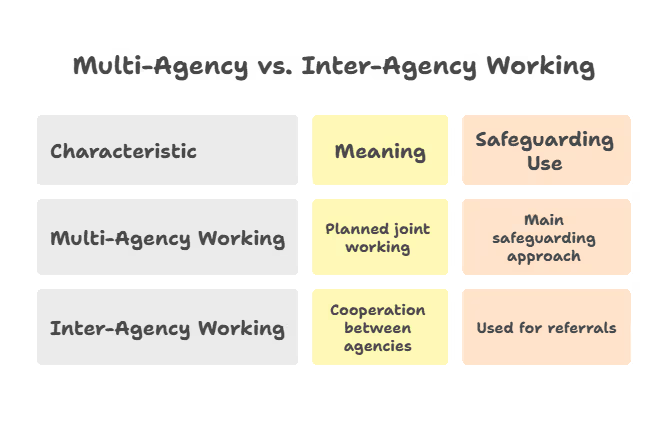
Multi-Agency Working vs Inter-Agency Working (Explained Simply)
In simple terms, multi-agency working means working together. Inter-agency working means working alongside each other.
People often see these terms used together, which causes confusion. They sound similar, but they describe different ways of working in safeguarding practice.
The key difference is how closely services plan, act, and share responsibility when protecting children or adults at risk.
Why Multi-Agency Working Is Important in Safeguarding
Multi-agency working is important in safeguarding because no single service can identify risk, understand need, or protect people effectively on its own. Safeguarding works best when professionals connect the dots early and act together.
- Early identification of risk
Different agencies spot different signs. When concerns are shared, patterns emerge sooner and intervention happens earlier. - A fuller picture of need
Health, social care, education, housing, and police each hold part of the story. Working together builds a clearer, more accurate understanding of risk and vulnerability. - Faster, joined-up responses
Clear coordination reduces delay, duplication, and confusion about who should act and when. - Shared accountability
Decisions are safer when responsibility is shared. Multi-agency working supports balanced judgement and reduces professional isolation. - Reduced risk of harm
Joined-up planning lowers the chance of missed warning signs and improves long-term safeguarding outcomes.
Multi-Agency Working in Health and Social Care
Safeguarding in health and social care never sits with one person. Care workers, nurses, GPs, and support staff each see different risks during routine contact. Those pieces only make sense when they are shared.
Multi-agency working in health and social care means services working together to protect people at risk. Information, concerns, and decisions are shared across teams. This helps build a fuller picture of what is happening in someone’s life.
For care workers and support staff, it gives clear routes for raising concerns. For health professionals, it supports safer decisions and shared responsibility. For children and adults at risk, it means better protection through joined-up care.
How Multi-Agency Working Operates in Practice
It often starts with something small. A comment in a handover. A bruise that doesn’t fit the story. A missed visit that feels different this time.
From there, multi-agency working moves through a set of steps. People follow them so they can act fast, share the right information, and put a safeguarding plan in place.
Identifying a safeguarding concern
Notice what you see, hear, and read. Stick to facts.
You might spot a change in presentation during personal care. You might hear a child describe harm in simple words. You might find bank cards missing during a home visit.
Ask yourself one key question. Does this person feel safe right now?
If risk feels immediate, you act at once. You don’t wait for a manager’s next meeting.
Record the concern in line with your setting’s policy. Use clear language. Keep opinion out.
Making a referral
You share the concern through the right route. In most settings, that means you raise it with your safeguarding lead first.
From there, you make a referral to the local authority. Children’s social care takes child protection referrals. Adult social care takes safeguarding adults referrals.
You include what matters for decision-making. Who is at risk. What happened. When it happened. Where it happened. Who else is involved.
You also explain what you’ve done so far. For example, you moved a resident away from a staff member while you await advice.
This is where thresholds come in. The receiving team uses local thresholds to decide the next step, from early help to a statutory response.
Lawful information sharing
People worry about “getting it wrong” with data. In safeguarding, the bigger risk often comes from staying silent.
Share information that is necessary and relevant. Keep it proportionate. Keep it secure. Then record what you shared and why. Government advice on information sharing supports this approach.
Use consent where it’s safe and possible. If consent isn’t possible, you still share when risk justifies it. You document your reasons.
In practice, this can look simple. A GP confirms missed appointments. A school shares attendance patterns. A district nurse flags repeated bruising in the same place.
Role of Multi-Agency Safeguarding Hubs (MASH)
A MASH helps agencies share information early. It brings key partners into one process so they can respond to a referral with a fuller picture.
The MASH triages what comes in. It checks known history, current risk, and who already works with the person or family.
It then applies local thresholds. That decision shapes the pathway. Early help. A social work assessment. A Section 47 enquiry for a child. Or, for adults, a decision on whether the local authority should make enquiries under Section 42 of the Care Act.
Not every area runs MASH in the same way. The principle stays the same. Share early, decide early, act early.
Multi-agency meetings and shared plans
Once agencies agree the level of risk, they meet. Sometimes that’s a professionals’ meeting. Sometimes it’s a strategy discussion. Sometimes it’s a safeguarding adults meeting.
The meeting turns information into a shared safeguarding plan.
The plan sets out actions and owners. It also sets timescales. It avoids vague tasks like “monitor the situation”.
In care, this might mean practical steps. Two staff support for personal care. A medication review with the GP. A welfare check by housing. A school plan to manage safe collection.
Someone coordinates the plan. Everyone updates their records. Everyone knows what they’re responsible for.
Review and escalation
Safeguarding work needs follow-through. So agencies review the safeguarding plan and check if risk has reduced.
If actions don’t happen, you don’t just note it and move on. You challenge it through agreed routes.
That’s escalation. It can start with a manager-to-manager conversation. It can move to a formal dispute process if needed. Working Together expects respectful professional challenge across agencies.
Escalation also applies when thresholds feel wrong. If a referral gets stepped down but risk stays high, you raise that. You share new information. You ask for a review.
Because the point isn’t process for its own sake. It’s getting the right help, at the right level, before harm grows.
Legal and Statutory Framework Supporting Multi-Agency Working
Safeguarding doesn’t rely on goodwill alone. In the UK, clear legal duties set out who must work together, when they must act, and what happens if they don’t.
These frameworks give professionals the authority to share concerns, challenge decisions, and stay involved until risk reduces.
Working Together to Safeguard Children (2023)
This guidance sets the expectations for how agencies protect children. It tells organisations how to work together, not just what to do in isolation.
It places joint responsibility on local authorities, health services, police, and education. Everyone plays a part, from early help to statutory intervention.
In practice, it means you don’t “hand over” a concern and step back. You stay involved. You share updates. You attend meetings when asked.
Children Act 1989 and 2004
These Acts form the backbone of child safeguarding in England. They place the child’s welfare at the centre of all decisions.
They require local authorities to assess risk and take action where harm is likely. They also expect other agencies to support that work.
For frontline staff, this means your information matters. Even small observations can shape how risk is understood.
Section 11 duties
Section 11 sets a clear standard. Certain organisations must have arrangements in place to safeguard children.
That includes NHS bodies, local authorities, police, and many commissioned services.
It affects day-to-day practice. Training. Safer recruitment. Clear reporting routes. Management oversight.
If systems don’t support safe practice, that’s a safeguarding issue in itself.
Care Act 2014
For adults, the Care Act provides the legal basis for safeguarding. It sets out when local authorities must make enquiries and who they must involve.
The focus stays on the adult’s wishes and wellbeing. Protection matters, but so does choice.
Multi-agency working under the Care Act often involves health, housing, the police, and care providers. Each holds part of the picture.
Safeguarding Adults Boards (SABs)

Every local authority area has a Safeguarding Adults Board. It brings key partners together to oversee adult safeguarding.
SABs agree local priorities. They review serious cases. They challenge practice when things go wrong.
Their work shapes policies and procedures that frontline staff use every day.
Local Safeguarding Children Partnerships (LSCPs)
LSCPs replaced Local Safeguarding Children Boards. They focus on shared leadership and accountability.
Local authorities, health, and police lead these partnerships together. Other agencies support the work.
For professionals, LSCPs influence how thresholds work, how referrals are handled, and how learning feeds back into practice.
Together, these frameworks do one thing well. They make safeguarding a shared duty, not a solo task.
Is “Multi-Agency Policy” the Same as a Safeguarding Policy? (True or False)
False — “multi-agency” describes how organisations work together, not a single safeguarding policy.
In UK safeguarding, policies sit within organisations. A care provider has its own safeguarding policy. An NHS trust has its own. So does a school or council service.
These policies explain internal roles, reporting routes, and staff responsibilities. They tell you what to do inside your organisation when a concern arises.
Multi-agency working sits alongside this. Local areas agree shared safeguarding arrangements that support joint working between services.
You see this in practice every day. Staff follow their employer’s safeguarding policy. At the same time, they work within local multi-agency arrangements when making a referral or joining a safeguarding plan.
So the term “multi-agency policy” can mislead. In the UK, safeguarding relies on organisational policies, supported by agreed multi-agency safeguarding arrangements.
Do Care Workers Have to Attend Multi-Agency Meetings?
It’s a common point of uncertainty in care settings. Meetings get scheduled, names appear on invites, and people wonder what’s expected of them.
The correct answer is: False.
Whether a care worker attends a multi-agency meeting depends on their role and involvement. Some attend in person. Others contribute in different ways.
In practice, many care workers support safeguarding without sitting in the room. They may provide written reports. They may share daily records. They may speak to a manager who attends on their behalf.
Attendance usually links to direct involvement. If a care worker knows the person well, their insight can matter. If not, their contribution may come through information sharing instead.
What matters is participation, not presence. Safeguarding works best when the right information reaches the right people, at the right time.
Do Care Workers Have to Attend Multi-Agency Meetings?
The correct answer is: False, because care workers do not always need to attend multi-agency meetings and involvement depends on their role and connection to the safeguarding concern.
This question often comes up in care settings. Meetings can feel formal, and expectations are not always clear.
Attendance depends on involvement. A care worker who knows the person well may attend. Another may not.
Many care workers contribute without being in the room. They share records. They provide written reports. They pass information to a manager who attends.
What matters is contribution. When care workers share clear information, safeguarding decisions improve, even if they are not present at the meeting.
Benefits of Effective Multi-Agency Working
When joint working functions as it should, practice feels steadier. Fewer gaps. Fewer assumptions. Better outcomes for people who rely on services to notice risk early.
Challenges and Barriers to Multi-Agency Working
Even with clear duties, joint working can feel hard on the ground. Pressures build, messages get missed, and people retreat to what they know.
Naming the barriers helps. So does being practical about how teams work around them.
Communication barriers
Information often travels through emails, forms, and handovers. Meaning can get lost along the way.
A simple solution is agreed points of contact. One named person per service reduces crossed wires. Clear summaries help too, written for readers outside your profession.
Role confusion
People don’t always know who leads or who decides. That uncertainty slows action.
Clarifying roles early makes a difference. Meetings should confirm who holds responsibility for each task. Written safeguarding plans help everyone stay aligned.
Information-sharing concerns
Staff often worry about breaching confidentiality. That hesitation can delay action.
The solution sits in training and confidence. Share what is necessary, relevant, and proportionate. Record why you shared it. Safeguarding law supports this approach when risk is present.
Organisational silos
Services work to different priorities. Systems don’t always speak to each other.
Joint meetings help break this down. So does professional curiosity. Asking, “What do you see that we don’t?” opens space for better decisions.
Time and workload pressures
Heavy caseloads limit capacity. Safeguarding can feel like an extra task.
Good multi-agency working saves time later. Early sharing reduces repeat referrals and crisis responses. Managers play a key role by protecting time for safeguarding work.
None of these barriers mean joint working fails. They show why it needs attention, structure, and steady leadership to work well.
Best Practice for Effective Multi-Agency Working
Good joint working rarely happens by chance. It grows from habits that teams build over time, often shaped by what has gone wrong before.
These principles reflect what works best in UK safeguarding practice, across health, care, education, and local authorities.
When these practices stay in place, joint working feels steadier. Not perfect. Just reliable when it matters most.
Summary & Key Takeaways for Learners and Practitioners
Safeguarding works best when no one carries it alone. Shared responsibility keeps people safer and practice stronger.
- Multi-agency working means services act together, not in isolation
- Safeguarding relies on clear roles and shared understanding
- Information sharing supports safe and timely decisions
- Attendance matters less than meaningful contribution
- Legal frameworks expect agencies to work together
- Good joint working improves outcomes for children and adults
Multi-agency working in safeguarding only works when people stay connected. Systems matter, but practice depends on shared responsibility, clear roles, and steady communication across services.
When agencies work together with purpose, concerns surface earlier and responses feel joined up. That’s how safeguarding moves from policy into everyday care, where it matters most.
FAQs
What is multi-agency working?
Multi-agency working is when different services work together to safeguard people. It involves sharing concerns, information, and responsibility. In practice, health, care, education, police, and local authorities coordinate action so risk is identified early and support feels joined up, not fragmented.
What does multi-agency mean?
Multi-agency means more than one organisation is involved. Each agency brings its own role, knowledge, and duty. Together, they share information and decisions so safeguarding does not sit with one service alone, especially when needs or risks cross professional boundaries.
When different agencies work together to safeguard children, what is this known as?
It is known as multi-agency safeguarding. Children’s services, schools, health, police, and others work together under shared arrangements. This joint approach helps identify harm, assess risk, and agree actions that protect the child across settings.
What is inter-agency working?
Inter-agency working is another term for services working together. It describes cooperation between organisations, often used interchangeably with multi-agency working. The focus stays the same: sharing information, coordinating roles, and responding collectively to safeguarding concerns.
Why is multi-agency working important?
Multi-agency working is important because no single service sees the full picture. Shared information leads to better decisions. Joint action reduces delays, avoids gaps in care, and improves outcomes for children and adults at risk of harm.
What is multi-agency working in health and social care?
It is coordinated working between health services, social care, and partner agencies. GPs, hospitals, care providers, councils, and others share concerns and plans. This approach supports safer care, especially where needs are complex or risks change over time.
What is a Multi-Agency Safeguarding Hub (MASH)?
A MASH is a central point for sharing safeguarding information. Different agencies work together to assess referrals, check known history, and decide next steps. This early coordination helps ensure the right response at the right level.
Is multi-agency policy the same as a safeguarding policy?
No, multi-agency policy is not the same as a safeguarding policy. Safeguarding policies sit within organisations. Multi-agency arrangements guide how services work together locally, but they do not replace individual organisational safeguarding policies.
Do care workers have to attend multi-agency meetings?
No, care workers do not always have to attend multi-agency meetings. Attendance depends on role and involvement. Some attend. Others contribute through reports, records, or managers. What matters is sharing relevant information, not physical presence.
What agencies are involved in multi-agency safeguarding?
Agencies usually include local authorities, NHS services, police, education, and care providers. Housing, probation, and voluntary services may also be involved. The mix depends on the person’s needs and the nature of the safeguarding concern.
How does information sharing work in safeguarding?
Information sharing involves passing on relevant details to protect someone from harm. Professionals share what is necessary and proportionate. They record why they shared it. Safeguarding law supports sharing when risk is present, even without consent.
What laws support multi-agency working?
Key laws include the Children Act, Care Act, and statutory safeguarding guidance. These frameworks require agencies to cooperate, share information, and protect people from harm. They give professionals the authority to act together, not separately.
What are the benefits of multi-agency working?
The main benefits are better decisions and safer outcomes. Shared information gives a fuller picture. Early action reduces crisis responses. Clear roles improve accountability. People experience more consistent support across services.
What challenges affect multi-agency working?
Common challenges include communication gaps, role confusion, and workload pressure. Concerns about information sharing also cause delays. Without clear structures, agencies can retreat into silos, which weakens safeguarding responses.
How can multi-agency working be improved?
Multi-agency working improves with clear roles, trusted relationships, and confident information sharing. Regular training helps. Formal processes support consistency. Learning from reviews strengthens practice, so joint working becomes reliable when risk emerges.