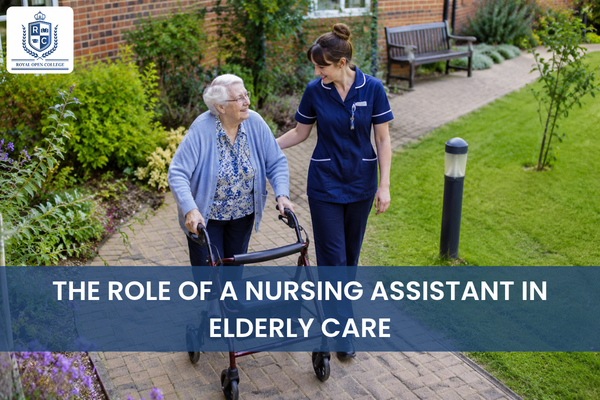
The role of a nursing assistant in elderly care is to support older people with daily activities, monitor their wellbeing and deliver delegated care under the direction of a registered nurse. Their responsibilities include personal care, mobility assistance, nutrition, hydration and reporting changes in residents’ health.
However, the role goes beyond physical assistance. Nursing assistants help residents maintain their dignity, independence and comfort while recognising concerns that may require professional attention. Their responsibilities vary depending on their training, competence and workplace policies.
This guide explains the daily duties, professional boundaries, essential skills, training requirements and career opportunities for nursing assistants in the UK. It also explores dementia care, safeguarding and the challenges of working with older people.
If you want structured learning before you apply, our Nursing Assistant Course runs online at your own pace across 89 lessons. This CPD course builds your knowledge of personal care, safeguarding and observations before you step onto a ward or into a home.
The Simple Version
A nursing assistant gives older people hands-on daily care under the direction of a registered nurse. Titles overlap across the UK, and scope depends on training, competence and employer policy. Check what your employer delegates before you apply, and expect induction training in your first weeks.
- Medicines: you assist or give only when trained, competent and delegated.
- Daily work centres on dignity, drinking, eating, moving and skin.
- Sudden change in a resident, such as new drowsiness or confusion, needs reporting straight away.
- England uses the Care Certificate, which has 16 standards.
- Long shifts and emotional strain come with the role.
What Is A Nursing Assistant In Elderly Care?
A nursing assistant gives hands-on care to older people under the direction of a registered nurse. You help with washing, dressing, meals, moving and daily checks, and you tell the nurse when something changes. Care homes with nursing, NHS wards and hospices employ this role.
Job titles differ by employer and by nation. Adverts use several names for similar work, so learn the main ones before you apply and read the duties list closely. Each name below points to roles with overlapping personal care duties and daily checks.
- Nursing Assistant: The title Northern Ireland adopted in 2018 for staff in nursing teams. Band 3 staff there are senior nursing assistants.
- Healthcare Assistant (HCA): A common title across England, in NHS hospitals and care homes with nursing.
- Healthcare Support Worker (HCSW): The NHS Employers title for Band 2 and Band 3 roles.
- Care Assistant: A social care title for personal care in care homes and people’s homes.
- Nursing Support Worker: The RCN term covering HCAs and HCSWs.
- Nursing Assistive Personnel: A broad term for staff who help nurses with basic care.
The RCN splits the nursing support workforce into two levels. The supportive level covers HCAs and HCSWs who deliver delegated, routine care. The assistive level covers nursing associates and assistant practitioners, who hold deeper knowledge and work within an agreed scope.
Is A Nursing Assistant The Same As A Care Assistant Or HCA?
The roles overlap, but nursing assistants usually work in nursing teams with delegated clinical tasks. Care assistants deliver personal care in social care settings, often without a nurse on site. Always read the advert, because employers define each title in their own way.
Role Comparison
| Role | Usual Setting | Supervision | Example Tasks |
|---|---|---|---|
| Care assistant | Usual Setting Care homes and people's homes | Supervision Senior carer or manager | Example Tasks Washing, dressing, meals, company |
| Healthcare assistant (HCA) | Usual Setting NHS wards and nursing homes | Supervision Registered nurse | Example Tasks Personal care, observations, records |
| Nursing assistant | Usual Setting Nursing homes, NHS wards, hospices | Supervision Registered nurse | Example Tasks Personal care, observations, delegated tasks |
| Nursing associate | Usual Setting NHS and care settings | Supervision Registered nurse, within an agreed scope | Example Tasks Wider care tasks, NMC regulated |
| Registered nurse | Usual Setting All settings | Supervision Accountable for care and delegation | Example Tasks Assessment, care planning, medicines |
In the NHS, Band 2 roles focus on personal care such as toileting, bathing, dressing and meals. Band 3 roles add a limited range of delegated clinical tasks under supervision, such as blood pressure checks, simple dressings and urine tests. NHS Employers published this split in November 2023.
A nursing associate sits between a support worker and a registered nurse. The role has its own NMC standards of proficiency and a wider scope. Registered nurses keep accountability for the care they delegate to nursing assistants and associates. The NMC opened the nursing associate register in January 2019.
Which Tasks Does A Nursing Assistant Handle, And Which Need Delegation?
A registered nurse delegates tasks to a nursing assistant, so your scope depends on training, competence and employer policy. The nurse stays accountable for overall nursing care, and you stay responsible for your own actions. Law, guidance and workplace rules each play a part.
Who supervises you and who answers for what
Supervision does not always mean a nurse stands beside you. In a nursing home, a registered nurse is on site and oversees your work. Hospital wards add ward managers and team leaders. In every setting, you work within your competence and report concerns promptly.
If a nurse asks you to do something outside your training, say so and ask for training first. You protect the resident and yourself. Note the request, who made the request and your reply in your own record. Saying no to an untrained task is good practice.
Three tiers of scope
Scope falls into three tiers. Personal care, routine observations and records sit inside most roles. Some tasks need extra training and employer sign-off. A few tasks stay with registered professionals, whatever your experience. Use the table to check any task you are asked to do.
Three Tiers of Scope
| Tier | Examples |
|---|---|
| Usually part of the role | Washing, dressing, meals and drinks, moving and handling, observations, care notes |
| Depends on training and policy | Giving some medicines, simple dressings, blood glucose checks, urine tests |
| Not part of the role | Diagnosis, writing the care plan, prescribing, deciding treatment |
Practical limits apply too. You do not manage a resident’s money, open their post or drive them in your own car without authorisation and insurance. These rules protect residents from financial harm and protect you from false claims. Ask for these rules in writing on your first day.
Medicines: assisting and giving
Medicines raise many questions in this role. Many sources say nursing assistants never give medicines, but guidance describes a fuller picture in care homes. The line between assisting and giving depends on training, competence and a registered nurse’s clear delegation.
Assisting with medicines
Assisting means you remind a resident, bring the medicine to them and watch them take their dose, while the resident stays in charge of the decision. Your employer’s policy sets which steps you perform. Always record every dose you assist with on the medicines chart.
Giving medicines under delegation
In care homes, guidance from 2016 states the law does not prevent care assistants from giving medicines. Staff must be suitably trained and competent, and the registered nurse must be confident of your competence before delegating. Controlled drugs and invasive techniques normally involve a nurse.
Inhalers, liquid medicines and antibiotics carry a higher risk of error than tablets or capsules. Ask for extra training and a competence check on each type before you give one, and record every dose straight away. Each employer sets its own policy, so practice differs between homes.
What Does A Nursing Assistant Do For Older People Each Day?
Nursing assistant job duties in an elderly care centre focus on dignity, safety and noticing change, and the job description lists them. You work from a care plan written with the care team, so each resident gets help matched to their needs. Three areas fill most of your day.
Personal care, continence and moving safely
You help residents wash, dress, shave, clean their teeth and use the toilet. Continence care needs privacy, patience and clear words, so residents keep their dignity. Changes in toilet habits, such as new urgency, strong-smelling urine or sudden confusion, belong in your report.
Knock before you enter, close the door and cover the resident during washing. Ask before you touch. Offer choices about clothes and timing. Residents with dementia respond to a calm voice and one instruction at a time. Regulation 10 requires providers to treat residents with dignity and respect.
You also help residents stand, walk and move between bed, chair and toilet using hoists, slide sheets or walking aids. About a third of people aged 65 and over fall at least once a year, so you clear trip hazards and report new unsteadiness.
Report these changes in movement:
- Holding furniture or walls for the first time
- Shorter steps or shuffling
- Fear of standing or refusal to walk
- Dizziness, new pain or a new bruise after a fall
Eating, drinking and swallowing
Older people often drink less than they need, which links to falls, constipation, changes in behaviour and slow wound healing. You offer drinks often, help residents eat safely and note how much each person takes. Care homes must meet every resident’s nutrition and hydration needs.
Swallowing problems, called dysphagia, raise the risk of choking, chest infection, dehydration and weight loss. Watch for coughing during meals, a wet or gurgly voice after drinking, food held in the mouth and repeated chest infections. Report these signs to the nurse and follow the resident’s eating and drinking plan.
Speech and language therapists set food and drink textures using the IDDSI scale, which has levels from 0 to 7. Serve the texture on the plan and ask the nurse or therapist before any change. Sit at eye level and let the resident set the pace.
Before each meal, check four things:
- Glasses, hearing aids and dentures are in place and fit well
- The resident sits upright and comfortable
- The food and drink match the texture on the plan
- You record food, fluid and any help given
Skin, pressure and infection
Skin needs regular checks. Pressure ulcers form when skin and tissue stay under pressure for too long, so you help residents change position when they are unable to move alone and report red or broken skin at once. A nurse assesses risk on admission.
Look where bone sits close to the skin, such as the heels, hips, base of the spine, elbows and shoulder blades. Redness, a blister, a hot patch or skin which stays red after you relieve pressure needs reporting to the nurse straight away.
Infection spreads fast in shared homes. Wash your hands before and after each task, wear gloves and aprons for personal care and clean shared equipment between residents. Report diarrhoea, vomiting or a new cough in one resident quickly, so the team acts before others fall ill.

How Does A Nursing Assistant Spot A Resident Getting Worse?
You spend long stretches beside each resident, so you often notice small changes first. A resident who eats less, sleeps more or speaks differently gives an early warning. Early reporting lets the nurse act while the problem is still small.
The Usual Day Check
Compare today with the resident’s usual day. We call this the Usual Day Check, a simple habit built on seven points. Get to know each resident’s normal first, because a change only shows against a baseline. Ask colleagues and relatives what normal looks like.
| Point | Compare Today with Usual | Report Straight Away |
|---|---|---|
| Eating | Compare Today with Usual Appetite and amount eaten | Report Straight Away Refuses meals or eats far less |
| Drinking | Compare Today with Usual Amount and willingness to drink | Report Straight Away Drinks little or passes dark urine |
| Toilet | Compare Today with Usual Frequency, colour, smell, continence | Report Straight Away New incontinence, pain or blood |
| Movement | Compare Today with Usual Walking, standing, transfers | Report Straight Away New unsteadiness, a fall or new pain |
| Talk and mood | Compare Today with Usual Speech, alertness, behaviour | Report Straight Away Sudden confusion, drowsiness or agitation |
| Skin | Compare Today with Usual Colour, warmth, pressure areas | Report Straight Away Redness, blisters or new bruises |
| Breathing | Compare Today with Usual Pace and effort, cough | Report Straight Away Fast, noisy or laboured breathing, or a new cough |
Record what you see in plain words and add the time. A note such as ‘ate half his lunch and slept through tea’ gives a nurse more than ‘seems off’. Say what differs from usual and when you first noticed the difference.
Delirium, infection and sepsis warning signs
Delirium is a sudden change in a person’s mental state. Staff sometimes mistake delirium for dementia, yet delirium is a serious condition. Hyperactive delirium brings restlessness and agitation. Hypoactive delirium brings withdrawal, quiet and sleepiness, so busy teams often miss the signs.
Dehydration, constipation, infection, pain and poor sleep all raise the risk of delirium. Make sure residents wear working hearing aids and glasses, offer drinks often and report pain or constipation. Guidance for long-term care asks teams to watch for sudden change at least daily.
Sepsis is a life-threatening reaction to infection. Guidance for settings outside hospital lists warning signs which include a new altered mental state, new changes in behaviour reported by a relative and a sudden drop in what the person manages alone. Report any sign straight away and say you are worried.
Hospitals score six observations on the NEWS2 chart: breathing rate, oxygen level, blood pressure, pulse, alertness and temperature. NHS England mandated NEWS2 in acute hospitals and ambulances. Care homes sit outside the mandate, and some use their own tools, so ask which tool your home uses.
What to tell the nurse
Mr Evans usually finishes his tea and chats at lunch. Today he leaves half, looks drowsy and says little. You notice the change, check his fluid chart and see he drank little since morning. You tell the nurse straight away, so she checks him before the problem grows.
-
Step 01 Notice the change
Notice a change against the resident's usual day.
-
Step 02 Check safety and comfort
Check the resident is safe and comfortable.
-
Step 03 Record your observations
Record what you saw, the time and any food or fluid taken.
-
Step 04 Report straight away
Tell the registered nurse or senior carer straight away.
-
Step 05 Follow up
Follow the nurse's plan and update the care notes.
Use a short script when you report. Give the resident’s name, what changed, when the change began, how the change differs from usual and what you already did. Then ask what the nurse wants you to do next. Never wait until the end of shift to pass on a worry.
How Does A Nursing Assistant Care For People With Dementia?
In England, an estimated 70% of residents in older-age care homes live with dementia, so dementia skills shape the whole role. You meet people at different stages, each with a life history, preferences and a way of showing needs. Good care starts with knowing the person.
How to communicate with a resident living with dementia
Speak slowly, use short sentences and give one instruction at a time. Approach from the front, say your name and get down to eye level. Offer two choices rather than open questions, such as 'tea or coffee?' Allow time for an answer before you ask again.
Learn each person's life story, favourite routines and the words which comfort them. A resident who worked nights for thirty years might stay awake after dark, so a quiet evening activity helps more than a firm bedtime. Life story books and care plans hold these details.
Choices, capacity and consent
The Mental Capacity Act 2005 applies in England and Wales. Its five principles tell you to assume a person has capacity, give practical help to decide, accept unwise choices, act in best interests when capacity is lacking and choose the least restrictive option.
Capacity depends on the decision and the moment. A resident might choose clothes well and still need help with a medicine decision. Offer choices through the day, record refusals and tell the nurse when a resident struggles to decide. The care team then leads any assessment and best interests decision.
Distress and behaviour
Distress is a form of communication. A resident who shouts, paces or resists care often has an unmet need, such as pain, thirst, hunger, a full bladder, fear or boredom. Check the need before you label the behaviour. Do not use force or restraint. Report any pattern to the nurse.
If you want more time on communication and daily routines for residents living with dementia, our Dementia Care & Management course gives you a focused place to start. You choose this extra study beside your main nursing assistant training if you wish.
How Do You Keep Residents Safe From Abuse And Neglect?
Safeguarding is central to the role, because many residents rely on others for care and have few ways to speak up. Care providers must protect residents from abuse and improper treatment under CQC Regulation 13. Your employer expects you to report every concern.
Signs to watch for
Abuse and neglect take many forms, including physical, emotional, financial and sexual abuse, neglect and organisational abuse. Signs rarely look obvious. Watch for the changes below and record exactly what you see and hear. Residents with dementia or limited speech rely on you to notice.
- • Unexplained bruises, burns or marks, especially in unusual places
- • Fear, flinching or withdrawal around one person
- • Missing money or belongings
- • Poor hygiene, weight loss, dehydration or untreated sores
- • Call bells left unanswered or long waits for the toilet or food
- • A resident who tells you something troubling, even in half a sentence
What to do and what to avoid
Make sure the resident is safe first. In an emergency, follow your emergency procedures straight away. Then report the concern to your manager or safeguarding lead and follow your employer’s policy. Write down facts only: what you saw and heard, the time and who was present.
Do not investigate, ask leading questions or promise to keep a secret. Tell the resident you will pass the concern to the right person. Stay calm, listen and thank them for telling you. Report even when you feel unsure, because the safeguarding lead decides the next step.
Royal Open College’s Safeguarding Decision Tree helps you practise safeguarding decisions and record concerns clearly. You choose a concern type, answer scenario questions and receive a report summary with risk indicators, recording points and next steps. The tool does not replace your safeguarding lead, local procedures or professional judgement.
What Does End Of Life Care Involve For A Nursing Assistant?
Some residents spend their final months in the care home, so you might give end-of-life care. End of life care means care in the last year of life. Your role centres on comfort, dignity and company, while the nurse and clinicians manage medicines and symptoms.
Guidance for the last days of life, which means about the last two to three days, asks teams to maintain comfort and dignity, communicate respectfully and involve the person and people important to them. The nurse leads clinical decisions, and you share what you see.
You help with mouth care, gentle repositioning, clean bedding and a calm room. You sit with residents who have no family nearby, and you help families with kindness and clear words. Record changes in breathing, comfort and responsiveness, and tell the nurse at once.
Know each resident’s advance care plan and wishes before the last days arrive. Homes should hold a copy of each plan in the place of residence, so read each plan, follow the wishes in the plan and ask the nurse when you are unsure.
What Is The Hardest Part Of Working With Older People?
The hardest parts are physical effort, emotional strain and long shifts. You lift, turn and walk with residents for hours, often on long shift patterns. Some residents decline or die, and you build close bonds before this happens. Grief is part of the work.
Care homes in England see staff turnover near 25% a year, so teams change often. Good homes still offer clear supervision, regular breaks and ongoing training. Ask the four questions below at interview and again before you accept any offer.
Prepare for your interview. Tick each question once discussed.
Who supervises me on each shift, and how do I reach them?
✎ Add notes ⌄
Which tasks do you delegate to nursing assistants, and who signs me off?
✎ Add notes ⌄
What induction, moving and handling and dementia training do you provide?
✎ Add notes ⌄
How do you help staff after a resident dies or a hard shift?
✎ Add notes ⌄
The work also brings rewards. You learn each resident’s routines, notice small changes early and earn the trust of families. Small wins matter, such as a resident who walks to the lounge again, finishes a meal or laughs at lunch.
What Skills Does A Nursing Assistant Need?
Employers look for personal qualities as well as qualifications. Each skill below grows on the job with supervision and feedback. Show examples at the interview, such as a time you stayed calm, noticed a change or explained something clearly to someone anxious.
Seven skills matter most:
- Communication: Speak clearly, listen well and adapt for hearing loss or dementia
- Observation: Notice small changes against a resident’s usual day
- Patience and compassion: Allow time and protect dignity during personal care
- Physical stamina: Lift, turn and walk safely using moving and handling training
- Teamwork: Pass on concerns clearly and follow the nurse’s plan
- Record keeping: Write factual notes with times
- Emotional resilience: Cope with loss and ask for help after a hard shift
Moving and handling, safeguarding, dementia and infection control training turn these personal qualities into safe daily habits. Ask each employer which training they provide before your first shift, and ask who checks your competence in each skill during your first weeks.
What Training Do You Need To Start As A Nursing Assistant?
Employers expect induction training and checked suitability for care work, and many ask for a Level 2 or Level 3 care qualification. Entry rules vary, so some homes hire new starters with no qualification and train them on the job.
Expect these checks before you start:
- A DBS check
- References from past employers or teachers
- Proof of your right to work in the UK
The Care Certificate has 16 standards for new care staff in England. The 2025 update added Standard 16 on awareness of learning disability and autism. Employers deliver and assess the standards during induction, and they add moving and handling and other mandatory training.
Providers registered with the CQC in England must give staff learning disability and autism training suited to their role. The Oliver McGowan Code of Practice took effect on 6 September 2025, and the government recommends the Oliver McGowan Mandatory Training package.
Work through each step and track your progress.
Take one step at a time.
Before you apply, test where you stand. The Nursing Assistant Career Readiness Checker asks some scenario questions across career goals, patient care, safeguarding and duty of care. You receive a readiness percentage, areas to strengthen and next steps. The result guides career planning only and does not guarantee a job.
CPD courses add knowledge but do not replace regulated qualifications or employer sign-off. Our Nursing Assistant Course suits you if you want structured study before applying, and our Care Certificate Course walks through the 16 standards.
Where Does A Nursing Assistant Career Go Next?
Many nursing assistants move into senior care roles, nursing associate training or nursing degrees. Each step adds responsibility and needs more study. Apprenticeships offer one route, and a nursing associate qualification might shorten a nursing degree through recognised prior learning.
You might also specialise in dementia care, mental health or end of life care, or move into a team leader role. Our guide to career progression after becoming a nursing assistant covers each route in more detail than this overview.
Select a role to explore its responsibilities.
Personal care in care homes and people's homes.
Delegated care under a registered nurse.
More delegated tasks and team guidance.
NMC regulated, with a wider scope.
Assesses, plans care and delegates.
Illustrative career pathway. Progression depends on qualifications, training and employer requirements.
Take the Next Step in Your Nursing Assistant Learning
Start by checking the scope. Ask employers which tasks they delegate, who supervises you and which training they provide. Then practise the core habit of this role: compare each resident with their usual day, record what you see and report change early.
Compare your study options when you feel ready. Our Nursing Assistant Course gives you structured online lessons you finish at your own pace, and the Care Certificate Course helps you learn the 16 standards. Check each employer’s entry rules before you enrol.
Frequently Asked Questions
Q: What does a nursing assistant do in a care home each day?
A: You help residents wash, dress, eat, drink, use the toilet and move safely. You watch skin, mood and appetite, record what you see and report changes to the nurse. Time spent talking with residents matters too, because company eases loneliness.
Q: Do nursing assistants give medicines?
A: Sometimes. In care homes, guidance from 2016 states the law does not prevent care assistants from giving medicines when they are trained, competent and delegated by a registered nurse. Controlled drugs and invasive techniques normally involve a nurse, and each employer sets its own policy.
Q: What are the signs a resident is getting worse?
A: Look for changes from the resident’s usual day: eating or drinking less, new drowsiness or confusion, a new cough, new unsteadiness or fresh skin marks. Record what you see with times and tell the nurse straight away. Sudden confusion or sleepiness needs reporting even when the resident looks otherwise well.
Q: What is the difference between a care home and a nursing home for staff?
A: A nursing home always has a qualified nurse on site, so nursing assistants work under the nurse’s direction. A residential care home provides personal care without 24-hour nursing, so care assistants there often report to a senior carer or manager.
Q: Do you need experience to become a nursing assistant?
A: No, many employers hire new starters as trainee care or healthcare assistants and provide induction training. Volunteering, work placements and an entry course such as a Level 2 diploma strengthen your application. Expect supervised duties at first, with tasks added as you show competence.
Q: How much does a nursing assistant earn in the UK?
A: NHS Band 2 roles in England pay £25,272 a year full-time from 1 April 2026, and Band 3 pay runs from £25,760 to £27,476. Scotland, Wales and Northern Ireland publish their own scales, and care homes set their own pay.
Q: Do nursing assistants work nights and 12-hour shifts?
A: Many care homes and hospitals run 24-hour rotas, so nights, weekends and 12-hour shifts are common. Shift patterns vary by employer, and some offer shorter days or part-time hours. Ask for a sample rota before you accept a job offer.
Q: What is a geriatric nursing assistant in the UK?
A: A geriatric nursing assistant is a US credential, not a UK job title. UK employers use nursing assistant, healthcare assistant or care assistant for similar work with older people. Check the advert’s duties and the employer’s training rules instead of the title.
Q: Do nursing assistants need to register with a regulator?
A: The NMC does not register nursing assistants, so employers check suitability, training and references instead. The NMC regulates nursing associates and registered nurses. Northern Ireland, Scotland and Wales publish their own codes and standards for support staff in nursing teams.
Q: Will an online CPD course get me a nursing assistant job?
A: No course guarantees a job. Employers look for induction training, references, suitable experience and a good interview. A CPD course builds knowledge and shows commitment, but employers decide which qualifications they accept, so check the advert and entry rules first.
Q: Do nursing assistants move from care homes to NHS hospitals?
A: Yes, many staff move between care homes and NHS hospitals because personal care, observation and record-keeping skills transfer well. Hospitals add their own competency checks and ask for evidence of your training, and Band 2 and Band 3 roles differ in tasks.