






Regulation 12. Enforced by CQC in England.
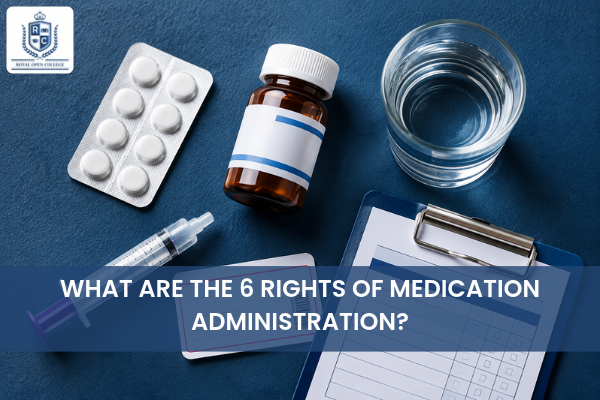
The 6 rights of medication administration are six checks: right person, right medicine, right route, right dose, right time and the right to decline. NICE sets them out for social care in England. You make all six before every dose.
Each right stops one kind of error. The person check prevents a swap, the route check keeps ear drops out of an eye, and the decline check respects a person’s choice. The rights are guidance, and Regulation 12 is the law. Your care plan and employer’s policy set the daily rules.
This guide gives you a short UK example for each right. You also learn what to do when someone declines a medicine and how to act after an error or near miss. To build on this guide, our Medication Administration Level 4 course gives senior carers and team leaders step-by-step, CPD-accredited learning in safe medication practice, so your checks become a steady routine.
Quick Answer
- The 6 rights are six NICE checks: person, medicine, route, dose, time and the right to decline.
- Some lists end with documentation. Check which list your employer uses.
- The rights are guidance. Regulation 12 is the law in England.
- Record every declined dose, with the time, the reason and who you told.
- Stop and ask when anything does not match. Ask before you give.
Next step: read your care plan and medicines policy before your next round.
Checks before each dose
Follow the checks in order before deciding what to do next.
START
Read the care plan and the MAR
STEP 01
Check the person, the medicine, the route, the dose and the time
STEP 02
Ask the person if they are ready to take the medicine
STEP 03
Review the checks and the person's response
DECISION POINT
Does everything match and does the person agree?
Select the situation to see the next action.
✓
Work through the checks in the same order every round. A fixed order protects you when a phone call or a question breaks your focus. If an interruption stops you mid-task, start again from the first check before you give anything.
Why Do Some Lists End With Documentation, And Are The Rights Law?
Lists differ because no single body sets one list for every service. NICE uses the right to decline in social care guidance for England. Other lists, including some from training providers and health services, end with documentation. Both share five checks: person, medicine, route, dose and time.
Two Common Lists Compared
| Feature | NICE Six | Documentation Six |
|---|---|---|
| Sixth check | Right to decline | Right documentation |
| Where you meet the list | NICE guidance for adult social care in England | Training providers and some health services |
| Records | A separate recommendation asks for a record of support every time | Built in as the sixth check |
| Strength | Names the person's choice as a check | Keeps the record in view |
Longer lists exist too. Some providers add informed consent, reason for the medicine or documentation to reach seven, eight or more rights. The extra checks are sensible habits, yet they are not the NICE list. Learn the NICE six first, then add what your employer asks.
Regulation 12 of the Health and Social Care Act 2008 (Regulated Activities) Regulations 2014 is law in England. The Care Quality Commission (CQC) enforces the regulation. Providers must employ competent staff and manage medicines in a proper and safe way.
NICE guideline NG67 covers adults who receive social care in the community, including at home. NICE guideline SC1 covers care homes. Both are guidance. NG67 tells care workers to give a medicine only when authorisation and clear instructions exist and the six Rs are met.
Medication administration · framework
Law, guidance, policy and learning
A quick four-part view of the framework that shapes safe medication practice in England.
Panel 2
Guidance
NICE NG67 for community care. NICE SC1 for care homes.
Panel 3
Policy
Your employer's medicines policy and your care plan.
Panel 4
Learning
A CPD course builds knowledge. Your employer confirms competence.
Alt text: Four-step graphic showing law, guidance, workplace policy and learning in medication administration in England.
On shift, your care plan and medicines policy decide what you do. The law and the guidance shape those documents. A CPD course builds your knowledge, but your employer decides who gives medicines. Ask your manager which documents apply to your role.
What Do The Person, Medicine And Route Rights Look Like On A Real Round?
These three checks open every round, so errors here reach the person first. Each example below shows one risk, one decision and the checks behind each decision. The people are fictional. Follow your own care plan, MAR and medicines policy for the exact steps in your service.
RIGHT 01
Right person
Example
Mrs Anne Walsh and Mrs Anna Welsh live on the same round and take morning tablets in blister packs. The care worker reads the full name and date of birth on each label and matches both to the MAR. She ignores the familiar face and the order of the bag.
Checks before you give
- ✓ Match the full name and date of birth on the label and the MAR, never a room number or a familiar face.
- ✓ Check the photo on the MAR when your service uses one.
- ✓ Ask the person to say their name when they are able to. A person with dementia might agree to the wrong name, so never rely on the answer alone.
- ✓ Keep medicines for different people apart in a shared home.
RIGHT 02
Right medicine
Example
Mrs Okafor returns from hospital with a new pack of her water tablet. The MAR still lists the old strength and a stopped medicine. The care worker gives nothing yet. She phones the office, confirms the change with the pharmacist and asks for the MAR update first.
Checks before you give
- ✓ Match the medicine name, strength and form on the label to the MAR.
- ✓ Give the medicine from the container supplied, never from a pot or a loose pack.
- ✓ Check the expiry date and the allergy status.
- ✓ Do not give a medicine the MAR no longer lists. Ask your manager, the prescriber or the pharmacist.
RIGHT 03
Right route
Example
Joan keeps eye drops and ear drops in one bag, and the bottles look alike. Her care worker reads the route on the label and the MAR before she opens a bottle. Joan also struggles to swallow, so the care worker asks the pharmacist before she crushes any tablet.
Checks before you give
- ✓ Read the route on the label and the MAR: mouth, eye, ear, skin, or inhaled.
- ✓ Read the body site on the label for creams and patches.
- ✓ Ask the pharmacist or prescriber before you crush a tablet or open a capsule. Some tablets, such as enteric-coated ones, are not suitable for crushing.
Do The 6 Rights Replace Training And Competence?
No. The six rights are a checking prompt and do not replace training. Regulation 12 requires competent staff. NICE and CQC recommend an annual review of knowledge, skills and competence. Your employer decides who gives medicines and confirms each person is ready to do so.
CQC expects providers to assess competence before new staff manage or give medicines, to keep records of each assessment and to note review dates. Assessors must be competent in the tasks they assess. A CPD course adds learning, but your employer confirms competence.
Areas to strengthen show you where to learn next. When the result points to gaps, our Nursing Assistant course name offers CPD-accredited learning for people building towards a healthcare assistant or support worker role. Choose the learning which matches your goal and your employer’s expectation
What Do The Dose And Time Rights Look Like On A Real Round?
Dose and time checks involve numbers, units and clocks. Mistakes happen when a round runs late and attention drops. These two examples show how a short check against the MAR and the label stops a mistake before the medicine reaches the person.
RIGHT 04
Right dose
Example
Sam takes a liquid medicine. The label gives the strength in milligrams for each 5 millilitres, and a review changed his dose last week. His care worker reads the new amount on the MAR, checks the strength on the bottle and measures with the oral syringe the pharmacy supplied.
Checks before you give
- ✓ Match the strength and the amount on the label and the MAR.
- ✓ Use the measuring device the pharmacy supplied.
- ✓ For a variable dose such as one or two tablets, record how much you gave.
- ✓ Ask when the label and the MAR disagree.
RIGHT 05
Right time
Example
Tariq takes a Parkinson's medicine at set times and a painkiller when required. A late call delays his round. His care worker gives the time-sensitive medicine first. She then checks the MAR for the last painkiller dose before she offers another.
Checks before you give
- ✓ For time-sensitive medicines, record the time you gave the dose. CQC asks for this with paracetamol medicines.
- ✓ For a when required (PRN) medicine, check the reason, the last dose time, the gap between doses and the daily maximum.
- ✓ After a PRN dose, record the amount, the time and whether the medicine worked.
- ✓ Tell your manager when a late round puts a time-sensitive medicine at risk.
What Should You Do When Someone Declines Or Refuses Their Medicine?
Respect the decision when the person has capacity, then record the decision and the reason. Decline and refuse mean the same here. NICE lists the right to decline as the sixth right. The Mental Capacity Act 2005 presumes capacity, and an unwise choice does not remove capacity.
The NICE and SCIE quick guide for home care managers calls the six rights a helpful prompt. A prompt reminds you what to check. Your care plan and your medicines administration record (MAR) hold the facts, so read both before each round.
Steps when a person declines
Follow the first three actions, then choose the outcome that applies.
↳
START
The person declines the medicine
STEP 01
⏱
Wait a short while
STEP 02
💊
Offer the medicine again
STEP 03
🔎
Ask about pain or discomfort
DECISION POINT
Does the person still decline?
Select the outcome to follow the correct branch.
NO
Outcome
Give the medicine and record the dose
YES
Outcome
Do not force the medicine
↳ Continue with these actions
STEP 04
Record the decline and the reason on the MAR
STEP 05
Raise your concern with your manager
STEP 06
Seek advice from a health professional
Choose YES or NO to reveal the next action.
Record every occasion on the MAR and in the care record, with the reason when the person gives one. A strong entry names the medicine, the time, what you did and who you told.
Compare two entries for the same morning
–
Weak entry
Refused meds.
✓
Stronger entry
08:10
Mr Hall declined his morning tablets.
08:25
Offered again. He said he felt sick.
08:40
Told the manager.
Three time-stamped entries showing what happened and who was told.
In care homes, NICE SC1 asks staff to tell the prescriber about ongoing refusal when the resident agrees. In the community, NG67 points you to raise concerns and seek advice. Repeated refusal needs a review by the prescriber, so never leave a pattern unreported.
Some people lack capacity to decide about a particular medicine. Covert administration then needs a capacity assessment, a best interests decision, pharmacist advice and a prescriber’s authority. Never hide a medicine in food or drink to get around a decline.
Handling a no perfecty comes with practice. The Nursing Assistant Career Readiness Checker lets you work through safeguarding and duty of care scenarios, then shows your readiness percentage and areas to strengthen. Use the result for career planning, not as a competence sign-off. Your employer confirms competence.
How Do The 6 Rights Work In A Care Home And In Someone's Own Home?
The six rights stay the same in both settings. The guidance and the paperwork differ. NICE NG67 covers social care in the community, including at home, and NICE SC1 covers care homes. Check which guideline fits your service and ask your manager when you are unsure.
In someone’s own home
You work alone in the person’s space with their own supplies, so nobody checks your work in the moment. Give each medicine from the container supplied. Give only the support agreed and written in the care plan. Record the support for each medicine on every occasion.
On each visit, check:
- The care plan is current and the MAR lists every medicine.
- Nothing has changed since your last visit, such as a new label, a new pack or a hospital stay.
- Nobody has moved, added or stopped a medicine. Tell your manager about any change.
Home visits put the checks in your hands. If you work in domiciliary care or plan to, our Domiciliary Care course offers CPD-accredited learning for home care roles. Your manager and care plan still decide the medicines support you give.
In a care home
NICE SC1 recommends each care home keep a medicines policy and review the policy. The policy covers giving medicines, covert administration plus staff training and competence. A team shares the work, so each person must still complete every check for each dose they give.
What Should You Do After A Medication Error Or Near Miss?
Protect the person first. Then get advice, report and record. A medication error reaches the person. A near miss is a prevented medicines-related incident with potential for harm. Report both through your employer’s process, because each one shows where a safeguard failed.
Where errors start
Errors rarely start with one careless act. They follow a late round, a rushed hospital discharge, similar names or a changed dose nobody updated. Match each slip to the right one that failed, because the fix depends on the check you missed.
Which right failed and what to do first
| Failed Right | Typical Error | First Action |
|---|---|---|
| Person | Medicine given to the wrong person | Stay with the person and get medical advice |
| Medicine | Stopped medicine given | Get advice from the pharmacist or prescriber |
| Route | Eye drops put in the ear | Get medical advice and tell your manager |
| Dose | Double dose given | Get medical advice and tell your manager |
| Time | Dose missed or given late | Check the MAR and ask for advice |
| Right to decline | Medicine given after the person declined | Tell your manager. Treat this as a safeguarding concern to review |
Record the facts and do not change an earlier entry. Providers must have processes for medicines-related safeguarding incidents under Regulation 13. CQC asks providers to record each incident as soon as possible. Your manager decides who to notify, such as CQC or the local safeguarding team.
Medication safety · Response sequence
What to do straight after
Follow these six actions after an error or near miss.
START
You notice an error or near miss
Response steps
Select a step
STEP 01 / 06
ACTION DETAILS
01
Check the person is safe
Check the person is safe.
!
Call 999 if they are in danger.
Response sequence
1 of 6
Some incidents raise a safeguarding concern. A medicine given against a person’s decision, hidden without authority or withheld on purpose belongs in this group. Report the concern through your employer’s safeguarding route straight away. Keep your record factual and share only what you saw.
Royal Open College’s Safeguarding Decision Tree helps you think a concern through. You choose a concern type, answer scenario questions and receive a report summary for recording and escalation. The tool does not replace your safeguarding lead, local procedures or professional judgement. In danger, follow emergency procedures.
Take the Next Step in Your Medication Safety Learning
Start with your own care plan and medicines policy. Check which list your employer uses and what support you give. Then compare each round with the 6 rights of medication administration in this guide. Raise any gaps with your manager at your next team meeting or supervision.
If you want structured learning to go with this guide, our Medication Administration Level 4 course suits senior carers and team leaders who oversee medicines support. The CPD-accredited course adds to your knowledge, while your employer confirms competence and decides who gives medicines.
Frequently Asked Questions
Q: What does medication administration mean in social care?
A: Medication administration means giving a prescribed medicine to a person. In social care, your care plan sets whether you prompt, assist or administer. The six rights guide each level. Your employer’s medicines policy sets the daily rules, and your manager confirms the level of support you give.
Q: Why are the 6 rights of medication administration important?
A: The checks catch slips before a medicine reaches the person. Errors in person, route, dose or time harm people, and a fixed routine of checks lowers the risk on every round. The checks also give you a clear point to stop and ask when anything does not match.
Q: What is the sixth right of medication administration?
A: NICE names the right to decline as the sixth right of medication administration. The person decides whether to take a medicine, and you respect the choice, record the decision and report the decline. Other lists name documentation as the sixth right instead, so check which list your employer uses.
Q: What are the 6 Rs of medicines administration under NICE?
A: The 6 Rs are right person, right medicine, right route, right dose, right time and the person’s right to decline. NICE sets them out in NG67 for adults who receive social care in the community, including at home. Your employer’s medicines policy confirms which checks apply in your service.
Q: Is the right to decline the same as the right to refuse?
A: Yes. Both words mean the person chooses not to take a medicine. NICE uses decline, and many policies and care records use refuse. Record every occasion on the MAR and in the care record, and note the reason when the person gives one.
Q: Is documentation one of the 6 rights?
A: In some lists, yes. Documentation closes the list in the documentation six used by many training providers. NICE leaves documentation out of its six, yet NG67 asks care workers to record the support they give for each medicine on every occasion. Follow your employer’s list.
Q: What are the 7 rights of medication administration?
A: Seven-right lists add one check, often documentation, to the five basic checks of person, medicine, route, time and dose. Other lists reach eight, nine or ten rights by adding reason, informed consent or the right to refuse. Follow the list in your employer’s policy.
Q: Are you allowed to crush tablets for someone who struggles to swallow?
A: Only with advice from the prescriber or pharmacist, recorded in the care plan. Some tablets, such as enteric-coated ones, are not suitable for crushing, and crushing creates dust. Never crush a tablet or open a capsule on your own judgement. Ask first, record the advice and follow the advice.
Q: What does PRN mean on a MAR?
A: PRN stands for pro re nata, which means when required. Before you give, check the reason, the gap between doses and the daily maximum on the protocol. After you give, record the amount, the time and whether the medicine worked. Tell the prescriber about overuse or poor effect.
Q: What is the difference between prompting, assisting and administering?
A: Prompting means you remind a person to take their medicine. Assisting means you help with the task, for example by opening a pack. Administering means you give the medicine yourself. Your care plan sets the level, and the checks still guide you at each level.
Q: Are you allowed to give medicine in food or drink?
A: Only when the person knows about the medicine and agrees, and the pharmacist or prescriber confirms the medicine is suitable. Hiding medicine without the person’s knowledge is covert administration. Covert administration needs a capacity assessment, a best interests decision, pharmacist advice and a prescriber’s authority, all recorded.
Q: How late is too late for a medicine?
A: No single time window fits every medicine. Time-sensitive medicines, such as some Parkinson’s medicines, need a set time to work safely. Follow the time and instructions on the MAR and in the care plan. Ask the prescriber or pharmacist when a dose runs late, and record what you did.
Q: How often is medication competence reviewed?
A: NICE and CQC recommend an annual review of knowledge, skills and competence for staff who manage or give medicines. CQC also expects providers to assess competence before new staff manage or give medicines. Providers keep records of each assessment and note the next review date.
Q: Are the rights the same in Scotland, Wales and Northern Ireland?
A: This guide covers England. Scotland, Wales and Northern Ireland have their own regulators and guidance, so the rules and the wording differ. Check the guidance for your nation and your employer’s medicines policy. Your manager confirms which rules apply to your service.