














Partnership Working in Health and Social Care

What Is Partnership Working In Health And Social Care?

Partnership working in health and social care involves organisations and professionals working together to deliver joined-up, person-centred support. This guide explains what partnership working means, why it is essential in the UK, who is involved, and how collaboration improves safety, continuity, and outcomes for people with complex needs.

Partnership working in health and social care becomes clear during hospital discharge. This is when one person needs support from more than one service. A patient may need medical follow-up, home care, housing support, and help from family. No one organisation can do it all.

Partnership working involves health and social care services working together. They share information and responsibility. This helps people receive joined-up, person-centred care without gaps or duplication.

This blog explores how partnership working functions across UK health and social care settings. It explains who works together, why collaboration matters, and how it improves outcomes for people with complex needs. You’ll also see practical care examples, common challenges, and clear explanations suited to study or practice. By the end, you’ll understand how joined-up working supports dignity, safety, and better care experiences.

TL;DR 

  • Partnership working means organisations working together to plan and deliver care.
  • It involves the NHS, local authorities, voluntary services, and service users.
  • Partnership working is essential in the UK for meeting complex health and care needs.
  • Joined-up working improves safety, continuity, and quality of care.
  • Service users benefit from coordinated, person-centred support.
  • Partnership working reduces gaps and duplication between services.
  • It is a key concept for health and social care students and professionals.
Health and Social Care Level 3 Diploma
Learn to promote Health and Social Care Level 3 Diploma!

What Partnership Working Means in Health and Social Care

Partnership working in health and social care involves different services working together. They support people with shared goals instead of working in isolation.

In plain terms, it’s about collaboration across health and social care settings. Organisations share information and plan care together. This coordination helps people experience joined-up, consistent support. Each partner keeps their role, but works towards the same outcomes.

For example, an older adult leaving the hospital may need input from NHS staff, a local authority social worker, a domiciliary care provider, and a voluntary service. When these partners plan together, care feels continuous, not fragmented.

Partnership working improves coordinated care, supports person-centred practice, and helps service users navigate complex systems with fewer gaps.

What Does Working in Partnership Mean in Practice?

Working in partnership means professionals don’t work in silos. They communicate, plan, and act together around the person receiving care.

Sharing information sits at the centre. With the right consent and safeguards, health and social care teams share relevant details so everyone understands the person’s needs. No repeating the same story. No missed risks.

Planning care together follows. Professionals agree goals, actions, and review points as a group. This often happens through discharge planning meetings, care reviews, or multi-disciplinary team discussions.

Clear roles and responsibilities prevent confusion. Each service knows what it’s responsible for and when to step in. That clarity matters.

Coordinated decision-making keeps care joined up. Changes happen once, not several times, and service users stay informed throughout.

Why Is Partnership Working Important in Health and Social Care?

Partnership working matters because many people have needs that cross health, social care, and community services. One service alone can’t meet them well.

Why Is Partnership Working Important in Health and Social Care?

Benefits of Partnership Working in Health and Social Care

Partnership working brings clear, practical advantages when services collaborate around shared goals and the needs of individuals.

  • Better outcomes for individuals Joined-up services respond more quickly to changing needs. Care plans feel coordinated, not fragmented.
  • More holistic, person-centred care Physical health, mental wellbeing, and social needs are considered together. The person stays at the centre.
  • Reduced duplication and delays Professionals share information and plans. Assessments aren’t repeated. Support starts sooner.
  • Improved communication between services Clear channels reduce misunderstandings. Decisions are consistent across teams.
  • More effective use of resources Services avoid overlap and work efficiently. Time, funding, and staff skills are used where they matter most.

Key Elements of Effective Partnership Working

Effective partnership working depends on shared goals, integrated services, service user involvement, open communication, and shared responsibility.

  • Shared vision and goals All partners agree what they are working towards. This keeps services focused on shared outcomes rather than individual priorities.
  • Integration between health and social care Health and social care services plan and deliver support together. Integrated services reduce gaps, delays, and repeated assessments.
  • Involvement of service users and carers Service users and carers take part in decisions about their care. This collaborative practice supports choice, control, and person-centred support.
  • Trust and open communication Professionals share information honestly and respectfully. Open communication builds trust and supports joined-up care.
  • Shared responsibility and accountability Partners accept joint responsibility for decisions and outcomes. Accountability sits across services, not with one organisation alone.

Levels of Partnership Working in Health and Social Care

Partnership working in health and social care operates at three clear levels, each supporting joined-up care in a different way.

  • Partnership with individuals and communities: This level focuses on working directly with service users, families, and carers. People take part in decisions about their care. Local communities and voluntary groups also support wellbeing and independence.
  • Partnership between professionals: Professionals from different disciplines work together. Nurses, social workers, therapists, and support staff share information, plan care, and make joint decisions to meet complex needs.
  • Partnership between organisations and agencies: Organisations collaborate at a strategic level. NHS services, local authorities, and voluntary agencies agree pathways, share resources, and coordinate services to improve outcomes across systems.

Partnership Working in Healthcare vs Social Care

Partnership working in healthcare and social care follows the same principles, but the focus and pace can differ.

In healthcare, partnership working often centres on clinical needs. NHS services work with other professionals to diagnose, treat, and manage conditions. Collaboration supports safe discharge, follow-up care, and continuity between hospital and community services.

In social care, partnership working focuses more on daily living, independence, and wellbeing. Local authorities, care providers, and voluntary services support housing, personal care, and long-term needs.

Despite these differences, integration matters. Health and social care overlap constantly. Joined-up working ensures people don’t fall between services and receive coordinated, person-centred support across both systems.

Partnership Working and Professional Relationships in Care Settings

Partnership working depends on clear, respectful relationships. Without them, joined-up care breaks down.

Inter-professional relationships happen between staff in different roles. Nurses, social workers, therapists, and care staff share knowledge. They plan together. This keeps care safe and consistent.

Multi-agency relationships link professionals across services. Health, social care, housing, and voluntary teams work together. This matters when needs are complex or risks are high.

Organisation-to-organisation partnerships sit at a wider level. NHS services and local authorities agree how support is delivered. Responsibilities stay clear.

Service user and family partnerships keep care person-centred. People and families help shape decisions.

Strong relationships improve communication, trust, and outcomes across care settings.

Examples of Partnership Working in Health and Social Care (UK)

Below are practical, UK-based examples of how partnership working happens in real care settings.

  • Hospital discharge planning NHS staff work with social care teams to arrange support before someone returns home.
  • Safeguarding adults Health services, local authorities, and the police share concerns to protect people at risk.
  • Mental health community teams Nurses, social workers, and psychologists support people together in the community.
  • Older people’s home support GPs, district nurses, and domiciliary carers coordinate daily care and medication.
  • GP, social worker, and housing coordination Services work together to address health, housing, and wellbeing needs.
  • Learning disability services Health professionals and social care teams plan long-term, person-centred support.
  • End-of-life care Palliative care teams, GPs, and carers support comfort and dignity at home.
  • Child protection cases Health visitors, schools, and social services share information and act together.
  • Reablement services Therapists and care staff help people regain independence after illness.
  • Substance misuse support NHS services and voluntary organisations provide joined-up treatment and recovery care.
  • Care home reviews GPs and community nurses review residents’ health needs with care staff.
  • Domestic abuse support Health services work with specialist charities and local authorities to keep people safe.

These examples show how partnership working supports coordinated, person-centred care across the UK system.

Tools That Support Partnership Working in Health and Social Care

Partnership working relies on simple, practical tools that help services stay connected and focused on the person.

Care and support plans

 These outline needs, goals, and actions. All services work from the same plan, which keeps care consistent.

Multi-agency meetings

 Professionals meet to share updates and agree next steps. This supports clear decisions and joined-up care.

Shared assessments

 Services gather information once and use it together. This reduces duplication and saves time for service users.

Information-sharing protocols

 Clear agreements explain what information can be shared and when. This supports confidentiality and safe collaboration.

Reviews and case conferences

 Regular reviews check progress and adjust support. Everyone stays informed and accountable.

Legal and Policy Framework Supporting Partnership Working (UK)

UK law supports partnership working by encouraging services to cooperate and plan care together.

The Care Act 2014 places a duty on local authorities to work with health services and other partners. It also promotes wellbeing, which often depends on joined-up care rather than one service acting alone.

The Health and Social Care Act 2012 supports integration across the NHS and local authorities. It encourages shared planning and coordinated delivery of care.

Integrated Care Systems (ICS) bring NHS organisations and local authorities together. They support collaboration across areas to improve outcomes.

The Care Quality Commission (CQC) expects services to work with others. It looks at how joined-up care supports safety and quality.

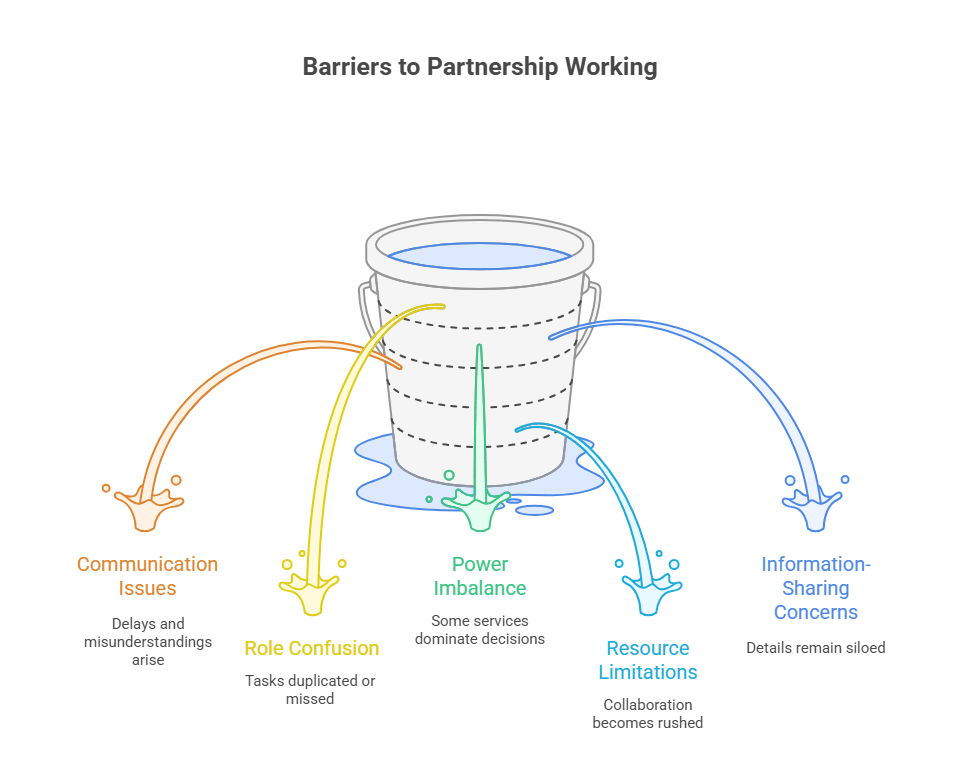
Barriers to Partnership Working (With Practical Solutions)

Partnership working can fail when systems, people, or processes don’t align. These barriers are common in UK care settings, but they’re manageable.

Barriers to Partnership Working (With Practical Solutions)

When barriers are addressed, partnership working becomes safer, clearer, and more effective for everyone involved.

Summary & Key Takeaways for Learners and Providers

  • Partnership working supports safer, more consistent care.
  • Joined-up services respond better to complex needs.
  • Service users benefit from coordinated, person-centred support.
  • Professionals make clearer decisions when they work together.
  • Organisations reduce gaps, delays, and duplication.
  • Strong partnerships improve trust across care settings.

Health and Social Care Level 3 Diploma

Learn to promote Health and Social Care Level 3 Diploma!

Frequently Asked Questions

1. What is partnership working in health and social care?

Partnership working in health and social care involves joint collaboration between professionals, services, organisations, and individuals. It focuses on sharing information, responsibilities, and decisions. This approach supports coordinated care, reduces service gaps, and helps meet people’s physical, emotional, and social needs effectively.

Partnership working means cooperation between people and organisations toward shared goals. It involves teamwork, trust, communication, and shared responsibility. In care settings, this approach ensures consistent support, prevents duplication of services, and improves coordination across health and social care systems.

Partnership working is important in care settings because it improves care quality and safety. Collaboration allows professionals to share expertise, reduce errors, and respond effectively to needs. Individuals benefit from joined-up services that provide continuous, reliable, and well-coordinated support.

Examples of partnership working include healthcare staff collaborating with social workers, care providers working with families, and voluntary organisations supporting statutory services. These partnerships ensure physical, mental, and social needs are addressed together, resulting in more holistic and effective care.

Partnership working involves service users, families, carers, healthcare professionals, social care workers, and external agencies. Each partner contributes skills, experience, and knowledge. Working together supports informed decision-making and ensures care reflects individual needs and preferences.

The benefits of partnership working include improved communication, better outcomes, and more efficient use of resources. Joint working reduces duplication, improves continuity of care, and ensures individuals receive consistent, high-quality support tailored to their needs.

Tools supporting partnership working include shared care plans, multidisciplinary meetings, referral systems, records, and secure communication methods. These tools help professionals exchange information, coordinate care, manage risks, and work effectively toward shared goals.

Partnership working supports person-centred care by ensuring individuals are involved in decisions. Professionals collaborate to respect preferences, values, and choices. Care is tailored to the individual rather than services, promoting dignity, independence, and improved wellbeing.

Partnership working in healthcare involves collaboration between professionals, patients, carers, and services. It supports shared decision-making and coordinated treatment. This approach improves communication, continuity of care, patient safety, and overall health outcomes across healthcare settings.

Working in partnership involves cooperation, shared responsibility, clear communication, and respect for roles. Partners agree goals, share information, and support one another. This approach helps services work smoothly together and deliver coordinated, effective care.

Working in partnership in adult social care is important because individuals often have complex needs. Collaboration ensures physical, emotional, and social support is coordinated, improving independence, wellbeing, and quality of life while preventing fragmented care delivery.

Working relationships in health and social care involve professional connections built on trust, communication, and cooperation. These relationships support teamwork, information sharing, and problem-solving. Strong working relationships improve coordination, efficiency, and overall care quality.

Challenges affecting partnership working include poor communication, unclear roles, time pressures, confidentiality concerns, and organisational differences. These issues can limit collaboration and delay care. Addressing challenges is essential to maintain effective, coordinated services.

Barriers to partnership working are overcome through clear communication, agreed responsibilities, shared goals, and trust. Training, leadership, and regular meetings support collaboration. Effective information-sharing systems also strengthen coordination between services and professionals.

Individuals can be involved in partnership working through sharing views, preferences, and goals. Participation in care planning and reviews ensures their voice is heard. Involvement promotes choice, independence, and care that reflects personal needs and priorities.

Recent Blogs

5 Skills Every UK Care Employer Wants (and How to Prove You Have Them)

5 Skills Every UK Care Employer Wants (and How to Prove You Have Them)

UK care employers do not hire based on good intentions. Under CQC Regulation 18, they must evidence staff competence at every inspection. This guide covers the 5 skills every UK adult social care employer screens for, why each one has a regulatory basis, and how to prove yours through your CV, interview, the Care Certificate, and workplace evidence.

CQC Standards and Training What Care Staff Need to Know in 2026

CQC Standards and Training: What Care Staff Need to Know in 2026

CQC does not publish a mandatory training list. Under Regulation 18, every registered provider must ensure staff are demonstrably competent, properly inducted, and continuously supported. This guide explains the legal basis for training in 2026, the 16 Care Certificate standards, Oliver McGowan Mandatory Training, training matrices, and the competence evidence CQC inspectors look for.