The Role of GDPR in Health and Social Care

The Role Of GDPR In Protecting Patient Data In Health And Social Care

GDPR plays a vital role in protecting patient data in health and social care. This guide explains how GDPR safeguards confidentiality, dignity, and trust, what counts as patient data, staff responsibilities, lawful data use, and how UK care services apply GDPR in everyday practice.

The Role of GDPR in Protecting Patient Data in Health and Social Care becomes real the moment a care worker lowers their voice in a corridor, or locks a shared computer before stepping away. These small actions protect dignity, trust, and personal safety.  They matter.

GDPR sets clear rules on how patient data is collected, used, shared, and protected in UK health and social care, ensuring confidentiality, safeguarding, and respect for individual rights in everyday care practice. 

This blog breaks GDPR down into everyday care situations you’ll recognise. It looks at common risks, simple good practice, and what staff are expected to do. By the end, you’ll know how to protect patient data confidently, without overthinking it.

TL;DR 

  • GDPR sets legal rules for protecting patient data in health and social care.
  • Health and care records count as special category data and need extra protection.
  • GDPR exists to protect dignity, confidentiality, and trust in care settings.
  • Patient data must be used lawfully, fairly, and kept secure at all times.
  • Consent is not always the lawful basis for using patient information in care.
  • Care staff and organisations both share responsibility for data protection.
  • In the UK, GDPR works alongside the Data Protection Act 2018.
Health and Social Care Level 3 Diploma
Learn to promote Health and Social Care Level 3 Diploma!

What Is GDPR in Health and Social Care?

GDPR is the UK’s main data protection law for keeping personal information safe. In health and social care, it sets clear rules for how patient and service user data must be collected, used, stored, and shared.

In the UK, this works through UK GDPR, alongside the Data Protection Act 2018. Together, they explain what organisations can do with personal data, and what they must protect. This includes health records, care plans, and any information that can identify a person.

GDPR applies across the whole care system. That means:

  • NHS services, including hospitals and GP practices
  • Care homes, both residential and nursing
  • Domiciliary care providers supporting people at home
  • Private health and social care providers of all sizes

The aim is simple. Protect dignity. Protect confidentiality. Make sure people can trust those who care for them. That’s the role of GDPR in UK health and social care.

What Is the Role of GDPR in Protecting Patient Data?

GDPR acts as a legal safeguard for patient information in health and social care. It sets boundaries on how sensitive data is handled. It protects people from misuse, loss, or inappropriate sharing.

It also works as a professional standard for care practice. Staff are expected to handle information with care, just like they handle medicines or personal support. That link matters. Data protection becomes part of safe, ethical care.

GDPR supports patient rights. It gives people control over how their information is used. They can expect transparency, accuracy, and respect. This sits at the heart of person-centred care.

Trust is the final piece. When services protect data properly, people feel safe sharing sensitive details. That trust supports confidentiality, safeguarding, and honest communication. Without it, care breaks down.

In practice, GDPR helps services do the right thing. It protects patients. And it reinforces good care standards every day.

Why Is GDPR Important in Health and Social Care?

GDPR protects people at their most vulnerable. It supports safe, respectful care. And it underpins trust.

In short, GDPR isn’t about rules for their own sake. It protects people. And it supports better care.

What Counts as Patient Data Under GDPR?

Patient data under GDPR includes any information that can identify a person receiving care. This applies across health and social care settings, whether records are digital, paper-based, or spoken.

Personal data includes:

  • Name, address, and date of birth
  • NHS number
  • Contact details
  • Appointment records and correspondence

Some information needs stronger protection. This is known as special category data.

Special category data includes:

  • Medical history and diagnoses
  • Mental health information
  • Details about disability or long-term conditions
  • Social care assessments and care plans

This data needs extra protection because misuse can cause harm. It can affect dignity, safety, and wellbeing. In care settings, people often have no choice but to share it. GDPR recognises that vulnerability and sets higher standards for how this information is handled.

GDPR and the Data Protection Act 2018

In the UK, GDPR does not work on its own. UK GDPR and the Data Protection Act 2018 sit together. One sets the core data protection rules. The other adds UK-specific detail for how those rules apply in practice.

The Data Protection Act 2018 supports GDPR in health and social care. It explains how sensitive health and care information should be handled. It also reflects the common law duty of confidentiality, which means information shared in confidence should not be disclosed without a valid reason.

Different bodies have different roles. The Information Commissioner’s Office (ICO) regulates data protection law. It oversees how organisations handle personal data. It does not regulate care delivery or clinical practice.

That responsibility sits elsewhere. The Care Quality Commission (CQC) inspects care quality and safety. Data protection supports good care. It does not replace care standards.

The GDPR Principles Explained for Health and Social Care

As discussed, the GDPR principles set out clear rules for how patient data must be collected, used, stored, and protected in health and social care to maintain confidentiality, safety, and trust.

Lawfulness, Fairness and Transparency

This principle means using patient data for a valid reason and being open about it. People should understand what information is collected and why.

In practice, this involves clear privacy notices and simple explanations during assessments or admissions. Nothing should feel hidden.

If this is ignored, trust breaks down. People may withhold information, which can affect care and safeguarding.

Purpose Limitation

Patient data must only be used for specific care-related purposes. Not for unrelated activities.

For example, information collected for treatment should not be reused for non-care purposes without a lawful basis.

If ignored, data may be misused. Confidentiality is lost.

Data Minimisation

This principle means recording only information that’s relevant to care.

A care plan should focus on health needs, risks, and support. It does not need unnecessary personal detail.

If too much data is recorded, the risk of exposure increases. Records also become harder to manage safely.

Accuracy

Under the GDPR principle of accuracy, care homes must keep records correct and up to date.

This includes updating care plans, medication details, and contact information when circumstances change.

If records are inaccurate, decisions may be unsafe. Care quality can suffer.

Storage Limitation

Storage limitation means keeping patient data only for as long as it’s needed.

For care homes, this means following retention periods and disposing of records securely. Paper should be shredded. Digital files deleted properly.

If data is kept too long, the risk of breaches increases. Old information can resurface and cause harm.

Integrity and Confidentiality (Security)

This principle focuses on the security of data in health and social care.

It includes strong passwords, locked cabinets, screen privacy, and controlled access to records.

If security fails, information can reach the wrong people. Dignity, safety, and trust are put at risk.

Lawful Bases for Using Patient Data (Not Just Consent)

Consent is one lawful basis under GDPR. It is not the default in health and social care. Most care relies on other lawful bases because people may not be able to give free or informed consent.

In everyday practice, these lawful bases are common.

Public task

Services use patient data to carry out duties in the public interest. This includes NHS treatment, assessments, and safeguarding work. If this basis is ignored, essential care could be delayed or blocked.

Legal obligation

 Some data use is required by law. Examples include record keeping, reporting concerns, or meeting regulatory duties.
If staff rely on consent instead, legal responsibilities may be missed.

Health and social care provision

 This covers diagnosis, treatment, and ongoing support. It allows staff to share relevant information within care teams. Without this basis, joined-up care would fail.

Vital interests

 This applies in emergencies where someone cannot consent. For example, sharing information to prevent serious harm. If this basis isn’t used, safety may be put at risk.

Consent can be unsuitable in care because of a power imbalance. People may feel they cannot say no. GDPR recognises this and allows care to continue lawfully, while still protecting rights and dignity.

Responsibilities of Health and Social Care Practitioners

Health and social care practitioners must protect patient data as part of their everyday role. Data protection isn’t separate from care. It sits alongside safeguarding and professionalism.

Maintaining verbal confidentiality

 Staff should speak about patients discreetly and only with those involved in care. Conversations in corridors, lifts, or shared spaces put confidentiality at risk.

Using secure systems and passwords

 Records must be accessed through secure systems. Passwords should never be shared. Screens should be locked when not in use.

Accessing records only when required

 Practitioners should view patient records only when it’s necessary for their role. Curiosity is not a lawful reason to access information.

Reporting concerns promptly

 Any data breach or risk should be reported straight away. Early reporting helps limit harm and protects patients.

In short, practitioners maintain the security of data by being careful, respectful, and alert. These actions protect dignity and trust in health and social care.

Data Protection Issues and Breaches in Health and Social Care

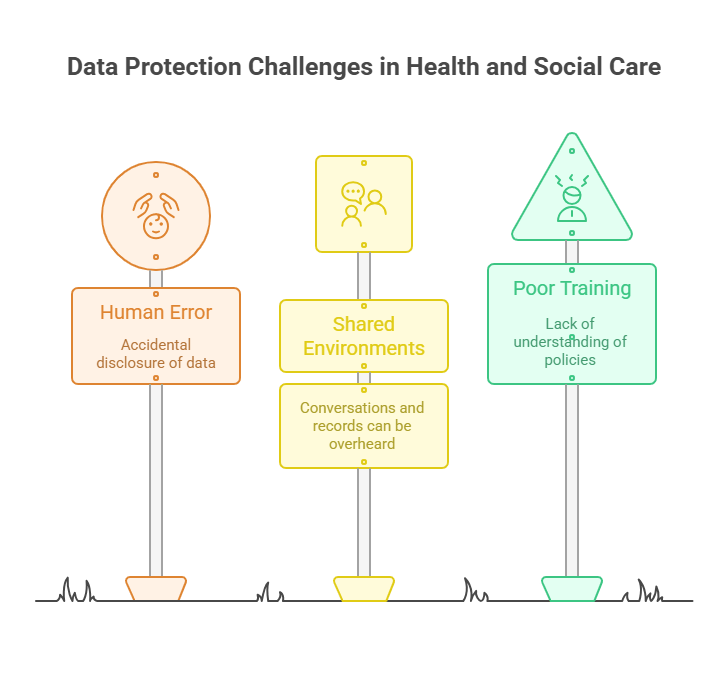
Data protection issues and breaches usually happen because of everyday working practices, not deliberate misuse, and GDPR aims to reduce these risks through clear rules and safeguards.

Data Protection Issues and Breaches in Health and Social Care

GDPR reduces these risks through clear implementation. Services train staff on data protection. They set access controls. They use secure systems. They encourage prompt reporting of concerns.

The focus stays practical. Protect people. Support safe care. Reduce risk through awareness and good systems.

GDPR in Care Homes and Residential Settings

GDPR in care homes focuses on protecting resident information in shared environments where many staff, visitors, and systems interact every day.

Care homes often use shared records. These may be paper files, digital systems, or both. Staff must return records after use and keep them out of public areas. Leaving files on desks increases risk.

Multiple staff access is common. Only staff involved in a person’s care should access their records. Clear role-based access helps prevent unnecessary viewing.

Secure storage matters at all times. Paper records should be kept in locked cabinets. Digital systems should use passwords and screen locks. Shared logins should be avoided.

Visitors and contractors also create risk. Screens should not be visible to visitors. Conversations about residents should stay private. Good habits protect dignity.

In residential care, GDPR supports safe routines. Simple actions make a real difference.

GDPR, Health & Safety, and Accident Records

Accident records in health and social care contain personal data and fall under GDPR. They must be handled with the same care as any other patient or staff information.

GDPR does not stop lawful health and safety reporting. Services still record accidents, incidents, and near misses to meet legal duties and protect people. The key is how that information is handled.

Only relevant details should be recorded. Records should be factual and accurate. Access should be limited to those who need the information for safety, investigation, or learning.

Confidentiality still applies. Accident records should be stored securely and shared only on a need-to-know basis. GDPR supports safe reporting while protecting dignity and privacy.

GDPR, Health & Safety, and Accident Records

Accident records do count as personal data under GDPR. They often include names, injuries, and details about what happened. That information needs care.

GDPR doesn’t block health and safety reporting. It allows it. Services still record accidents and near misses to keep people safe and meet legal duties. Nothing changes there.

What does matter is control. Record what’s relevant. Keep it factual. Share it only with people who need it to act or learn.

Not everyone needs access. And not every detail needs repeating. When accident records stay confidential and secure, GDPR supports safety without putting privacy at risk.

Who Regulates Data Protection in Health and Social Care?

The Information Commissioner’s Office (ICO) regulates data protection in health and social care across the UK. It oversees how organisations handle personal data and enforces UK GDPR and the Data Protection Act 2018.

The Care Quality Commission (CQC) does something different. It inspects care quality, safety, and standards. It does not regulate data protection law.

In short, the ICO looks at how data is used and protected. The CQC looks at how care is delivered. Different roles. Both matter.

Summary & Key Takeaways for Learners and Providers

  • GDPR sets clear rules that support safe, respectful care.
  • Patient data protection sits at the heart of dignity and confidentiality.
  • Good data practice improves trust between people and care services.
  • GDPR protects staff as well as patients when information is handled correctly.
  • Lawful data use supports safeguarding and care quality.

Simple, consistent habits reduce risk in everyday care settings.

Health and Social Care Level 3 Diploma
Learn to promote Health and Social Care Level 3 Diploma!

Frequently Asked Questions

What is GDPR in health and social care?

GDPR is the UK data protection framework that controls how personal and patient information is collected, used, stored, and shared in health and social care. It protects privacy, dignity, and individual rights while allowing lawful data use to support safe, effective care delivery.

In care settings, GDPR means staff must handle personal information responsibly, keep records secure, limit access to those who need it, and explain clearly how data is used. It supports safe care while respecting confidentiality and individual rights.

GDPR is important because health and social care data is highly sensitive. Misuse can cause harm, distress, or loss of trust. GDPR protects confidentiality, supports safeguarding, and helps people feel safe sharing information needed for proper care.

Patient data includes any information that identifies a person receiving care, such as names, addresses, NHS numbers, medical history, mental health details, care plans, and social care records. GDPR protects this information from misuse or unnecessary access.

Health data is classed as special category data because it reveals sensitive details about a person’s physical or mental condition. If mishandled, it could lead to discrimination, stigma, or serious harm, so GDPR applies stronger protections.

GDPR protects patient data by setting legal rules for lawful use, confidentiality, security, accuracy, and accountability. It ensures information supports care, safeguarding, and decision-making without being misused, shared inappropriately, or exposed to unnecessary risk.

Consent is not always required in health and social care. Services often rely on legal duties, public tasks, or health and social care provision to use data lawfully, especially when consent may be impractical or could place people at risk.

The GDPR principles guide safe data use in healthcare. They include lawfulness, fairness, transparency, purpose limitation, data minimisation, accuracy, storage limitation, and integrity and confidentiality. Together, they protect patient information throughout its lifecycle.

Storage limitation means care homes must keep records only for as long as they are needed for care, legal, or safeguarding purposes. Once no longer required, records should be securely destroyed according to retention policies and guidance.

GDPR protects confidentiality by limiting who can access records, requiring secure storage, and preventing unnecessary sharing. Staff should only discuss or disclose information when it is lawful, relevant, and necessary for care or safeguarding purposes.

Care workers must protect confidentiality, use secure systems, access records only when required, follow data protection policies, and report concerns quickly. Everyday actions, like locking screens and speaking privately, play a key role in compliance.

If staff suspect a data breach, they should report it immediately to a manager or data protection lead. Prompt reporting allows risks to be contained, individuals protected, and legal duties met without delay or concealment.

Data security is maintained through passwords, access controls, locked storage, staff training, secure IT systems, and clear policies. These measures reduce risk in busy care environments where information is shared across teams and services.

The Data Protection Act 2018 is the UK law that works alongside UK GDPR. It sets national rules for handling personal data, covers specific health and care situations, and supports lawful, ethical data use across services.

The Information Commissioner’s Office, known as the ICO, regulates GDPR in the UK. It oversees how organisations handle personal data and can take action when data protection law is not followed.

GDPR supports safeguarding by allowing lawful information sharing when there is risk of harm. It balances privacy with protection, ensuring concerns can be shared appropriately while still respecting dignity and confidentiality.

Common issues include human error, shared workspaces, weak passwords, poor training, unlocked screens, and discussing personal information in public areas. GDPR aims to reduce these risks through clear rules and everyday good practice.

GDPR is implemented through policies, staff training, secure systems, clear lawful bases, access controls, and regular reviews. These steps help embed safe data handling into daily care routines.

For care homes, GDPR means protecting resident information in shared environments. Records must stay secure, access must be controlled, and confidentiality must be maintained during handovers, visits, and daily care activities.

GDPR improves trust and safety by showing people their information is respected and protected. When data is handled properly, individuals feel more confident sharing details needed for safe, person-centred care.

Recent Blogs

5 Skills Every UK Care Employer Wants (and How to Prove You Have Them)

5 Skills Every UK Care Employer Wants (and How to Prove You Have Them)

UK care employers do not hire based on good intentions. Under CQC Regulation 18, they must evidence staff competence at every inspection. This guide covers the 5 skills every UK adult social care employer screens for, why each one has a regulatory basis, and how to prove yours through your CV, interview, the Care Certificate, and workplace evidence.

CQC Standards and Training What Care Staff Need to Know in 2026

CQC Standards and Training: What Care Staff Need to Know in 2026

CQC does not publish a mandatory training list. Under Regulation 18, every registered provider must ensure staff are demonstrably competent, properly inducted, and continuously supported. This guide explains the legal basis for training in 2026, the 16 Care Certificate standards, Oliver McGowan Mandatory Training, training matrices, and the competence evidence CQC inspectors look for.