



🌷Spring Sale! Get any Course for £11.99 Only!
Offer ends soon! 00 : 00 : 00
Use Coupon Code 👇
SPRING98
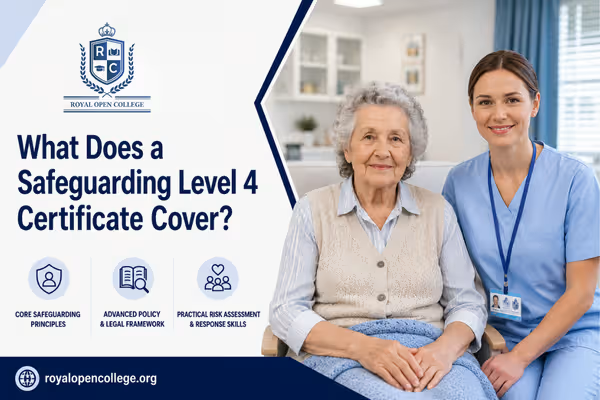
What Does a Safeguarding Level 4 Certificate Cover?

What Does a Safeguarding Level 4 Certificate Cover?

A Safeguarding Level 4 Certificate is built for practitioners in designated or lead roles. The certificate covers complex abuse recognition, the LADO process, multi-agency working, supervision, and adult safeguarding under the Care Act 2014. Aligned with Working Together to Safeguard Children 2026, this guide breaks down every topic area, who needs the certificate, and what you learn to do.

A named nurse is asked by her manager to recommend Level 4 safeguarding training for two senior colleagues. Before she agrees, she needs to know what the certificate actually covers, whether it meets NHS Intercollegiate framework requirements, and how it goes further than the Level 3 training her colleagues already hold.

If you are in a similar position, whether you are a DSL, safeguarding manager, named professional, or employer making a training decision for your team, this guide gives you a complete and accurate picture of what a Safeguarding Level 4 Certificate covers.

TL;DR:

  • A Safeguarding Level 4 Certificate is an advanced qualification for those in designated or lead safeguarding roles
  • Core topics include legislation, complex abuse recognition, risk assessment, multi-agency working, allegations management, supervision, and leadership
  • Working Together to Safeguard Children 2026 is the current statutory guidance, published by the DfE in March 2026, replacing the 2023 edition
  • Adult safeguarding content is included in many Level 4 qualifications, particularly in health and social care settings
  • Curriculum content varies across awarding bodies. NQual, CACHE (NCFE), and Highfield each offer their own Level 4 qualifications.
  • No single UK law requires this certificate by name. Employer policy and sector regulator expectations drive the requirement.

Authority Clarification: Is a Level 4 Safeguarding Certificate a Legal Requirement?

A Safeguarding Level 4 Certificate is an advanced professional qualification. It is not a standalone legal requirement by name.

The legislation underpinning safeguarding at this level includes the Children Act 1989 and 2004, the Care Act 2014, and Working Together to Safeguard Children 2026. In education settings, Keeping Children Safe in Education (KCSiE 2024) sets out training expectations for Designated Safeguarding Leads.

The NHS Standard Contract references the Intercollegiate Safeguarding framework for named clinical roles. None of these documents name a specific Level 4 RQF certificate as mandatory. They require practitioners in lead roles to demonstrate advanced safeguarding competence. A Level 4 certificate provides that evidence.

The four layers to understand:

⚖️ Law

Children Act 1989 and 2004, Care Act 2014.

Legally enforceable duties.

📖 Statutory Guidance

Working Together 2026, KCSiE 2024.

Organisations must follow unless exceptional circumstances apply.

🔍 Regulatory Expectation

CQC and Ofsted set inspection standards but do not name specific certificate levels.

🏢 Employer Policy

sets the specific training requirement for your post.

What Is a Safeguarding Level 4 Certificate?

A Safeguarding Level 4 Certificate is an advanced qualification for practitioners who hold designated or lead responsibility for safeguarding within their organisation. It goes well beyond awareness training. At this level, you learn to manage complex cases, supervise colleagues, lead referral and investigation processes, and build effective safeguarding policy.

The term “Level 4” refers to two distinct things in UK safeguarding practice.

In formal qualification terms, Level 4 sits on the Regulated Qualifications Framework (RQF), the national qualification system overseen by Ofqual. Awarding bodies including NQual, CACHE (NCFE), and Highfield offer Level 4 qualifications, though their unit titles and assessment structures differ from one another.

In NHS and health settings, Level 4 also describes a competency tier within the Intercollegiate Safeguarding framework, published by the Royal College of Paediatrics and Child Health (RCPCH) with partner organisations. The children’s Intercollegiate document was updated in November 2025. The Adult Safeguarding: Roles and Competencies second edition was published in July 2024. The Intercollegiate framework is a competency benchmark, not a qualification. Both definitions describe the same level of senior safeguarding responsibility, but they are not interchangeable products.

This certificate applies across health, social care, education, early years, and the voluntary sector. It targets practitioners whose primary duties include leading, overseeing, or advising on safeguarding at an organisational or multi-agency level.

What Does a Safeguarding Level 4 Certificate Cover?

Core coverage areas are broadly consistent across providers, though unit titles, structure, and depth vary by awarding body. The sections below reflect what a strong, framework-aligned Level 4 qualification includes.

Legislation and Legal Frameworks

At Level 4, the expectation is not simply to know the law but to apply it to real and complex cases. The certificate covers:

Children Act 1989 and 2004, including the threshold of significant harm and Section 47 enquiry duties
📖
⚖️
Care Act 2014, Section 42: the statutory duty to carry out adult safeguarding enquiries
Working Together to Safeguard Children 2026, the current statutory guidance published by the DfE in March 2026
👥
🎓
Keeping Children Safe in Education (KCSiE 2024), the statutory guidance for education settings, with a 2025 update currently in consultation
Data Protection Act 2018 and UK GDPR, specifically around information sharing in safeguarding contexts
🔒
🛡️
The Prevent duty under the Counter-Terrorism and Security Act 2015
You learn to apply this knowledge to referral decisions, threshold judgements, and multi-agency communication. You also learn to advise colleagues accurately on their statutory responsibilities.

Recognising and Responding to Complex Abuse

Level 3 builds awareness of abuse types. Level 4 builds the capacity to lead a response to complex, multi-layered safeguarding scenarios. Topics include:

  • Child Sexual Exploitation (CSE) and exploitation dynamics
  • County lines and criminal exploitation of children and young people
  • Radicalisation and the Prevent duty
  • Female Genital Mutilation (FGM) and mandatory reporting duties
  • Honour-based abuse
  • Domestic abuse, coercive control, and its impact on children
  • Child-on-child abuse and peer-on-peer harm
  • Online harms and digital safeguarding
  • Modern slavery and human trafficking
  • Extra-familial harm and contextual safeguarding
  • Adverse Childhood Experiences (ACEs) and trauma-informed practice

Working Together to Safeguard Children 2026 places stronger expectations on practitioners to recognise extra-familial harm, the harm children experience in communities and online rather than only within the family home. The certificate prepares you to apply contextual safeguarding principles to your assessment and planning.

You also learn to apply professional curiosity as a safeguarding standard, seeking to understand the lived experience of children and families rather than accepting surface-level explanations.

Risk Assessment and Thresholds of Harm

At Level 4, risk assessment moves well beyond checklists. You study structured, evidence-based approaches to assessing risk across multiple domains: the child or adult, the family environment, and the wider community and social context.

The certificate prepares you to:
Apply threshold frameworks accurately under both children's and adult safeguarding legislation
Make and document complex professional judgements in a way that withstands scrutiny
Identify disproportionality and potential bias in risk assessments
Use professional curiosity as an active practice standard across all cases

Multi-Agency Working and Information Sharing

Safeguarding at Level 4 is multi-agency by nature. You study the roles and responsibilities of all statutory safeguarding partners under Working Together 2026: local authorities, Integrated Care Boards (ICBs), and the police.

You also learn the structure and function of:

  • Local Safeguarding Children Partnerships (LSCPs)
  • Safeguarding Adults Boards (SABs)
  • Lead Safeguarding Partners (LSPs) and Delegated Safeguarding Partners (DSPs)
  • Child Protection Conferences and strategy meetings
  • Section 47 enquiries under the Children Act 1989

A key focus at this level is information sharing. You learn when the duty to share information overrides the duty to protect confidentiality, how to record information-sharing decisions defensibly, and how to apply UK GDPR in safeguarding contexts without defaulting to over-caution.

Managing Allegations Against Staff

This area is missing from most Level 4 training content published online. It is a standard, legally grounded, and operationally critical part of the certificate.

When an allegation is made against a person working with children, Working Together to Safeguard Children 2026 places specific statutory obligations on the Designated Safeguarding Lead or named professional. At Level 4, you learn to:

01
Refer the allegation to the Local Authority Designated Officer (LADO) within 24 hours of becoming aware of it
02
Oversee or conduct a fact-finding process, keeping it separate from any disciplinary procedure
03
Carry out a risk assessment of the individual during the investigation period
04
Maintain confidential, accurate records throughout the process
05
Work alongside HR, the LADO, and the police where appropriate
06
Refer to the Disclosure and Barring Service (DBS) where an allegation is substantiated
Managing allegations correctly protects children, protects your organisation, and ensures staff are treated fairly throughout.

Supervision, Safeguarding Leadership, and Organisational Policy

Level 4 practitioners supervise other safeguarding practitioners. The certificate covers different models of safeguarding supervision and prepares you to provide structured, reflective supervision to colleagues managing active or complex cases.

You also learn to:

  • Support colleagues through the emotional and psychological demands of complex safeguarding work
  • Challenge unsafe decisions made by other professionals within and outside your organisation
  • Develop, implement, and audit your organisation’s safeguarding policy against current statutory guidance
  • Contribute to Child Safeguarding Practice Reviews (CSPRs) and embed lessons into your organisation’s procedures
  • Understand the named professional’s role in court proceedings, including presenting evidence and contributing to formal assessments

Working Together 2026 introduces explicit expectations around anti-racist and anti-discriminatory practice for leaders. Level 4 professionals are expected to actively challenge racism and discrimination in safeguarding practice and to create inclusive cultures. This is no longer an optional awareness area. It is a stated leadership expectation.

Adult Safeguarding at Level 4

In health and social care settings, Level 4 training extends to adult safeguarding under the Care Act 2014.

Section 42 of the Care Act 2014 places a statutory duty on local authorities to conduct a safeguarding enquiry when an adult with care and support needs is at risk of, or experiencing, abuse or neglect. At Level 4, you learn to lead and contribute to these Section 42 enquiries.

Key content areas in adult safeguarding include:

The six safeguarding principles under the Care Act 2014: empowerment, prevention, proportionality, protection, partnership, and accountability
Making Safeguarding Personal (MSP): an outcomes-focused approach placing the adult's own wishes at the centre of the safeguarding process
Safeguarding Adults Reviews (SARs) and what they require from lead practitioners
Mental Capacity Act 2005 principles and best interest decision-making
Deprivation of Liberty Safeguards (DoLS) and the transition to Liberty Protection Safeguards (LPS)
Safeguarding Adults Boards (SABs) and their statutory multi-agency function
Note: MCA, DoLS, and LPS content applies primarily to health and adult social care settings. Not every Level 4 certificate includes this content. Check the course curriculum before enrolling if adult safeguarding is a core part of your role.

How Does Level 4 Differ from Level 3 Safeguarding?

The difference between Level 3 and Level 4 is fundamentally about responsibility, not just knowledge. Level 3 prepares practitioners to respond to safeguarding concerns, make referrals, and fulfil the Designated Safeguarding Lead function within their setting. Level 4 prepares practitioners to lead safeguarding strategy, supervise other DSLs, manage complex multi-agency cases, and advise the whole organisation.

To make this practical: a GP practice safeguarding lead needs Level 3 training. A Named GP, Named Nurse, or Named Doctor, the senior professional with strategic safeguarding responsibility across a health organisation, needs Level 4 or above. The RCGP confirmed this distinction in its updated safeguarding standards published in October 2024.

The table below shows how responsibilities shift between the two levels.

Level 3 vs Level 4: A Practical Comparison

Level 3 is not always a formal prerequisite for Level 4. Entry requirements vary by awarding body. In practice, most providers and employers expect Level 3 to be current and valid before Level 4 training is undertaken.

Responsibility Area Level 3 Level 4
Primary role Designated Safeguarding Lead Named professional, senior safeguarding lead
Case focus Individual cases within the setting Complex, multi-agency, cross-sector cases
Allegations process Aware of the LADO process Leads the LADO referral within 24 hours
Supervision Receives safeguarding supervision Provides and models supervision to others
Policy Implements safeguarding policy Develops, audits, and reviews policy
Multi-agency role Participates in meetings and processes Leads within multi-agency safeguarding meetings
Court role Attends when required Understands the named professional expert role
Anti-discriminatory practice Awareness Active challenge and leadership expectation
Level 3 is not always a formal prerequisite for Level 4. Entry requirements vary by awarding body. In practice, most providers and employers expect Level 3 to be current and valid before Level 4 training is undertaken.
Who Is a Level 4 Safeguarding Certificate For?

Who Is a Level 4 Safeguarding Certificate For?

Level 4 is a qualification for practitioners with designated or lead safeguarding responsibility. It is not a course for general staff.

Roles Where Level 4 Is Typically Required or Expected

In Healthcare:

  • Named nurses for safeguarding
  • Named doctors for safeguarding
  • Named GPs for organisations commissioning primary care
  • Named health visitors
  • Named midwives
  • Named health professionals in ambulance services
  • Senior clinical leads with safeguarding oversight in mental health trusts

In Education:

  • Senior leaders with strategic multi-agency safeguarding responsibility in large or federated settings
  • Professionals moving into named or designated safeguarding roles above the standard DSL function

In Social Care and Early Years:

  • Safeguarding managers overseeing multiple DSLs or complex statutory casework
  • Senior practitioners leading Section 47 and Section 42 enquiries
  • Early years leads with designated safeguarding responsibility

In the Voluntary Sector:

  • Safeguarding leads with direct oversight of other safeguarding workers and responsibility for complex cases

Do I Need Level 4? A Quick Decision Guide

START HERE

Do you supervise other safeguarding practitioners or DSLs?
Yes
Level 4 is likely appropriate for your role.
No
Move to next question.
Do you hold a named professional or designated strategic safeguarding role?
Yes
Level 4 is likely appropriate for your role.
No
Move to next question.
Do you manage complex, multi-agency safeguarding cases with cross-sector responsibility?
Yes
Level 4 is likely appropriate for your role.
No
Level 3 is more likely appropriate.
Always confirm the correct level with your employer, NHS Trust, Local Authority, or sector regulator. GP practice safeguarding leads need Level 3, not Level 4. The RCGP confirmed this in its October 2024 safeguarding standards update.

Does a Level 4 Safeguarding Certificate Meet CQC, Ofsted, or Employer Requirements?

No single UK law requires a Level 4 Safeguarding Certificate by that name. What drives the requirement varies by sector and by role. Understanding the four layers below helps you make accurate decisions for your team.

Primary Legislation

The Children Act 1989 and 2004 and the Care Act 2014 place statutory safeguarding duties on organisations and individuals. These Acts do not specify a certificate level. They establish the duty to safeguard. Competency expectations follow from that duty through guidance and regulation.

Statutory Guidance

Working Together to Safeguard Children 2026, published by the DfE on 18 March 2026, and KCSiE 2024 both set competency expectations for safeguarding leads. Neither document specifies an RQF level. Both expect practitioners in lead roles to demonstrate advanced, role-appropriate safeguarding knowledge and the ability to lead their organisation’s safeguarding response.

Regulatory Expectations

CQC does not mandate Level 4 by name. During inspections, CQC expects clear evidence of advanced safeguarding competence in lead roles. A Level 4 certificate provides a verifiable evidence trail. Ofsted expects DSLs in schools and early years settings to have appropriate training for their role, as set out in KCSiE, but does not specify an RQF level. The NHS Standard Contract references the Intercollegiate Safeguarding framework for named clinical staff, which aligns directly with Level 4 competency expectations.

Employer and Sector Policy

Most regulated employers in health, education, and social care specify Level 4 training for named or designated lead roles as a condition of employment or as part of their workforce development framework. This is the most common practical driver of the requirement.

The safest approach: check your employer’s current safeguarding policy, your sector regulator’s training framework, and your NHS Trust or Local Authority requirements before enrolling on any course.

How Long Does It Take and How Often Should It Be Renewed?

How Long Does Level 4 Training Take?

Completion time varies depending on the format and the awarding body.

  • One-day face-to-face or virtual course: typical for Intercollegiate Level 4 training for named health professionals. The NSPCC delivers this format, with content aligned to the healthcare Intercollegiate framework. Their most recent data shows 98.4% of Level 4 training participants recommend the course.
  • Multi-unit RQF Level 4 qualification: takes several weeks to complete, combining guided learning with assessed tasks. The NQual Level 4 Award for Designated Safeguarding Leads carries 5 credit points on the RQF.
  • Online blended delivery: widely available and accepted by most employers and sector regulators. Delivery format does not affect the validity of the qualification in most settings.

How Often Should It Be Renewed?

There is no universal legal expiry date for safeguarding certificates in the UK. Renewal frequency is set by your sector, employer, or awarding body.

Sector or Provider
Recommended Renewal Frequency
NQual Level 4 Award
Every 2 years
Caring for Care Level 4 course
Every 2 years minimum
BAMT Level 4 training
Every 3 years
NHS Intercollegiate framework
Check with your NHS Trust
General sector guidance
Every 2 to 3 years
Some organisations require annual CPD updates alongside full renewal every two to three years. Always check your organisation's training policy and your sector framework to confirm the correct interval for your specific role.

Summary and Next Steps

A Safeguarding Level 4 Certificate prepares designated leads and named professionals to manage complex cases, supervise colleagues, lead multi-agency processes, and build a strong safeguarding culture across their organisation. It is a qualification for those with the most significant safeguarding responsibilities in health, education, social care, early years, and the voluntary sector.

Before enrolling, check your employer’s safeguarding training policy, confirm which awarding body and qualification type your sector regulator recognises, and verify whether the course covers the areas your role requires. If you are ready to take the next step, view our Level 4 Safeguarding Certificate or speak to our team about the right course for your role and sector.

FAQ

Q: What topics are covered in a Safeguarding Level 4 Certificate?

A: A Level 4 Safeguarding Certificate covers legislation and legal frameworks, complex abuse recognition, risk assessment, multi-agency working, allegations management, safeguarding supervision, leadership, and organisational policy. In health and social care settings, adult safeguarding content is also included. Exact topics vary by awarding body and qualification structure.

A: Yes, depending on the qualification. Some certificates focus on children's safeguarding, others on adults, and some cover both. If adult safeguarding is essential to your role, check the curriculum before enrolling and look for content aligned with the Care Act 2014 and the Adult Safeguarding: Roles and Competencies document, second edition, published in July 2024.

A: A DSL qualification is role-specific to education and focuses on the Designated Safeguarding Lead function within schools and similar settings. A Level 4 Safeguarding Certificate applies across multiple sectors, including health, social care, and the voluntary sector. Some DSL qualifications are accredited at Level 4 on the RQF, but this does not make them equivalent to all Level 4 safeguarding certificates.

A: CQC does not mandate Level 4 by name in its regulations. During inspections, CQC expects evidenced advanced safeguarding competence in lead roles, and a Level 4 certificate provides that evidence trail. Always check the current CQC inspection framework for your service type alongside your organisation's safeguarding policy.

A: Level 3 is not a universal formal prerequisite, but most providers and employers expect it to be current before Level 4 training is undertaken. Prerequisites vary by awarding body, so check the entry requirements of your chosen course before enrolling.

A: Recognised awarding bodies include NQual, CACHE (NCFE), and Highfield, all of which offer Level 4 qualifications regulated by Ofqual. CPD-accredited certificates from other providers are also available but are not Ofqual-regulated qualifications. Check which type your employer or sector regulator accepts before enrolling.

A: No single UK law requires a Level 4 certificate by that name. The requirement is driven by employer policy, sector regulator expectations, and statutory guidance including Working Together to Safeguard Children 2026 and KCSiE 2024. Check your employer's safeguarding training policy and your sector framework for the actual requirement.

A: There is no universal legal expiry date for safeguarding certificates in the UK. Most sector guidance recommends renewal every two to three years, but some employers require more frequent refreshers. Always check your organisation's safeguarding training policy and your sector framework for the correct renewal interval for your role.

A: No. Level 5 and above exists for designated professionals and strategic safeguarding leads working at a system-wide level, such as Designated Doctors or Designated Nurses for safeguarding at integrated care board level. The Intercollegiate Safeguarding framework sets out competencies from Level 1 through to Level 5.

A: Yes. Complex abuse types are a core part of Level 4 training. The certificate covers county lines, CSE, radicalisation, FGM, honour-based abuse, modern slavery, and online harms at greater depth than Level 3 awareness content. Working Together to Safeguard Children 2026 reinforces expectations around extra-familial harm and contextual safeguarding, both of which are integral at Level 4.

Recent Blogs

HCA Course vs Nursing Assistant Course: Which Should You Choose?

HCA Course vs Nursing Assistant Course: Which Should You Choose?

Two courses. Similar price. Different titles. Before you spend money on either, read this. In the UK, HCA courses and nursing assistant courses lead to the same role. What NHS employers check is the qualification type behind the course, not the name on the listing. This guide explains the difference between regulated and unregulated qualifications, what the Care Certificate actually is, and which course fits your career goal.

How Long Does a Nursing Assistant Course Take in the UK?

How Long Does a Nursing Assistant Course Take in the UK?

Nursing assistant training in the UK ranges from a few hours to 18 months. The right route depends on whether you are employed, how your training is funded, and what qualification you need. This guide maps every real UK pathway with honest timelines, updated Care Certificate information for 2025, and practical guidance on choosing the route that works for you.

How Long Does Safeguarding Level 4 Training Take Duration, Format and Renewal

How Long Does Safeguarding Level 4 Training Take? | Duration, Format and Renewal

Level 4 safeguarding training takes 1 to 2 days in instructor-led settings or 7 to 40 hours online. The intercollegiate framework, not commercial providers, sets the standard for named professionals. This guide covers how duration varies by format, why the 3-year renewal figure is accurate, and what to check with your ICB before booking. Built on ICD 2025 and RCN Adults ICD 2024.