










What Is a Pharmacy Dispenser Roles, Legal Responsibilities, Training and Career Path in the UK

What Is a Pharmacy Dispenser? Roles, Legal Responsibilities, Training and Career Path in the UK

A pharmacy dispenser prepares and supplies medicines under pharmacist supervision. This guide covers legal responsibilities, supervision rules, Level 2 qualifications, workplace assessment, and career paths in the UK.

Imagine collecting a prescription from your local pharmacy. The pharmacist handles the final clinical check. But another trained person assembles, labels, and prepares your medication. That person is the pharmacy dispenser, a key but often misunderstood role in UK healthcare.

This guide covers what the role involves, what the law requires, and how to enter the profession correctly.

TL;DR

  • A pharmacy dispenser prepares and supplies medicines under pharmacist supervision.
  • The role is not regulated the way pharmacists or pharmacy technicians are.
  • Most employers require a Level 2 qualification.
  • The pharmacist holds final legal responsibility for dispensing.
  • Workplace competence assessment forms part of most training routes.

Authority Clarification

This guide draws on UK medicines legislation, supervision requirements, NHS workforce structures, and current qualification pathways. It separates employer expectations from statutory legal requirements to keep information accurate.

Pharmacy Assistant And Technician Foundation Diploma

Learn to Promote Pharmacy Assistant And Technician Foundation Diploma!

What Is a Pharmacy Dispenser?

A pharmacy dispenser is a trained support worker who prepares, labels, and supplies medicines under pharmacist supervision. They are not registered healthcare professionals but play a key role in safe dispensing across community and hospital pharmacies.

Alternative Job Titles

Employers use different titles for this role. You may see:

  • Dispensing assistant
  • Pharmacy assistant
  • Pharmacy support staff

The tasks tied to each title are broadly the same. Always check job descriptions before applying.

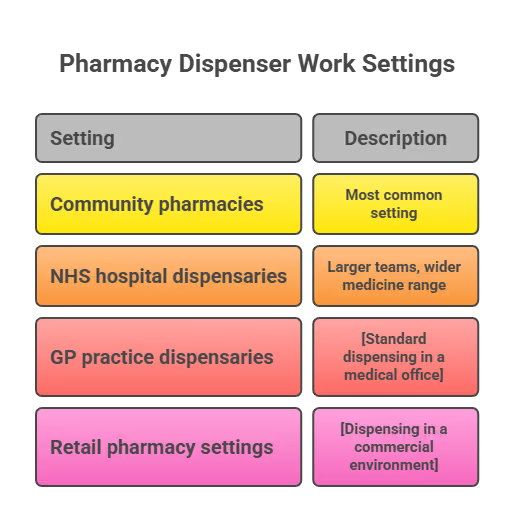
Where They Work

Where They Work

What Does a Pharmacy Dispenser Do on a Daily Basis?

A pharmacy dispenser assembles prescriptions, labels medicines, manages stock, and handles patient enquiries under supervision. They process prescriptions accurately before a pharmacist or authorised technician completes the final clinical and accuracy checks.

Prescription Assembly

Prescription assembly sits at the heart of the role. This means:

  • Reading and interpreting prescriptions
  • Selecting the correct medicine, strength, and form
  • Measuring and packaging medicines accurately

Dispensers do not verify clinical decisions. The supervising pharmacist holds that responsibility. Where electronic prescriptions are in use, dispensers also retrieve and process them digitally.

Labelling and Documentation

Every dispensed medicine needs accurate labelling. This includes:

  • The patient’s name and address
  • Dosage instructions
  • Warnings and cautionary labels

Labelling errors put patients at risk. Dispensers follow written standard operating procedures (SOPs) at every stage. Records must be clear and meet the pharmacy’s documentation standards.

Stock Control and Inventory

Good stock management keeps the pharmacy safe. Dispensers:

  • Order medicines and supplies as needed
  • Check expiry dates and rotate stock
  • Store medicines in the correct conditions

In hospital settings, stock control covers a larger range of specialist medicines. Temperature-sensitive medicines need cold-chain storage and careful monitoring.

Who Is Legally Responsible for Dispensing Medicines in the UK?

UK medicines law places legal responsibility for the safe supply of Prescription Only Medicines with the pharmacist. Pharmacy dispensers work under supervision and do not hold final clinical responsibility for prescription accuracy.

Supervision Requirements

UK medicines legislation sets clear boundaries for dispensing. Key points:

  • Dispensing takes place on registered pharmacy premises
  • A pharmacist oversees the dispensing process
  • Dispensers follow written SOPs approved by the pharmacy

The level of direct supervision can vary depending on the task and the dispenser’s assessed competence. The pharmacist stays responsible throughout.

Why This Matters

Why This Matters

Is a Pharmacy Dispenser a Regulated Professional?

Pharmacy dispensers are not regulated professionals in the UK and do not need to register with the General Pharmaceutical Council (GPhC). But they must work within regulated pharmacy environments and follow strict standard operating procedures.

The GPhC sets education and training requirements for pharmacy support staff. Training programmes must meet GPhC standards, even though individual dispensers do not register with the GPhC.

Difference Between Registration and Supervision

This distinction trips up a lot of people. Here is how it breaks down.

Registration applies to pharmacists and pharmacy technicians. These are protected titles in law. Only GPhC-registered individuals can use them. Registration requires an approved qualification, fitness-to-practise standards, and annual renewal.

Supervision applies to pharmacy dispensers. They work under a registered pharmacist’s direction. They do not hold a protected title and are not GPhC registrants.

This does not remove accountability. Dispensers must work competently, follow SOPs, and stay within the boundaries their employer and pharmacist set.

What Qualifications Do You Need to Become a Pharmacy Dispenser?

UK law sets no mandatory qualification for pharmacy dispensers. But most employers expect a Level 2 Pharmacy Services qualification or apprenticeship before they appoint someone to a dispensing role.

A recognised qualification shows employers you understand safe dispensing principles. It also builds a foundation for working competently under supervision.

Level 2 Pathways

The GPhC recognises several Level 2 training routes for pharmacy support staff. Current options include:

  • Level 2 Diploma in Pharmacy Services – offered by Buttercups Training, the National Pharmacy Association (NPA), MediaPharm, Open Awards, and Pearson-Edexcel
  • Pharmacy Services Assistant Apprenticeship – available through Buttercups Training, Open Awards, Pearson-Edexcel, and Skills4Pharmacy
  • SVQ in Pharmacy Services at SCQF Level 6 – the Scottish route, recognised by Qualifications Scotland

The GPhC publishes a list of approved providers on its website. Check the list before enrolling.

Employer vs Legal Requirement

UK primary legislation does not require a dispenser to hold a Level 2 qualification before starting work. But the Level 2 is the industry standard. Most NHS trusts and community pharmacy employers will not appoint a dispenser without it, or without a commitment to complete it.

Employers hold responsibility for the competence of staff working under supervision. Requiring a recognised qualification is how they meet that duty.

How Does Workplace Assessment Work?

How Does Workplace Assessment Work

Workplace assessment covers supervised practical tasks, portfolio evidence, and demonstrated safe dispensing. Most recognised qualifications need on-the-job training before the candidate earns the award.

Qualifications for pharmacy support staff combine knowledge learning with evidence from the workplace. Candidates must show they can apply their learning in a real dispensing environment.

Practical Competency Evidence

Assessors observe dispensers at work and collect evidence. This includes:

  • Adherence to standard operating procedures
  • Safe medicine handling, including storage and disposal
  • Accurate dispensing observed in practice

A portfolio supports this by recording completed tasks, supervisor witness statements, and written reflections. Assessment criteria map to National Occupational Standards for pharmacy support roles. Candidates must meet all standards before the qualification is awarded.

Can a Pharmacy Dispenser Give Medical Advice?

Pharmacy dispensers provide general product information and reinforce pharmacist instructions. Clinical advice and final medication decisions belong to the pharmacist.

In practice, a dispenser explains how to take a medicine or points to printed patient information. They cannot advise on whether a medicine suits a patient’s condition, suggest dosage changes, or discuss drug interactions.

Over-the-Counter vs Prescription Medicines

The boundary shifts slightly depending on medicine type.

For over-the-counter (OTC) medicines, dispensers share factual product information. Recommending a specific OTC treatment based on a patient’s symptoms is a clinical task. Pharmacists and trained medicines counter assistants handle this.

For prescription medicines, the dispenser assembles and labels the item. All clinical confirmation, suitability checks, and final accuracy checking rests with the pharmacist. Any clinical question from a patient goes straight to the pharmacist.

What Is the Difference Between a Pharmacy Dispenser and a Pharmacy Technician?

Pharmacy technicians are registered healthcare professionals with a protected title. Pharmacy dispensers are support staff who work under supervision without registration requirements.

Both roles work with medicines in pharmacy settings. But their legal standing, scope of practice, and training levels differ significantly.

Registration

Training Level Comparison

Pharmacy dispensers complete a Level 2 qualification in pharmacy services. Pharmacy technicians complete a Level 3 qualification. Both routes require workplace-based assessment and portfolio evidence.

The Level 3 covers clinical knowledge, medicines optimisation, and wider healthcare practice in greater depth. It also satisfies the education requirement for GPhC registration.

What Skills Are Essential for Safe Dispensing?

Accuracy, attention to detail, communication, and procedure-following are the essential skills for pharmacy dispensers. Small errors in labelling or medicine selection harm patients.

Dispensing demands both practical skill and strong interpersonal ability. Speed and accuracy need to work together, especially during busy periods.

Key skills include:

  • Detail orientation: Spotting errors in prescriptions or packaging before they reach the patient
  • IT skills: Using dispensing software, patient record systems, and the NHS Electronic Prescription Service
  • Team communication: Working clearly with pharmacists, technicians, and other support staff
  • Confidentiality: Handling patient data in line with data protection rules and pharmacy governance standards

Solid numeracy helps too, especially when measuring liquids or calculating quantities. Following written instructions precisely is non-negotiable in a role built on SOPs.

How Much Does a Pharmacy Dispenser Earn in the UK?

Pay depends on the employer, setting, and location. NHS roles follow support staff pay bands and community pharmacy salaries vary by region and experience.

NHS pharmacy dispensers sit at Band 2 or Band 3 of the Agenda for Change (AfC) pay scale. NHS jobs also include a pension scheme, annual leave above the statutory minimum, and staff benefits.

Community pharmacy pay is set by individual employers and does not follow a national scale. Pay differs between independent pharmacies, large chains, and supermarket pharmacies. Where you work in the UK makes a difference too.

Because pay benchmarks shift regularly, this guide avoids specific figures. Check current vacancies on NHS Jobs and employer websites for up-to-date rates.

What Career Progression Is Available?

With experience and further training, pharmacy dispensers progress into senior support roles or complete additional qualifications to become registered pharmacy technicians.

The dispenser role is often a starting point for a pharmacy career. Employers back progression through structured training and internal development.

Technician Pathway

Supervisory Roles

Some experienced dispensers move into lead dispenser or dispensary supervisor roles. These involve coordinating other support staff, overseeing stock systems, and keeping SOPs on track across the team.

Supervisory roles do not always need GPhC registration. They rely on demonstrated competence and employer trust. In hospital settings, experienced dispensers may also move into specialist roles such as aseptic preparation support, where medicines are produced under controlled conditions for individual patients.

What Has Changed in Pharmacy Roles Since 2024?

Pharmacy service expansion has increased task delegation within pharmacies since 2024. But supervision laws and the regulatory status of dispensers have not changed.

The pharmacy sector has shifted significantly. The day-to-day context for dispensers looks different. Their core legal position stays the same.

Workforce Skill-Mix

NHS England and the devolved health services push skill-mix models so pharmacists can focus on clinical work. More routine dispensing moves to support staff as a result. Dispensers handle greater volume in this environment. But the supervision requirement holds firm.

Digital Prescription Systems

The NHS Electronic Prescription Service (EPS) covers most dispensing settings now. Dispensers receive and process prescriptions digitally far more than on paper. Competence with dispensing software and EPS workflows is a practical requirement in most NHS and community pharmacy settings.

Pharmacy Service Expansion

Pharmacies deliver more services than before, including Pharmacy First, vaccination programmes, and blood pressure monitoring. Pharmacists and, in some cases, registered pharmacy technicians deliver these services. They fall outside a dispenser’s role. But they reshape the team structure and daily pace of modern pharmacy, and dispensers need to know where their responsibilities end.

Summary

A pharmacy dispenser is a key support professional who prepares medicines safely under pharmacist supervision. The role is not regulated by statute, but it demands structured training, workplace competence, and strict adherence to UK medicines law. A clear grasp of supervision boundaries and qualification pathways is essential for safe practice and career growth.

Pharmacy Assistant And Technician Foundation Diploma

Learn to Promote Pharmacy Assistant And Technician Foundation Diploma!

FAQ

1. Is a pharmacy dispenser legally required to register with the GPhC?

No. Pharmacy dispensers do not register with the General Pharmaceutical Council. Registration is a legal requirement for pharmacists and pharmacy technicians only. Dispensers must work within registered premises under pharmacist supervision. Their training must meet GPhC-set standards. But they do not hold registered professional status with the regulator.

No. UK primary legislation does not require dispensers to hold a Level 2 qualification. But it is the industry standard. Most NHS employers and community pharmacy operators expect candidates to hold, or be working towards, a GPhC-recognised Level 2 programme before appointing them to a dispensing role.

No. Dispensers do not perform independent final accuracy checks. A pharmacist must check each prescription before it reaches the patient. In some settings, a qualified accuracy checking technician (ACT) carries out this check instead. The dispenser assembles the prescription correctly and passes it forward for checking.

The supervising pharmacist carries legal responsibility for the safe supply of Prescription Only Medicines. Where a dispenser causes harm by failing to follow SOPs or working outside their agreed role, the employer may also face accountability through employment law. Dispensers are not individually liable in law for clinical decisions. But they must follow SOPs and escalate concerns to the pharmacist.

A Level 2 qualification takes six to twelve months for most candidates. Apprenticeship routes run for up to eighteen months because they combine work-based learning with formal study. Completion depends on employer support, assessor availability, and how fast the candidate gathers evidence.

Yes. Most Level 2 qualifications are designed around employment. Apprenticeship pathways require candidates to be working in a pharmacy throughout. Even standalone qualifications need the candidate in a pharmacy setting to build portfolio evidence. Providers structure learning to fit around working schedules.

No statutory GCSE requirement exists in law. Individual employers set their own entry requirements. Many expect GCSEs in English and Maths or equivalent qualifications. Some accept relevant work experience in a customer-facing or healthcare role. Check individual job adverts for a clear picture of what each employer expects.

A medicines counter assistant works at the pharmacy counter and advises customers on general sale and pharmacy medicines. A pharmacy dispenser works in the dispensary and assembles and labels prescription medicines. Both roles sit under pharmacist supervision. In smaller pharmacies, one person may carry out both functions depending on employer arrangements.

No. Clinical advice, recommending medicines based on symptoms, discussing drug interactions, or suggesting dosage changes, belongs to the pharmacist. Dispensers explain how to take a prescribed medicine and direct patients to printed information. Any clinical question from a patient goes straight to the pharmacist.

Yes. NHS hospital pharmacies employ dispensers to support medicine supply for inpatients, outpatients, and discharge prescriptions. Hospital-based dispensers work in larger teams. Vacancies appear on NHS Jobs. NHS employment brings Agenda for Change pay, a pension scheme, and annual leave above the statutory minimum.

A workplace portfolio collects evidence that a candidate can do their job competently. It includes observation records, supervisor witness statements, written task accounts, and underpinning knowledge evidence. The portfolio maps to National Occupational Standards for pharmacy support staff. Candidates must reach the required standard across all areas before they earn the qualification.

The Human Medicines Regulations 2012 is the primary legislation. It built on the Medicines Act 1968 and sets the legal categories of medicines, conditions for supply, and the need for pharmacist oversight when dispensing Prescription Only Medicines. The regulations cover England, Scotland, Wales, and Northern Ireland, with devolved frameworks running alongside UK-wide provisions.

Yes. Dispensing experience builds a strong practical foundation for technician training. The next step is a GPhC-approved Level 3 qualification in pharmacy services. On completion, you apply to register with the GPhC. Several providers offer Level 3 programmes, including apprenticeship routes designed for people already working in pharmacy.

Yes. The pharmacy dispenser role is a recognised entry point for school leavers who want healthcare work without a degree. Employers set their own entry requirements. Many accept GCSEs in English and Maths. The Pharmacy Services Assistant Apprenticeship combines earning, working, and gaining a recognised qualification from day one.

Accuracy and reliability matter above everything else. Dispensers handle medicines for real patients and errors cause harm. A methodical approach, sharp attention to detail, and the discipline to follow procedures every day are non-negotiable. Good communication, patience with the public, and care with patient data complete the picture of a strong pharmacy dispenser.

Dispensers may handle controlled drugs depending on their setting and employer policies. Controlled drugs carry extra legal requirements under the Misuse of Drugs Act 1971. Dispensers do not make clinical decisions about controlled drug prescriptions. All handling follows the pharmacy’s SOPs and stays under pharmacist supervision.

A standard operating procedure is a written document that explains how to carry out a specific task in the pharmacy. UK law requires registered pharmacy premises to maintain SOPs. They cover prescription assembly, labelling, stock management, and error reporting, among other tasks. All pharmacy staff must read, sign, and follow the relevant SOPs before they work unsupervised.

Both are common. Community pharmacies recruit part-time staff, including evenings and weekends. Hospital and NHS settings offer full-time and part-time contracts. Apprenticeship contracts need a minimum number of weekly hours to meet qualification requirements. Check individual vacancies for specific working arrangements.

An accuracy checking dispenser completes extra training to perform final accuracy checks on dispensed items without the pharmacist re-checking each one. This role is not available everywhere. It depends on employer policy and the relevant regulatory framework. ACD training sits above the standard Level 2 qualification. Buttercups Training and the NPA offer ACD programmes.

GPhC-recognised qualifications apply across England, Wales, and Northern Ireland. Scotland uses the SVQ in Pharmacy Services at SCQF Level 6, recognised by Qualifications Scotland. Candidates who complete a GPhC-recognised programme elsewhere in the UK should check with prospective Scottish employers about equivalence. Most UK pharmacy employers accept GPhC-recognised qualifications regardless of where training was completed.

Recent Blogs

5 Skills Every UK Care Employer Wants (and How to Prove You Have Them)

5 Skills Every UK Care Employer Wants (and How to Prove You Have Them)

UK care employers do not hire based on good intentions. Under CQC Regulation 18, they must evidence staff competence at every inspection. This guide covers the 5 skills every UK adult social care employer screens for, why each one has a regulatory basis, and how to prove yours through your CV, interview, the Care Certificate, and workplace evidence.

CQC Standards and Training What Care Staff Need to Know in 2026

CQC Standards and Training: What Care Staff Need to Know in 2026

CQC does not publish a mandatory training list. Under Regulation 18, every registered provider must ensure staff are demonstrably competent, properly inducted, and continuously supported. This guide explains the legal basis for training in 2026, the 16 Care Certificate standards, Oliver McGowan Mandatory Training, training matrices, and the competence evidence CQC inspectors look for.

Mental Health Awareness in Care What Level 3 Learners Need to Know

Mental Health Awareness in Care: What Level 3 Learners Need to Know

Most guides treat mental health awareness as a general topic. For Level 3 care learners, it is a regulated workforce skill. This guide explains what Care Certificate Standard 9 now requires, where Level 3 learners sit in the competency framework, which laws apply, and how to recognise and escalate concerns in a care setting.