











20 High-Paying Nursing Jobs in the UK (2025 Guide)

20 High-Paying Nursing Jobs In The UK

High-paying nursing jobs in the UK are driven by responsibility, not job titles alone. This guide explains how NHS pay bands shape nurse salaries, which advanced and leadership roles earn the most, and how nurses realistically progress into Band 7–9 positions or higher-paid private and locum work.

20 High-Paying Nursing Jobs In The UK is a search driven by frustration, curiosity, and hope. Many nurses assume pay depends on job titles alone. It doesn’t. In reality, nurse salary in the UK follows a structured system.

The 20 high-paying nursing jobs in the UK are senior leadership, specialist, and advanced nursing roles that usually sit at higher NHS pay bands or equivalent private sector grades, not standard ward roles.

This guide explains how NHS pay bands shape earnings, why advanced nursing roles command higher pay, and where the highest paid nursing jobs UK sit across the NHS and private sector. You’ll get clarity, not hype, and a realistic view of how progression actually works.

TL;DR

  • Most high-paying nursing jobs in the UK sit at NHS Band 7–9.
  • Pay is driven by NHS pay bands, not job titles alone.
  • The highest paid nursing jobs UK are usually senior leadership or advanced nursing roles.
  • Director of Nursing, Nurse Consultant, and Advanced Nurse Practitioner roles earn the most.
  • Leadership responsibility, advanced practice, and prescribing rights increase pay.
  • Specialist expertise matters more at senior levels than clinical setting alone.
  • Private and locum roles can pay more than the NHS, with less security.

Advanced qualifications, often at Master’s level, are common in top-paid roles.

Nursing Assistant Level 3 Diploma
Learn to promote Nursing Assistant Level 3 Diploma!

Nurse Salary in the UK – How Pay Works in 2026

Nurse salary in the UK is shaped more by role, responsibility, and setting than by simple averages. Most registered nurses start on Band 5, then progress as their skills, autonomy, and scope of practice grow.

That starting point matters. But it doesn’t tell the full story. Many “average nurse salary” figures online blend students, new registrants, senior specialists, and managers into one number. It sounds helpful. It isn’t.

Here’s why those averages mislead. A newly qualified staff nurse, an advanced clinical practitioner, and a nurse consultant all sit under the same job title umbrella. Their pay, accountability, and decision-making power are very different. Lumping them together hides how progression actually works.

In the NHS, pay follows the Agenda for Change framework, overseen by NHS Employers and set out on GOV.UK. Each role sits within a band. Each band reflects complexity, leadership, and clinical risk. Progression usually comes from moving up bands, not just spending time in post.

Private and independent providers work differently. Some offer higher headline pay. Others trade salary for flexibility, narrower roles, or different shift patterns. There’s no single structure, and comparisons aren’t always like for like.

So when people ask about the salary of a nurse in the UK, the better question is this. What role are you aiming for, and where do you want to work? That’s what really determines earning potential.

NHS Nurse Bands Explained (Band 5 to Band 9)

NHS nurse bands are part of the Agenda for Change framework. It sets pay based on responsibility, skill, and scope of practice. Not job titles alone. Each band reflects what you’re trusted to do.

Band 5 is the starting point for registered nurses. You deliver direct care, follow care plans, and build confidence in practice. It’s where most nurses begin.

Move up, and the role changes. Band 6 senior nurse roles bring more autonomy. You may lead shifts, supervise others, or manage a specialist caseload. Decision-making matters more here.

Pay starts to rise meaningfully at Band 7 advanced practice. These roles carry clinical authority. Think advanced assessments, complex decisions, and leadership across services. You’re often shaping care, not just delivering it.

Above that sit Band 8a–8d leadership roles. These nurses lead teams, services, or whole departments. Strategy enters the picture. So does accountability for outcomes, budgets, and quality.

At the top, Band 9 executive nursing roles focus on system-level leadership. Policy, governance, and organisational direction define the work. Few roles reach this level, but they carry the highest responsibility.

Progression isn’t about time served. It’s about scope. Responsibility. Leadership. As those grow, bands rise. That’s how NHS nursing pay really works.

NHS Nurse Bands Explained (Band 5 to Band 9)

NHS nurse bands sit within the Agenda for Change framework. They link pay to responsibility, scope, and decision-making. Not job titles alone. The higher the band, the greater the trust placed in the role.

NHS Nurse Bands Explained (Band 5 to Band 9)

How progression really works

Progression through nursing bands isn’t about years alone. It’s about:

  • Responsibility
    The level of clinical or operational accountability you hold. This includes managing risk, handling complex cases, and being answerable for outcomes.
  • Autonomy
    How independently you work. Higher bands expect confident decision-making without constant oversight, especially in complex or uncertain situations.

Leadership scope
The scale of influence in your role. This may involve leading teams, shaping services, or contributing to strategy beyond day-to-day care.

What Counts as a “High-Paying” Nursing Job in the UK?

A high-paying nursing job in the UK is one that sits at NHS Band 7 or above, carries advanced clinical or leadership responsibility, or offers specialist or locum pay well above standard staff nurse rates.

When people search for the highest paid nurses in the UK, they often expect one clear role. In reality, “high-paying” reflects scope and accountability. Not job title alone.

A nursing role is usually considered high-paying if it meets one or more of the following:

  • NHS Band 7 to Band 9
    These roles involve advanced decision-making, service leadership, or strategic responsibility beyond routine clinical care.
  • Senior salaried positions, often £50,000+
    Common in advanced practice, consultant nursing, senior management, and executive roles. Pay reflects accountability and risk.
  • Specialist or locum roles paying £40+ per hour
    Seen in shortage areas or high-risk services. Rates can be high, but work may be less predictable.
  • Advanced clinical, prescribing, or leadership accountability
    Roles with independent prescribing, complex judgement, or system-level responsibility usually attract higher pay.

What doesn’t count? Most Band 5 and standard Band 6 roles. They’re skilled and demanding, but they’re not classed as high-paying within UK nursing frameworks.

This keeps the definition realistic. And rooted in how nursing pay actually works in the UK.

20 High-Paying Nursing Jobs in the UK

This list focuses on UK nursing roles that attract higher pay because of senior responsibility, advanced practice, leadership scope, or specialist expertise, not simply years of experience.

1. Director of Nursing

  • Executive nurse responsible for clinical standards, patient safety, and workforce strategy
  • Typically aligned with Band 9 or equivalent executive level
  • Pay reflects board-level accountability rather than frontline delivery
  • Higher pay links to organisational risk, regulation, and system leadership
  • Progression usually comes from senior Band 8 leadership roles with executive development

2. Head of Nursing / Clinical Director

  • Leads nursing practice across a service, division, or specialty
  • Commonly sits at Band 8c to 8d
  • Pay reflects senior leadership and service performance responsibility
  • Higher pay links to workforce oversight and quality governance
  • Progression often follows Modern Matron or senior advanced practice roles

3. Modern Matron

  • Oversees care standards, staff performance, and patient experience
  • Usually positioned at Band 8a or 8b
  • Pay follows senior NHS management bands
  • Higher pay reflects visible accountability for ward or service quality
  • Progression typically comes from Band 7 leadership roles 

4. Clinical Services Manager

  • Manages multiple clinical services or departments
  • Usually aligned with Band 8b to 8d
  • Pay reflects operational leadership rather than bedside care
  • Higher pay links to responsibility for performance, staffing, and delivery
  • Progression often comes from senior nurse leadership positions

5. Care Home Manager (RGN)

  • Leads clinical care, staffing, and regulatory compliance in registered care settings
  • Sits outside NHS bands within the private sector
  • Pay reflects senior management responsibility
  • Higher pay links to regulatory accountability and business oversight
  • Progression often follows deputy or senior nursing management roles

Advanced and Specialist Practice

6. Nurse Consultant

  • Provides expert leadership within a defined clinical specialty
  • Usually positioned at Band 8b to 8d
  • Pay reflects advanced expertise and service influence
  • Higher pay links to specialist authority and service development
  • Progression often follows Clinical Nurse Specialist roles with postgraduate study

7. Advanced Nurse Practitioner (ANP)

  • Works autonomously to assess, diagnose, and manage care
  • Typically sits at Band 7 or 8a
  • Pay reflects independent clinical practice
  • Higher pay links to autonomy, prescribing, and complex decisions
  • Progression requires specialist experience and Master’s-level training

8. Senior Prescribing Nurse

  • Manages treatment plans in primary care or specialist services
  • Usually aligned with Band 7 to 8a
  • Pay reflects prescribing authority and clinical judgement
  • Higher pay links to risk management and accountability
  • Progression often follows specialist nursing roles with prescribing qualifications

9. Clinical Nurse Specialist

  • Delivers expert care within a defined specialty
  • Usually sits at Band 7
  • Pay reflects specialist knowledge rather than management duties
  • Higher pay links to complex case management and advisory work
  • Progression often follows Band 6 specialist posts

10. Advanced Mental Health Practitioner

  • Leads complex mental health assessments and interventions
  • Usually aligned with Band 7 or 8a
  • Pay reflects clinical risk and autonomy
  • Higher pay links to independent decision-making
  • Progression often follows senior mental health nursing roles

11. ICU / Critical Care Advanced Nurse

  • Delivers advanced care in high-risk critical care environments
  • Typically positioned at Band 7 or 8a
  • Pay reflects specialist skills and clinical risk
  • Higher pay links to life-critical decision-making
  • Progression requires extensive critical care experience

High-Earning Specialist and Operational Roles

12. Senior Scrub Nurse

  • Leads specialist theatre practice during complex procedures
  • Usually sits at Band 6 or 7
  • Pay reflects advanced theatre expertise
  • Higher pay links to technical skill and surgical responsibility
  • Progression follows extensive theatre experience

13. Endoscopy Nurse (EPIC-trained)

  • Performs advanced diagnostic and therapeutic endoscopy procedures
  • Usually positioned at Band 6 or 7
  • Pay reflects specialist procedural training
  • Higher pay links to demand and technical skill
  • Progression often follows further endoscopy certification

14. Neonatal Intensive Care Nurse (Senior)

  • Cares for critically ill newborns in intensive settings
  • Usually aligned with Band 6 or 7
  • Pay reflects high-acuity specialist care
  • Higher pay links to risk and expertise
  • Progression follows neonatal specialist training

15. Paediatric Nurse (Senior / Specialist)

  • Supports children with complex or long-term health needs
  • Usually sits at Band 6 or 7
  • Pay reflects specialist responsibility
  • Higher pay links to advanced paediatric expertise
  • Progression follows specialist paediatric roles

16. Charge Nurse

  • Leads ward teams and oversees daily operations
  • Usually positioned at Band 6
  • Pay reflects shift leadership responsibility
  • Higher pay links to staff coordination and oversight
  • Progression often leads to Band 7 leadership roles

17. Clinical Manager (Nights)

  • Oversees hospital operations outside standard hours
  • Usually aligned with Band 7
  • Pay reflects autonomous decision-making
  • Higher pay links to responsibility during reduced on-site support
  • Progression often follows senior ward leadership roles

18. District Nurse Team Leader

  • Manages community nursing teams and complex caseloads
  • Usually positioned at Band 7
  • Pay reflects autonomous community practice
  • Higher pay links to independent decision-making
  • Progression requires district nursing qualifications

19. Research Nurse (Senior / NIHR-funded)

  • Leads delivery of clinical research within healthcare settings
  • Usually aligned with Band 6 or 7
  • Pay reflects research governance and specialist expertise
  • Higher pay links to study leadership responsibility
  • Progression often follows experience in NIHR-funded research

20. Theatre Nurse (Advanced / Lead)

  • Manages theatre teams and complex surgical care
  • Usually positioned at Band 7
  • Pay reflects leadership in high-risk environments
  • Higher pay links to patient safety accountability
  • Progression follows senior theatre nursing experience

Specialist Nurse Salaries in the UK (Explained Simply)

Specialist nursing roles don’t automatically mean higher pay. The difference comes from level, not the label. A specialist nurse at Band 5 or 6 earns much the same as any other nurse at that band.

Pay starts to shift when specialism comes with seniority or autonomy. For example, a cardiac nurse working as part of a ward team won’t earn more just because the specialty is complex. A senior cardiac nurse leading clinics or managing pathways will.

The same applies in older people’s care. A geriatric nurse on a ward usually sits within standard bands. A geriatric Clinical Nurse Specialist supporting frailty services across a trust earns more because the role shapes care, not just delivers it.

Specialist roles become higher-earning when they include:

  • Band 7 or above responsibility
  • Independent decision-making
  • Service leadership or pathway ownership
  • Advisory or training duties across teams

Think of the difference this way. A diabetes nurse following set protocols earns standard pay. A lead diabetes nurse designing services, advising GPs, and managing risk earns more.

So if you’re researching specialist nurse salary in the UK, focus on role scope, not just the specialty name. That’s what drives pay.

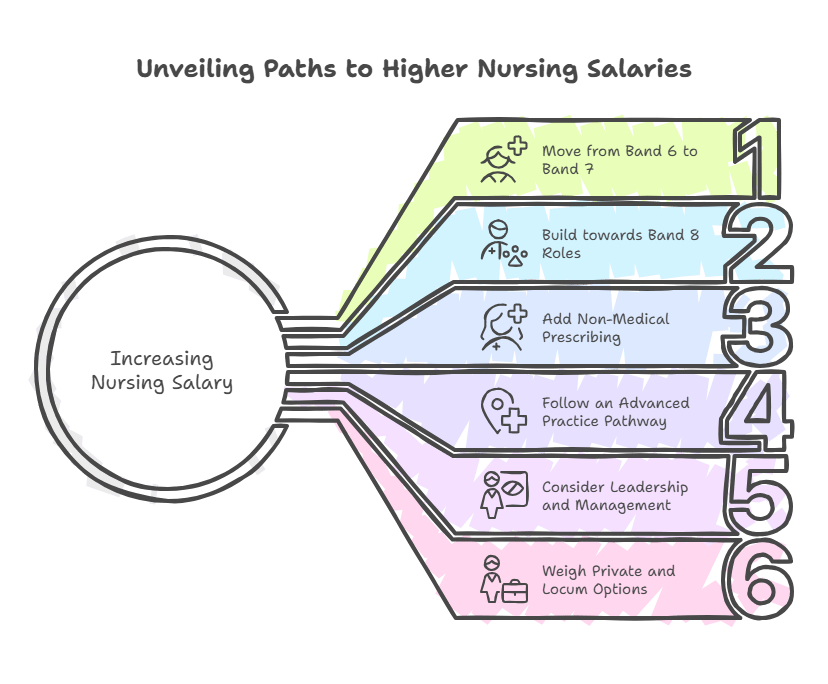
How to Increase Your Nursing Salary in the UK

The most reliable way to increase your nursing salary in the UK is to increase your scope of practice. Then move into roles with more autonomy, risk, and responsibility. That’s what bands reward.

How to Increase Your Nursing Salary in the UK

If you want a simple rule, here it is. Increase your scope, then match it to a role that rewards it. That’s how pay rises tend to happen in UK nursing.

CPD, Advanced Practice & Leadership Pathways That Lead to Higher Pay

Continuing professional development links directly to pay progression in UK nursing. Not because courses raise salaries on their own. Because they unlock roles with more scope and responsibility.

Prescribing qualifications

Non-medical prescribing opens access to senior clinical roles. It allows nurses to manage treatment independently. This matters most in primary care, mental health, and long-term condition services. Pay rises when prescribing becomes part of the role, not just a certificate.

Advanced clinical assessment

Advanced assessment skills support autonomous practice. They’re central to advanced nurse practitioner and senior specialist roles. When nurses assess, diagnose, and plan care independently, bands usually increase. Responsibility drives pay.

Leadership and management training

Leadership training supports progression into Band 7 and Band 8 roles. It prepares nurses to lead teams, manage services, and oversee quality. These roles pay more because they carry accountability for people and performance.

Master’s-level study

Many higher-paid roles expect postgraduate study. Often at Master’s level. This underpins advanced practice, consultant roles, and senior leadership posts. The qualification itself doesn’t raise pay. The role it enables does.

CPD works best when it’s purposeful. Choose development that matches the role you want next. That’s how learning translates into higher pay in UK nursing.

Summary & Key Takeaways for Nurses and Learners

  • Higher nursing pay in the UK links to responsibility, not job titles alone.
  • Roles at Band 7 and above usually mark the shift into higher pay.
  • Advanced practice increases pay when it brings autonomy and clinical authority.
  • Leadership and management roles pay more because they carry accountability.
  • Specialist roles earn more when they include senior or advisory responsibility.

If you’re planning your next step, focus on building scope, confidence, and leadership. That’s what turns nursing experience into long-term progression and stronger pay in the UK.

Nursing Assistant Level 3 Diploma
Learn to promote Nursing Assistant Level 3 Diploma!

Frequently Asked Questions

What is the highest-paid nursing job in the UK?

The highest-paid nursing job in the UK is Director of Nursing. These roles usually sit at Band 9 or equivalent and carry organisation-wide responsibility for clinical quality, workforce strategy, governance, and patient safety across NHS trusts or large healthcare providers.

Band 9 earns the most within the NHS. These roles involve executive leadership, strategic decision-making, and accountability at trust or system level rather than frontline clinical work.

A Level 7 nurse usually refers to a Band 7 role. These posts involve advanced practice, specialist leadership, or service management, with pay reflecting autonomy and responsibility rather than length of experience.

Specialist nurses are paid more only when the role includes senior responsibility. Clinical Nurse Specialist or lead specialist roles at Band 7 or above earn more because they advise, lead, and shape services.

Private nurses can earn more in some senior or specialist roles, but pay varies widely and often comes with fewer benefits, less job security, and weaker progression structures than NHS roles.

Adult nurses usually start at Band 5 in the NHS. Pay increases as nurses move into senior, specialist, or leadership roles with greater responsibility.

Nurse bands link pay to responsibility, autonomy, and leadership under the Agenda for Change framework. Progression depends on role scope, not time served.

Nursing jobs paying over £50,000 are usually at Band 8 or above, including senior leadership, advanced practice, consultant, and executive nursing roles.

CPD increases nursing salary when it leads to higher-band roles. Prescribing, advanced practice, and leadership training unlock posts with greater responsibility and pay.

There is no single average nurse wage that reflects reality. Pay varies by band, role, location, and responsibility, making averages unreliable.

No nursing specialty pays the most by default. Senior or lead roles within specialties earn more because of responsibility, not the specialty itself.

Nurse bands run from Band 5 to Band 9. Band 5 covers entry-level registered nurses, while Band 9 covers executive nursing leadership.

Reaching Band 7 depends on skills, experience, and role progression. There is no fixed timeframe, and advancement is not automatic.

Management roles are often better paid because they involve staff, service, and budget responsibility, though advanced clinical roles can reach similar pay levels.

Prescribing qualifications, advanced practice training, leadership development, and Master’s-level study increase pay fastest when they lead directly to higher-band roles.

Recent Blogs

5 Skills Every UK Care Employer Wants (and How to Prove You Have Them)

5 Skills Every UK Care Employer Wants (and How to Prove You Have Them)

UK care employers do not hire based on good intentions. Under CQC Regulation 18, they must evidence staff competence at every inspection. This guide covers the 5 skills every UK adult social care employer screens for, why each one has a regulatory basis, and how to prove yours through your CV, interview, the Care Certificate, and workplace evidence.

CQC Standards and Training What Care Staff Need to Know in 2026

CQC Standards and Training: What Care Staff Need to Know in 2026

CQC does not publish a mandatory training list. Under Regulation 18, every registered provider must ensure staff are demonstrably competent, properly inducted, and continuously supported. This guide explains the legal basis for training in 2026, the 16 Care Certificate standards, Oliver McGowan Mandatory Training, training matrices, and the competence evidence CQC inspectors look for.