




🌷Spring Sale! Get any Course for £11.99 Only!
Offer ends soon! 00 : 00 : 00
Use Coupon Code 👇
SPRING98
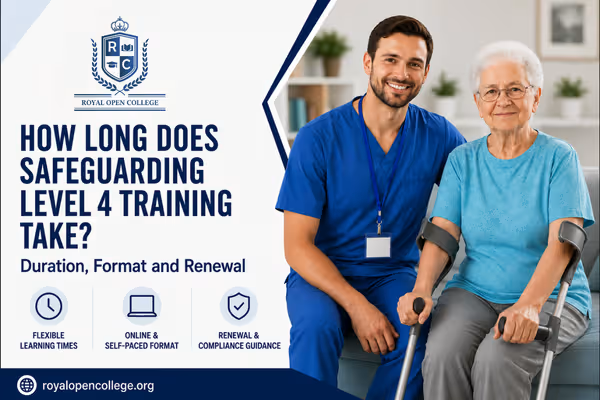
How Long Does Safeguarding Level 4 Training Take Duration, Format and Renewal

How Long Does Safeguarding Level 4 Training Take? | Duration, Format and Renewal

Level 4 safeguarding training takes 1 to 2 days in instructor-led settings or 7 to 40 hours online. The intercollegiate framework, not commercial providers, sets the standard for named professionals. This guide covers how duration varies by format, why the 3-year renewal figure is accurate, and what to check with your ICB before booking. Built on ICD 2025 and RCN

A named nurse at an NHS trust steps into the role on a Monday. By Thursday, her line manager asks when she plans to book Level 4 training. She searches online. Answers range from one day to six weeks, with no explanation for the gap.

Safeguarding Level 4 training takes 1 to 2 days in instructor-led settings, or 7 to 40 hours online, depending on format and provider. Your role, sector, and employer requirements shape the final answer.

The standard governing Level 4 in UK healthcare comes from the intercollegiate safeguarding framework, produced jointly by NHS royal colleges and professional bodies. This guide gives you the complete picture before you book. Learners comparing course options can review Safeguarding Level 4 training to understand how Level 4 CPD content is structured before checking suitability with their employer.

TL;DR: Quick Answer

Before reading further, here are the key facts:

  • Online self-paced: 7 to 40 hours, depending on provider and course depth
  • Classroom or virtual instructor-led: 1 to 2 days (6 to 12 contact hours)
  • Blended delivery: pre-learning modules combined with a half or full interactive day
  • Renewal: every 3 years as a minimum, with annual CPD updates between refreshers
  • Who needs Level 4: named professionals and designated safeguarding leads in NHS and social care settings, not general workforce staff
What Is Safeguarding Level 4 and Who Is It For?

What Is Safeguarding Level 4 and Who Is It For?

Level 4 safeguarding training is a competency tier within the intercollegiate safeguarding framework. The framework is produced jointly by NHS royal colleges and professional bodies, including the Royal College of Nursing (RCN), the Royal College of Paediatrics and Child Health (RCPCH), and the Royal College of General Practitioners (RCGP). The framework sets out the knowledge, skills, and behaviours expected of healthcare staff at each level of safeguarding responsibility.

Safeguarding Level 4 is not a qualification. Searching for a “Level 4 safeguarding qualification” returns vocational diplomas from the Regulated Qualifications Framework (RQF). These are entirely separate from the intercollegiate competency standard. Many practitioners confuse the two.

The intercollegiate Level 4 is a professional standard, not a formal academic award. Booking an RQF diploma when your employer requires intercollegiate Level 4 training creates a compliance gap, not a solution.

Level 4 applies to staff who hold named or lead safeguarding roles within their organisations. These roles carry specific safeguarding accountability beyond general clinical practice.

Named and lead roles at Level 4 include:

🛡️
Named nurse for safeguarding (children and adults)
👨‍⚕️
Named doctor for safeguarding
🤱
Named midwife for safeguarding
🏥
Named GP for safeguarding (England)
🚑
Named health professional in ambulance organisations
🧠
Specialist child psychologists and child psychiatrists in mental health trusts
🤝
Social care safeguarding leads with equivalent named responsibilities
⚠ Important Clarification

One clarification from the RCGP Safeguarding Standards published in October 2024: GP practice safeguarding leads do not need Level 4 training. They need Level 3. Level 4 applies only to GPs and nurses holding strategic named or designated roles. Booking Level 4 without checking your role requirements wastes time and creates no compliance benefit.

Children vs Adults: Are These Different Frameworks?

Two separate intercollegiate documents govern safeguarding training in the UK. For children, the current authority is the ICD 2025, published by RCPCH as the 5th edition, replacing the 2019 version entirely. For adults, the current authority is Adult Safeguarding: Roles and Competencies for Health Care Staff, 2nd edition, published by the RCN in 2024. Both documents use the Level 4 designation for named professional roles. Some practitioners, including named nurses and named midwives, need to meet competencies across both frameworks. Check your job description and your ICB requirements before booking to confirm which applies.

How Long Does Safeguarding Level 4 Training Take?

Safeguarding Level 4 training does not have a single fixed duration. The intercollegiate framework sets competency outcomes for named professional roles. Providers design courses to meet those outcomes. Duration varies based on course design, not regulatory prescription.

Here is the breakdown by format:

Format Typical Duration Key Notes
Online self-paced 7 to 40 hours Duration depends on provider depth, scenario content, and assessment complexity. Not all online formats meet the intercollegiate participatory requirement.
Classroom instructor-led 1 to 2 days Typically 6 to 12 contact hours. Face-to-face delivery with group work and case study discussion.
Virtual instructor-led (live) 1 to 2 days Delivered live via video platform with interactive sessions and peer discussion. Meets participatory standards when designed correctly.
Blended Varies Pre-learning modules (typically 2 to 6 hours) combined with a half or full live interactive day.

The intercollegiate framework requires at least 50% of safeguarding education and training to be participatory. Participatory means interactive. Passive reading or click-through eLearning does not meet this standard in most NHS and social care settings.

A self-paced online course where the learner reads content and answers questions without peer discussion or group work falls short of what many employers and ICBs expect at Level 4.

NSPCC Learning, one of the most widely recognised providers of Level 4 training in the UK, delivers Level 4 exclusively through live virtual sessions or in-person formats. This reflects the participatory requirement in the intercollegiate framework directly.

Level 4 training runs longer than Level 3 because the competency demands are greater. The named professional role requires the ability to advise colleagues, contribute to multi-agency processes, lead safeguarding governance, and deliver training within the organisation. A half-day programme rarely covers this depth adequately.

Why Does Duration Vary So Much Between Providers?

No regulatory body mandates a specific number of hours for Level 4 training. Provider duration reflects course design choices, including the depth of scenario-based work, the number of case studies, assessment methods, and whether the course addresses children and adults content separately. Shorter courses are not automatically weaker.

A well-designed blended programme with strong pre-learning and a full interactive day often meets competency outcomes effectively. Before booking, ask the provider how their course maps to the ICD 2025 for children or the RCN Adults ICD 2024. Your ICB or employer sometimes sets minimum hour expectations for the named role, so confirm this before comparing providers on duration alone.

Does Format Affect Whether the Training Is Accepted?

The format of your Level 4 safeguarding training directly affects whether your employer or Integrated Care Board (ICB) will accept the certificate. This is a practical compliance point most pages on this topic do not address.

The intercollegiate framework sets competency outcomes, not delivery format. The framework does not ban online delivery. What the framework requires is at least 50% participatory training. An ICB or NHS trust interpreting this standard for named professional roles will often require live interactive or face-to-face delivery as the minimum acceptable format.

In NHS settings, ICBs set local training expectations for the organisations they fund. Some ICBs publish approved training lists or specify minimum delivery standards for Level 4 named roles. A self-paced online course from a commercial provider might not appear on your ICB’s approved list, even if the provider markets the course as Level 4.

Consider this scenario. A named nurse new to a trust books a self-paced online Level 4 course lasting 14 hours. At her annual appraisal, the trust’s safeguarding team reviews the certificate and finds the delivery format does not meet their multi-agency participatory requirement. She needs to repeat the training. This situation is more common than provider websites acknowledge.

Before booking Level 4 training, check the following and compare it with when Level 4 safeguarding training is needed

1
Your ICB's safeguarding training guidance or approved provider list
2
Whether your trust accepts online-only delivery for your specific named role
3
How the provider's course meets the intercollegiate participatory requirement
4
Whether the course covers children, adults, or both, based on your role
Checking these four points before booking takes under 30 minutes. The consequences of getting it wrong cost significantly more.

How Often Does Level 4 Safeguarding Training Need to Be Renewed?

Level 4 safeguarding training requires renewal every 3 years as a minimum. This standard comes from the intercollegiate safeguarding framework, not from individual training providers. Between full refreshers, annual CPD updates are expected as part of maintaining named professional competence.

Important: Several online sources, including the AI-generated overview currently appearing in Google search results for this topic, state a renewal figure of 1 to 2 years. This figure does not come from the intercollegiate document. The 1 to 2 year figure appears to originate from commercial training blogs and from the education sector standard, where Designated Safeguarding Leads in schools refresh every 2 years under Keeping Children Safe in Education (KCSIE).

The education sector standard and the NHS healthcare standard are different frameworks with different renewal cycles. Applying the school DSL cycle to a named NHS professional creates a compliance error that affects both the practitioner and the organisation.

In NHS healthcare settings, the renewal structure is:

Full refresher training
Every 3 years, aligning with NMC revalidation cycles
Annual appraisal review
Level 4 competencies and learning discussed at appraisal, as recommended by the ICD 2025
Ongoing CPD between refreshers
Safeguarding supervision, case discussion, reflective practice, multi-agency learning events, and learning from national or local case reviews all count toward maintaining competence
NMC revalidation — nurses
For nurses, participatory Level 4 training counts toward NMC revalidation CPD hours. NMC revalidation requires 35 hours of CPD over 3 years, with 20 of those hours participatory. A live instructor-led Level 4 course qualifies as participatory CPD.
A passive self-paced eLearning course does not. For GMC revalidation, check GMC-specific guidance directly, as requirements differ from NMC standards.
35 hrs
CPD / 3 yrs
20 hrs
participatory
GMC revalidation — doctors
For GMC revalidation, check GMC-specific guidance directly, as requirements differ from NMC standards.
Local requirements
Employer and ICB policy sometimes sets shorter renewal cycles for specific settings. Always check local requirements alongside the intercollegiate standard.
Is Safeguarding Level 4 Training a Legal Requirement?

Is Safeguarding Level 4 Training a Legal Requirement?

Level 4 safeguarding training is not directly required by law. No Act of Parliament prescribes safeguarding training hours or competency levels for named professionals. Getting this distinction right matters. Overclaiming legal status misleads employers and practitioners, and creates unnecessary confusion about where the real obligation lies.

Working Together to Safeguard Children 2023 is statutory guidance. The Care Act 2014 establishes safeguarding duties for adults at risk. Neither document specifies training levels or hours for individual named roles. Both place a duty on organisations to ensure staff are trained appropriately for their safeguarding responsibilities.

The intercollegiate framework defines what “appropriately trained” means in practice for each role group, including Level 4. This framework is professional guidance, not statute. In healthcare settings, NHS royal colleges, NHS England, and the CQC all treat compliance with the intercollegiate framework as the expected professional standard.

The Care Quality Commission inspects safeguarding under the CQC safeguarding quality statement within the Safe area of its Single Assessment Framework. Key Line of Enquiry S1 asks how systems, processes, and practices keep people safe from harm and abuse. Inspectors assess whether named or specialist safeguarding staff hold current and appropriate training for their role. A Level 4 gap for a named professional is a risk finding during CQC inspection, and one the organisation must address.

The accurate framing of the obligation: Level 4 training is required by professional standards, expected under the intercollegiate framework, and directly relevant to CQC inspection outcomes. For named professionals in NHS-funded services, this creates real and specific compliance pressure, even without a direct statutory duty.

Never assume the absence of a specific law makes training optional for these roles.

Level 3 vs Level 4: What Is the Difference?

Level 3 and Level 4 safeguarding training serve different roles with different accountability. Booking the wrong level is a common mistake, particularly among practitioners moving into named roles for the first time.

A practice nurse who identifies and refers safeguarding concerns during appointments needs Level 3. A named nurse who advises clinical staff across the organisation, contributes to serious case reviews, and leads safeguarding governance needs Level 4. The content overlaps in places. The responsibility does not.

The difference between Level 3 and Level 4 safeguarding is about role, accountability, and organisational function, not simply the depth of subject knowledge.

Feature Level 3 Level 4
Who needs it Registered clinical practitioners with direct safeguarding responsibilities Named professionals and designated safeguarding leads
Core responsibility Recognise, respond, and refer safeguarding concerns Advise, lead, govern, and train others on safeguarding
Accountability level Individual clinical Organisational and system-level
Typical duration Half day to 1 full day 1 to 2 days (classroom) or 7 to 40 hours (online)
Renewal Varies by sector (2 to 3 years) Every 3 years, with annual CPD between refreshers
Framework reference ICD 2025 and RCN Adults ICD 2024 ICD 2025 and RCN Adults ICD 2024
Revalidation Counts toward NMC/GMC CPD (participatory) Counts toward NMC/GMC CPD (participatory)

A practitioner should not self-select Level 4 based on personal interest or ambition. The role title in your contract and your employer’s training requirements determine the correct level. If your organisation has asked you to hold a named safeguarding role, your employer should confirm the level required in writing before you book.

If you are entering a named professional role for the first time, complete Level 3 before Level 4. The ICD 2025 confirms Level 4 builds directly on Level 3 competencies. Providers including NSPCC Learning require a valid Level 3 certificate as a prerequisite for Level 4 enrolment. Skipping Level 3 means starting Level 4 without the competency foundation the framework assumes you already hold.

Key Takeaways

  • Level 4 safeguarding training takes 1 to 2 days instructor-led or 7 to 40 hours online, depending on format and provider depth.
  • The intercollegiate framework sets competency outcomes for named professional roles, not a fixed number of hours. Duration follows course design, not regulatory prescription.
  • Renewal is required every 3 years as a minimum, with annual appraisal review and CPD activities expected between full refreshers. The 1 to 2 year figure found online reflects education sector standards, not NHS healthcare requirements.
  • Online-only delivery does not always meet employer or ICB requirements at Level 4. At least 50% of training must be participatory under the intercollegiate framework. Confirm your format with your ICB before booking.
  • Level 4 is not a direct legal requirement, but creates real compliance pressure through professional standards and CQC inspection under Key Line of Enquiry S1. Named professionals in NHS-funded services without current Level 4 training create a risk finding for their organisation.
  • Named professionals and designated leads sit at Level 4. GP practice safeguarding leads require Level 3, not Level 4, per RCGP Safeguarding Standards published in October 2024.
  • The NHS safeguarding levels framework is currently governed by the ICD 2025 for children and the RCN Adults ICD 2024. Any source referencing the 2019 intercollegiate document for children or the 2018 adults edition is citing outdated guidance.

What to Do Next

Before booking Level 4 safeguarding training, work through these five steps:

1
Check your role title and job description against the ICD 2025 (children) or RCN Adults ICD 2024 to confirm Level 4 applies to your post.
2
Contact your ICB safeguarding team or trust training department to confirm whether online, blended, or face-to-face delivery is accepted for your specific named role.
3
Review your training records. A certificate older than 3 years requires renewal.
4
Confirm whether your role requires competencies in both the children and adults frameworks before selecting a course.
5
Ask any prospective provider how their course aligns with the current intercollegiate document before enrolling.
Level 4 safeguarding training is a professional standard with real compliance weight. Getting the format, timing, and framework right protects you, your role, and the people your organisation exists to safeguard.

FAQ

Q: Is safeguarding Level 4 training the same as a Level 4 qualification?

A: No. Level 4 safeguarding training is a competency tier within the intercollegiate safeguarding framework, produced by NHS royal colleges. A Level 4 qualification sits within the Regulated Qualifications Framework (RQF) as a formal vocational or academic award. These are entirely separate systems with no shared structure or mutual recognition.

A: Online delivery options exist for Level 4, but not all employers or ICBs accept online-only certificates for named professional roles. The intercollegiate framework requires at least 50% of training to be participatory and interactive. Before booking, confirm your employer's or ICB's specific requirements for your named role.

A: Refresher training is typically shorter than the initial course, often delivered as a one-day update or structured CPD event. Full renewal is required every 3 years in line with intercollegiate guidance, with annual appraisal review and ongoing CPD activities expected in between.

A: Children and adults safeguarding are governed by two separate intercollegiate documents. Some named professionals, including named nurses and named midwives, need to meet competencies under both frameworks. Check your job description and ICB requirements to confirm which documents apply to your specific role.

A: A named professional holds a safeguarding lead role within a single NHS provider organisation. A designated professional holds strategic safeguarding oversight across a system or ICB area. The ICD 2025 confirms these are distinct roles, requiring separate post holders to prevent conflicts of interest.

A: There is no statutory right to employer funding for Level 4 training. In NHS settings, ICBs often fund named professional training as part of their safeguarding governance obligations. Check with your line manager, HR department, or ICB safeguarding team to confirm what funding exists for your role.

A: Participatory Level 4 training counts toward NMC CPD hours within the 3-year revalidation cycle, which requires 35 hours total with 20 participatory hours. For GMC revalidation, check GMC-specific CPD guidance directly, as requirements differ from NMC standards.

A: Certificates are generally transferable between NHS employers. Some trusts and ICBs require in-house or locally approved delivery for named professional roles. Check what your new employer accepts before assuming an existing certificate from a previous post remains valid.

A: A lapsed Level 4 certificate creates a gap in professional standards compliance and a risk finding during CQC inspection. There is no individual criminal penalty, but holding a named safeguarding role without current training creates professional and organisational risk for both you and your employer. Renew promptly and document the gap in your CPD record.

A: Check your ICB safeguarding training guidance or approved provider list before selecting a provider. NHS trust training directories list locally approved options. For social care roles, BASW provides relevant guidance. NSPCC Learning is widely used in healthcare settings and maps courses directly to the intercollegiate framework.

A: The intercollegiate safeguarding framework is joint guidance from NHS royal colleges including the RCN, RCPCH, and RCGP. The ICD 2025 (children, published autumn 2025) and the RCN Adults ICD 2024 are the current editions. Level 4 training must align with this framework to meet NHS and CQC expectations for named professional roles.

Recent Blogs

What Is Designated Safeguarding Lead Training Level 5?

What Is Designated Safeguarding Lead Training Level 5?

Designated Safeguarding Lead Training Level 5 supports adults who lead or assist with safeguarding duties in UK settings. This guide explains what Level 5 CPD learning means, what learners cover, who it suits, and how it helps improve safer practice across education, care, health, and community roles.