What Is the 2025 Updated Care Certificate? Everything You Need to Know
What Is the 2025 Updated Care Certificate? Everything You Need to Know
The 2025 updated Care Certificate causes confusion across health and social care. This guide explains what people mean by “new,” what has actually changed, and how the Care Certificate still supports safe induction for care workers in England.
Many people now search for the “2025 updated Care Certificate.” The phrase sounds official, but it causes confusion. The Care Certificate still exists as an induction framework. It has not been replaced or relaunched as a brand-new programme.
What has changed is how learning resources support the Care Certificate and how it fits into wider workforce development. This guide explains what people mean by the “new” Care Certificate, what has actually changed, and what has stayed the same.
Why do people call it the “new” Care Certificate?
People use the term “new Care Certificate” for several reasons.
Health and social care continues to change. Care providers now place stronger focus on inclusive care, mental health, dementia, infection control, and digital learning tools. Learning resources that support the Care Certificate reflect these priorities more clearly than before.
At the same time, the Level 2 Adult Social Care Certificate launched as a regulated qualification. This new qualification draws on similar knowledge areas, which adds to the confusion. Many people assume the Care Certificate itself has changed or been replaced.
It has not.
Care Certificate Course – Standards (1 to 16)
Learn to promote Care Certificate Course – Standards (1 to 16)!
The Care Certificate is a set of standards used in England to support the induction of health and social care support workers. It helps new staff learn how to give safe, respectful, and compassionate care.
The Care Certificate is not a qualification. It does not award a formal certificate from an awarding body. Employers deliver and assess it in the workplace.
The Care Certificate supports the non-regulated workforce. This includes care assistants, support workers, and healthcare support workers.
What has actually changed?
The purpose of the Care Certificate stays the same. It supports safe and consistent care at the start of employment.
What has evolved is the focus of learning support.
Current Care Certificate resources place clearer emphasis on:
Learning disability and autism awareness
Mental health and dementia awareness
Infection prevention and control
Equality, inclusion, and dignity
Use of digital learning tools to support theory
These topics already sit within Care Certificate learning. They now receive clearer attention because care practice continues to evolve.
This reflects changes in care needs, not a new framework.
What has not changed?
Some things remain exactly the same.
The Care Certificate is not required by law
Employers decide who completes it
Assessment takes place in the workplace
Practical observation remains essential
Online learning supports knowledge only
Many employers aim to complete the Care Certificate during the first few months of work. This is guidance, not a legal rule.
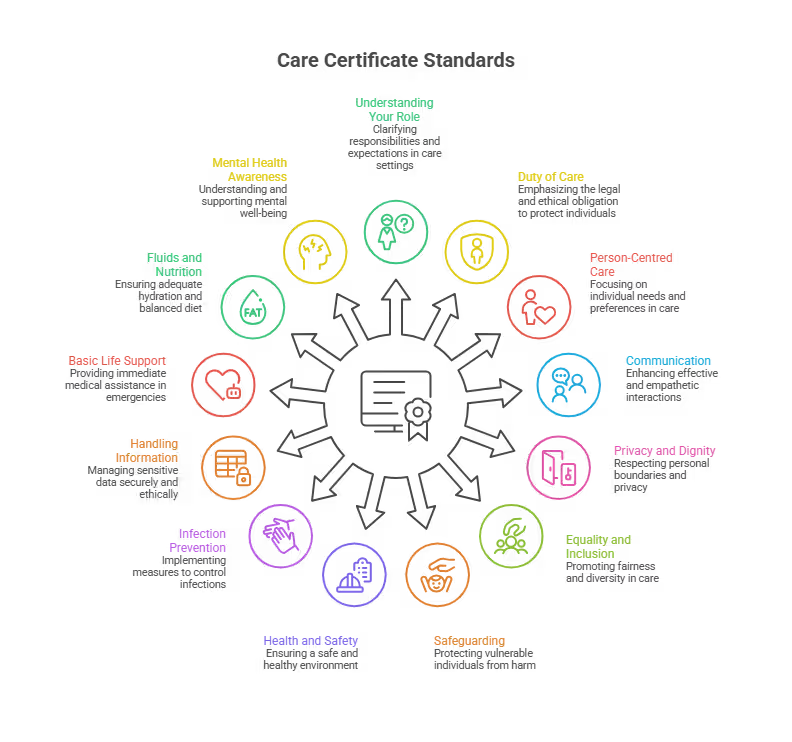
How many standards does the Care Certificate use?
Many current resources refer to 16 standards.
These standards cover the full range of core care knowledge and practice, including:
All standards must be completed before an employer signs off the Care Certificate.
Who the updated Care Certificate support?
The Care Certificate supports people who enter care roles without professional registration.
It usually applies to:
Care assistants
Support workers
Healthcare support workers
Social care support staff
Registered professionals, such as nurses or doctors, do not need to complete it. Their professional training already covers these areas.
Employers decide how the Care Certificate fits into their induction process.
Care Certificate vs Level 2 Adult Social Care Certificate
This comparison causes the most confusion.
The Care Certificate:
Supports workplace induction
Is not a qualification
Focuses on safe practice at work
The Level 2 Adult Social Care Certificate:
Is a regulated qualification
Is delivered by training providers
Formalises learning with assessment
The two are linked by subject matter, not purpose. One supports starting work. The other supports recognised learning and progression.
Where CPD courses fit?
The Care Certificate supports the start of a care role. CPD learning supports growth after induction.
CPD courses help care workers:
Deepen understanding
Build confidence
Strengthen safe practice
Prepare for further learning
CPD does not replace the Care Certificate or regulated qualifications.
Royal Open College offers CPD health and social care courses that support learners alongside induction and ongoing development. These courses focus on practical understanding and flexible learning for people already working in care.
Common misunderstandings about the “new” Care Certificate?
Many people misunderstand the changes. Here are the facts.
The Care Certificate has not been replaced
It is not mandatory by law
Online courses alone cannot award it
There is no confirmed nationwide relaunch
It remains an induction framework, not a qualification
Understanding these points helps learners and employers make informed decisions.
What learners and employers should focus on?
The Care Certificate continues to play a key role in safe care. It helps new staff start work with clear standards and shared expectations.
The focus should stay on:
Safe and compassionate care
Clear induction processes
Ongoing learning and development
When learners understand how the Care Certificate, qualifications, and CPD fit together, they build stronger and more confident care careers.
Why does this guide matter?
The term “2025 updated Care Certificate” creates noise. Clear information cuts through it.
This guide explains what has changed, what has not, and how the Care Certificate fits into today’s care workforce. That clarity helps learners, employers, and providers move forward with confidence.
Care Certificate Course – Standards (1 to 16)
Learn to promote Care Certificate Course – Standards (1 to 16)!
Protecting adults from harm starts with understanding the legal responsibilities behind everyday care. Those responsibilities vary across the UK, and several laws can apply to the same situation. Knowing how they fit together helps you make sense of your role. Explore the main legislation and what it means for safeguarding decisions in your workplace.
What makes an adult vulnerable is not always obvious from their age or diagnosis. Understanding their situation means looking at the support they need and the challenges they face in protecting themselves from abuse or neglect. Explore how these factors shape vulnerability, why individual circumstances matter and what this means for recognising concerns in adult safeguarding.
Abuse can take different forms and recognising the differences makes safeguarding concerns easier to understand. Child safeguarding commonly groups abuse into physical, emotional and sexual abuse, alongside neglect. These categories can overlap and appear in different settings. This guide explains what each type means and how to recognise important warning signs in everyday safeguarding practice.