Level 3 safeguarding training is advanced, role-specific learning for designated safeguarding leads, managers, and senior practitioners in the UK. It covers legislation, managing disclosures, making referrals, and multi-agency working across health, education, and care settings.
Level 3 safeguarding training is advanced, role-specific learning for professionals with designated safeguarding responsibilities in the UK. It goes beyond basic awareness and equips practitioners to manage safeguarding concerns, lead referrals, and support multi-agency working. It applies across health, education, social care, and voluntary sector settings.
What Does “Level 3” Mean in Safeguarding?
The term “level” in safeguarding training is a sector convention in the UK. It is not a regulated qualification framework. Different organisations and sectors use level labels to describe the depth and role-focus of training.
The NHS, education sector, and social care all reference levels in their safeguarding frameworks, but the exact content and expectations differ between them. A Level 3 course for a school Designated Safeguarding Lead will look different from Level 3 training for a named nurse in an NHS trust. This is why the same label can mean different things in different settings.
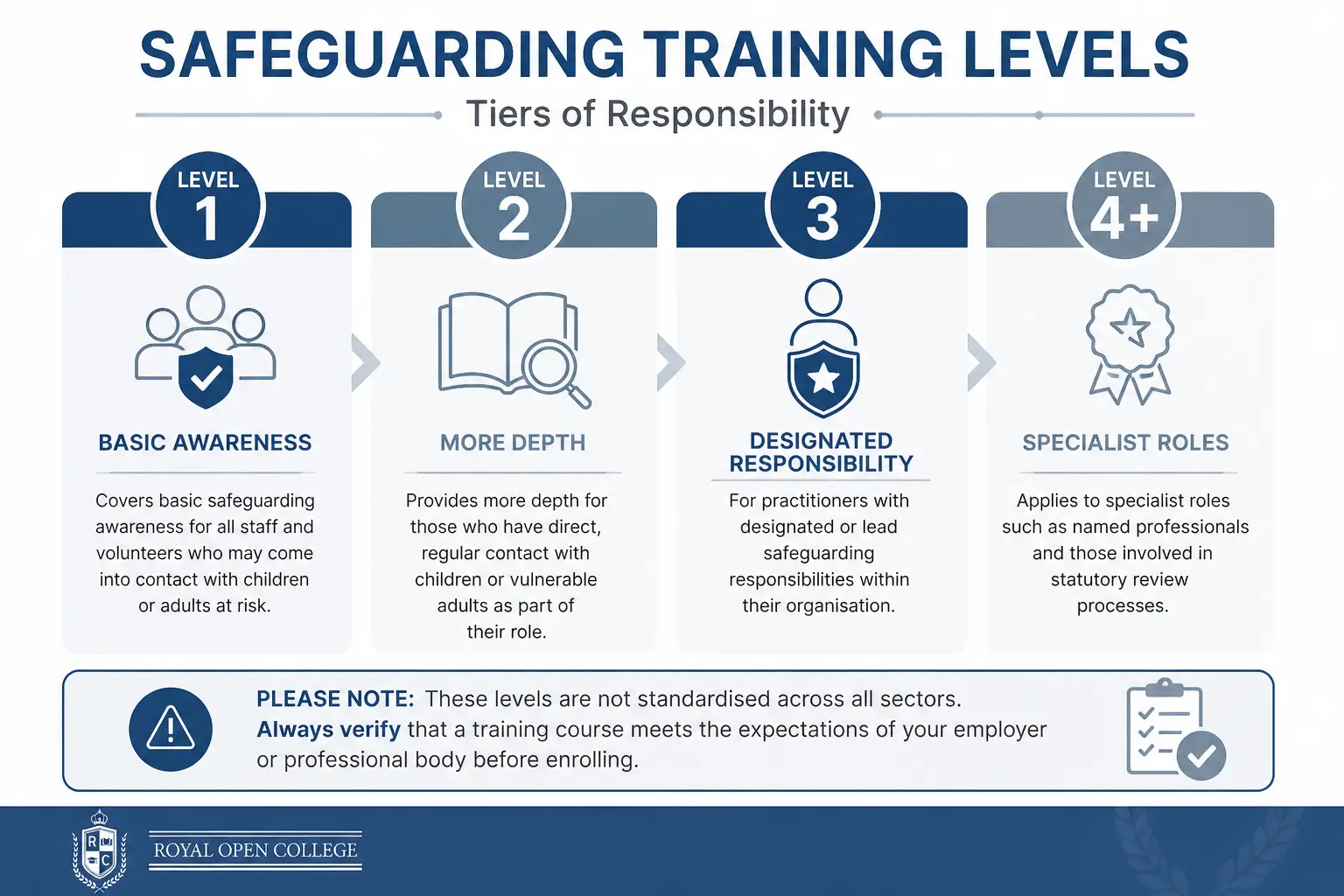
As a broad guide, the levels describe different tiers of responsibility:
Level 1 covers basic safeguarding awareness for all staff and volunteers who may come into contact with children or adults at risk.
Level 2 provides more depth for those who have direct, regular contact with children or vulnerable adults as part of their role.
Level 3 is for practitioners with designated or lead safeguarding responsibilities within their organisation.
Level 4 and above apply to specialist roles such as named professionals and those involved in statutory review processes.
Because these levels are not standardised across all sectors, always verify that a training course meets the expectations of your employer or professional body before enrolling.
Who Is Level 3 Safeguarding Training For?
Level 3 training is for practitioners whose role involves leading or managing safeguarding within their organisation. It is not aimed at all staff. It is designed for those who carry designated responsibility.
Designated Safeguarding Leads (DSLs) in schools, colleges, and early years settings hold statutory responsibilities under Working Together to Safeguard Children 2023. They need in-depth training to lead safeguarding policy and practice across their setting.
Named Nurses, Named Doctors, and Named Midwives in NHS trusts and health settings require advanced safeguarding knowledge aligned with intercollegiate frameworks for children and adults.
Managers and supervisors in adult social care need to understand the Care Act 2014, Making Safeguarding Personal, and how to lead safeguarding enquiries and referrals.
Designated Safeguarding Officers (DSOs) in charities and voluntary organisations carry lead responsibility for safeguarding within their teams and must demonstrate advanced competency.
Safeguarding leads in sports clubs and community organisations are increasingly expected to hold Level 3 training in line with guidance from national governing bodies.
If your role involves overseeing safeguarding referrals, managing disclosures, or holding formal responsibility for your organisation’s safeguarding policy, Level 3 training is likely relevant to you.
What Does Level 3 Safeguarding Training Cover?
While content varies between sectors, Level 3 training commonly covers the following core areas.
Legislation and statutory guidance. Practitioners develop understanding of key legislation relevant to their setting. This includes the Children Act 1989 and 2004, Working Together to Safeguard Children 2023, the Care Act 2014, and the Children and Social Work Act 2017. Training covers how this guidance applies in real practice.
Recognising abuse and neglect. Level 3 training builds on foundation knowledge. It covers physical abuse, emotional abuse, sexual abuse, neglect, domestic abuse, child sexual exploitation (CSE), child criminal exploitation (CCE), county lines, modern slavery, and radicalisation. Learners develop the ability to recognise patterns over time, not just respond to single incidents.
Managing disclosures. This is a core skill at Level 3. Learners develop the ability to receive and respond to disclosures from children or adults at risk in a safe, professional, and legally sound way. This includes knowing when to reassure, what not to promise, and how to document accurately.
Making referrals to statutory services. Level 3 equips practitioners to make effective referrals to children’s social care, adult safeguarding teams, and the police. This includes understanding thresholds for intervention and how to present information clearly and professionally.
Multi-agency working and information sharing. Safeguarding in the UK depends on collaboration. Level 3 training covers contributing to multi-agency meetings such as child protection conferences, strategy meetings, Multi-Agency Risk Assessment Conferences (MARACs), and safeguarding adults reviews. Learners also develop knowledge of UK GDPR principles as they apply in safeguarding contexts.
Managing allegations against staff. Senior practitioners and managers need to understand how to handle concerns raised about colleagues or adults in positions of trust. In England, this includes knowing when and how to make a referral to the Local Authority Designated Officer (LADO).
Implementing and reviewing safeguarding policies. Those in lead roles are often responsible for developing or reviewing their organisation’s safeguarding policies and procedures. Training covers what a robust policy needs to contain and how to keep it current.
Safeguarding in diverse settings and contexts. Advanced training addresses safeguarding across different settings and with specific groups, including Looked After Children, children with disabilities, unaccompanied asylum-seeking children, and adults with care and support needs.
What Level 3 Safeguarding Training Does Not Include
It is important to be clear about what Level 3 safeguarding training is and is not.
It is not a regulated qualification. It does not lead to a Level 3 Award, Certificate, or Diploma on the Regulated Qualifications Framework (RQF). A CPD training course and a regulated qualification are different things.
It does not guarantee compliance. Completing a Level 3 training course does not automatically mean your organisation or role meets all relevant regulatory requirements. Statutory safeguarding expectations for DSLs, NHS named professionals, and social workers are set by government guidance and sector regulators. Training supports your development toward those requirements, but your employer or professional body defines what is needed for your specific role.
It does not replace employer induction requirements. Organisations have their own induction and supervision processes for safeguarding. A training course supports but does not substitute for those processes.
If you are unsure whether a specific course meets the requirements of your role, check with your employer, line manager, or relevant professional body.
How Does Level 3 Differ from Level 1 and Level 2?
Level 1 gives all staff a baseline understanding of safeguarding. The focus is awareness. Staff learn what safeguarding means, what abuse looks like in broad terms, and what to do if they have a concern.
Level 2 deepens this for people who work directly with children or adults at risk. The focus shifts to recognition and response. Practitioners develop the ability to spot signs of concern and understand their responsibilities more clearly.
Level 3 changes the nature of the learning. The focus becomes leadership, decision-making, and accountability. Practitioners at this level lead their organisation’s safeguarding response. They make complex judgements, manage multi-agency processes, and take responsibility for outcomes.
The right level depends on your role and responsibilities, not just your experience or time in the sector.
Does Level 3 Safeguarding Training Need to Be Refreshed?
Safeguarding knowledge must stay current. Legislation, guidance, and practice change over time. New serious case reviews and child safeguarding practice reviews produce new learning. Sector guidance is updated to reflect this.
How often Level 3 training needs renewal depends on your sector and employer. Some organisations require annual updates or refresher training. The RCGP safeguarding standards for general practice, for example, require annual safeguarding updates for Level 3 staff. Keeping Children Safe in Education expects DSLs to refresh their training at least every two years.
Always check the expectations set by your employer and any relevant sector guidance. Do not rely solely on a certificate expiry date.
Where Is Level 3 Safeguarding Training Used in the UK?
Level 3 training applies across a wide range of UK settings.
Education. DSLs in schools, colleges, and early years settings are expected to hold in-depth safeguarding training to fulfil their statutory responsibilities. Keeping Children Safe in Education 2024 sets out the specific expectations for this role.
Health and social care. NHS staff in named roles and social care managers use Level 3 training to meet expectations set by intercollegiate safeguarding frameworks. Professional bodies including the RCGP and Royal College of Nursing publish detailed standards for this level of training.
Voluntary and sports sectors. Managers, coaches, and safeguarding officers in charities and sports clubs are expected to hold Level 3 training in line with guidance from funders, commissioners, and national governing bodies.
Common Misunderstandings About Level 3 Safeguarding Training
Level 3 means the same thing everywhere. It does not. The levels are a convention, not a standardised national framework. Always read a course’s aims and objectives and check them against your sector’s guidance.
Completing a Level 3 course makes you a safeguarding lead. It does not. The safeguarding lead role is assigned by your employer. Training develops your knowledge to carry out that role more effectively.
A CPD course and a qualification are the same thing. They are not. CPD-accredited training supports professional development. A regulated qualification involves external assessment by a regulated awarding body. These serve different purposes.
Once trained, you are trained for life. Safeguarding is an evolving practice area. Training needs regular renewal to remain current and effective.
Studying Through Royal Open College (CPD Learning)
Royal Open College offers a Safeguarding Level 3 CPD course for professionals looking to develop their knowledge in child protection and safeguarding practice. The course covers child development, recognising and responding to abuse, multi-agency working, safeguarding legislation, supporting vulnerable adults, and managing safeguarding concerns across diverse settings.
It is CPD-accredited and fully online, with 12 months of access and a self-paced format. This makes it practical for working professionals who want to build on their safeguarding understanding in a structured way.
The course supports continuing professional development. It is not a regulated qualification. Learners should verify whether their employer or regulatory body has specific training requirements for their role before enrolling.
Quick Recap
Level 3 safeguarding training is advanced, role-specific CPD for designated safeguarding leads, managers, and senior practitioners in UK health, education, and care settings.
It covers legislation, recognising abuse, managing disclosures, making referrals, multi-agency working, and implementing safeguarding policy.
Requirements and renewal expectations vary by sector and employer. Always check what your professional body or organisation requires for your specific role.
This article is for informational purposes only. Safeguarding training requirements vary by role and sector. Always consult your employer or relevant professional body for guidance specific to your situation.
Protecting adults from harm starts with understanding the legal responsibilities behind everyday care. Those responsibilities vary across the UK, and several laws can apply to the same situation. Knowing how they fit together helps you make sense of your role. Explore the main legislation and what it means for safeguarding decisions in your workplace.
What makes an adult vulnerable is not always obvious from their age or diagnosis. Understanding their situation means looking at the support they need and the challenges they face in protecting themselves from abuse or neglect. Explore how these factors shape vulnerability, why individual circumstances matter and what this means for recognising concerns in adult safeguarding.
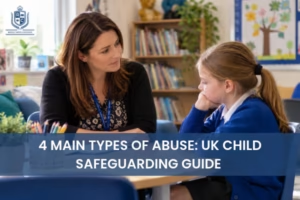
Abuse can take different forms and recognising the differences makes safeguarding concerns easier to understand. Child safeguarding commonly groups abuse into physical, emotional and sexual abuse, alongside neglect. These categories can overlap and appear in different settings. This guide explains what each type means and how to recognise important warning signs in everyday safeguarding practice.