The Care Certificate is an employer-led induction for new care workers in England. It covers 16 standards since the 2025 update. Your employer must sign it off. It is not a qualification. CPD study supports the knowledge part of your induction.
The Care Certificate is a workplace induction framework for care workers in England. It covers 16 standards since the 2025 update. You build your knowledge, prove your skills at work, and your employer signs it off.
What Is the Care Certificate?
Skills for Care, Skills for Health, and Health Education England built the Care Certificate together. They launched it in 2015. It grew from the Cavendish Review, which examined how care assistants and support workers were trained.
Before 2015, two older frameworks existed. The Care Certificate replaced both. It pulled everything into one clear induction for the non-regulated care workforce.
Many care workers in England do not register with a professional body. The Care Certificate gives them a shared base of skills and knowledge. It shows employers, families, and regulators that new staff can deliver safe and compassionate care from day one.
It is not a qualification. No awarding body issues it. It carries no RQF level. Your employer creates the record and holds it.
Care Certificate Course – Standards (1 to 16)
Learn to promote Care Certificate Course – Standards (1 to 16)!
The Care Certificate targets new and unregistered workers in health and social care in England. It suits people who are new to care or who have not finished an equivalent induction before.
Roles that need it include care assistants and support workers in residential and nursing homes, home care and domiciliary care workers, healthcare assistants in NHS and private hospitals, personal assistants employed directly by individuals, and volunteers, kitchen staff, porters, and cleaners with direct contact with service users. It also applies to people moving into care from other industries.
Workers who already show competency across all 16 standards may skip parts of the process. Employers use a mapping tool to find any gaps. Only those gaps need addressing.
Requirements vary by role and setting. Confirm with your employer what applies to you.
The Care Certificate applies in England only. Scotland, Wales, and Northern Ireland each run their own induction frameworks.
What Are the 16 Care Certificate Standards?
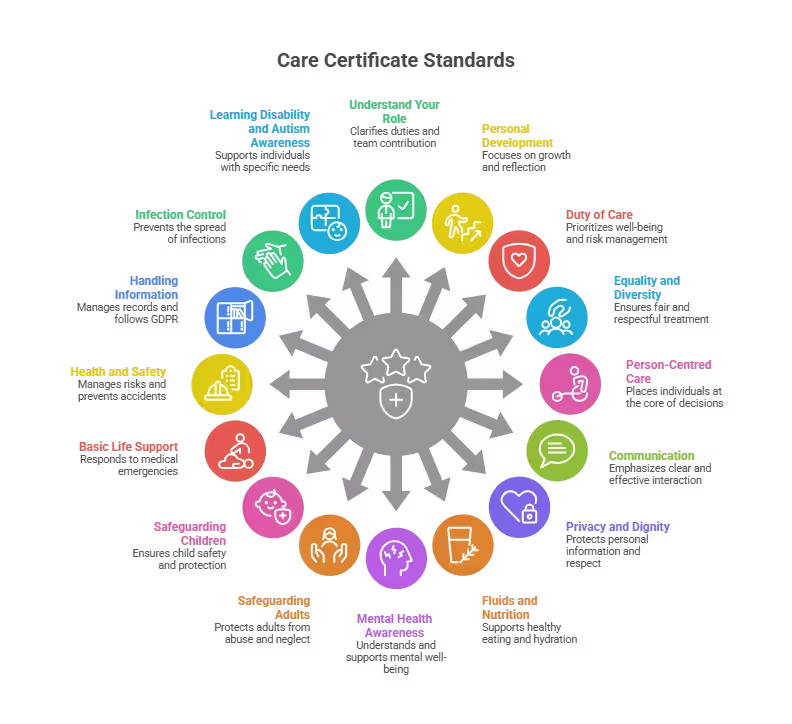
The 2025 update raised the total to 16 standards. Each one has a knowledge part and a competency part. You must meet both before sign-off.
Standard 1: Understand Your Role You learn your duties, your boundaries, and how your role supports the wider care team.
Standard 2: Your Personal Development You create a Personal Development Plan and build habits of reflection and growth.
Standard 3: Duty of Care You act in the best interests of the people you support. You manage risk and raise concerns when needed.
Standard 4: Equality and Diversity You treat every person fairly and with respect. You understand protected characteristics and remove barriers to care.
Standard 5: Work in a Person-Centred Way You place the individual at the heart of every decision. You support their independence, dignity, and choices.
Standard 6: Communication You communicate clearly through words, body language, and written records. You listen well and share information across the care team.
Standard 7: Privacy and Dignity You protect personal information and treat every person with dignity in every interaction.
Standard 8: Fluids and Nutrition You help individuals access food and drink that meets their needs. You spot signs of poor nutrition or dehydration.
Standard 9: Awareness of Mental Health, Dementia, and Learning Disabilities You understand how these conditions affect people. You provide tailored, compassionate support in everyday care.
Standard 10: Safeguarding Adults You spot signs of abuse or neglect in adults. You follow your organisation’s reporting and escalation procedures.
Standard 11: Safeguarding Children You understand child protection responsibilities. You report concerns and create safe environments for children.
Standard 12: Basic Life Support You respond to medical emergencies. You know core CPR steps, the recovery position, and immediate first response actions.
Standard 13: Health and Safety You assess risks, handle equipment correctly, use PPE, and respond to accidents and incidents.
Standard 14: Handling Information You manage personal records with care, follow GDPR rules, and document accurately.
Standard 15: Infection Prevention and Control You follow hygiene protocols, prevent cross-contamination, and manage waste correctly.
Standard 16: Awareness of Learning Disability and Autism (added March 2025) You support individuals with learning disabilities and autism through person-centred approaches. You adapt your communication and promote their independence.
What Does the Sign-Off Process Involve?
The sign-off process has two parts: knowledge and competency.
For the knowledge part, you complete workbooks or written answers for each standard. Questions use prompts like “describe”, “explain”, or “identify”. Some employers use online learning to support this. You record answers in a workbook or digital portfolio.
For the competency part, your employer or a workplace assessor watches you work. They confirm you apply your knowledge in real care situations. If a relevant situation does not come up at work, some employers use role play to fill the gap.
The assessor is a line manager, senior carer, or trained workplace assessor. Before signing off, they check five things about your evidence.
It is authentic. You produced it yourself. It is valid. It links to the standard being assessed. It is current. It reflects your skills right now. It is sufficient. It fully covers the standard. It is reliable. It genuinely shows what you know and can do.
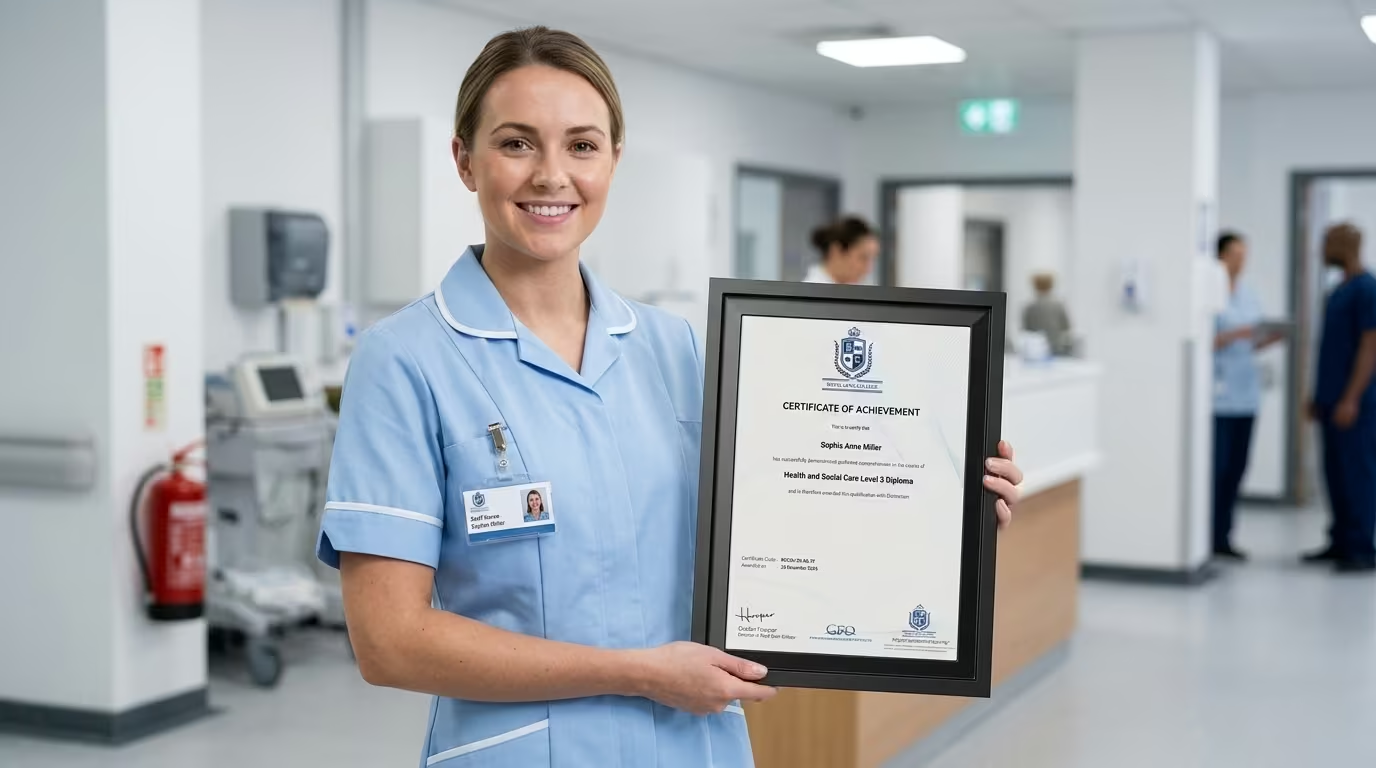
When all 16 standards are signed off, your employer awards the Care Certificate. Many use the national certificate template from Skills for Care to print a copy for you.
How Long Does It Take to Complete?
Skills for Care sets no fixed deadline. Most employers aim to wrap up the process within 12 weeks of a new starter joining.
The knowledge element takes around 12 to 13 hours online. The full timeline depends on when your employer can schedule workplace observations.
Your prior experience, your learning pace, and your employer’s induction structure all shape the timeline. Someone new to care may use the full 12 weeks. Someone returning to the sector may move faster.
Is the Care Certificate a Legal Requirement?
The Care Certificate is not a legal requirement. No legislation mandates it.
The Care Quality Commission expects registered providers in England to use it. CQC updated its position statement in December 2022. It confirmed it supports and expects the Care Certificate across health and social care. CQC examines it under the safe key question, focusing on staffing quality.
A provider without a structured induction process faces scrutiny during inspection. The absence of a Care Certificate does not break a specific regulation. But it raises concerns about workforce competency.
Most care employers treat it as a standard requirement for all new frontline staff.
Can You Complete the Care Certificate Entirely Online?
Online learning covers the knowledge part only. It does not replace workplace assessment or employer sign-off.
To receive a completed Care Certificate, your employer must observe your practice in a real care setting. They confirm you meet each of the 16 standards. Without this, the process stays incomplete.
Many employers use a blended approach. Learners complete online modules for the theory and workplace observations for the practical part. This is the most common model across care providers in England.
Some employers use free elearning from the NHS elearning for healthcare platform. Others use CPD-accredited training from third-party providers. Either way, employer-led assessment must follow.
Some providers describe their online courses in ways that suggest you walk away with a completed Care Certificate. This is misleading. Online training prepares you. Only your employer completes the award.
Does the Care Certificate Expire?
The Care Certificate carries no expiry date. It is portable. You take it from one employer to another without restarting from scratch. A new employer can accept your existing certificate if they trust your knowledge and skills remain current.
Skills for Care recommends refreshing key areas, especially safeguarding, on a regular basis. Many employers require annual refresher training on specific standards regardless of whether the Care Certificate is already complete.
If you leave the care sector for a long period, your new employer may ask you to show your competency again before relying on a previous certificate.
What Changed in the 2025 Care Certificate Update?
The Care Certificate gained a 16th standard in March 2025: Awareness of Learning Disability and Autism.
This standard equips care workers to communicate with and support individuals with learning disabilities and autism. It covers communication adjustments, sensory needs, and approaches that respect each person’s rights and promote their independence.
Skills for Care, NHS England, and the Department of Health and Social Care are updating digital elearning resources to reflect the new standard. Until those updates launch, workers should use existing resources alongside any updated guidance from their employer.
Any training resource that still lists only 15 standards is out of date. Before enrolling in a preparation course, confirm it covers all 16 standards, including Standard 16.
Common Misunderstandings About the Care Certificate
The biggest confusion is calling the Care Certificate a qualification. It is not. It carries no RQF level. No awarding body issues or verifies it. Some training providers use language that implies learners walk away with a complete Care Certificate. They do not. What they provide covers the knowledge element. Employer sign-off still follows.
A second confusion is thinking CQC legally requires it. CQC does not enforce a legal mandate. It expects it as evidence of a safe induction. This matters for employers who worry that non-completion breaks a regulation. It does not, but it creates inspection concerns.
A third issue is the 15 versus 16 standards confusion. Many online providers, articles, and job descriptions still reference 15 standards. The March 2025 update raised this to 16. Any resource listing 15 is out of date.
Finally, many people assume the Care Certificate applies across the UK. It applies in England only.
What Can You Do After the Care Certificate?
The Care Certificate is a starting point for a career in health and social care. It opens the door to several progression routes.
Strong next steps include the Level 2 Diploma in Care and the Level 3 Diploma in Adult Care. Apprenticeships in adult care or healthcare support are also solid options. From there, many workers move toward senior care assistant, team leader, deputy manager, or registered manager roles.
Specialist CPD courses in areas like medication management, end of life care, dementia care, and mental health awareness deepen your expertise. They show employers you keep growing professionally.
The Care Certificate tells employers you completed a structured induction. It shows you can deliver safe, person-centred care. It is a foundation, not a ceiling.
Studying Through Royal Open College (CPD Learning)
Royal Open College offers a Care Certificate preparation course covering all 16 updated standards. This includes Standard 16 on autism and learning disability awareness, added in 2025.
The course is CPD-accredited and aligns with Skills for Care, Skills for Health, and Health Education England guidance. It supports the knowledge elements of your workplace induction. You study each of the 16 standards at your own pace, before and during your employer-led assessment.
Two bonus courses come included: Observational Skills for Carers and Document Control for Care Workers. Both build skills you use every day in a care setting.
This is a CPD learning resource, not a qualification. It does not replace the workplace sign-off your employer carries out. It is a flexible study tool for new starters, career changers, and experienced care workers refreshing their knowledge.
Quick Recap
The Care Certificate covers 16 standards since the March 2025 update. Standard 16 focuses on autism and learning disability awareness.
It is not a qualification. No awarding body issues it. Your employer awards it through workplace assessment and sign-off.
Online CPD learning builds your knowledge across all 16 standards. It does not replace the employer-led competency assessment that must happen at work.
Care Certificate Course – Standards (1 to 16)
Learn to promote Care Certificate Course – Standards (1 to 16)!
Protecting adults from harm starts with understanding the legal responsibilities behind everyday care. Those responsibilities vary across the UK, and several laws can apply to the same situation. Knowing how they fit together helps you make sense of your role. Explore the main legislation and what it means for safeguarding decisions in your workplace.
What makes an adult vulnerable is not always obvious from their age or diagnosis. Understanding their situation means looking at the support they need and the challenges they face in protecting themselves from abuse or neglect. Explore how these factors shape vulnerability, why individual circumstances matter and what this means for recognising concerns in adult safeguarding.
Abuse can take different forms and recognising the differences makes safeguarding concerns easier to understand. Child safeguarding commonly groups abuse into physical, emotional and sexual abuse, alongside neglect. These categories can overlap and appear in different settings. This guide explains what each type means and how to recognise important warning signs in everyday safeguarding practice.