The Care Certificate is an employer-led framework for new NHS and social care staff. Your employer runs the programme, assesses your competency, and awards the certificate. You must meet all 16 national standards within 12 weeks. This guide explains how the process works and how CPD learning supports your journey.
The Care Certificate is completed through your employer, not through an external exam board or awarding body. Your NHS Trust or care provider runs the programme, supports your learning, and signs off each standard. You must meet all 16 national standards within 12 weeks of starting your role.
What Is the Care Certificate?
The Care Certificate is a national framework for health and social care support workers. Skills for Care, Skills for Health, and NHS England developed it jointly in 2015. Its origins lie in the Cavendish Review, which recommended a clear baseline standard for all new support workers entering the sector.
The framework sets out the essential knowledge, values, and practical skills every new support worker must demonstrate. It applies across NHS Trusts, community health services, residential care homes, and domiciliary care settings.
The Care Quality Commission (CQC) references the Care Certificate within its inspection framework. It describes the certificate as setting the standards for healthcare support worker induction and as forming the foundation for ongoing learning and development. Embedding the Care Certificate into staff induction is widely recognised as good practice by CQC.
One thing to understand from the outset: the Care Certificate is not a regulated qualification. It is an employer-led framework. No independent awarding body issues it directly to you. Your employer assesses your competence and awards it on their own authority.
Care Certificate Course – Standards (1 to 16)
Learn to promote Care Certificate Course – Standards (1 to 16)!
The Care Certificate applies to healthcare support workers (HCSWs) and healthcare assistants (HCAs) who are new to their role. It covers staff working in NHS Trusts, social care providers, community health teams, and private care organisations.
Roles that typically complete the Care Certificate include:
Healthcare assistants in hospital and community settings
Support workers in residential and nursing care homes
Domiciliary care workers delivering care in people’s homes
Trainee nursing associates during their early induction phase
Housekeeping staff in some NHS Trusts
Existing staff can also complete the Care Certificate. Some NHS Trusts begin this process at appraisal for employees who have not previously been assessed against all 16 standards. Your contract and employer policy will confirm what applies to your specific role.
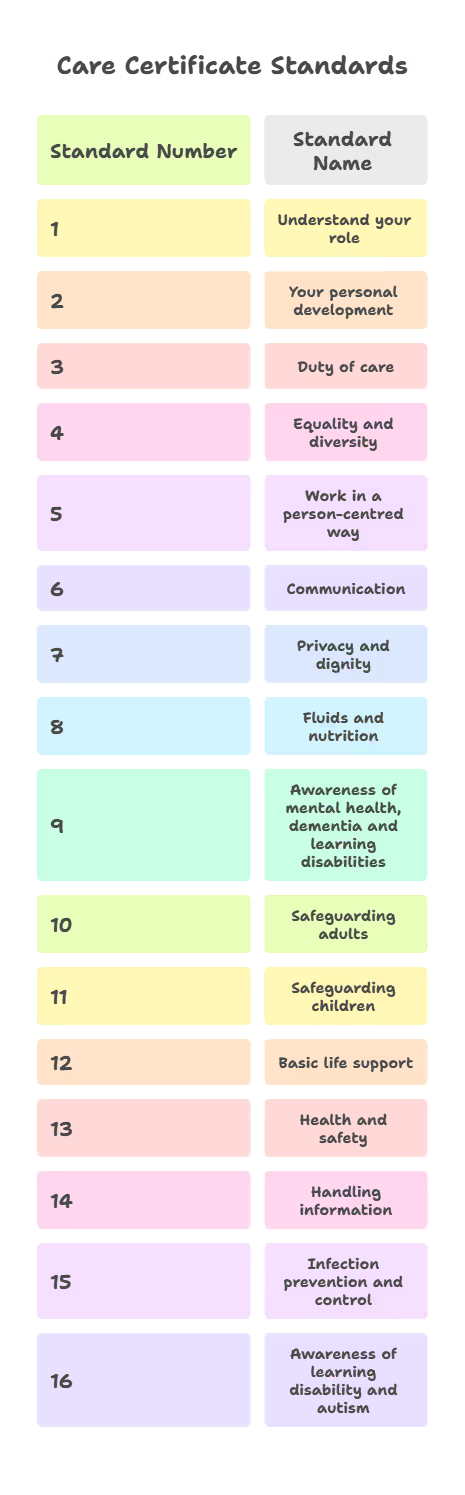
What Are the 16 Care Certificate Standards?
In March 2025, Skills for Care, Skills for Health, and NHS England updated the Care Certificate from 15 to 16 standards. The new Standard 16 covers awareness of learning disability and autism. This reflects wider sector developments and supports more inclusive care practice across all settings.
Each standard includes specific learning outcomes and practical competency criteria. You must demonstrate both knowledge and applied practice across all 16 before your employer can sign off your certificate.
If you find resources still listing 15 standards, they are using outdated guidance. The 16-standard version is current across all NHS and social care settings.
How Does the Care Certificate Process Work in the NHS?
The exact process varies between Trusts. But the overall structure follows a consistent pattern. Most NHS employers break it into five stages.
Stage 1 – Induction
You begin the Care Certificate as part of your formal induction. Most Trusts run a structured induction period lasting one to two weeks. During this time you attend classroom or workshop sessions, complete mandatory e-learning, and begin building familiarity with Care Certificate standards before you start working independently.
Stage 2 – E-Learning
Many NHS Trusts use the e-Learning for Healthcare (e-LfH) platform to deliver online modules. These cover the theoretical knowledge behind each standard. You work through them alongside your ward or service duties. Some modules link directly to scenario-based activities to help you apply learning to real care settings.
Stage 3 – Workbook or Handbook Completion
You complete a Care Certificate workbook throughout the process. This document gathers evidence of your knowledge and records how you apply each standard in practice. Some Trusts use paper-based handbooks and others use digital versions. The workbook is your primary evidence record and supports the final sign-off conversation.
Stage 4 – Workplace Observation and Sign-Off
An assessor signs off each standard in your workbook. In most Trusts, this is your line manager or a designated buddy. A buddy is an experienced colleague who has previously completed the Care Certificate. They observe your practice, hold professional discussions with you, and confirm that you have met the required level of competence. This stage is the heart of the employer-led process.
Stage 5 – Recording and Certification
Once all 16 standards are signed off, your Trust records completion on the NHS Electronic Staff Record (ESR). Many Trusts also issue a physical certificate. Some hold award ceremonies to recognise staff who complete the programme. The ESR record is portable, meaning it moves with you between NHS employers.
How Long Does the Care Certificate Take?
You must complete the Care Certificate within 12 weeks of starting the process. For most NHS employees, that clock starts on their first day of employment.
Some Trusts set an internal target of eight to ten weeks. This builds in review time before the 12-week deadline. Others use the full period, particularly in busy clinical settings where buddy availability can vary.
Your pace depends on your ward, your buddy’s schedule, and how quickly you move through the e-learning and workbook sections. Arriving with solid prior knowledge of the standards often shortens the process considerably.
Who Actually Awards the Care Certificate?
Your employer awards the Care Certificate. There is no national awarding body, external exam board, or central certification provider that issues it to you directly.
This matters. Completing any online course, CPD programme, or e-learning module does not, on its own, fulfil the Care Certificate requirements. The employer sign-off is the non-negotiable element. Without it, the official framework remains incomplete.
This does not reduce the value of online learning. It means that external training plays a preparatory and supportive role, not a replacement role.
Can You Prepare for the Care Certificate Before Starting a Job?
You cannot receive the official Care Certificate before you are employed. Employer sign-off is mandatory. But you can build strong knowledge of all 16 standards before your first day.
Many people entering the care sector choose to study the standards in advance. This is a practical and increasingly common approach. It gives you a head start during induction, helps you engage more confidently with your buddy’s assessments, and lets you demonstrate your commitment to care before you walk through the door.
Prior knowledge also helps during recruitment. Employers notice candidates who understand duty of care, person-centred practice, and safeguarding responsibilities. It signals that you take the role seriously.
What Is the Difference Between the Official Care Certificate and a CPD Course?
This is one of the most common areas of confusion. It is worth setting out clearly.
The official Care Certificate:
Is awarded by your employer following competency assessment
Requires practical sign-off in a real workplace setting
Must be completed within 12 weeks of starting the process
Is recorded on the NHS Electronic Staff Record
Cannot be awarded by any external training provider
A CPD course on Care Certificate standards:
Is completed online and independently
Builds theoretical knowledge across all 16 standards
Awards a CPD certificate upon successful completion
Does not include employer-led competency assessment
Does not replace the official employer sign-off
A CPD course is genuinely useful. It gives you structured knowledge before or alongside employment. It prepares you for workplace assessments. It can strengthen job applications in a competitive market. And it demonstrates a commitment to professional development that employers value.
The two things work well together. CPD learning supports the employer-led process. It does not sit in competition with it.
Studying Through Royal Open College (CPD Learning)
Royal Open College offers a Care Certificate Course that covers all 16 updated standards, including the 2025 awareness of learning disability and autism addition. The course is CPD-accredited and aligned with Skills for Care. It is 100% online and self-paced, which makes it accessible for career starters, those returning to care, and existing support workers who want to refresh their knowledge.
Completing this CPD course does not award the official Care Certificate and does not fulfil the employer sign-off requirement. What it does is give you a structured, thorough grounding in every standard before or alongside employment. Many learners use it to build confidence ahead of NHS induction, to support their personal development planning, or to demonstrate initiative during the job application process.
CPD learning is about continuous professional growth. The Royal Open College Care Certificate Course supports that growth at every stage of a care career.
Quick Recap
The Care Certificate is an employer-led framework, not a regulated qualification. Your NHS Trust or care provider runs the process and awards the certificate after confirming competency across all 16 standards.
You must complete all 16 national standards within 12 weeks of starting your role. The standards were updated in March 2025 to include a new standard on awareness of learning disability and autism.
No external course alone can replace the employer sign-off. CPD training supports your preparation and professional development but does not fulfil the official framework requirement.
Care Certificate Course – Standards (1 to 16)
Learn to promote Care Certificate Course – Standards (1 to 16)!
Protecting adults from harm starts with understanding the legal responsibilities behind everyday care. Those responsibilities vary across the UK, and several laws can apply to the same situation. Knowing how they fit together helps you make sense of your role. Explore the main legislation and what it means for safeguarding decisions in your workplace.
What makes an adult vulnerable is not always obvious from their age or diagnosis. Understanding their situation means looking at the support they need and the challenges they face in protecting themselves from abuse or neglect. Explore how these factors shape vulnerability, why individual circumstances matter and what this means for recognising concerns in adult safeguarding.
Abuse can take different forms and recognising the differences makes safeguarding concerns easier to understand. Child safeguarding commonly groups abuse into physical, emotional and sexual abuse, alongside neglect. These categories can overlap and appear in different settings. This guide explains what each type means and how to recognise important warning signs in everyday safeguarding practice.