

🌞 Summer Sale! Get any Course for £11.99 Only!
Offer ends soon! 00 : 00 : 00
Use Coupon Code 👇
SUMMER98
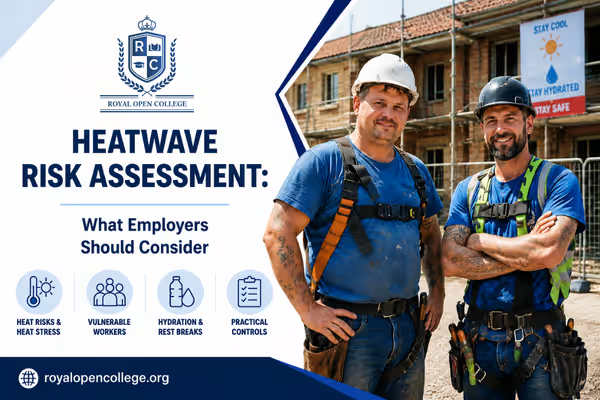
Heatwave Risk Assessment: What Employers Should Consider

Heatwave Risk Assessment: What Employers Should Consider

A heatwave risk assessment helps employers spot where hot weather could put staff, visitors or service users at risk. It should look at the workplace, the task, the people affected, PPE, hydration, rest breaks and practical ways to reduce heat stress.

A heatwave risk assessment helps employers understand how hot weather could affect their staff, visitors, customers, service users, or anyone else in the workplace. It is not just about checking the temperature. It is about looking at the full situation, the type of work, the people doing it, the building, outdoor conditions, PPE, hydration, rest breaks, and how quickly someone could become unwell in the heat.

For UK employers, this topic matters because there is no single legal maximum workplace temperature. That does not mean heat can be ignored. Employers still need to assess heat-related risks and take sensible steps to protect people. Managers, supervisors, HR teams, and care-sector staff who want to build confidence in this area can explore Royal Open College’s Heatwave: Health and Safety Tips course, which supports CPD knowledge around heat risks without replacing employer-led risk assessments, workplace procedures, or legal advice.

Quick recap

  • Heat risk depends on the worker, task, setting, clothing, PPE and weather conditions.
  • Employers should think about water, ventilation, shade, rest breaks, work timing and vulnerable people.
  • Care homes, healthcare settings, outdoor teams and PPE users may need extra planning during hot weather.

What is a heatwave risk assessment?

🌡️

A heatwave risk assessment is a practical check of how hot weather could affect people at work. It is not just about reading a thermometer.

📋

A good assessment looks at the whole situation.

Questions to ask:

What work is being done?
💪 Is it physical?
🌬️ Is the room poorly ventilated?
👕 Are staff wearing uniforms or PPE?
🚗 Are people working outside or travelling between visits?

Are any workers:

🤰 Pregnant 👴 Older 🤒 Unwell ♿ Disabled 🆕 New to the Role 💊 Taking Medication That May Affect Heat Tolerance
🎯

These questions help employers move from guessing to planning.

What should employers check first?

Start with the workplace. Look at air temperature, direct sunlight, humidity, air movement and heat from equipment, kitchens, laundries, vehicles or machinery.

Then look at the task. Heavy lifting, fast movement, personal care, cleaning, cooking, maintenance, warehouse work and outdoor jobs can all increase body heat. HSE says heat stress risk can depend on work rate, working climate, work clothing, PPE and individual factors.

Finally, speak to staff. If people are feeling dizzy, tired, thirsty, confused or unable to concentrate, do not ignore it.

Who may be more at risk?

Some workers feel the heat more than others. This may include pregnant workers, older workers, people with heart or breathing conditions, people with disabilities, people taking certain medicines, and staff who are new or returning after time away.

In health and social care, employers should also think about residents, patients and service users. Some people may rely on staff for drinks, room comfort, movement, medication routines and help staying away from direct sun.

What controls can reduce heat risks?

🌿

Small changes can make a big difference.

🌬️ Improve ventilation 🪟 Close blinds ☀️ Move work away from direct sunlight 💧 Provide cool drinking water ⏸️ Allow extra breaks 🔄 Rotate duties 🏋️ Reduce heavy work 🕐 Plan harder tasks for cooler parts of the day
📌

Acas says employers must provide suitable drinking water, and extra breaks for cold drinks may help during hot weather.

🌳 For outdoor work, think about:

🌳 Shade 🧴 Sunscreen advice 🌅 Earlier starts 📉 Fewer tasks at peak heat 🛋️ Safe rest areas

What about PPE, uniforms and dress codes?

PPE should not be removed if it is needed for safety. But employers should ask whether the task can be shortened, delayed, moved to a cooler area, or shared between staff.

In hot settings, PPE can make it harder for the body to cool itself. GOV.UK guidance says PPE heat-stress risk depends on work rate, workplace climate, PPE and the individual.

If formal dress is not safety-critical, lighter clothing or temporary dress-code flexibility may help.

What should care and healthcare employers consider?

Daily Care Planning

Care homes, clinics, hospitals, supported living and home care teams should link heatwave planning with daily care. This may include hydration checks, room temperature checks, medicines, staff fatigue, lone working, travel between visits, and plans for amber or red alerts.

Heat-Health Alerts

UKHSA’s Heat-Health Alert action card gives health and social care providers suggested actions at different alert levels.

Common misunderstandings

A heatwave risk assessment does not mean work must stop at one set temperature. UK law does not work that way.

A fan is not always enough. Heat risk depends on the task, room, clothing, people and controls.

Heat risk is not only an outdoor issue. Indoor staff can also struggle in kitchens, care homes, laundries, warehouses, clinics and poorly ventilated offices.

A CPD course can support knowledge and confidence, but employers still decide what training, procedures, supervision and workplace controls are suitable for each role.

Recent Blogs

Food Safety During Hot Weather: What Staff Should Know

Food Safety During Hot Weather: What Staff Should Know

Hot weather can make food safety harder because food warms faster and bacteria can grow more quickly. Staff should keep chilled food cold, hot food hot, prevent cross-contamination, manage leftovers carefully, and follow workplace food safety procedures.