




Compare Safeguarding Children Level 3 Training Options

Compare Safeguarding Children Level 3 Training Options

Compare Level 3 safeguarding children training by requirement, assessment and employer evidence. Healthcare, schools and social care follow different guidance. A CPD course adds to learning but does not replace employer checks or a regulated qualification.

Compare Level 3 safeguarding children training options by who sets the requirement and how learning is assessed. Healthcare, schools and social care each use the label differently. Your employer confirms which option counts for your service.

The label comes from the healthcare Intercollegiate Document, whose fifth edition appeared in 2025. Schools in England follow Keeping Children Safe in Education 2026 instead. An Ofqual-regulated RQF Level 3 diploma is a different award again.

Choosing between routes gets easier once you know your duties. The CPD-accredited Safeguarding Children Level 3 course from Royal Open College is one self-paced option. Compare the course topics with your role and employer policy before you enrol.

Quick Recap

  • Level 3 safeguarding describes a training level, not an Ofqual-regulated qualification.
  • Your role, setting and employer decide the level and the route you need.
  • A certificate shows completed learning, while employers judge competence in practice.

What are the main Level 3 safeguarding children training routes?

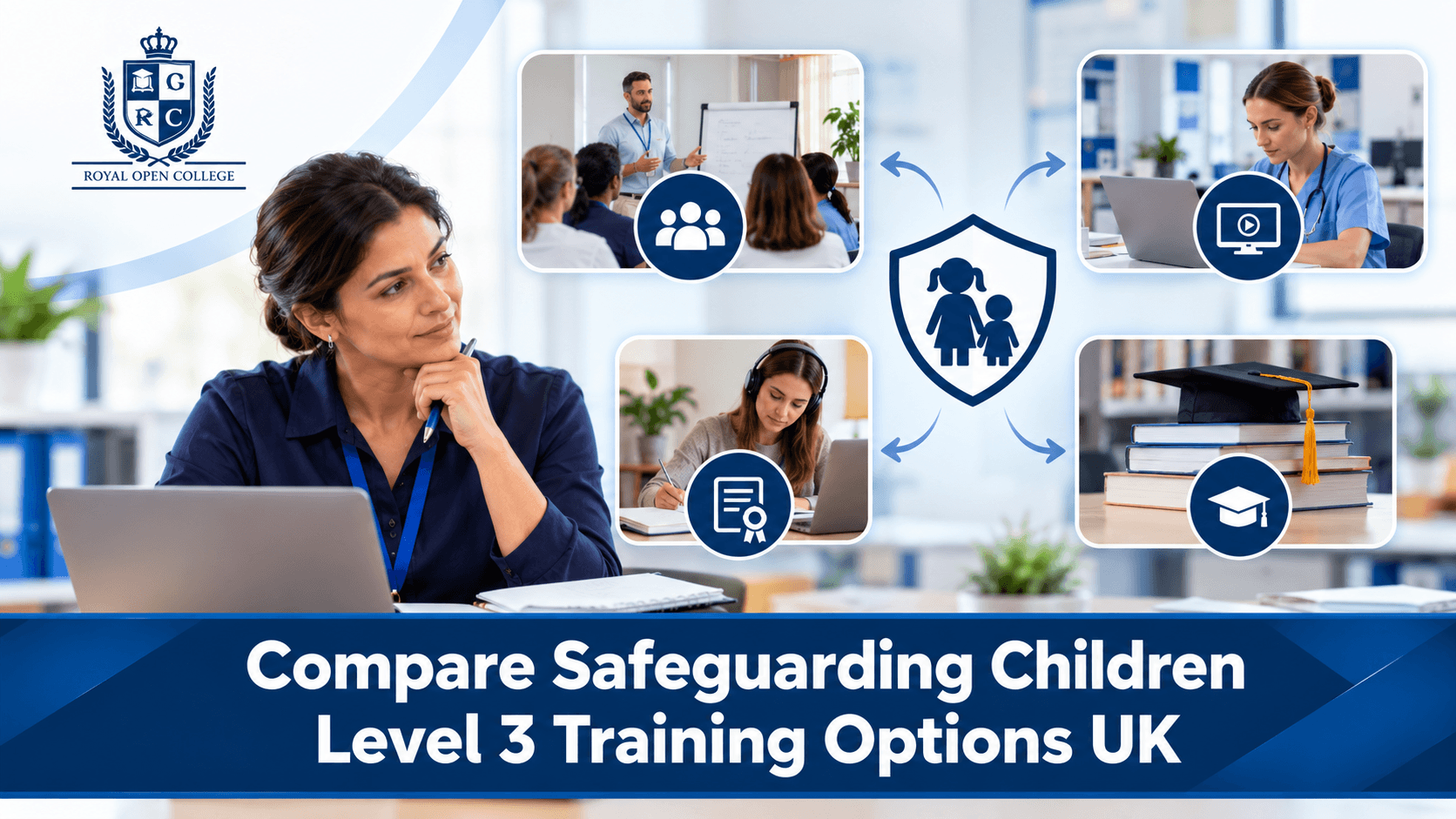
Four routes cover most Level 3 safeguarding children training in the UK. They differ in who sets the content and how learners prove progress. Each suits different duties and employer rules. Check each route against your duties before you pay for any course.

Compare Safeguarding Children Level 3 Training Options.
    • Employer or local partnership sessions: Employer and local safeguarding partnership sessions teach the procedures used in your area. The employer or partnership sets the content and checks attendance. These sessions suit staff who make referrals within one local authority area.
    • Framework-mapped healthcare e-learning: Framework-mapped healthcare e-learning follows learning outcomes set for NHS and other healthcare staff. Providers map courses to the Core Skills Training Framework or the Intercollegiate Document. Clinical staff should confirm the mapping with their employer before they enrol.
    • CPD e-learning: CPD e-learning gives self-paced study with an assessment and a certificate of completion. The provider sets the content and the pass mark. CPD accreditation is not Ofqual regulation. This route suits staff who want to build knowledge around existing duties.
    • Regulated qualifications: Regulated qualifications are awarded under the Regulated Qualifications Framework and assessed to set standards. Many include workplace assessment, so they take longer than a short course. Choose this route when your employer or job description names a qualification.

Which Level 3 route suits healthcare, schools and social care?

Your sector decides the route, because each sector follows different guidance.

Healthcare staff

Healthcare staff follow the Intercollegiate Document, so framework-mapped learning often fits. Employers set refresher intervals, so check your service policy.

Schools and colleges in England

Designated safeguarding leads in schools and colleges follow Keeping Children Safe in Education. Annex B sets out the lead’s role. Training follows the duties of the role, not a Level 3 label.

Social care and other settings

Social care and voluntary services usually follow employer policy and local safeguarding partnership guidance. Local partnership arrangements set the referral routes you follow. Scotland, Wales and Northern Ireland publish their own guidance.

What evidence does each route give your employer?

Each route leaves a different record, from attendance logs to assessed portfolios.

  • Employer sessions produce attendance records and local case discussion notes.
  • Framework-mapped e-learning produces a certificate tied to stated learning outcomes.
  • CPD e-learning produces a certificate and an assessment result.
  • Regulated qualifications produce an awarded certificate and assessed workplace evidence.

None of these records proves competence alone. Supervision and observed practice show how you apply the learning.

Does the law require Level 3 safeguarding training?

Law and statutory guidance usually expect suitable safeguarding training without naming a commercial Level 3 course. Employers turn these expectations into role-based training rules. Inspectors look for evidence of training and competence.

What changed in the 2026 guidance for England?

Working Together to Safeguard Children 2026 replaced the 2023 edition after publication on 18 March 2026. Keeping Children Safe in Education 2026 took effect on 1 September 2026. Check the edition your course and policies cite.

How do you choose the right Level 3 option?

People most often mistake a training level for a qualification or proof of competence. These errors waste study time and leave gaps in practice.

  • Employer policy gets treated as law, which hides who sets the requirement.
  • Guidance for England gets applied in Scotland, Wales or Northern Ireland.
  • Learners buy a course without checking the framework their employer uses.
  • One course gets assumed to cover every setting and every inspection.
  • Designated safeguarding lead duties get mixed up with general Level 3 learning.

How do you choose the right Level 3 route?

Match your duties to your employer’s policy and national guidance, then pick the route they name. A children’s home manager checks the provider’s policy and local safeguarding procedures first. A children’s ward nurse follows the hospital’s framework and local training policy. A DSL in a school checks Keeping Children Safe in Education and the school’s training policy. Keep your certificate, learning notes and supervision records together.

Practise safeguarding decisions before a real concern arises. Our Safeguarding Decision Tree offers UK-aligned scenario questions. You pick a concern type and receive a report with suggested next steps. The tool does not replace your Designated Safeguarding Lead or emergency procedures.

Read the statutory duties in Working Together to Safeguard Children 2026 on GOV.UK. Then ask your manager which framework applies to your role.

Studying through Royal Open College (CPD learning)

The Safeguarding Children Level 3 course from Royal Open College is CPD-accredited online learning. Lessons cover recognising abuse, assessing risk, making referrals and recording concerns. Learners study at their own pace and finish with an online assessment.

The course adds to your continuing professional development. Check your employer’s training requirements before you enrol. Workplace competency checks still apply after any course.

Recent Blogs