







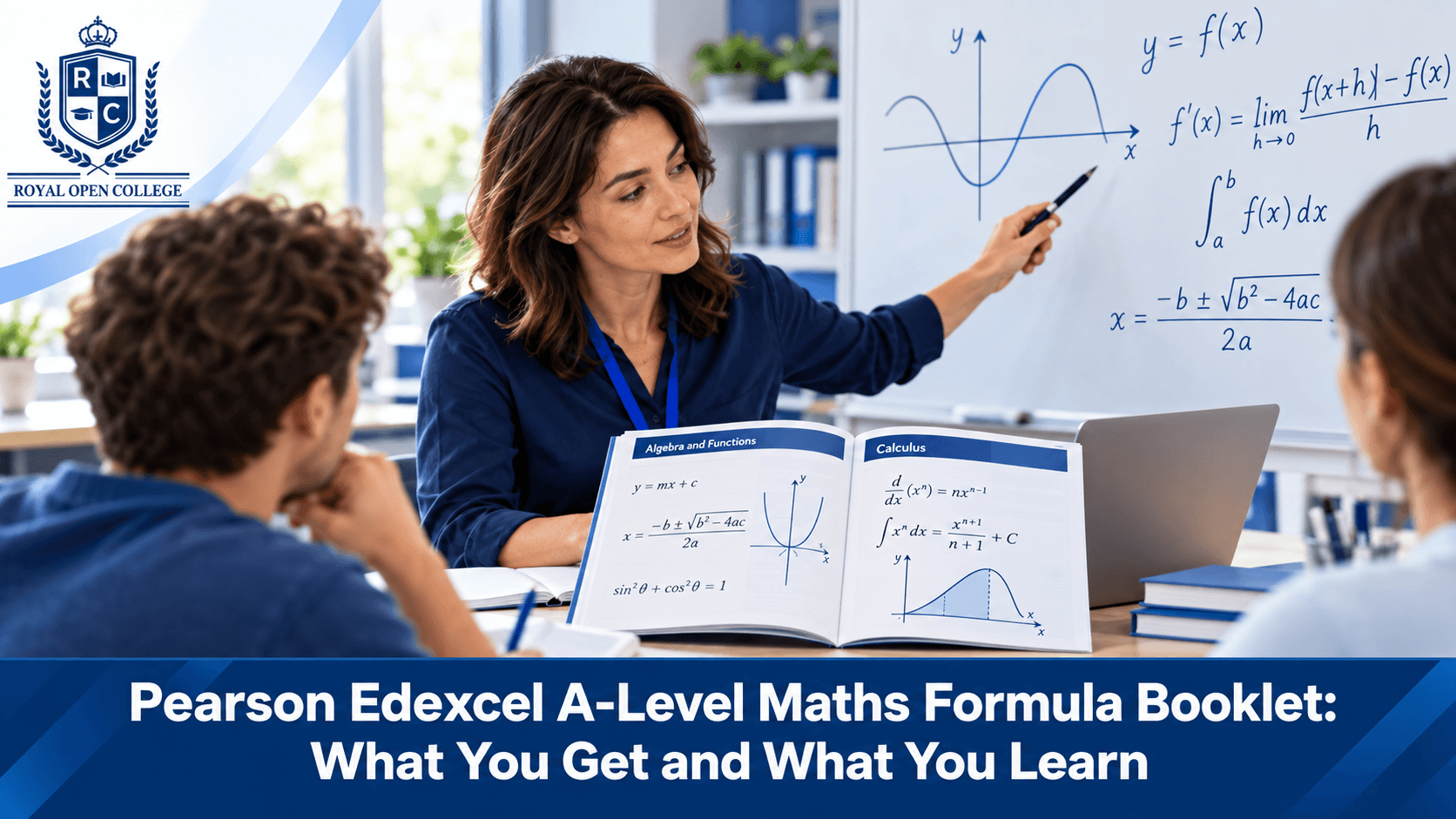



Pearson Edexcel A-Level Maths Formula Booklet

Pearson Edexcel A-Level Maths Formula Booklet: What You Get and What You Learn

Pearson gives you a formula booklet in all three Edexcel 9MA0 papers, but the booklet prints selected formulae and four statistical tables only. You learn the rest yourself, such as the quadratic formula and the sine rule, which Pearson leaves out. This guide shows which formulae to locate, derive or recall and how to revise with the booklet.

The Pearson Edexcel A Level Maths booklet gives you formulae to look up and to prove, then leaves a third group to you. You look up the trapezium rule and the quotient rule. You prove the geometric series sum. You learn the quadratic formula and the sine rule by heart.

The Department for Education sets the recall list, so Pearson keeps those results out of the booklet. Printed does not mean skipped, because a question might ask you to prove the result. Tag each formula Locate, Derive or Recall, then revise by tag. The lookup below tags common formulae.

This guide sorts every formula into three tags, Locate, Derive and Recall. You get a lookup table, the exam rules and three checked examples. For extra practice with rearranging formulae, Royal Open College offers Functional Skills Maths Level 3 as CPD learning, not as an A Level.

Before You Read On

  • Pearson gives the booklet in all three 9MA0 papers.
  • The booklet prints selected formulae and four statistical tables.
  • You learn the quadratic formula, sine rule, product rule and F = ma yourself. 
  • The Pearson booklet covers AS, A Level and Further Maths. Read the A Level pages. 
  • Calculators are allowed in all three papers. Stored formulae are banned.
  • The exam copy stays unmarked and stays in the exam room.
  • Tag each formula Locate, Derive or Recall.
  • Print a clean copy for timed past papers and log each lost mark by cause.

What Is the Edexcel A-Level Maths Formula Booklet?

The Edexcel A-Level Maths formula booklet is Pearson’s Mathematical Formulae and Statistical Tables, the official document you use in all three 9MA0 papers. The booklet prints selected formulae and four statistical tables. The booklet is not a full list of the formulae you need, because you learn the rest yourself.

Pearson issued the booklet in July 2017 as Issue 1, and the cover shows the Issue number. The same document covers AS, A Level and Further Maths, so you read the A Level Mathematics pages only. A year in a page title does not mean Pearson issued a new booklet.

Key facts

  • Qualification: Pearson Edexcel Level 3 Advanced GCE in Mathematics (9MA0)
  • Papers: three papers, each 2 hours and 100 marks
  • Statistical tables: binomial cumulative, normal percentage points, correlation critical values and random numbers
  • Calculators: allowed in all three papers
  • 2027 papers: 26 May, 9 June and 16 June, all in the afternoon

Source: Pearson booklet Issue 1, Pearson specification Issue 4 and Pearson Summer 2027 timetable (final).


How Do You Check You Have the Right Edexcel Formula Booklet?

How Do You Check You Have the Right Edexcel Formula Booklet

Check your course code, your paper cover and your booklet sections before you revise. Pearson also publishes a booklet for International A Levels, and search results sometimes show the International one. These four quick checks confirm your copy matches your own course today.

  • Your course code starts with 9MA0 for A Level or 8MA0 for AS.
  • Your paper cover reads Mathematical Formulae and Statistical Tables (Green). International A Level papers read Yellow or Blue.
  • Your booklet has AS and A Level sections, not units labelled P1 to P4.
  • Booklets from AQA, OCR or GCSE Maths do not apply to your papers.

Print a copy of Pearson’s Mathematical Formulae and Statistical Tables and use the booklet for every past paper. Pearson publishes the PDF free on its Edexcel A Level Mathematics pages. The exam copy stays blank, so mark only your printed practice copy and note page numbers as you work.

Is this formula in the Edexcel A-Level Maths formula booklet?

Sort every formula into one of three tags. Locate means the booklet prints the formula. Derive means the booklet prints the formula, but a question might ask you to prove the result. Recall means you learn the result, because Pearson does not print the formula.

How to Tag Any Formula in Four Steps

  1. Check the formula booklet
    Find the A Level Mathematics section and look for the formula.
  • Formula is printed there → move to the proof check.
  • Formula is not printed there → move to the recall check.
  1. Check whether you may need to prove it
  • Yes → tag it Derive and learn the proof or derivation.
  • No → tag it Locate and learn where to find it in the booklet.
  1. Check whether it is on the recall list
    Use DfE Appendix B and Pearson Appendix 1.
  • Yes → tag it Recall and learn it from memory.
  • No → check the specification or course content for that topic and confirm with your teacher if needed.
  1. Record it in your formula log
    For each formula, write down:

Formula → Tag → Booklet page, if relevant

Your final tag should be one of three:

Locate — know where to find it
Derive — know how to prove or obtain it
Recall — know it from memory

How to Tag Any Formula in Four Steps

Quick lookup for common formulae

Formula

Printed in booklet?

Tag

Quadratic formula

No

Recall

Sine rule and cosine rule

No

Recall

Area of a triangle, ½ab sin C

No

Recall

Double-angle formulae

No

Recall, or Derive from compound-angle formulae

Product rule and chain rule

No

Recall

Quotient rule

Yes

Locate

Arithmetic and geometric series sums

Yes

Derive

Trapezium rule

Yes

Locate

Constant-acceleration (suvat) equations

Yes

Derive

Weight, friction and F = ma

No

Recall

Source: Pearson booklet Issue 1, DfE Appendix B and Pearson specification Appendix 1.

Locate: formulae the booklet prints

These formulae sit in the A Level Mathematics pages, so you need not memorise them. Learn where each one appears, because hunting for a page costs time. In summer 2023 a minority of candidates did not quote the small-angle approximation, though the booklet prints the correct version.

  • Arithmetic and geometric series sums
  • Binomial expansions
  • Change of base for logarithms
  • Compound-angle identities
  • Small-angle approximations
  • Quotient rule and the derivatives of tan, sec, cot and cosec
  • Integration by parts
  • Trapezium rule and Newton-Raphson
  • Constant-acceleration equations
  • Binomial probability with mean and variance, standard deviation and Sxx
  • Four statistical tables

Derive: printed formulae you might prove

Pearson prints these results, but the subject content expects you to understand where they come from. A question might ask you to prove the sum of a geometric series, and quoting the printed result does not prove anything. Practise the proof as well as the formula.

  • Sums of arithmetic and geometric series
  • Differentiation from first principles, which starts from the chord gradient the booklet prints
  • Constant-acceleration equations, built from the definition of acceleration

Recall: formulae you learn by heart

Pearson does not print these formulae, and the Department for Education requires every exam board to expect them without help. A question gives one of these formulae only as the starting point for a proof or as a result to prove.

  • Algebra: quadratic formula, laws of indices, laws of logarithms, straight-line equation and perpendicular gradients
  • Sequences: nth term of arithmetic and geometric progressions
  • Trigonometry: sine rule, cosine rule, area half ab sin C, the three Pythagorean identities, sin 2A, cos 2A and tan 2A
  • Circles and shapes: circle circumference and area, Pythagoras, trapezium area, prism volume, arc length rθ and sector area half r²θ
  • Calculus: derivatives and integrals of xⁿ, sin kx, cos kx, eᵏˣ, ln x and 1/x, plus the product and chain rules
  • Vectors: magnitude of a vector
  • Mechanics: weight = mass × g, F ≤ μR and F = ma
  • Statistics: mean from frequencies and Z = (X − μ) ÷ σ

Watch the edge cases. Pearson prints the quotient rule but not the product rule or the chain rule. Pearson prints the derivatives of tan, sec, cot and cosec but not those of sin, cos, eᵏˣ or ln x. Learn the gaps first.

What are the exam rules for the booklet and your calculator?

Pearson provides the booklet in every 9MA0 paper and allows a calculator in all three, within Pearson’s rules. Your paper cover lists both under what you must have. The booklet on your desk belongs to Pearson and stays unmarked. You leave the booklet in the exam room.

  • Your calculator needs an iterative function and statistics functions.
  • Your calculator must not do symbolic algebra, differentiation or integration. The calculator must not hold stored formulae.
  • Give exact answers, such as surds or fractions, when the question asks for them.
  • Quote table values in full. If you use a calculator value instead, match the accuracy.
  • Solving quadratics or simultaneous equations on a calculator is fine, but show enough steps. Cubic and quartic equations need factorising first.
What are the exam rules for the booklet and your calculator?

Plan your timed practice around the 2027 dates. All three papers run in the afternoon and last 2 hours each. UK centres start between 1:00 pm and 2:00 pm, so check your own start time with your exam centre. Pearson has published the final timetable.

  • Paper 1, Pure Mathematics 1: Wednesday 26 May 2027
  • Paper 2, Pure Mathematics 2: Wednesday 9 June 2027
  • Paper 3, Statistics and Mechanics: Wednesday 16 June 2027

How do you revise with the formula booklet?

Practise with a clean copy of the booklet on timed past-paper questions, and log why you lose each mark. This builds speed in finding formulae and shows which tag causes your errors. Follow the five steps below, then work through the three examples.

  1. Confirm your course is 9MA0 and print the booklet.
  2. Tag every formula on your topic list as Locate, Derive or Recall.
  3. Practise locating. Time how long each printed formula takes to find.
  4. Practise choosing. Name the formula and its tag before you solve.
  5. Review by cause. Log each lost mark as forgot formula, wrong formula, algebra slip, calculator slip or misread condition.

Write each formula before you substitute. Pearson’s mark scheme awards the method mark for a correct formula and an attempt to use the formula, even with small slips in the numbers. An unquoted formula puts the method mark at risk if any working goes wrong.

What are the common mistakes with the formula booklet?

Most mistakes come from revision sheets which disagree with Pearson’s own documents. Check each claim below against the booklet and specification before you trust a source. These errors appear on pages in search results, so correct them early in your revision.

  • Myth: Paper 1 bans calculators.
    Fact: all three papers allow a calculator within the rules.

  • Myth: A separate AS booklet exists.
    Fact: one document holds the AS and A Level sections.

  • Myth: The booklet leaves out series sums.
    Fact: the booklet prints arithmetic and geometric series sums.

  • Myth: The booklet prints the sine rule and the double-angle formulae.
    Fact: you learn the sine rule, and you learn or derive the double-angle formulae.

  • Myth: You annotate the exam copy.
    Fact: the copy stays unmarked and stays in the room.

  • Myth: The booklet gives the value of g.
    Fact: use g = 9.8 m/s² unless a question states another value.

  • Myth: Poisson tables belong to 9MA0.
    Fact: Poisson tables belong to Further Maths.

  • Myth: The International booklet works for 9MA0.
    Fact: the International booklet belongs to a separate qualification. Download the current copy from the Pearson Edexcel A Level Mathematics (2017) page.

Before You Start Revising

  • The booklet prints the quotient rule and the derivatives of tan, sec, cot and cosec. You learn the product rule, the chain rule and the other standard derivatives.
  • Practise the proofs behind printed results: the geometric series sum, first principles and the suvat equations.
  • Rebuild cos 2A and sin 2A from the compound-angle formulae.
  • Check each answer by a second route.
  • Green on your paper cover means UK 9MA0. Yellow or Blue means International A Level.
  • Plan around the 2027 papers: 26 May, 9 June and 16 June.
  • Trust Pearson’s booklet over a revision sheet.

What else do students ask about the formula booklet?

Q: Does the booklet change every year?

A: The booklet carries an Issue number and date on the cover. The 2017 booklet is Issue 1, July 2017. Check the cover of your copy, and download the booklet again each September to see whether Pearson has issued a new version.

A: Pearson also runs International A Levels, which share the booklet title Mathematical Formulae and Statistical Tables. The International booklet uses unit labels such as P1, M1 and S1, and paper covers read Yellow or Blue. Your 9MA0 paper cover reads Green.

A: No. The tables sit beside your calculator, and the course expects you to use the distribution functions for binomial and Normal probabilities. Quote table values in full, and match the accuracy of the table if you use a calculator value instead.


A: Pearson sets no fixed number. Appendix 1 of the specification lists the results you recall, and the Department for Education lists the same results in Appendix B. The list covers algebra, trigonometry, calculus, vectors, mechanics and statistics, so learn the list and not the whole booklet

A: Only when a question asks. The subject content expects proofs such as differentiation from first principles, the constant-acceleration equations and the compound-angle formulae. Copying a printed result does not prove the result, so practise each proof as well as the formula.

A: In summer 2023 on Paper 1, some candidates wrote an incorrect quadratic formula, and a minority did not quote the small-angle approximation, though the booklet prints the correct version. Laws of logarithms also caused errors. Check these three first when you review your lost marks.

A: No. Pearson lists the quadratic formula among the results you recall, so the booklet does not print the formula. Learn the formula and quote the formula first, even when your calculator solves the equation, because the mark scheme rewards a quoted formula.

A: Yes. The A Level Mathematics pages print the five constant-acceleration equations. You still choose the equation, so check acceleration is constant and list the known values before you substitute. A question might also ask you to derive the equations from the definition of acceleration.

A: No. Pearson prints one document for AS, A Level and Further Maths, with a section for each qualification. Read the A Level Mathematics pages for 9MA0 and the AS pages for 8MA0. Skip the Further Maths pages, because those formulae do not belong to your papers.

A: Pearson publishes the booklet free as a PDF on its Edexcel A Level Mathematics pages. Print a clean copy and use the copy for timed past papers. Your exam copy stays blank and stays in the room, so mark only your printed practice copy.

A: No, for 9MA0. The A Level Maths tables are binomial cumulative, normal percentage points, correlation critical values and random numbers. Poisson tables belong to Further Maths, so skip the Poisson pages in the shared booklet and read only the A Level Mathematics pages.

Studying through Royal Open College

Royal Open College offers Functional Skills Maths Level 3 as CPD learning. The lessons include substitution into given formulae and algebraic techniques, skills you use when you rearrange and substitute into booklet formulae. You finish with an online assessment and a CPD certificate.

This course is not an A Level, not a regulated qualification and not preparation for Pearson 9MA0 papers. Your exam centre and Pearson set exam requirements. Check your own course content with your teacher before you add extra study. A CPD certificate records learning, not a grade.

If you return to maths after a break, start with the basics. Royal Open College also offers Functional Skills Maths Level 2 as CPD learning, which rebuilds number and algebra confidence. In England, 27.1 percent of provisional GCSE maths entries in summer 2026 came from year 12 or above.

Print your booklet today and tag your first ten formulae. Log each lost mark by cause in your next timed paper, and review the log every week. Add extra study, including Royal Open College learning, only after you check your course content with your teacher.

Recent Blogs