🌞 Summer Sale! Get any Course for £11.99 Only!
Offer ends soon! 00 : 00 : 00
Use Coupon Code 👇
SUMMER98
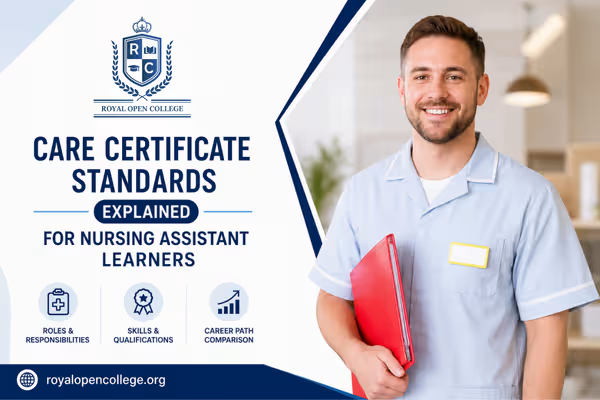
Care Certificate Standards Explained for Nursing Assistant Learners

Care Certificate Standards Explained for Nursing Assistant Learners

The Care Certificate sets the baseline for every new nursing assistant in England. Updated in March 2025 to 16 standards, it covers safeguarding, infection control, communication, and your legal duty of candour. Standard 16 now carries a statutory training requirement under the Health and Care Act 2022. This guide explains what each standard means in your role and what your

It is 6.45am on a medical ward. A nursing assistant arrives for her first shift. She attends handover, helps a patient wash and dress, records observations, and notices a change in breathing that she escalates to the registered nurse. Every action she takes connects to a standard in the Care Certificate.

If you are starting a nursing assistant, healthcare assistant, or healthcare support worker role in England, the Care Certificate is the framework that sets out exactly what you need to know, do, and demonstrate before you work independently. This guide explains all 16 standards in, what each one means for your role, what changed in March 2025, and what your employer will assess.

TL;DR: What You Need to Know First

The Care Certificate now has 16 standards, updated in March 2025 by Skills for Care, NHS England, and Skills for Health.

  • There are 16 standards, not 15. Any resource listing 15 is out of date.
  • The Care Certificate is an induction framework, not a qualification.
  • It is not legally mandatory overall, but Standard 16 carries a statutory requirement for all CQC-regulated services.
  • You cannot complete it through online learning alone. Workplace assessment is required for every standard.
  • The certificate does not expire once your employer signs it off.
  • Full implementation of the updated 16-standard framework was required across all CQC-registered services by July 2025.
Authority Clarification Law, Guidance, and Employer Policy.

Authority Clarification: Law, Guidance, and Employer Policy

This section separates the legal facts from sector guidance and employer decisions, because this distinction is the most common source of confusion in all online content about the Care Certificate.

Law means a statutory requirement you must comply with. Standard 16 is backed by Section 181 of the Health and Care Act 2022. This is law. CQC-registered providers must ensure staff receive appropriate learning disability and autism training. The Oliver McGowan Code of Practice, which came into force 6 September 2025, sets how that requirement must be met.

Regulatory expectation means CQC uses the Care Certificate as the benchmark for judging induction quality under Regulation 18. Failing to implement it properly creates a compliance risk during inspection. It is not a legal mandate, but the practical consequences of ignoring it are real.

Guidance means recommended practice. The Care Certificate framework itself is guidance. Skills for Care, NHS England, and Skills for Health strongly recommend it. Most employers treat it as de facto mandatory for new starters because it reflects what CQC looks for.

Employer policy means what your specific employer requires of you. Many employers treat the Care Certificate as a condition of completing your probation or beginning unsupervised work. This is an employer decision, not a legal requirement, even though in practice it functions as mandatory within that organisation.

Understanding these distinctions protects you from both overclaiming and underestimating your obligations.

What Is the Care Certificate and Who Does It Apply To?

The Care Certificate is an identified set of standards that health and social care workers follow in their daily working life. Skills for Care, NHS England, and Skills for Health developed it together for the non-regulated workforce, with the Department of Health and Social Care holding copyright.

It applies to people starting new roles in health and social care who are not already registered professionals. In health settings, this includes nursing assistants, healthcare assistants, healthcare support workers, assistant practitioners, maternity support workers, physiotherapy assistants, radiography assistants, and occupational therapy assistants. In adult social care, it covers care assistants, domiciliary carers, residential support workers, home care workers, and personal assistants.

Registered professionals such as nurses, doctors, social workers, and occupational therapists gain similar skills through their professional training. They do not need to complete the Care Certificate.

The framework applies to England. Wales, Scotland, and Northern Ireland each operate their own workforce induction frameworks. If you work outside England, check with your relevant national workforce body.

Who Developed the Care Certificate Standards?

Skills for Care, NHS England, and Skills for Health developed the Care Certificate jointly. The Department of Health and Social Care holds copyright over the standards. The framework was first introduced in 2015 and updated in March 2025 to reflect changes in how care is delivered today.

Is the Care Certificate a Qualification?

No. The Care Certificate is an induction framework. It does not sit on the Regulated Qualifications Framework (RQF) and is not regulated by Ofqual. Completing it does not grant a licence to practise or a formal academic credential. Your employer delivers it, assesses it, and signs it off. The Level 2 Adult Social Care Certificate is the Ofqual-regulated qualification that builds on the same 16 standards. These are two separate things, and the difference matters for your career.

Is the Care Certificate Legally Required?

The short answer is no, not across the board. The Care Certificate as a whole is not a statutory requirement under UK law. No legislation mandates that every care worker must hold one.

However, the situation is more specific than a simple yes or no, and getting this wrong causes real problems.

What CQC Expects

The Care Quality Commission (CQC) expects providers to use the Care Certificate under Regulation 18 of the Health and Social Care Act 2008 (Regulated Activities) Regulations 2014. Regulation 18 requires employers to ensure staff are competent, properly trained, and supervised.

The Care Certificate is the recognised framework CQC uses to judge whether induction meets that standard. During inspection, CQC asks how employers know their staff are competent. A completed workbook alone is not enough. Evidence of observation, supervision, and assessed practice is what inspectors look for.

The Standard 16 Legal Exception

Standard 16 is different from the other 15 standards. Under Section 181 of the Health and Care Act 2022, it is a legal requirement that all staff working in CQC-registered services receive training on how to interact appropriately with people with a learning disability and autistic people, at a level appropriate to their role.

The Oliver McGowan Code of Practice came into force on 6 September 2025. It sets minimum standards for how this training is delivered across all CQC-regulated settings, including general wards, care homes, and community services. This applies to every nursing assistant in a CQC-registered service, not only those working in specialist learning disability or autism services.

So the correct way to understand mandatory status is this:

  • The Care Certificate framework overall: not legally mandatory, but strongly expected by CQC under Regulation 18.
  • Standard 16 specifically: a statutory requirement under the Health and Care Act 2022 for all CQC-registered providers.

What Changed in the March 2025 Update?

The March 2025 update was the first revision of the Care Certificate since the framework launched in 2015. It raised the number of standards from 15 to 16 and made substantive changes to several existing standards.

🔄
Here is what changed:
🧠

Standard 9 is now titled "Awareness of mental health and dementia" only. Learning disability content has been removed from this standard entirely and relocated to the new Standard 16. Any resource still calling Standard 9 "Awareness of mental health, dementia and learning disability" is using the pre-2025 version.

💙

Standard 13 now includes a ninth sub-outcome (13.9) covering how nursing assistants manage their own mental health and personal wellbeing at work.

🔐

Standard 14 was updated to include data breach reporting processes, reflecting the current UK GDPR framework.

🧼

Standard 15 (Infection Prevention and Control) was significantly expanded. It now covers the chain of infection in full (six links), PPE donning and doffing correctly, decontamination, blood and bodily fluid spill handling, and clinical waste disposal.

♾️

Standard 16 is an entirely new standard: Awareness of Learning Disability and Autism. It carries a statutory training requirement for CQC-registered services.

💻

Standard 2 now explicitly names digital skills alongside literacy, numeracy, and communication as functional skills nursing assistants must develop.

Full implementation across all CQC-registered services was required by July 2025.

What Update Resources Are Available?

Skills for Care publishes the updated standards PDF, the assessor and employer guide, the self-assessment tool, and a summary of changes document, all available at skillsforcare.org.uk. NHS England elearning resources are still being updated to reflect the full 2025 revision. Until those updates complete, the official standards PDF is the authoritative reference.

All 16 Care Certificate Standards Explained

The 16 standards are not abstract rules sitting in a document somewhere. They map directly onto what a nursing assistant does every working day. Below is a plain-English explanation of each standard, what it covers, and what it looks like in your role.

01
👤
Standard 1: Understand Your Role

Standard 1 covers your responsibilities in your specific role, how your role fits within your organisation, and the importance of working within the boundaries your employer sets. It includes understanding your employment rights, the aims and values of your service, and when and how to escalate concerns. This standard also covers your duty of candour, which is the responsibility to be open and honest with individuals and their families when something goes wrong, whether or not harm occurred.

Agreed ways of working is a key term here. It refers to your employer's policies, procedures, and expected practices, including those that are informal. You need to show you work in line with these, access them when needed, and know when to raise concerns through your organisation's procedures.

Nursing assistant example: Before performing a delegated clinical task, a nursing assistant checks their employer's agreed ways of working to confirm the task is within their role and that they have received the training required to carry it out safely.

02
📈
Standard 2: Your Personal Development

Standard 2 focuses on your responsibility for your own learning and growth. It covers agreeing a personal development plan with your manager, identifying learning needs, reflecting on practice, and using feedback to improve. The 2025 update added digital skills explicitly alongside literacy, numeracy, and communication as functional areas you need to develop.

You need to demonstrate that you understand what continuing professional development (CPD) means and why it matters throughout your career, beyond induction.

Nursing assistant example: During a supervision session, a nursing assistant identifies that she is not confident using the ward's electronic patient record system. She and her supervisor agree a development plan to address this gap with targeted support.

03
🤝
Standard 3: Duty of Care

Standard 3 covers two related but distinct duties. Your duty of care means you must aim to provide high-quality care to the best of your ability and tell someone if there are reasons you cannot do so. Your duty of candour means being open and honest when things go wrong.

This standard also covers handling complaints and comments correctly, recognising and reporting adverse events, incidents, errors, and near misses, and managing confrontation or difficult situations using communication to reduce risk.

Nursing assistant example: A nursing assistant notices she accidentally skipped a step in a pressure care routine. She reports this to her line manager as a near miss, documents it according to her organisation's incident reporting procedure, and participates in the learning review.

04
🌍
Standard 4: Equality, Diversity, Inclusion and Human Rights

Standard 4 requires you to understand equality, including the nine protected characteristics under the Equality Act 2010, diversity, inclusion, and human rights. You need to recognise how discrimination happens, challenge it appropriately, and demonstrate culturally sensitive care in practice.

This standard expects you to identify the legislation and codes of practice relevant to your role and show that your interactions actively promote fair treatment for every individual you support.

Nursing assistant example: A nursing assistant works with a patient whose cultural background includes specific food preferences and religious practices. She checks the patient's care plan, communicates with the catering team, and adapts her approach to ensure the patient's cultural needs are met with respect.

05
💙
Standard 5: Work in a Person-Centred Way

Standard 5 covers putting the individual at the centre of everything you do. Person-centred values include individuality, independence, privacy, partnership, choice, dignity, respect, and rights. You need to understand how these apply in daily care and demonstrate them through your actions.

This standard also covers mental capacity. Under the Mental Capacity Act 2005, you must assume that a person has capacity to make decisions unless there is evidence they do not. You need to understand what capacity means, what consent requires, and what best interest decisions, advance statements, and advance decisions involve.

Nursing assistant example: A nursing assistant assists a patient who wants to wash independently despite mobility difficulties. Following the care plan and respecting the patient's preference for independence, she stays nearby to offer support if needed rather than taking over the task.

06
💬
Standard 6: Communication

Standard 6 covers all forms of communication: verbal (tone, volume, clarity), non-verbal (body language, eye contact, positioning, touch), written, and digital. The 2025 update strengthened the focus on digital communication tools and assistive technologies, which now form an explicit part of this standard.

You need to show you adapt your communication style to meet the needs, wishes, and preferences of each individual, understand barriers to communication and how to reduce them, and maintain confidentiality in line with your organisation's policies.

Nursing assistant example: A nursing assistant works with a patient who has a speech impairment following a stroke. She uses a communication board provided by the speech and language therapy team, checks she has understood the patient correctly, and records the communication method used in the care plan.

07
🔒
Standard 7: Privacy and Dignity

Standard 7 covers maintaining the privacy and dignity of every person you care for. This includes practical actions such as knocking before entering a room, ensuring curtains and screens are in the correct position during personal care, using appropriate volume when discussing someone's care, and never disclosing information an individual would wish to keep private.

This standard also covers supporting individuals to make informed choices, understanding active participation, and ensuring your own personal views do not influence their decisions.

Nursing assistant example: A nursing assistant prepares to assist a patient with a bed bath on a four-bed ward. She draws the curtains fully, checks with the patient that she is ready to proceed, positions clothing appropriately throughout, and lowers her voice when asking about the patient's personal preferences.

08
🥤
Standard 8: Fluids and Nutrition

Standard 8 covers supporting individuals to eat and drink safely in line with their care plan. You need to understand the importance of good nutrition and hydration, recognise signs of poor intake such as dark urine, confusion, dry mouth, weight loss, or fatigue, and know how to report concerns.

Food safety and hygiene form part of this standard, as does supporting individuals with restricted movement to access fluids and food as independently as possible.

Nursing assistant example: A nursing assistant notices that a patient on the ward has not finished their meals for two days and has reduced fluid intake. She records this accurately on the fluid balance chart and reports her concern to the nurse in charge at the end of her shift.

09
🧠
Standard 9: Awareness of Mental Health and Dementia

An important update first: as of March 2025, Standard 9 no longer covers learning disability. That content moved entirely to the new Standard 16. Any resource that still names this standard as covering learning disability is using the old framework.

Standard 9 now covers mental health conditions and dementia only. At minimum, you need to understand psychosis, depression, and anxiety as common mental health conditions, and understand what dementia means including its key types and causes. You need to recognise early signs of deterioration, understand why these conditions affect care needs differently, and know how to support individuals and families to access other services.

The standard also covers relevant legislation and policies and how they affect day-to-day care for people with mental health needs or dementia.

Nursing assistant example: A nursing assistant notices that a resident with dementia who is usually calm has become increasingly agitated and is not recognising familiar staff. She documents the change in behaviour, reports it to the registered nurse, and adjusts her communication approach, using slower speech, gentle eye contact, and familiar routines to reduce distress.

10
🛡️
Standard 10: Adult Safeguarding

Standard 10 covers your responsibilities in protecting adults at risk from harm and abuse. Under the Care Act 2014, an adult at risk is a person aged 18 or over who has care and support needs and who is unable to protect themselves from abuse or neglect because of those needs.

Types of abuse covered include physical, domestic violence, sexual, psychological, financial, modern slavery, discriminatory, organisational, neglect, and self-neglect. This standard also covers restrictive practices, which are defined as interventions that restrict an individual's movement, liberty, or freedom to act independently. You need to understand your organisation's policies on restrictive practices and your role in implementing them safely.

Standard 10 also addresses risks associated with technology use and how to support individuals to stay safe online without being risk-averse.

Nursing assistant example: A nursing assistant notices unexplained bruising on a patient during personal care. She does not question the patient directly or discuss it with colleagues on the ward. She follows her organisation's safeguarding procedure, reports her observation to the nurse in charge, and documents it accurately.

11
👶
Standard 11: Safeguarding Children

Standard 11 addresses protecting children from abuse and neglect. This standard applies differently depending on whether you work in a health setting or a social care setting, and this distinction is not explained anywhere else online.

If you work in health

You must meet the most up-to-date national minimum training standards for safeguarding children at the level appropriate to your workplace, as set out in the intercollegiate guidance issued by the Royal College of Nursing. The level required depends on your role and the setting. A nursing assistant on a paediatric ward has a higher level of responsibility than one in an adult acute ward, but all health workers in CQC-regulated services have safeguarding children obligations.

If you work in social care

You must be able to explain what you must do if you suspect a child or young person you meet in any circumstances is being abused or neglected.

Nursing assistant example: A nursing assistant working in an NHS community setting attends training to confirm she meets the minimum intercollegiate safeguarding children standards appropriate to her role. She checks with her manager which level of training applies to her specific duties.

12
❤️
Standard 12: Basic Life Support

Standard 12 requires you to complete practical basic life support training that meets UK Resuscitation Council guidelines. Online learning alone does not satisfy this standard. The training must be practical and hands-on.

The type of BLS training depends on the patients you work with:

  • Adult BLS applies to nursing assistants working with adults in health and social care settings.
  • Paediatric BLS applies to those working with children in health settings.
  • Newborn life support applies to those working with newborn patients in health settings.

You need to complete the correct training for your specific patient group and setting.

Nursing assistant example: A nursing assistant working on an adult medical ward completes annual adult BLS refresher training in the workplace with a trained facilitator. She practises correct compression depth and rate on a manikin and has her competence assessed and signed off by her assessor.

13
⚕️
Standard 13: Health and Safety

Standard 13 is one of the most comprehensive in the framework. It has nine distinct sub-outcomes, and infection control is not one of them. Infection control belongs in Standard 15. This is one of the most common errors in online content about the Care Certificate.

The nine areas Standard 13 covers are:

  • Your health and safety responsibilities at work, your employer's responsibilities, and those of others in your setting
  • Risk assessment, including why it matters and how and when to report risks you identify
  • Moving and assisting safely, maintaining individual dignity. In health settings this is called moving and assisting. In social care it is called moving and positioning. The glossary distinguishes the two.
  • Responding to accidents and sudden illness, including the types of accidents that occur and what you are and are not authorised to do in response
  • Medication and healthcare tasks, including the agreed ways of working for medication, and which tasks you are not authorised to carry out until you are assessed as competent
  • Hazardous substances, including how to identify them and demonstrate safe practices for storing, using, and disposing of them
  • Fire safety, including preventing fires and what to do if a fire occurs
  • Work security, including measures to protect your own security and the security of those you support
  • Managing your mental health and personal wellbeing (sub-outcome 13.9, strengthened in the 2025 update), including recognising factors that affect your own wellbeing and knowing how to access support

Nursing assistant example: A nursing assistant identifies a spill of cleaning fluid in a patient's room. She puts up the hazard sign immediately, reports the spill to facilities following her organisation's agreed ways of working, and documents the incident on the reporting system.

14
📄
Standard 14: Handling Information

Standard 14 covers how you access, record, store, and share information about individuals. You need to understand the legislation and agreed ways of working that govern information handling, including UK GDPR, and why secure systems matter.

The 2025 update added explicit guidance on data breach reporting. You need to know how and to whom to report if agreed ways of working or legislation have not been followed, or if there has been a data breach or risk to data security.

Keeping records that are up to date, complete, accurate, and legible is a core requirement of this standard.

Nursing assistant example: A nursing assistant finishes updating a patient's electronic care record. She saves the entry, logs out of the system, and does not leave the screen open. Later she realises a colleague accessed the record without authorisation. She reports this to her manager as a potential data security concern.

15
🧼
Standard 15: Infection Prevention and Control

Standard 15 was significantly expanded in the March 2025 update. It now covers the full chain of infection across six links: the infectious agent, reservoir, portal of exit, mode of transmission, portal of entry, and susceptible host. Understanding this chain helps you identify where to break transmission in your specific care setting.

The expanded standard now explicitly covers:

  • Standard IPC precautions and your role in following them
  • Effective hand hygiene, including demonstrating the correct technique using appropriate products
  • How your own health, hygiene, and vaccination status affect infection risk
  • Correct donning (putting on) and doffing (taking off) of PPE appropriate to the care activity
  • Appropriate methods for cleaning and decontamination of the care environment and equipment
  • Safe handling of blood and bodily fluid spills
  • Safe handling and disposal of infected or soiled linen, equipment, and clinical waste

Nursing assistant example: A nursing assistant is about to provide personal care for a patient in a contact isolation room. She follows the correct PPE donning sequence: apron first, then mask if required, then gloves last. On leaving the room, she doffs in the correct order, disposing of each item safely before washing her hands.

16
♾️
Standard 16: Awareness of Learning Disability and Autism

Standard 16 is the new standard added in March 2025. It is not simply an awareness module. It carries a statutory training requirement for every nursing assistant working in a CQC-registered service.

Under Section 181 of the Health and Care Act 2022, all staff in CQC-registered services must receive training on how to interact appropriately with people with a learning disability and autistic people, at a level appropriate to their role. This applies to nursing assistants on general wards, in care homes, and in community settings. It is not limited to those working in specialist services.

The Oliver McGowan Code of Practice came into force on 6 September 2025. It sets the minimum standards for how this training must be delivered, including requirements for co-production and co-delivery with people with lived experience, and how training must be quality assured.

Standard 16 and the Oliver McGowan Mandatory Training are not the same thing:

  • Standard 16 in the Care Certificate is the induction-level baseline. It confirms that a nursing assistant has foundational awareness of learning disability and autism as part of their overall induction.
  • The Oliver McGowan Mandatory Training is a separate, more comprehensive programme with two tiers. It is the government's preferred route for providers to meet the legal requirement under the Health and Care Act 2022. Tier 1 is for all staff. Tier 2 is for those who provide direct care to people with a learning disability or autistic people.

Completing Standard 16 during induction is the starting point. Your employer then needs to ensure you complete the level of Oliver McGowan training appropriate to your role.

Nursing assistant example: A nursing assistant completes Standard 16 as part of her induction, building foundational awareness of how learning disability and autism affect communication and care needs. Her employer then enrols her in Oliver McGowan Tier 1 training to meet the organisation's statutory obligations under the Health and Care Act 2022.

How Is the Care Certificate Assessed?

The Care Certificate requires both theoretical learning and practical workplace assessment. Completing an online course alone does not meet the requirements. This is confirmed by both Skills for Care and NHS England.

Assessment works in two ways:

Knowledge evidence covers the learning outcomes that use words like “describe,” “explain,” “define,” “list,” or “identify.” This type of evidence comes from workbooks, written or verbal questions, case studies, or audio submissions.

Performance evidence covers outcomes that use words like “demonstrate,” “take steps to,” “use,” or “show.” This evidence must come from your real workplace activity and must be observed by your assessor. Simulation is only permitted where the standards specifically allow it.

Who Assesses and Signs Off Your Certificate?

Your employer, manager, or a designated assessor signs off your Care Certificate. The assessor must be competent in the standards they are assessing and must have direct experience of the relevant care context. An external training provider cannot sign off your Care Certificate on your employer’s behalf. The health or social care employer always takes final responsibility for sign-off.

Skills for Care provides an official certificate template. The completed certificate should be accompanied by your portfolio of evidence to support portability if you change employer.

What Counts as Evidence?

Evidence types include:

  • Direct workplace observation by your assessor
  • Witness statements from colleagues or supervisors
  • Reflective accounts of your practice
  • Responses to questions, either written or verbal
  • Case studies
  • Professional discussion records

There is no single prescribed format. Your assessor judges what is appropriate for the setting, the standard being assessed, and your individual learning needs.

What About Previous Experience?

Experience is valuable and your employer will use the self-assessment tool at the start of your induction to understand what you already know. However, experience alone does not replace assessment. You must still demonstrate competence against the current 2025 standards, regardless of how long you have worked in care.

The self-assessment tool helps tailor your induction so you are not repeating learning you have already done. It does not remove the need for assessed competence.

How Long Does It Take?

Skills for Care and NHS Employers confirm that individuals should complete all 16 standards within 12 weeks of starting the process. The actual time depends on your employer’s induction programme, your starting knowledge as identified by the self-assessment tool, and how your workplace assessments are scheduled.

What Is the Difference Between the Care Certificate and the Level 2 Adult Social Care Certificate?

These two things are often confused, and the difference matters for your career.

The Care Certificate and the Level 2 Adult Social Care Certificate are both based on the same 16 standards. But they are entirely different products serving different purposes.

Category Care Certificate Level 2 Adult Social Care Certificate
📌 Type
Induction framework Ofqual-regulated qualification
🎓 Qualification status
Not a qualification Yes, regulated by Ofqual (QN: 610/5022/2)
🏢 Who delivers it
Your employer An approved awarding organisation centre
⏱️ How long it takes
Up to 12 weeks 6 to 8 months for new starters
🔁 Portable across employers
Yes, in most cases Yes, fully portable as a regulated qualification
📈 Progression value
Baseline induction standard Recognised career credential
💷 Cost
Employer-funded induction Funding available through LDSS (up to £1,540 per learner for 2025/26)

Currently, 54% of direct care workers in England do not hold a Level 2 or above qualification, according to Skills for Care. The Level 2 Adult Social Care Certificate was introduced specifically to address this gap and to give care workers formal recognition for the skilled work they do.

You do not need to complete both, but many employers will offer the Level 2 as a structured next step after you finish your Care Certificate. The Level 2 builds on the same foundations, going deeper into knowledge and skills, and gives you a portable credential that is recognised across employers without needing to repeat training.

Common Misconceptions About the Care Certificate

Several claims about the Care Certificate circulate online that are either wrong or oversimplified. Here is what the evidence actually shows.

⚠️
Misconception
The Care Certificate Is Legally Mandatory
Fact

It is not a statutory requirement overall. The CQC strongly expects providers to use it, and failure to implement it properly creates real inspection risk under Regulation 18. Standard 16 is the specific legal exception under the Health and Care Act 2022.

💻
Misconception
You Can Complete It Fully Online
Fact

Online learning covers theoretical knowledge only. Performance evidence for every standard must come from real workplace activity observed by a competent assessor. Completing a course and receiving a digital certificate from a training provider does not satisfy the Care Certificate.

👀
Misconception
Previous Experience Removes the Need for Assessment
Fact

Experience counts and is recognised through the self-assessment tool. But competence must still be demonstrated against the current 2025 standards regardless of how long you have worked in the sector. Your assessor needs to observe you working safely in your current role.

📅
Misconception
The Care Certificate Expires
Fact

It does not have an expiry date. Once your employer signs it off, the certificate stands. CQC looks for evidence of ongoing CPD and competence during inspection, but that is separate from the certificate itself.

🧠
Misconception
Standard 9 Still Covers Learning Disability
Fact

As of March 2025, Standard 9 covers mental health and dementia only. Learning disability content moved entirely to Standard 16. If you are working from a resource that still includes learning disability in Standard 9, it is using the pre-2025 version and is out of date.

🎓
Misconception
The Care Certificate and the Level 2 Adult Social Care Certificate Are the Same Thing
Fact

They are not. The Care Certificate is an induction framework with no qualification status. The Level 2 Adult Social Care Certificate is an Ofqual-regulated qualification. Both are based on the same 16 standards, but they serve different purposes and carry different weight in career progression.

What Happens After You Complete the Care Certificate?

Completing your Care Certificate is the beginning of your development pathway, not the end of it.

Your completed certificate is nationally recognised across England. If you move to a new employer, they should accept your Care Certificate without requiring you to start again. They will use the self-assessment tool to check for any gaps against current standards, but you should not need to repeat the full process.

Your Progression Routes

The Care Workforce Pathway, launched in January 2024 and expanded to eight role categories in April 2025, maps out clear progression routes across the sector. From your Care Certificate, your next steps as a nursing assistant in England typically follow one of these routes:

Route 1

Deepen your knowledge and gain a qualification

Complete the Level 2 Adult Social Care Certificate or a Level 3 Diploma in Health and Social Care. These give you a recognised qualification and open doors to senior care worker and team leader roles.

Route 2

Healthcare Support Worker Apprenticeship

A paid employed route that combines work and study toward a nationally recognised standard. Suitable if you prefer to learn while earning without self-funding your training.

Route 3

Trainee Nursing Associate

For those aiming toward registration. Trainee Nursing Associates work at NHS Band 3 during a two-year foundation degree programme and achieve NMC registration as a Registered Nursing Associate (Band 4) on completion. Many go on to a degree apprenticeship route to become a registered nurse (Band 5).

Band 3 Band 4 ✓ Band 5

NHS England confirms that completing the Care Certificate is the gateway to these structured progression routes. Hampshire and Isle of Wight ICS explicitly states that Care Certificate completion enables progression to Nursing Associate and registered nurse pathways.

Royal Open College offers courses aligned to the Care Certificate standards and progression pathways for nursing assistants and healthcare assistants. Browse our health and social care qualifications to find the right next step for your role.

Key Takeaways

  • The Care Certificate now covers 16 standards, updated in March 2025 by Skills for Care, NHS England, and Skills for Health. Any resource still listing 15 standards is out of date and should not be used for induction.
  • The framework is not a qualification and is not legally mandatory across the board. Standard 16 is the exception. Under Section 181 of the Health and Care Act 2022, all staff in CQC-registered services must receive training on learning disability and autism awareness, at a level appropriate to their role.
  • Online learning alone does not satisfy the Care Certificate. Every standard requires assessed workplace evidence. Your employer or a designated assessor must observe your practice, review your evidence, and sign off each standard before you receive your certificate.
  • Standard 9 covers mental health and dementia only. Learning disability content moved to Standard 16 in 2025. Standard 13 covers health and safety across nine sub-outcomes. Infection prevention and control belongs in Standard 15. These are the three most common errors in competing online content.
  • The Oliver McGowan Code of Practice came into force on 6 September 2025. It sets minimum standards for how learning disability and autism training must be delivered across all CQC-regulated settings. Standard 16 in the Care Certificate is the induction baseline. Oliver McGowan Mandatory Training is the separate programme your employer uses to meet the full statutory requirement.
  • The Care Certificate does not expire. It transfers to new employers in most cases. A completed certificate accompanied by your portfolio evidence is nationally recognised across England.
  • Completing the Care Certificate opens structured progression routes including the Level 2 Adult Social Care Certificate, the Healthcare Support Worker Apprenticeship, the Trainee Nursing Associate pathway, and eventually registered nurse training. The Care Workforce Pathway, expanded in April 2025, maps these routes clearly for nursing assistants at every stage.

FAQ

Q: Does the Care Certificate expire?

A: No. Once your employer signs off your Care Certificate, it does not carry an expiry date. CQC inspections include review of ongoing CPD and current competence, but that is separate from whether your original certificate is still valid.

A: No. Online learning covers the theoretical knowledge component only. Every standard requires practical workplace assessment observed by a competent assessor. NHS England and Skills for Care both confirm that the Care Certificate requires theoretical study and practical application in your place of work.

A: Your employer, manager, or a designated assessor who is occupationally competent in the standards they are assessing signs off your Care Certificate. An external training provider cannot sign it off on your employer's behalf. Skills for Care provides an official template, and your portfolio of evidence should accompany the completed certificate.

A: No. Experience is recognised through the self-assessment tool, which helps tailor your induction. However, you still need to demonstrate competence against the current 2025 standards through workplace assessment. Experience does not replace observed, assessed practice.

A: No. The Care Certificate framework applies to England. Wales, Scotland, and Northern Ireland each operate their own workforce induction frameworks. If you work outside England, contact your relevant national workforce development body for the applicable framework in your setting.

A: Standard 16 is the Care Certificate’s induction-level baseline for learning disability and autism awareness. The Oliver McGowan Mandatory Training is a separate, more detailed programme with two tiers, co-delivered by people with lived experience. Both arise from the legal requirement under the Health and Care Act 2022. Standard 16 is where your induction begins. Oliver McGowan training is what your employer must provide to meet the full statutory requirement.

A: Skills for Care advises completing all 16 standards within 12 weeks of starting the process. The actual time depends on your employer's induction structure, your starting knowledge as identified through the self-assessment tool, and how your workplace assessments are scheduled.

A: Evidence types include workplace observations, witness statements, reflective accounts, written or verbal responses to questions, and case studies. There is no single required format. Your assessor decides what is appropriate for your setting, your role, and the specific standard being assessed.

A: Yes, in most cases. The Care Certificate is nationally recognised in England. A new employer should accept your completed certificate without requiring the full process to be repeated. They will ask you to complete a self-assessment to identify any gaps against current standards.

A: No. The Care Certificate is an induction framework. Mandatory training refers to specific statutory and regulatory training requirements determined by the employer, CQC, and applicable legislation. Some Care Certificate content overlaps with mandatory training topics, such as safeguarding and infection control, but completing the Care Certificate does not automatically satisfy all mandatory training requirements.

A: The Care Certificate is for non-registered support workers. Registered nurses qualify through an NMC-approved degree programme and hold professional registration with the Nursing and Midwifery Council. A nursing assistant who has completed the Care Certificate is not a registered nurse and does not hold NMC registration. The two roles have different scopes of practice, different levels of accountability, and different career pathways.

A: Yes. The Care Certificate applies to all new starters in direct care roles in CQC-registered services, regardless of employment type. This includes permanently employed staff, agency workers, and bank staff. CQC expects providers to ensure all direct care staff, including agency workers, are properly inducted. If you are working through an agency, check with your employer what induction evidence has already been completed and what your placement provider requires.

Recent Blogs

Does Nursing Assistant Certification Expire in the UK?

Does Nursing Assistant Certification Expire in the UK?

Three nursing assistant credential types exist in the UK. Each has different rules on expiry, portability, and employer recognition. The Care Certificate stays valid for life. Your mandatory training does not. This guide gives returning workers, job-changers, and new entrants the full picture, grounded in Skills for Care and CQC guidance, not US renewal rules.

Nursing Associate Course Online: What UK Learners Must Know First

Nursing Associate Course Online: What UK Learners Must Know First

Nursing associate training in the UK is employer-led, NMC-regulated, and blended, not fully remote. This guide answers the online question directly, then covers both training routes, 2026/27 Band 3 and Band 4 pay rates, apprenticeship levy funding, ARRS eligibility, geographic availability, and the step-by-step pathway from trainee nursing associate to registered nurse.

How Long Does an HCA Course Take?

How Long Does an HCA Course Take?

The answer to “how long does an HCA course take” depends entirely on which route you mean. From a 1-day CPD course to a 24-month apprenticeship, each training type serves a different purpose. This guide breaks down every UK healthcare assistant training route with accurate 2025 durations, funding options, and clear guidance on which path fits your situation.