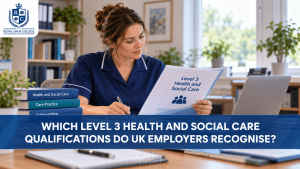

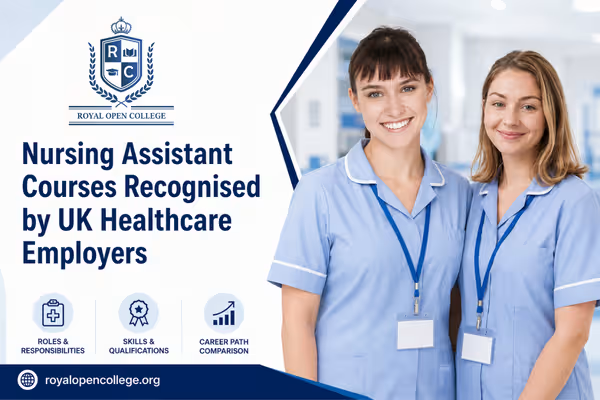



Nursing assistant courses recognised by UK healthcare employers are usually courses that teach the knowledge needed for safe, caring and professional support work. But “recognised” does not mean every NHS trust, care home or agency will accept the same course. Employers decide what training fits the role, the setting and their own policy.
A good nursing assistant course should help you understand the areas employers often look for, such as safeguarding, infection control, communication, patient dignity, care notes, health and safety and basic medication awareness. For learners who want structured CPD learning before applying, Royal Open College’s Level 3 Diploma in Nursing Assistant Complete Training can support this knowledge, while employer induction, Care Certificate assessment, DBS checks and regulated qualifications remain separate where required.
Quick recap
- Employers value training that supports safe care, safeguarding, communication, infection control and patient dignity.
- CPD courses can support your CV, but employer acceptance depends on the role, setting and local policy.
- Always check whether the job asks for experience, Care Certificate, DBS, workplace training or a regulated qualification.
What does “recognised by employers” really mean?
It simply means an employer may see the course as useful evidence of learning. It can show that you have taken time to understand the basics of patient care before applying.
In the UK, nursing assistant roles may also be advertised as Healthcare Assistant, Healthcare Support Worker, Clinical Support Worker, Care Assistant, Nursing Auxiliary or HCA. Each employer may use different wording, so do not rely on one job title only.
A care home may value personal care and dementia awareness. A hospital ward may focus more on infection control, observations, teamwork and record keeping. A home care agency may look closely at safeguarding, communication, mobility support and lone working awareness.
Are CPD courses and regulated qualifications the same?
CPD course
A CPD course supports continuing professional development. It helps you build knowledge, refresh skills and show interest in the sector.
Regulated qualification
A regulated qualification is different. It appears on an official qualification register and follows a formal awarding body framework.
Know its place
That does not make CPD useless. It just means you should understand its place. CPD training can help you prepare for interviews, improve your care knowledge and show commitment.
But if a job advert clearly asks for a regulated Level 2 or Level 3 qualification, you must follow that requirement.
What topics do UK healthcare employers usually value?
Employers usually value courses that reflect real care duties. A strong nursing assistant course should cover:
Safeguarding adults and children, infection prevention, health and safety, communication, privacy, dignity, person-centred care, personal hygiene, nutrition, hydration, mobility support, medication awareness, documentation and reporting concerns.
These topics matter because nursing assistants often support people when they feel weak, worried, unwell or dependent on others. A good course should not just teach definitions. It should help you understand how to care with patience, respect and common sense.
How does this link to the Care Certificate?
The Care Certificate is a workplace framework used in health and social care. It now has 16 standards, including communication, duty of care, privacy and dignity, fluids and nutrition, infection prevention, safeguarding and awareness of learning disability and autism.
A CPD course can help you understand many of these areas before you start work. But the Care Certificate normally needs employer-led assessment in the workplace. Your employer checks what you know and what you can do in real practice.
So, CPD learning can prepare you, but it should not be described as a full Care Certificate replacement unless proper workplace assessment is included.
What do employers check besides your course?
Employers look at the whole person. A certificate can help, but it is only one part of your application.
They may also check your right to work in the UK, Enhanced DBS suitability, references, care experience, interview answers, English communication, occupational health clearance, values, reliability and willingness to complete local training.
For some tasks, such as patient observations, medication support or moving and handling, employers may require local training and workplace competency sign-off before you can do them.
Common misunderstandings
One common mistake is thinking "CNA" is the main UK title. It is not.
UK employers usually say:
Another mistake is thinking one online course guarantees a job. It does not.
Employers still decide based on the role, your experience, your interview, your checks and their local policy.
Also, be careful with words like:
Unless a provider can clearly prove that claim, it is safer to look for course content that matches employer expectations rather than relying on big promises.