

Local Nursing Assistant and Healthcare Support Worker Training Centres in the UK

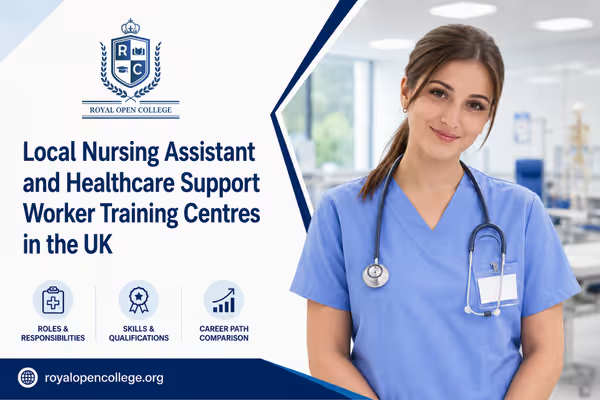
Local Nursing Assistant and Healthcare Support Worker Training Centres in the UK

Local Nursing Assistant and Healthcare Support Worker training in the UK usually comes through NHS trusts, colleges, apprenticeships, care agencies, employer induction, and online CPD. The best route depends on your location, job goal, employer policy, and workplace training needs.

The best place to start as a Nursing Assistant and Healthcare Support Worker is your nearest NHS trust, local college, apprenticeship provider, adult learning centre, or care employer. Training routes vary by area, so the right option depends on your location, job goal, current experience, and whether you want NHS, care home, agency, or community care work.

For flexible study, Royal Open College’s Level 3 Diploma in Nursing Assistant Complete Training gives structured CPD learning in patient care, safeguarding, infection control, communication, medication awareness, mobility, nutrition, and record keeping. It helps build knowledge, while employer induction, Care Certificate sign off, and workplace assessment still depend on the role and setting.

Quick recap

  • Local HCSW training often comes through NHS trusts, colleges, apprenticeships, agencies, or employer induction.
  • The Care Certificate usually links to workplace induction and employer sign off.
  • Online CPD learning helps with knowledge, but it does not replace employer training, workplace checks, or a regulated qualification where required.

What counts as a local Nursing Assistant training centre?

A local training centre is not always a single classroom. In the UK, training comes from different places.

You might train through:

01

An NHS trust

02

NHS Professionals

03

A local FE college

04

An adult learning provider

05

A care home or agency

06

An apprenticeship provider

07

A private training centre

08

An online CPD provider

This matters because each route has a different purpose. A college course gives classroom learning. An apprenticeship gives paid work-based training. An employer gives induction and role-specific training. CPD learning helps you refresh knowledge or prepare before applying.

Where do Healthcare Support Workers train in the UK?

Healthcare Support Workers often train after getting a job. If you apply for an NHS Healthcare Support Worker, Healthcare Assistant, HCA, HCSW, Nursing Assistant, or clinical support worker role, the employer usually explains the training route.

In many NHS settings, new staff complete local induction, mandatory training, supervised practice, and Care Certificate work. In care homes or community care, training depends on the service, people being cared for, and local policy.

If you are starting from zero, search NHS Jobs, your local NHS trust website, local college pages, and apprenticeship listings. Use different job titles because employers do not all use the same wording.

Is the Care Certificate done at a training centre?

The Care Certificate is usually completed through your employer once you start work. It is linked to real care practice, not only online lessons.

The Care Certificate has 16 standards. These include duty of care, safeguarding, communication, privacy and dignity, infection prevention and control, health and safety, mental health and dementia awareness, and learning disability and autism awareness.

Online learning helps with the knowledge part. Your employer decides how to check your practice and what evidence your role needs.

Is the Care Certificate done at a training centre?

Are colleges and apprenticeships good routes?

Yes. Local FE colleges suit learners who prefer classroom study before applying for care work. They often offer health and social care courses linked to care, communication, safeguarding, equality, and person-centred practice.

Apprenticeships suit learners who want paid work and training together. The Level 2 Healthcare Support Worker apprenticeship is a common entry route. It links study with real duties such as personal care, record keeping, infection control, and basic clinical support.

How do you choose the right training route?

Choose based on your goal:

  • For NHS work, check NHS Jobs and local NHS trust pages.
  • For paid training, search Healthcare Support Worker apprenticeships.
  • For classroom study, check local FE colleges.
  • For flexible preparation, choose online CPD learning.
  • For current care staff, ask your manager what training your role needs.

Common misunderstandings

One common mistake is thinking every Nursing Assistant course gives the same outcome. It does not. A CPD course, college course, apprenticeship, Care Certificate, and employer induction all serve different purposes.

Another mistake is thinking CNA is the main UK job title. UK employers usually use Healthcare Assistant, Healthcare Support Worker, HCA, HCSW, Nursing Assistant, or clinical support worker.

The safest step is simple.

Check the job advert, ask the employer what training they expect, and choose the route linked to your role, setting, and local policy.

Recent Blogs

How to Get an NVQ Level 3 in Health and Social Care in the UK

How to Get an NVQ Level 3 in Health and Social Care in the UK

The NVQ Level 3 in Health and Social Care has evolved into the Level 3 Diploma in Adult Care, updated following new Skills for Care criteria introduced in 2025. To achieve it, you need workplace access and an approved training centre. Assessment is competence-based, built around observed practice, portfolio evidence and professional discussion.

What Is Health and Social Care? A UK Guide

What Is Health and Social Care? A UK Guide

Health and social care covers two distinct systems with different purposes, funding, and providers. Health care delivers clinical treatment for illness and injury. Social care helps people manage daily life when age, disability, or long-term conditions affect their independence. Across the UK, arrangements differ between the four nations, with adult social care largely separate from NHS healthcare.

Can You Reheat Salmon? The Best Methods That Actually Work

Can You Reheat Salmon? The Best Methods That Actually Work

You can reheat salmon safely with the right storage, temperature, and technique. Too much heat can leave it dry before the centre warms through. This guide explains the best ways to reheat salmon, how long cooked salmon keeps in the fridge, and the UK FSA rules that apply.