How to Understand Body Language in Health and Social Care

How to Understand Body Language in Health and Social Care

Body language covers the signals people send through facial expressions, posture, eye contact, touch, and space. For care workers, reading these signals supports person-centred care, meets Care Certificate Standard 6, and helps meet legal duties under the Mental Capacity Act 2005 and Equality Act 2010.

Marion works at a residential care home. One morning, she notices a resident with advanced dementia has stopped making eye contact at mealtimes. He no longer speaks. His shoulders pull inward. He turns his face away when the spoon comes close.

Marion doesn’t wait for a verbal complaint. She spots the distress signals and tells the nurse. The team investigates and finds a dental problem.

Marion didn’t guess. She read body language.

This guide explains what body language means in health and social care, why it matters legally, and how care workers build this skill in practice.

TL;DR

  • Body language is non-verbal communication (NVC): facial expressions, posture, gestures, eye contact, touch, and proximity.
  • Reading NVC supports duties under the Mental Capacity Act 2005, Equality Act 2010, and Accessible Information Standard.
  • The claim that 93% of communication is non-verbal is a myth. It misrepresents Albert Mehrabian’s 1967 research.
  • Culture, dementia, autism, and learning disabilities all change how people express and read body language.
  • The CQC Single Assessment Framework (November 2023) assesses communication under the “Caring” quality statements.
  • Self-awareness, reflective practice, and individual care plans build this skill.

Communication Skills In Health And Social Care

Learn to Promote Communication Skills In Health And Social Care!

Who Governs Body Language in Care?

No single UK body governs body language as a standalone subject. Several organisations share responsibility.

The Care Quality Commission (CQC) regulates health and social care providers in England under the Health and Social Care Act 2008. Skills for Care publishes workforce development guidance, including the Care Certificate. NHS England and the Social Care Institute for Excellence (SCIE) produce communication guidance. The Nursing and Midwifery Council (NMC) and Health and Care Professions Council (HCPC) regulate registered nurses and allied health professionals. Both professional codes reference communication duties.

The legal duties most relevant to body language sit within the Mental Capacity Act 2005, the Equality Act 2010, the Accessible Information Standard (DAPB1605), and the Care Act 2014. These are laws. Non-compliance carries legal consequences.

Care Certificate Standard 6 and CQC quality statements are guidance and regulatory frameworks. They set expectations for practice and inspection. They are not legislation. This distinction matters when care workers describe obligations to colleagues or in written records.

What is body language in health and social care?

Body language covers the signals people send through facial expressions, posture, gestures, eye contact, touch, and physical space. In care settings, these signals replace or support speech when words are hard or impossible to use.

Defining non-verbal communication in care

Non-verbal communication (NVC) covers everything a person communicates without words. Researchers divide it into several types.

Kinesics covers body movement, gesture, and facial expression. Proxemics describes how people use physical space. Oculesics refers to eye contact, gaze, and blinking. Haptics covers touch. Paralanguage refers to vocal cues such as tone, pace, and pitch. Paralanguage travels alongside speech but sits technically apart from body language.

In care, these signals carry real weight. A person with advanced dementia may not say “I’m in pain.” They may grimace, pull back, or grow agitated. A care worker trained to spot these signals responds before the situation escalates.

Body language and person-centred care

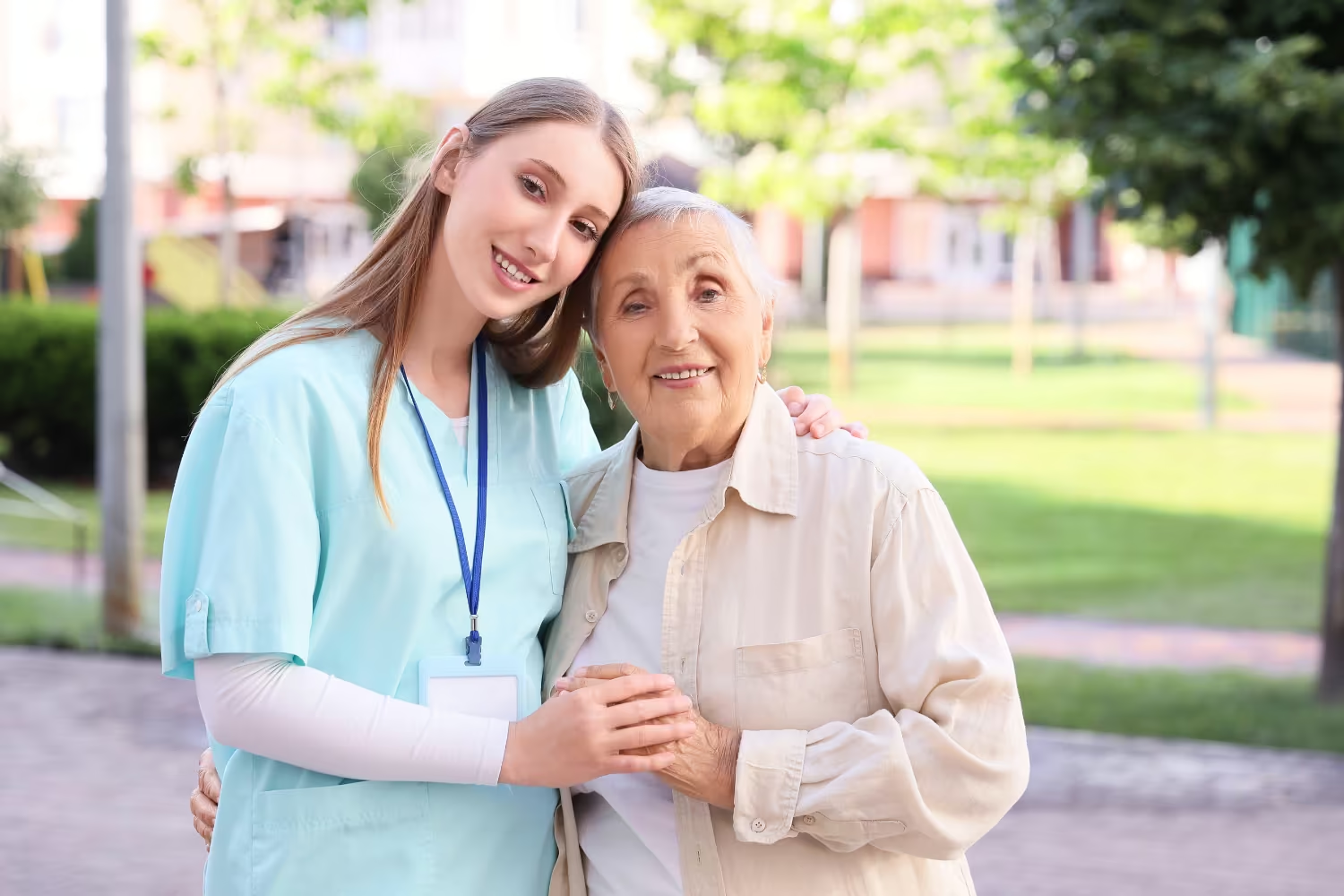
Person-centred care means seeing the whole person, not just a diagnosis or care plan. Understanding body language helps care workers detect emotions, preferences, and discomfort the person can’t express verbally.

Skills for Care and NHS England both identify communication as core to quality care. Reading NVC sits at the centre of that communication, not at the edges of it.

Why does body language matter for care workers?

Why does body language matter for care workers

Body language matters because many people in care settings can’t communicate verbally. Reading non-verbal signals helps workers detect pain, distress, and preferences, supports consent processes, and underpins safe, respectful care.

Communication beyond words

Many people who receive care have conditions that affect verbal communication. These include advanced dementia, stroke, acquired brain injury, learning disabilities, autism, and sensory impairments.

For these people, body language is often their main communication channel. A care worker who can’t read NVC risks missing information about pain, emotional state, or refusal of care. That gap has real consequences for safety and dignity.

Trust and the care relationship

Body language shapes the relationship between worker and service user. Workers who maintain appropriate eye contact, use open posture, and match their tone to the context build trust faster than those who don’t.

Trust matters. A service user who trusts their care worker speaks up more, accepts support more readily, and takes part in their own care planning.

Professional accountability

The CQC inspects providers on how well staff communicate with service users. Closed posture or dismissive facial expressions can appear in inspection evidence. This connects directly to ratings under the “Caring” quality statement in the Single Assessment Framework.

What are the different types of body language and non-verbal communication?

Body language divides into distinct categories. Each one carries different information. In care settings, workers observe multiple channels at once to build an accurate picture of what a service user experiences.

Facial expressions

The face is the most expressive part of the body. Psychologist Paul Ekman identified six basic emotions through universal facial movements: happiness, sadness, anger, fear, disgust, and surprise. Later research added contempt.

Care workers watch for three key signals. Micro-expressions are brief, involuntary facial movements lasting under one second. They reveal concealed emotions. The Duchenne smile is a genuine smile that reaches the eyes. It differs from a social smile, which uses the mouth only. Pain indicators include brow furrowing, grimacing, and a clenched jaw.

Posture and body direction

Eye contact

Eye contact signals attention. But norms vary widely between cultures and neurological conditions. Autistic people often reduce eye contact without this meaning discomfort or disengagement. Workers don’t treat reduced eye contact as a universal negative signal.

Proxemics: use of space

Anthropologist Edward Hall identified four distance zones: intimate (0 to 45 cm), personal (45 cm to 1.2 m), social (1.2 to 3.6 m), and public (over 3.6 m). Care tasks often require intimate distance. Workers manage this sensitively and seek consent wherever possible.

Touch

Appropriate, consensual touch communicates warmth and reassurance. Unconsented touch causes distress, particularly for people with sensory sensitivities, trauma histories, or cognitive impairment. Workers explain what they are about to do before initiating touch during care delivery.

Paralanguage

Paralanguage covers vocal features: tone, pitch, pace, volume, and silence. A calm, lower-pitched voice signals safety. A raised or rapid voice triggers anxiety. Workers monitor their own paralanguage, particularly during challenging interactions when stress changes vocal tone without the worker noticing.

Is understanding body language a legal requirement?

For some aspects of care, yes. UK law places direct obligations on health and social care workers to communicate using methods that include non-verbal approaches. These obligations come from the Mental Capacity Act 2005, the Equality Act 2010, and the Accessible Information Standard.

Mental Capacity Act 2005 (law)

The Mental Capacity Act 2005 (MCA) applies in England and Wales. Section 3 defines the criteria for assessing whether a person makes a decision. One criterion: the person communicates a decision by any means.

The MCA Code of Practice states that assessors explore all possible communication methods before concluding someone lacks capacity. This includes non-verbal responses such as eye movements, body direction, and changes in affect.

A capacity assessment that ignores non-verbal signals can be legally flawed. The consequences can be serious for the person and for the provider.

Equality Act 2010 (law)

The Equality Act 2010 protects disabled people from discrimination. Section 20 creates a duty to make reasonable adjustments. In communication terms, care providers adapt their approach for people whose disability affects how they send or receive information.

Reasonable adjustments include using objects of reference instead of verbal explanation, adapting gesture to support comprehension, and allowing additional processing time. A provider that communicates only verbally with a service user who needs non-verbal methods may fail this legal duty.

Accessible Information Standard (DAPB1605) (law)

Care Act 2014 (law)

The Care Act 2014 establishes a wellbeing duty for local authorities in England. It requires that care and support promotes the person’s participation in decisions. For people who communicate non-verbally, providers support and respond to NVC to meet this participation duty.

Law versus guidance: the key distinction

The MCA 2005, Equality Act 2010, Accessible Information Standard, and Care Act 2014 are law. Non-compliance carries legal consequences.

Care Certificate Standard 6 and CQC quality statements are guidance and regulatory frameworks. They shape practice and inspection outcomes. They are not legislation.

What does the Care Certificate say about body language?

Care Certificate Standard 6 covers communication and requires care workers to demonstrate awareness of different communication methods, including non-verbal communication. The Care Certificate is an induction framework for new workers, not a regulated qualification.

What Standard 6 requires

Standard 6 is titled “Communication.” It covers six areas: understanding effective communication, meeting individual communication and language needs, promoting effective communication, understanding confidentiality, supporting people with specific communication needs, and knowing how to access extra support.

Within these areas, learners demonstrate understanding of verbal and non-verbal communication. They recognise that some service users communicate entirely through non-verbal means. The standard requires workers to adapt their approach to meet individual needs.

The Care Certificate is employer-led

The Care Certificate is not an Ofqual-regulated qualification. Skills for Care, NHS England, and Health Education England publish it. Employers assess and sign it off. Training quality varies between organisations.

Workers who hold the Care Certificate have demonstrated competence as their employer assessed it. They don’t hold a nationally standardised or externally verified qualification. Training providers and employers are transparent about this distinction.

What this looks like in practice

A care worker applying Standard 6 identifies how each service user communicates verbally and non-verbally. They record communication needs and preferences in the care plan. They adjust their communication style to match each person. They recognise and respond to non-verbal signs of distress, pain, or refusal.

How does the CQC assess communication under the Single Assessment Framework?

How does the CQC assess communication under the Single Assessment Framework

The CQC assesses communication under the “Caring” quality statements in the Single Assessment Framework (SAF), introduced in November 2023. Inspectors look for evidence that staff communicate in ways that respect each person’s needs. They gather this from observation, service user feedback, staff interviews, and records.

What the SAF replaced

Before November 2023, the CQC used the Key Lines of Enquiry (KLOEs) framework. KLOEs organised evidence around five questions: Safe, Effective, Caring, Responsive, and Well-led. Communication evidence appeared mostly under “Responsive.”

The SAF keeps these five themes but rebuilds them around quality statements. Each statement starts with “We…” and describes the outcome providers should achieve.

Relevant quality statements

Under “Caring,” the SAF includes quality statements about treating people with kindness and respect, involving people in decisions, and responding to emotional needs. Communication runs through all of these.

Inspectors observe directly whether staff maintain appropriate eye contact, use open body language, and adapt their approach to the service user. Failure to do so creates evidence relevant to Caring quality statement scores.

CQC Communication Report (September 2024)

In September 2024, the CQC published a thematic report on communication in health and social care. The report found communication failures in a disproportionate number of cases rated as Requires Improvement or Inadequate. Staff training in NVC was inconsistent across the sector.

The report did not create new legal requirements. It reinforced existing expectations and confirmed that communication stays a priority inspection area.

What this means for workers

During a CQC inspection, an inspector may observe a care worker’s body language directly. Closed posture, avoided eye contact, or talking over a service user all produce evidence relevant to the Caring quality statement. Workers understand that their body language forms part of what CQC evaluates.

Is the 93% statistic true? The Mehrabian myth explained

The 93% rule is false as a general rule. Albert Mehrabian’s 1967 studies tested how people judge emotional messages when words and tone conflict. The findings do not describe how communication works in general.

What Mehrabian actually found

In 1967, Mehrabian ran two studies with around 67 participants, all women, in a lab setting. The studies tested how people interpreted feelings and attitudes when they received conflicting signals: for example, a positive word spoken in a negative tone.

The results: 55% of emotional meaning came from facial expression, 38% from vocal tone, and 7% from words. Mehrabian himself has stated repeatedly that these figures apply only to the communication of feelings and attitudes when verbal and non-verbal signals conflict. They do not apply to communication in general.

Why the myth spread

Why the myth spread

What to say instead

A research-grounded statement for care workers: “Non-verbal communication, including facial expressions, posture, and tone of voice, contributes meaningfully to how we understand each other. For people with limited verbal communication, non-verbal signals become the main source of information about their needs and emotions.”

This is accurate, grounded in evidence, and useful for care practice.

How does cultural background affect body language?

Cultural background shapes how body language is expressed and read. Gestures, eye contact norms, and touch customs mean different things in different cultures. Care workers avoid applying a single cultural framework to every service user.

Eye contact norms

In many Western European cultures, sustained eye contact signals attentiveness and respect. In some South Asian, East Asian, and African cultural contexts, sustained eye contact with an older person or a person of higher status signals disrespect. A care worker who interprets lowered eyes as disengagement misreads a respectful communication norm.

Gestures and their meanings

The “thumbs up” gesture carries a positive meaning in mainstream UK culture. In some parts of the Middle East, it carries an offensive meaning. Workers don’t rely on gestures as universal signals. They don’t assume a service user reads a gesture the way the worker intends.

Touch and personal space

Norms around touch and personal space vary widely. Concepts of appropriate conversation distance, acceptable greeting touch, and comfort with clinical touch differ between individuals and backgrounds. Workers seek to understand individual preferences rather than apply a single standard.

Avoiding stereotypes

Cultural background provides context, not prediction. Individual variation within any cultural group is wide. A care worker who assumes how someone communicates based on their background risks causing offence and missing the individual.

The correct approach: learn general cultural norms as background knowledge, treat each service user as an individual, ask and listen, and document communication preferences in the care plan.

How do you read body language in people with dementia?

People with dementia communicate needs, pain, and emotional state through body language as verbal communication becomes harder. Care workers observe and interpret these non-verbal signals systematically, using validated tools where appropriate.

Why body language becomes the main channel

Dementia is a progressive condition that affects memory, language, and executive function. In moderate to advanced stages, many people lose the ability to build verbal sentences, name their pain, or make requests. Their body continues to communicate.

Common non-verbal signals in people with dementia include facial grimacing or brow furrowing (possible pain indicators), changes in posture such as slumping or rigidity, increased restlessness or agitation, withdrawal or turning away, vocalisation changes such as moaning, and altered eating behaviour.

The PAINAD scale

The PAINAD scale

Communication passports

A communication passport records how an individual communicates, including their non-verbal signals and what those signals mean for that specific person. For example: “When James rocks in his chair, he needs the bathroom.”

SCIE and NHS England recommend communication passports for people with complex communication needs. Workers create them with the person and their family or carers. All staff who support that individual use them.

The validation approach

The validation approach, developed by Naomi Feil, focuses on empathising with the emotional content of communication rather than correcting factual misunderstandings. When a care worker uses this approach, they respond to the feeling behind a non-verbal signal rather than its surface meaning. This supports dignity and reduces distress.

How do you understand body language in autistic people?

Autistic people have different, not deficient, patterns of non-verbal communication. Eye contact avoidance, reduced facial expression, and repetitive movements carry different meaning in autistic people. Care workers don’t apply neurotypical interpretive frameworks to autistic communication.

The double empathy problem

Researcher Damian Milton described the “double empathy problem” in 2012. His work challenges the assumption that autistic people have communication deficits. He argues that communication difficulties between autistic and non-autistic people run both ways. Non-autistic people misread autistic communication too.

This reframes the task for care workers. The goal is mutual understanding, not teaching autistic people to communicate in neurotypical ways.

Common differences in autistic NVC

Autistic people may reduce or avoid eye contact without this signalling disengagement. They may use stimming: repetitive self-stimulating behaviour such as rocking, hand-flapping, or humming, as a regulatory strategy rather than a sign of distress. They may have a different range of facial expressions. They may prefer greater or lesser physical distance than is typical. They may find unexpected touch aversive even when the worker intends it as reassurance.

Workers don’t interpret these differences as non-compliance or distress without individual knowledge of the person.

Augmentative and Alternative Communication (AAC)

Some autistic people use AAC systems. AAC includes low-tech tools such as symbol boards and the Picture Exchange Communication System (PECS), and high-tech tools such as speech-generating devices and apps. Care workers supporting AAC users receive training specific to the system that person uses.

Individual communication profiles

The most effective approach is an individualised communication profile, developed with the autistic person, their family, and where relevant a speech and language therapist. Workers record this in the care plan and all staff who support that person use it.

What does positive body language look like in care?

What does positive body language look like in care

Positive body language in care includes open posture, appropriate eye contact, a calm facial expression, and use of space that respects the service user’s preferences. These signals communicate safety, attention, and respect.

Open posture and positioning

Open posture means uncrossed arms, a relaxed spine, and facing the service user directly. A care worker who stands with arms crossed and body turned sideways signals, whether they mean to or not, that they are not present.

Where possible, workers position themselves at the service user’s eye level. Standing over a seated person feels imposing and reduces the sense of equality in the interaction.

Appropriate eye contact

Appropriate eye contact means natural gaze without staring. Workers follow the service user’s lead. When the person does not maintain eye contact, the worker accepts this and does not interpret it negatively.

Matching expression to context

A calm, attentive face builds trust. Workers match their facial expression to the tone of the interaction. During a difficult conversation, a neutral or sympathetic expression fits. Expressions of impatience or surprise, even unintentional ones, damage the care relationship.

Tone of voice and pace

A calm, moderate-pitched voice signals safety. A measured pace gives service users, particularly those with cognitive impairment or anxiety, time to process what is being said. Appropriate silence signals patience and willingness to wait.

Respectful touch

Where touch forms part of care delivery, workers explain what they are about to do, deliver it with consent, and calibrate it to the person’s comfort level. Workers recognise that not every service user finds touch reassuring.

What is negative body language in care settings?

Negative body language in care includes closed posture, dismissive facial expressions, poor use of space, and task-focused behaviour that ignores the service user’s emotional state. These signals cause distress and erode dignity.

Closed posture and task focus

Crossed arms, hunched shoulders, or turning the body away from the service user signals disengagement. Completing care tasks while avoiding eye contact signals that the worker treats the task as more important than the person. This contradicts person-centred care and undermines dignity.

Non-verbal microaggressions

Rolling the eyes, sighing loudly, glancing at a phone during conversation, or responding in a tone that implies impatience all communicate low regard for the service user. These behaviours may be unconscious. They still cause harm.

Invading personal space

Body language under stress

Care work is demanding. Workers under stress display closed posture, rushed movements, or clipped vocal tone without noticing. Regular supervision and reflective practice help workers recognise and manage their own non-verbal signals under pressure. This is a professional skill, not a personal failing.

What has recently changed in guidance?

Three significant developments since 2022 change how care providers manage and evidence communication, including body language. These are the CQC Single Assessment Framework (November 2023), the Accessible Information Standard update (2022), and the CQC Communication Report (September 2024).

CQC Single Assessment Framework (November 2023)

In November 2023, the CQC replaced the Key Lines of Enquiry (KLOEs) framework with the Single Assessment Framework (SAF). This was the most significant change to CQC inspection methodology in a decade.

Under KLOEs, communication evidence appeared mainly under “Responsive.” The SAF restructures evidence around quality statements. Communication evidence now appears across multiple quality statements within “Caring.”

The SAF introduced a new evidence category: people’s experiences. Service users’ reported experiences of how staff communicate with them now carry greater weight in the inspection process. Providers demonstrate that they gather, act on, and learn from this feedback.

Workers trained under the KLOEs framework need to update their understanding of how the CQC now gathers and uses communication evidence.

Accessible Information Standard update (2022)

The 2022 update strengthened the requirement for NHS and publicly funded social care providers to identify, record, and act on communication support needs.

Key changes included a stronger emphasis on proactive identification of communication needs rather than waiting for the person to request support. Expectations around recording needs in electronic records became clearer. The scope broadened to cover more provider types.

The 2022 update confirms that communication support, including for people who use NVC or AAC, is a legal obligation. It is not an optional service enhancement.

CQC Communication Report (September 2024)

In September 2024, the CQC published a thematic report on communication in health and social care. Communication failures appeared in a disproportionate number of cases rated as Requires Improvement or Inadequate. Staff training in NVC was inconsistent across the sector. Providers with strong communication cultures identified and acted on early signs of deterioration more effectively than those without.

The report did not create new legal requirements. It reinforced existing expectations and confirmed that communication stays a priority inspection area.

What this means for employers and training providers

These three changes together make the case for embedding NVC training into induction and ongoing CPD. Employers who rely on the Care Certificate alone for communication training may find it falls short of what the SAF and the updated Accessible Information Standard now expect.
How can care workers improve their body language skills?

How can care workers improve their body language skills

Care workers build body language skills through reflective practice, supervision, peer observation, and structured training. These methods develop self-awareness, which underpins intentional non-verbal communication in care practice.

Build self-awareness first

The first step is awareness of your own non-verbal habits. Many workers are unaware of how they appear physically during care interactions.

Questions worth reflecting on: What is my default facial expression when I focus on a task? How do I use eye contact when I feel rushed? What changes in my posture and tone when I feel tired?

Video reflection during training exercises, used with appropriate consent, builds this awareness.

Use supervision and reflective practice

Supervision provides a structured space to discuss communication challenges. Workers bring specific interactions where they felt uncertain about what a service user communicated non-verbally. They discuss how they interpreted and responded.

Reflective practice frameworks such as Gibbs’ Reflective Cycle support workers to examine their communication behaviour in a structured, consistent way.

Peer observation

With appropriate consent and governance, peer observation allows workers to observe each other during care interactions and give feedback. This builds shared understanding of what positive NVC looks like in practice and normalises communication as a professional skill.

Structured CPD and e-learning

Formal communication training, including dedicated content on NVC, forms part of CPD for care workers. The CQC Communication Report (2024) found that providers with strong outcomes invested in regular structured communication CPD.

E-learning allows workers to revisit concepts at their own pace and works alongside face-to-face practice in a blended learning approach.

Learn individual service user profiles

The most directly applicable improvement a care worker makes is learning, recording, and applying the communication profiles of the people they support. Ask the person and their family how they communicate. Observe the person over time and identify patterns. Record observations in the care plan or communication passport. Share this information with colleagues at handover.

Summary

Body language is not a soft skill at the edge of care work. For a large proportion of people who receive health and social care in the UK, non-verbal communication is their main channel for expressing pain, preferences, consent, and distress.

UK law creates direct obligations in this area. The Mental Capacity Act 2005 requires consideration of all communication methods in capacity assessment. The Equality Act 2010 requires communication adaptations as reasonable adjustments. The Accessible Information Standard requires identification, recording, and action on communication support needs. The Care Act 2014 requires support for participation, which needs accessible communication.

Care Certificate Standard 6 and the CQC Single Assessment Framework set professional expectations for communication in care. The SAF, introduced in November 2023, gives greater weight to service users’ reported communication experiences. The CQC Communication Report of September 2024 identified inconsistent NVC training as a sector-wide issue.

The 93% claim is a myth. It misrepresents Albert Mehrabian’s 1967 research, which tested a specific scenario involving conflicting emotional messages. Workers who understand the true scope of that research make more accurate judgements about what body language tells them and what it does not.

Body language varies across cultures, conditions, and individuals. Reading NVC accurately requires knowledge of the individual person, not the application of universal rules. Communication passports, individualised care plans, and structured supervision support workers to develop this knowledge systematically.

Care workers who develop strong NVC skills detect deterioration earlier, support autonomy more effectively, build trust more reliably, and demonstrate the qualities CQC inspectors assess under the Caring quality statements. These are professional skills built through reflective practice, supervision, peer observation, and structured CPD.

Communication Skills In Health And Social Care

Learn to Promote Communication Skills In Health And Social Care!

Frequently Asked Questions

What is body language?

Body language is non-verbal communication through physical signals. It includes facial expressions, gestures, posture, eye contact, touch, and use of space. In health and social care, body language is often the main communication channel for people who cannot speak due to dementia, learning disabilities, autism, or stroke. Reading it accurately is a core care skill.

Body language matters because many service users cannot communicate verbally. Care workers who read non-verbal signals accurately identify pain, distress, and refusal of care. This supports safe care delivery, person-centred practice, and compliance with legal duties under the Mental Capacity Act 2005 and the Equality Act 2010. Missing these signals carries real risks.

Specific legal duties relevant to non-verbal communication exist in UK law. The Mental Capacity Act 2005 requires assessors to explore all communication methods before concluding someone lacks capacity. The Equality Act 2010 requires communication adaptations as reasonable adjustments. The Accessible Information Standard is a legal requirement under the Health and Social Care Act 2012. Care Certificate Standard 6 is guidance, not law.

The 93% rule states that 93% of communication is non-verbal. This misrepresents research by Albert Mehrabian in 1967. His studies tested how people judge emotional messages when words and tone conflict. The findings apply only to that specific scenario. Mehrabian has clarified this repeatedly. The 93% figure does not apply to communication generally and should not appear in care training without this qualification.

Care Certificate Standard 6 covers communication. It requires new care workers to demonstrate awareness of verbal and non-verbal communication. Workers show they can identify individual communication needs, adapt their approach, and recognise when specialist support is needed. The Care Certificate is an employer-assessed induction framework. It is not an Ofqual-regulated qualification. Training quality varies between employers.

The CQC Single Assessment Framework (SAF) is the inspection methodology the CQC introduced in November 2023. It replaced the Key Lines of Enquiry (KLOEs) framework. The SAF organises evidence around quality statements and gives greater weight to service users’ reported experiences. Communication sits primarily under the “Caring” quality statements. Workers trained under KLOEs need to understand how evidence is now gathered.

CQC inspectors gather evidence from direct observation, conversations with service users and families, staff interviews, and records. Inspectors observe whether staff use appropriate eye contact, open posture, and adaptive communication approaches. Under the SAF, service user feedback about how staff communicate carries particular evidential weight. A care worker’s body language can directly affect a provider’s inspection rating.

The Accessible Information Standard (DAPB1605) is a legal requirement under section 250 of the Health and Social Care Act 2012. It requires NHS bodies and publicly funded social care providers to identify, record, and act on communication support needs. The 2022 update strengthened proactive identification of needs and broadened the scope to cover more provider types. Non-compliance is a legal risk, not just a quality concern.

NVC is communication without spoken or written words. It includes kinesics (body movement and gesture), proxemics (use of space), oculesics (eye contact and gaze), haptics (touch), and paralanguage (vocal cues such as tone, pace, and pitch). NVC accompanies verbal communication and, for many service users, replaces it entirely. It is a core communication skill for care workers in every setting.

Augmentative and Alternative Communication (AAC) covers methods used by people who cannot communicate effectively through speech alone. AAC includes low-tech tools such as symbol boards and PECS, and high-tech tools such as speech-generating devices. AAC works alongside non-verbal communication and forms part of an individual’s communication profile. Care workers supporting AAC users receive training specific to the system that person uses.

Makaton is a language programme that combines symbols, signs, and speech. People with learning disabilities, autism, and other communication difficulties use it. Unlike British Sign Language (BSL), Makaton delivers simplified signs alongside speech simultaneously. Care workers who support Makaton users receive specific Makaton training. General sign awareness does not replace this.

Dementia progressively reduces verbal communication, making body language the main way a person expresses needs and emotions. Care workers learn to observe and interpret non-verbal signals systematically. The PAINAD scale provides a validated framework for assessing pain through NVC. Communication passports record individual patterns for use across the care team. Workers who miss these signals risk missing pain, distress, and refusal of care.

Autism changes how non-verbal communication is produced and interpreted. This represents difference rather than deficit. Autistic people may avoid eye contact, use stimming as a regulatory tool, have a different range of facial expressions, and have specific preferences around space and touch. Workers do not interpret these differences as signs of distress or disengagement without individual knowledge of the person.

Researcher Damian Milton developed the double empathy problem in 2012. He challenges the assumption that autistic people have communication deficits. Milton argues that communication difficulties between autistic and non-autistic people run both ways. Non-autistic people misread autistic communication too. This reframes communication as a two-way professional skill rather than a deficit to be corrected in autistic people.

A communication passport records how an individual communicates, including their non-verbal signals and what those signals mean for that specific person. For example: “When James rocks in his chair, he needs the bathroom.” SCIE and NHS England recommend communication passports for people with complex communication needs. Workers create them with the person and their family or carers. All staff who support that person use them.

Kinesics is the study of body movement as communication. It covers gestures, posture, facial expressions, and gait. Anthropologist Ray Birdwhistell coined the term in the 1950s. In health and social care, kinesics helps workers understand how service users communicate through movement, particularly those who cannot use verbal communication. It forms part of the broader framework of non-verbal communication in care.

Proxemics is the study of how people use physical space in social interaction. Anthropologist Edward Hall identified four distance zones: intimate (0 to 45 cm), personal (45 cm to 1.2 m), social (1.2 to 3.6 m), and public (over 3.6 m). Care tasks often require intimate distance. Workers manage this with care, explain what they are doing, and obtain consent wherever possible.

Paralanguage refers to vocal features that accompany speech but are not words. These include tone, pitch, pace, volume, and silence. Paralanguage reveals emotional state and intent. A calm, moderate-pitched voice signals safety. Rapid or high-pitched speech communicates urgency or anxiety. This can distress service users with sensory sensitivities or cognitive impairment. Workers monitor their own paralanguage actively.

Micro-expressions are brief, involuntary facial movements lasting less than one second. They occur when a person experiences an emotion they are consciously or unconsciously concealing. Psychologist Paul Ekman’s research suggests they reveal genuine emotional states. In care settings, awareness of micro-expressions helps workers detect concealed distress in service users who are reluctant to complain or who lack the language to express discomfort.

Care workers treat non-verbal signs of distress, discomfort, or refusal as significant communication. The right response: acknowledge the signal, pause the task if it is safe to do so, seek to understand the cause, and document the observation and response in the care record. Where the signal may indicate pain, follow the provider’s pain assessment and reporting protocol. Document all observations and actions.

Reflective practice is a structured process of examining professional behaviour to identify learning opportunities. For body language, it helps care workers identify unconscious non-verbal habits, consider how their body language affected an interaction, and plan adjustments. Gibbs’ Reflective Cycle provides a structured approach suitable for individual use and supervision sessions. Regular reflection builds more intentional, person-centred communication over time.

The Care Act 2014 establishes a wellbeing duty for local authorities in England. It requires that care and support promotes the person’s participation in decisions. For people who communicate primarily non-verbally, providers support and respond to NVC to meet this participation duty. This applies to local authorities and their commissioned providers. Failing to enable communication participation undermines the wellbeing duty under the Act.

Recent Blogs

5 Skills Every UK Care Employer Wants (and How to Prove You Have Them)

5 Skills Every UK Care Employer Wants (and How to Prove You Have Them)

UK care employers do not hire based on good intentions. Under CQC Regulation 18, they must evidence staff competence at every inspection. This guide covers the 5 skills every UK adult social care employer screens for, why each one has a regulatory basis, and how to prove yours through your CV, interview, the Care Certificate, and workplace evidence.

CQC Standards and Training What Care Staff Need to Know in 2026

CQC Standards and Training: What Care Staff Need to Know in 2026

CQC does not publish a mandatory training list. Under Regulation 18, every registered provider must ensure staff are demonstrably competent, properly inducted, and continuously supported. This guide explains the legal basis for training in 2026, the 16 Care Certificate standards, Oliver McGowan Mandatory Training, training matrices, and the competence evidence CQC inspectors look for.